Category Archives: Shudder Premiere

Misty Mountain Hop

Gwen

by Hope Madden

“Steal a sheep and they’ll take your hand. Steal a mountain and they’ll make you a lord.”

Writer/director William McGregor clarifies the source of real horror in his period chiller Gwen, premiering this week on Shudder.

The Witch, Hagazussa, The Wind – something in the air has horror filmmakers examining the choices facing women throughout our brutal, unforgiving history. McGregor’s addition to the collective reflection is as slow a boil as any of them – slower, maybe. And though his film casts a spell, the scary part is how well it tells the truth.

Gwen (Eleanor Worthington-Cox) is a teenaged farmer’s daughter in 19th century north Wales, where the value of real estate is quite a bit higher than the value of three female lives. Her father’s away at war and her mother (Maxine Peake, extraordinary) seems harder and more frantic by the day.

With her cherubic cheeks and school marm’s stare, Worthington-Cox does an excellent job of oscillating between taking on the maternal role and behaving like a child.

Peake, as ailing matriarch Elen, pits herself against everyone—often even her own daughter—in an attempt to protect her family and stand up for herself. The performance is bone chilling as well as heartbreaking. There is palpable longing in the relationship between Gwen and Elen, both of them desperate for an existence other than this, one where maternal love and nurturing were more than luxuries.

McGregor’s wisest instinct is in confining the story to Gwen’s point of view, her immediate perspective. Outside of two brief scenes, we see only what Gwen sees, hear only what Gwen hears. Even as she readies herself for adulthood, the world is a mystery to Gwen, and so it is a mystery to us. Very little makes sense as she sees it, and that perspective gives the entire film a menacing quality, a spookiness that shapes the narrative.

Certainly if you thought The Witch lacked action, or Hagazussa explained too little, Gwen may be frustrating. Which does not make it any less exceptional as a film.

Though the filmmaker builds atmospheric dread that leads to a stunning climax, it’s a stretch to call Gwen horror. McGregor’s direction calls to mind gothic thrillers—ghosts and isolation, women slowly going mad—all elements he eerily amplifies sonically with whispering winds, crackling lightning, and a distant howl or shriek. The way he lenses Gwen’s surroundings, smoke and mist giving way to mine-ravaged hillsides, conjures similar bleakness.

But the story itself is a socially conscious drama brimming with despair and outrage.

Muted Fury

The Furies

by Brandon Thomas

Horror and social commentary are synonymous with one another. Fifty years ago, Night of the Living Dead tapped into America’s anxiety about the Vietnam War. 1978’s Dawn of the Dead used the zombie apocalypse to attack consumerism. More recently, Jordan Peele’s Get Out looked to horror to comment on race in America. These are all top-shelf examples of horror tackling social issues. 

Of course, not everyone can be George Romero or Jordan Peele. The new Shudder exclusive, The Furies—screening as part of Australia’s Monster Fest in October before its release in Australian cinemas from November 7—is a stark example of that.

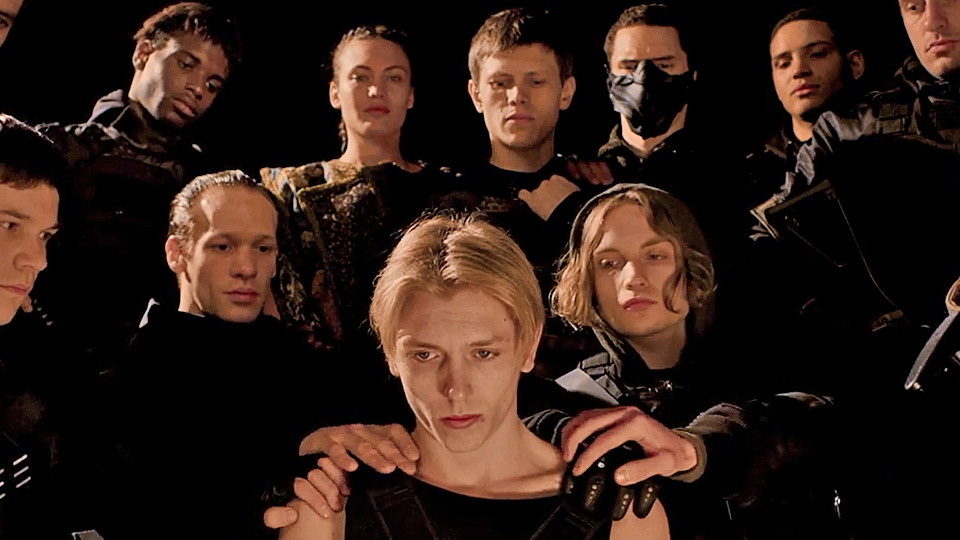
After being kidnapped right off the street, Kayla wakes up in a coffin-sized box somewhere in the Australian outback. Before she can get her bearings, she finds herself hunted by someone wearing a horrific mask. As Kayla makes her way through this hellscape of murder to find a friend, she and the other hunted girls start to succumb to their form of savagery.

The Furies starts strong with a visually impressive prologue. Director Tony D’Aquino gets everything on the screen – from production design to some top-notch gore effects. Visually, the movie is a feast. 

Content-wise?

It’s a tonally confused mess.

There’s a weak attempt at commenting on women’s treatment in horror. When these characters aren’t being hunted down by armed slashers, they’re assigned another one of these ghouls as a protector. On paper this sounds like a novel idea: “Women are either fodder or in need of protection in these movies!” Unfortunately, D’Aquino never does anything more than set those ideas up.

Complicating things more is the way these women are written as merely paper-thin caricatures. They run, scream and die. Rinse, repeat. Kayla’s journey of “discovery” has the depth of a red Solo cup. Instead of looking inward at her own darkness and allowing that to come through in the performance, the movie settles for wearing a dark hoodie and saying tough things while handling a taser.

The messy ideas continue into the movie’s overall tone. The horror elements are strong, but there are also some half-realized sci-fi threads peppered about. Instead of exploring these nuggets in any meaningful way, D’Aquino treats them like the first episode of a network series to be explored later.

Despite some impressive visual sleight of hand with excellent cinematography and practical gore effects, The Furies can’t overcome the inherent shallowness of its story and execution. 


Hell to Pay

Hell House LLC 3: Lake of Fire

by Brandon Thomas

I’m an easy mark for found footage movies.

When done well, their use of unseen horror gets under my skin like no other kind of scary movie. There’s a heart-pounding anticipation prevalent in these movies that tends to hit everything I find terrifying.

Of course, this reaction comes with good found footage movies. Does Hell House LLC 3: Lake of Fire rank up there with the greats? 

Yeah… not so much.

Right before its demolition, Russell Wynn (Gabriel Chytry) swoops in to buy the infamous Abaddon Hotel. He’s young, showy, rich… and full of potentially bad ideas, such as using the hotel as the venue for his popular interactive show, “Insomniac.” Along for the ride is a journalist and her camera crew, a handful of actors for the show, and Russell’s dedicated, but ultimately naive, staff.

The original Hell House LLC delivered a budget-friendly, but fun, offering into the found footage canon. The filmmakers weren’t reinventing the wheel, but they understood what they could produce with the premise and money available to them. Director Stephen Cognetti’s knowledge of how to make basic scares work lifted the film to a higher level. 

The slow-building of dread is a staple in this genre. It’s what gets the audience to squirm well before the proverbial shit hits the fan. Hell House LLC 3 peaks early with its scares and doesn’t quite finds its footing again. The climax ends up being more chaotic than scary with conveniently placed camerawork being substituted for well-placed frights. 

The film truly stumbles by relying too heavily on the installments that came before. There’s far too much time spent building a mythology that brings in characters from the other two movies. As a result, Hell House LLC 3 never gets to work as a singular piece of filmmaking.  

Outside of a few clever scares, this third installment in the Hell House LLC series never manages to rise above being a middling effort.

https://youtu.be/k3BpmE10u4E


Urban Jungle

Tigers Are Not Afraid

by Hope Madden

Comparing most films to Pan’s Labyrinth would be setting a bar too high. Guillermo del Toro’s macabre fable of war and childhood delivers more magic, humanity and tragedy than any one film should be allowed.

And yet, it’s hard to watch Issa Lopez’s Tigers Are Not Afraid without thinking about little Ofelia, the fairies and the Pale Man.

Lopez’s fable of children and war brandishes the same themes as del Toro’s masterpiece, but grounds the magic with a rugged street style.

Tigers follows Estrella, a child studying fairy tales—or, she was until her school is temporarily closed due to the stray bullets that make it unsafe for students. As Estrella and her classmates hide beneath desks to avoid gunfire, her teacher hands her three broken pieces of chalk and tells her these are her three wishes.

But wishes never turn out the way you want them to.

There is an echo through Latin American horror that speaks to the idea of a disposable population. You find it in Jorge Michel Grau’s brilliant 2010 cannibal horror We Are What We Are and again in Emiliano Rocha Minter’s 2016 taboo-buster, We Are the Flesh.

Lopez amplifies that voice with a film that feels horrifying in its currency and devastating in the way it travels with the most vulnerable of those discarded people.

Estrella is befriended by other orphans in her city, each aching with the loss of parents and each on the move to escape the dangers facing the powerless.

Though Tigers bears the mark of a del Toro – Labyrinth as well as The Devi’s Backbone – it can’t quite reach his level of sorrowful lyricism. It makes up for that with the gut punch of modernity. Though this ghost story with tiny dragons and stuffed tigers is darkly fanciful, it’s also surprisingly clear-eyed in its view of the toll the drug war takes on the innocent.

It’s Latin American horror at its best.

Day for Night of the Living Dead

One Cut of the Dead

by Hope Madden

For about 37 minutes, you may feel like Shin’ichirô Ueda’s One Cut of the Dead delivers, cleverly enough, on a very familiar promise.

One Cut opens as a micro-budget zombie movie, which soon reveals itself to be a film within a film when real zombies show up on set. As the bullying egomaniac director continues filming, ecstatic over the authenticity, Ueda appears to deconstruct cinema.

And though that may sound intriguing on the surface, the truth is that what transpires after that 37 minute mark officially defines Ueda as an inventive, gleeful master of chaos and lover of the magic of nuts and bolts filmmaking.

To detail any additional plot points—as tempting as that is—would spoil the enjoyable lunacy One Cut has in store.

Suffice it to say, Ueda improves upon that opening act without really losing the themes he introduces. Everything that feels like a misstep blossoms into an inspired bit, all of it highlighting Ueda’s true love for what he’s doing.

Likable and silly, One Cut is brightly economical, embracing rather than hiding its shoestring – in fact, Ueda’s camera jubilantly closes in on shoestrings. His movie giddily exposes the neuroses, dangers, tribulations and mistakes—he really, deeply loves the mistakes—inherent in genre filmmaking. If nothing else, this movie is a mash note to artistic compromise.

The manic comedy proves as infectious as the zombiism on the screen, and much of the reason is the committed cast. Ueda allows each performer the opportunity to grow and discover, and every actor at one point or another takes full advantage of his or her moment to shine.

Harumi Shuhama particularly impresses as, well, let’s just say she’s the make up artist and self defense hobbyist. Yuzuki Akiyama delivers the most layered performance, but, playing the director, Takayuki Hamatsu steals every scene. He’s hilarious, adorable, compassionate, and incredibly easy to root for.

Like this movie.

Tale of Two Mothers

The Wrath

by Hope Madden

This week, Shudder premieres a Korean ghost story, and there is always reason to be optimistic about a Korean ghost story.

Young-sun Yoo’s The Wrath revisits Hyeok-su Lee’s somewhat obscure 1986 period thriller, Woman’s Wail. A young woman of humble birth is brought to the ancient home of a high ranking Korean official, ostensibly to marry his youngest son. In truth, she’s been brought here to trick a vengeful spirit.

What unspools is a historically set spectral tale of family dysfunction, classism, sexism, and women who hate other women—or, in a single label, the horrors of patriarchy. All of which has been done before, and better. (Please see Jee-woon Kim’s masterpiece A Tale of two Sisters. Seriously, please see it.) But The Wrath is a very pretty film that delivers a fairy tale quality and solid performances.

The Wrath is more of a spook show than Two Sisters, with lots of wraiths and jump scares, lots of blood spitting and black ooze spitting and blood spatter and arterial spray, plus gorgeous costumes and a well-designed and well-used set.

The film drops us into a story in progress. A young girl (Na-eun Son) traveling to the secluded property is intercepted by a well to do son returning home. His step-mother (Young Hee Seo, wonderful), who appears to be head of the household, offers a chilly reception to both travelers.

Soon the girl is pregnant, the son is dead, and there’s something suspicious out in the storage shed.

Yoo’s film works best when he doesn’t try to explain too much. Heavy-handed flashbacks to the events that led to the family’s curse feel perfunctory and uninspired, while the hinted at spookiness generates more atmosphere.

For a period film, Yoo contains the environment to create something both believable and economical, the image of a very pretty yet desolate trap.

Na-eun Son, whose role offers the most layers, particularly impresses, but the whole cast embraces these somewhat slightly written characters. Each performer draws on period appropriate attitudes and, more importantly, finds a way to generate chemistry with the others trapped in the same confined quarters.

If you’ve seen much from Korea’s deep cinematic closetful of wronged-women-turned-vengeful-spirit options, there are few real surprises to be found in The Wrath. It’s a capably made film that wastes little time, boasts strong performances and offers familiar but creepy fun.