Category Archives: New In Theaters

Reviews of what’s out now

Lips Together and Blow

Whistle

by Hope Madden

Wish Upon. Polaroid. Talk to Me. Ouija. Choose or Die. The “gang of youngsters stumble across a cursed object to everyone’s peril” subgenre is alive and thriving.

But hey, Talk to Me was good.

Corin Hardy’s Whistle isn’t particularly good. It is incredibly formulaic, with mainly one-dimensional characters forever making unlikely choices because the plot requires that they do. It’s shot quite well, though.

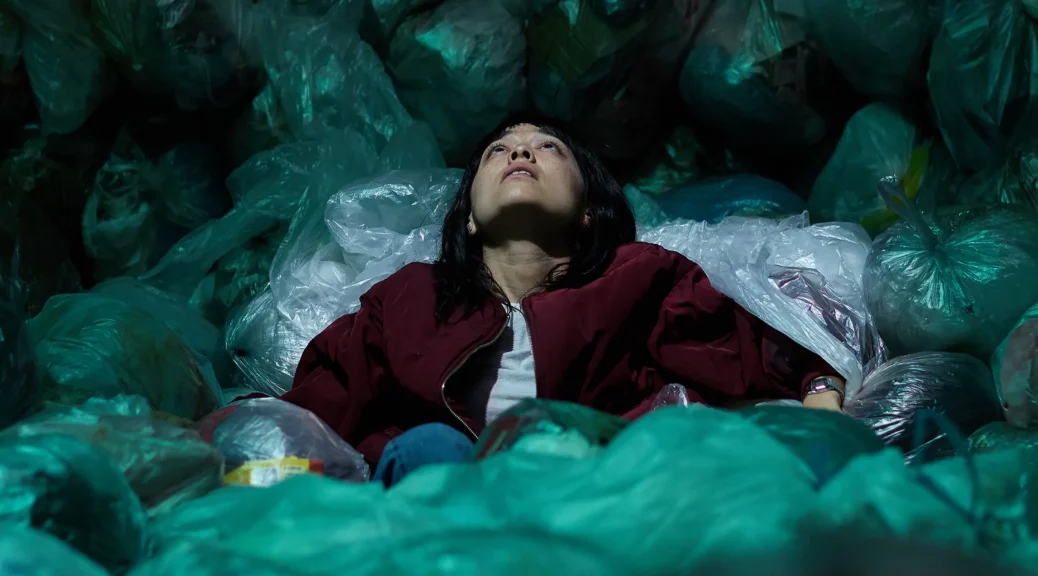
Dafne Keen (Logan) just moved in with her cousin after some terrible mishaps. Her first day in the new high school, she opens her locker—vacated by a basketball star who inexplicably died recently—and finds some kind of creepy, ancient looking skull whistle.

Any number of ridiculous contrivances later, and a group of high school cliches—the burnout (Keen), the smart girl (Sophie Nélisse), the drunken asshole jock (Jhaleil Swaby), his hot girlfriend (Ali Skovbye), and the comic book nerd (Sky Yang)—have to battle death as conjured by that creepy whistle.

Yes, writer Owen Egerton mashes some Final Destination whatnot in with the other familiar beats. Don’t expect that franchise’s Rube Goldberg style kills, but Hardy does bring some blood and gore, as promised by that R rating.

The curse itself does feel somewhat fresh. The death stalking each victim is their own natural death, just come early. Why their own death would want to creep around, chasing and terrifying their still-alive selves for days beforehand is a bit of a mystery.

Percy Hynes White stands out as a new twist on the neighborhood drug dealer, and Nick Frost is fun as a teacher who likes to hand out detentions. Truthfully, most of the cast does solid work, impressive given the uninspired script. James is particularly hamstrung with the most boilerplate character among them.

Keen struggles, too, delivering a one-note melancholy character that never feels authentic.

There is fun to be had here and there, especially at the Harvest Festival. One basketball player goes in costume as Teen Wolf without mention, and another unnamed werewolf character is a treat. The whole festival setting is filmed beautifully and reminds you that Hardy has some skill.

Not enough to elevate this script to something worth watching, though.

Bloodless

Dracula

by Hope Madden

There are those who would call Francis Ford Coppola’s 1992 film Bram Stoker’s Dracula a masterpiece. The score is undeniable, the costuming and set design glorious, the use of shadow, the creature design, the pulsing sensuality, Gary Oldman—all of it is exquisite. The entire balance of the ensemble? Terrible. There, I said it.

Still, it’s a memorable take—for many, a beloved all-timer—on Stoker’s vampire classic. I will assume that French filmmaker Luc Besson (Léon: The Professional, La Femme Nikita) is a fan. While his Dracula delivers much in the way of new ideas, the source material for his script is less Stoker’s novel than Coppola’s film.

He’s not hiding it. He even borrows—homages—bits and pieces of Wojciech Kilar’s score.

Caleb Landry Jones is Vlad the Second, Count Dracul. He loves his wife, Elizabeta (Zoë Bleu). He fights the Crusades to eradicate Muslims for God. But God does not protect his Elizabeta, so he curses God and searches the endless centuries, hoping for his loves return.

This storyline is 100% Coppola, not in the novel at all. Landry Jones is a talented actor, and versatile. See Nitram. But his performances tend to be somewhat interior, and you cannot help but compare his anguish over Elisabeta with Oldman’s in the ’92 film. Landry Jones comes up short.

And though Besson manages one pretty impressive wide shot of the Vlad armies, the earth burning behind them, nothing can compare to the macabre puppet masterpiece Coppola brought to the same scene.

But, after Act 1, the film settles into some new territory. France! No Renfield, no Van Helsing, no fight for Lucy’s hand, no Demeter. Christoph Waltz (a little bit autopilot here) is a priest whose order has been tracking vampires for 400 years. With this storyline, Besson, who wrote the script, forges some new ideas. Newish. And Matilda De Angelis is a particular joy as Dracula’s helper.  

Fresh ideas aside, Besson doesn’t bring much Besson to the film. There’s too little action here, and most of it is carried out by little CGI gargoyles, more comedic than thrilling. One scene doesn’t naturally lead to the next, characters feel disconnected to the plot, and, worst of all, it’s very talky and a bit dull. I’d call it a fanciful period piece before I called it horror.

It’s OK to borrow. What’s hard is to come up with anything original, because no fictional character has been on screen more often in the history of film than Dracula. Even Jesus hasn’t been depicted as often in film. So, it’s fine to borrow as long as you can do something new to merit another go. Besson just about accomplishes that. Just about.

Off the Gridlock

Shelter

by George Wolf

Just how many off-the-books groups of elite assassins are there? And does Jason Statham have expired membership cards from all of them?

Apparently, quite a few. And yes.

In Shelter, the secret group is called Black Kite, and Michael Mason (Statham) has been exiled and on the run since he broke a golden rule ten years ago. While hiding out at a lighthouse in the Scottish Isles, Mason’s rescue of a drowning girl named Jesse (Hamnet‘s talented Bodhi Rae Breathnach) gets them both spotted by MI-6’s new high tech surveillance system.

So now Michael’s been made, Jesse’s an orphan and they’re both on the top secret hit list.

This time out, Naomi Ackie gets to be the director barking orders in front of video feeds, while Bill Nighy is the oily spymaster who crossed Statham years ago. Much like the chess pieces Mason likes to play with, director Ric Roman Waugh is just moving new pieces around the same formulaic playground.

Screenwriter Ward Parry adds on the trusty child-in-danger trope, along with no shortage of cliched dialog.

“You really think we can outrun what we are?”

“Maybe I’m becoming like you…”

“You don’t want this life.”

It’s more plug-and-play action on the way to a requisite showdown, but Statham and Breathnach share decent chemistry, Waugh (the Greenland films, Angel Has Fallen) orchestrates some effective hand-to-hand combat sequences, and he’s able to build the film with a bit more nuance than Statham’s usual fare.

It ain’t Hamnet, but at least our righteous killing machine isn’t lathering up with a tube of shark repellant.

Rainbow Connection

Arco

by Hope Madden

A child who can’t wait to grow up goes against his parents’ wishes and stumbles head long into a dangerous adventure. Between the family-film formula for its plot and the hand-drawn animation, Ugo Bienvenu and Gilles Cazaux’s Oscar nominated Arco feels like it comes from another time. And that’s a lot of its charm, because the retro-futuristic vibe balances a delightful vintage SciFi quality with a disconcerting reality.

Arco (voice in English by Juliano Valdo, in French by Oscar Tresanini) is a boy from the distant future who, sort of accidentally, travels back in time to 2075 where he crash lands in the life of a lonely little girl named Iris (Romy Fay/Margot Ringard Oldra).

With her parents working in the city, joining by hologram for dinners and bedtime, Iris spends most of her time with a nanny robot named Mikki, and a toddler brother named Peter. But Arco shakes up her world, offering connection and companionship she’s been missing. Together, they’ll figure out how to get him back to his time before it’s too late.

Again, the premise itself is not that unusual. It’s essentially E.T.   

Bienvenu, writing with Félix de Givry, livens up the story with the loony humor of a bumbling threesome bent on finding the rainbow boy. They’d seen a boy just like him as children, and nobody believed them. Now they want proof.

The bowl cuts and rainbow sunglasses mark the characters—voiced in English by Will Ferrell, Andy Samberg, and Flea—as harmless goofballs, but they serve more purpose than simply comic relief.

The miracle the filmmakers conjure with Arco is that the childlike wonder of the characters, the wholesome storyline, and the beautiful animation belie the absolute bleakness of the film’s context. The world around Iris is literally on fire, a danger that Bienvenu illustrates with lush ferocity and amplifies with a daring, feverishly paced third act.

Those two worlds—hopeful wonder and bleak reality—inevitably collide, and though Act 3 resolves as you likely expect it to, it taps into the bittersweet emotion and timeless hope that marks all great family films.

Survivor: Boss Level

Send Help

by George Wolf

As much as Send Help feels like the Sam Raimi film that it is, the writing credits seem a bit unfinished. With a premise taken more from Triangle of Sadness than Castaway, and two pivotal plot points lifted from films I won’t mention for fear of spoilers, you’d expect at least an inspired by or story elements citation of the previous works.

No? Alrighty then. Raimi works from a script by the team of Damian Shannon and Mark Swift (Baywatch, 2009’s Friday the 13th, Freddy vs. Jason), providing the requisite dark humor, blood splatter and body fluids for a fun, root-for-the-underdog romp.

Linda Liddle (Rachel McAdams) is that underdog. Linda puts in long, committed hours in the strategy and planning department of a big firm. She’d been promised a major promotion from the founder (nice Bruce Campbell portrait on the wall!), but now he’s passed on and the d-bag son Bradley (Dylan O’Brien) has taken over.

And Bradley’s gonna give Linda’s promotion to his frat buddy instead.

Linda sticks up for herself, so Bradley gives her the chance to prove her worth at a big merger meeting in Bangkok. But when their plane crashes, Linda and Bradley end up as the only ones left alive on a deserted island. And right away, Linda’s skills are very valuable indeed.

Turns out, she’s a survivalist junkie who has auditioned for Survivor. Linda knows her way around the dangers of an uninhabited locale, while Bradley doesn’t know much beyond silver spoon-fed privilege. So Linda will not take kindly to being ordered around like the under-appreciated underling she was back in the office.

Bradley eventually becomes contrite, but can he be trusted? Linda appears ever helpful, but can she be trusted? Their castaway days become an increasingly bloody game of cat, mouse and wild boar, with some wonderfully competitive chemistry between McAdams and O’Brien.

She makes Linda’s transition to alpha female a crowd-pleasing hoot, and he crafts Bradley with a perfectly obnoxious mix of misguided mansplainer and smug elitist.

Yes, it’s over the top, just like you expect a Sam Raimi deserted island playground to be. What an unspoiled canvas for some blood spray, projectile vomiting, and a little survival of the deadliest. Game on!

Send Help delivers the R-rated fun, and it’s instantly relatable to the countless souls who’ve secretly dreamed of doing bodily harm to an insufferable boss. But it’s a comeuppance fantasy that still remains easily forgettable…unless you’ve seen the couple films it repeatedly recalls.

Then we’ll have something to talk about.

Point of No Return

Return to Silent Hill

by Hope Madden

When I used to pick my son up from his dorm, invariably there was a video game on whether anyone was playing or not. Mainly it was badly articulated characters delivering stilted, unrealistic but wildly dramatic dialog on an endless loop because, with no one playing, there was no action.

I could also be describing Christophe Gans’s twenty-years-in-the-making sequel, Return to Silent Hill.

I did not care for the filmmaker’s 2006 Silent Hill, a film that followed a mother into a supernatural town to save her adopted daughter. The sequel, also based on the incredibly popular video game of the same name, follows a distraught man (James Sunderland) who returns to a supernatural town to save his girlfriend (Hannah Emily Anderson).

Gans’s original at least boasted Radha Mitchell, who can, in fact, act. Gans didn’t give her much opportunity, but she tried. Do not look for that here. Though it doesn’t seem that acting is what Gans is after. He lights and frames actors specifically to make them seem less fleshy, less human. Their movement is stiff and unnatural, their dialog stilted and dumb. You truly feel like you’re watching a video game you’re not playing. Nobody’s playing.

You would hope that in the 20 years between projects, the creature design would have improved. Not the case. You rarely get a good eyeball on any of the creatures—and the video game does have a slew of creepy beasties to choose from—and when you do see them, they’re bland and they do nothing.

Because nothing happens in this movie. The entire film feels like being trapped in the between action set ups of a video game that nobody is playing. Nothing happens. There is no action.

Somebody thought the storyline, sans shootouts, without monster carnage, just the storyline of a video game was interesting enough to make a movie out of. They were incorrect.

Somewhere Beyond the Sea

Magellan

by Hope Madden

Lav Diaz’s 2-hour and 40-minute epic Magellan is not for the impatient viewer. With no exposition, a primarily stationary camera, and only one internationally known actor (Gael García Bernal in the title role), the filmmaker quietly undermines a historically accepted notion of exploration and perseverance.

Scenes have a painterly quality, the framing and lighting especially of interiors giving the impression of an oil painting. Each scene, threaded loosely together by time and location, feels more like a work of art into which characters tumble and behave.

Relying almost exclusively on long takes with an unmoving camera, Diaz emphasizes not the characters in a scene but its geography, its ecology. Even in sound design, the crash of ocean waves, the rustle of jungle leaves, the creak and moan of a ship at sea are given equal, sometimes even primary attention. These set ups let the environment dictate the scene, emphasizing the natural world and not the puny individuals so desperate to leave a mark.

Diaz, who generally films in black and white, revels in the hues and tones of the environments. Rich, deep browns in ship quarters conflict with the steely blue grey of the sky and ocean, which pale beside the rich greens of land. And the filmmaker insists that you notice, holding every shot far longer than expected so there’s nothing for you to do but take note of the brutal beauty.

The showiest thing about Magellan is its silences, what Diaz leaves unexplored and disregarded. Don’t go into this film expecting a rousing image of endurance and vision. This film is not impressed by the explorer. Diaz’s languid camera empties his film of the urgency you might expect of a film so pointedly critical of colonizers and exploiters, and that seems to be the point.

Diaz robs Magellan of the passion and romance often attached to his single-minded mission. The film’s unhurried nature subverts expectations and leeches the nobility from the history, leaving instead the impression of blundering, cruel acts performed by misguided, greedy men who died in the mud, far from home, while trying to steal land and enslave human beings.

The Healing Skies

H Is for Hawk

by George Wolf

“I don’t have a hobby, I have a hawk.”

“Mabel” became much, much more than a hobby for Helen Macdonald, and H Is for Hawk adapts their award-winning memoir with nearly equal amounts of the magical and the mundane.

Claire Foy is understated and touching as Helen, who was teaching English at a university in Cambridge when their beloved father Alisdair (Brendan Gleeson, characteristically splendid) suddenly collapsed and died in 2007.

Leaning on memories of exploring nature and birding with their father, and their years of experience in falconry, Helen channelled feelings of grief into the adoption and training of a Eurasian goshawk.

Just the fact that the emotional vessel here is a notoriously stubborn bird of prey instead of a dog, a horse, or a wayward teen is enough to stir your interest. Director and co-writer Philippa Lowthorpe rewards it early. Foy and Gleeson shine in some bittersweet flashbacks, and Helen’s cautious bonding with Mabel is in turns emotional and educational.

As Mabel hones her hunting instincts, the wildlife framing from cinematographers Charlotte Bruus Christiansen and Mark Payne-Gill can be beautifully majestic. Eventually, though, the lack of firmer hands from Lowthorpe and editor Nico Leunen begins to take a toll.

The pace of the film becomes laborious and plodding, enough to even overshadow the introspective and touching work from Foy. There is never a doubt we believe the healing journey Helen and Mabel are sharing, but the excessive documentary-ready wildlife footage eventually increases our detachment while it bloats the run time.

Despite the similarities with 1969’s Kes, Lowthorpe isn’t trying for a Ken Loach-style social critique. At the heart of this film is an intensely personal story of “an honest encounter with death.” It is a unique and well-crafted film, but the honesty of H Is for Hawk is just spread too thin for a truly memorable flight.

Testify

The Testament of Ann Lee

by Hope Madden

Filmmaker Mona Fastvold (The World to Come) draws you into her latest by dancing into the woods with an ecstatic group dressed a bit like Puritans. The dance feels simultaneously choreographed and organic, but definitely somehow forbidden.

The Testament of Ann Lee spins its period tale, the true story of a founding leader of the Shakers, with none of the baggage expected of a historical drama. Snapshots of formative moments are held together with liltingly earnest narration from fellow shaker Mary Partington (Thomasin McKenzie), and with dance.

It’s a tough film to fit into a neat category, as, it would seem, was Lee herself. Played undiluted passion by Amanda Seyfried, Lee is a self-contained human in progress, aware of herself, her inclinations, and the pressures around her. She knows God in an uncompromising way and wants only to find community as devoted as she. She finds it with the Shakers, so named because, unlike the Quakers, they dance.

What Seyfried delivers is just shy of astonishing. There is no artifice, nothing calculated or naieve. And though the script offers you room to find reasons for Lee’s faith and the hang ups that fuel her fervor, it does not decide for you or judge her.

Fastvold’s script, (penned with Brady Corbet, with whom she wrote last year’s Oscar contender The Brutalist), does not ask you to believe that Lee was the second coming of Christ, as she and her assembly did. Nor does it ask you to disbelieve it. But it asks, quietly and regularly, all kinds of questions, delivers all kinds of information, suggests any number of possible answers. The approach to the writing is anthropological without being burdensome or dry, while the direction itself is passionate and bold, not an ounce of cynicism or pretension.

If you know little or nothing about the Shakers, we have that in common. Among the many joys of Fastvold’s film is that it unveils information without belaboring points. You’re left with questions, not because you can’t follow the film, but because you’re intrigued enough to want to know more.  

This is a passionate, bold film about building community, finding and remaining true to yourself, and the unrivaled power of dancing.

The Slate Is Never Clean

In Cold Light

by Hope Madden

Maxime Giroux’s gritty thriller In Cold Light keeps you off kilter, moving from dreamy confusion to full-on sprint and back again.

Maika Monroe is Ava, and our first sprint with Ava ends in a violent drug bust. But after her two-year sentence, she finds herself back in Ponoka, Alberta. No fresh start, she’s clean but she’s otherwise ready to return to leading the smalltime drug operation she left behind. But they’ve moved on.

Her twin brother (Jesse Irving) tries to reason with her, tries to convince her to take the 40k he’s been setting aside for her while she did her time, but Ava can see that her once small operation has bitten off more than it can chew and is now dealing with real big, real bad guys.

She’s right, and those bad guys are the reason for more sprinting.

The story itself is somewhat simple, but Giroux, working from Patrick Whistler’s script, keeps your attention by revealing information as necessary, and by situating Ava’s world inside something lived-in but not ordinary. The context gives the story roots, authenticity, and opportunity for some pretty wonderful, dreamlike sequences.

Monroe’s sharp. The character of Ava is interior, speaking only as necessary, always thinking, weighting options. The performance feels caged, desperate but simultaneously controlled. Monroe’s long been a master of using stillness to manipulate a scene and an audience. She did it with precision in Watcher, among other films. Once again, Monroe uses an electric silence to say more than dialog could properly manage.

Giroux surrounds her with a game supporting cast. Troy Kotsur delivers a particularly layered performance, and a cameo from Helen Hunt is chilling. There’s not a weak link in the ensemble, and barely a stray or needless phrase in the script.

If anything, the film could have used maybe a few more sentences of exposition, especially as it closes. To leave so much up to interpretation invites the suggestion of plot holes, which In Cold Light doesn’t have, but it does leave more to the imagination than it probably should. Regardless, it’s a more than solid thriller and another impressive turn from Monroe.