Category Archives: New In Theaters

Reviews of what’s out now

Too Superficial to Satisfy

Mandela: Long Walk to Freedom

by Hope Madden

In offering the world a glimpse of the phenomenal life of Nelson Mandela, director Justin Chadwick wisely relied on the words of the man himself, adapting Mandela’s autobiography for his film. Chadwick’s vision is grand, the performances strong, and the story not only compelling, but tragically timely. So why does Mandela: Long Walk to Freedom feel unsatisfying?

The fault is certainly not with the film’s leads. Idris Elba’s performance is alive with exploration. You can see his temperament adapt and change along with Mandela’s experiences. Elba finds a depth of character not provided on the page of William Nicholson’s screenplay, and his maturing characterization allows the film, which suffers from Cliffs Note-idis, a bit of depth it would otherwise lack.

Likewise, Naomie Harris deftly handles the far more radical change in character demanded from a depiction of Winnie Mandela. From idealist to radical, Harris nails the metamorphosis, but because of the way we simply check in with Winnie every few years, the role lacks much opportunity for nuance.

The film simply covers too much ground. It does so with sumptuous set design, a convincing ensemble, and a directorial hand that respects the source material enough to uncover flaws as well as triumph. But what Chadwick needed to do was narrow his vision.

Long Walk to Freedom offers perhaps the most compelling depiction of the relationship between Nelson and Winnie Mandela yet brought to the screen, aided by performances that ache with tenderness. Elba commands the screen with a smoldering charisma worthy of a portrait of Mandela, while Harris treats Winnie Mandela with respect and compassion without sugar coating her behavior.

Had Chadwick and Nicholson plumbed this rich relationship a bit more, or simply chosen any smaller slice of Mandela’s life to examine more fully, their film – with the gifts it has to offer – could have become a magnificent memorial for mourners and a fascinating introduction for those only drawn to the story of the leader because of his recent passing.

Instead, the filmmakers settled for a superficial treatment, hitting all the high points without examining the depth or complexity of anything. It’s an unfortunate compromise, both because all the needed ingredients were in place for a truly grand biopic, and because Mandela deserved a more memorable send off.



Verdict-3-5-Stars


http://www.youtube.com/watch?v=hmm-aazQQKA
Quintessentially Disney


by George Wolf


The God of Irony must be smiling on Saving Mr. Banks, the “Disneyfied” account of a legendary author afraid the film version of her greatest work would get… Disneyfied.

Leave it to a pair of reliably great actors, and the memories of one of Disney’s most treasured classics, to make sure the whole affair turns out much better than a black fly in your Chardonnay.

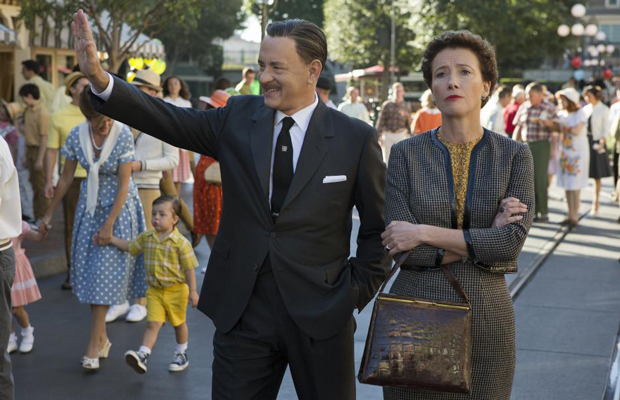
Emma Thompson brings wit and humanity to the role of P.L. Travers, who for years rebuffed all offers from Walt Disney himself to turn her Mary Poppins stories into a movie. Tom Hanks plays Mr. Disney with the charming twinkle you’d expect, and from their first scenes together, he and Thompson exhibit a playful, unmistakeable chemistry that buoys the film.

The fact that Saving Mr. Banks is as enjoyable as it is feels like an underdog snatching victory from sure defeat.

The script, from Kelly Marcel and Sue Smith, takes (according to numerous accounts) many “feel good” liberties with the story of how Mary Poppins came to fruition. Even worse, the director is John Lee  Hancock, the man behind The Blind Side, a downright criminal piece of whitewashing if ever there was one.

Together they fill the backstory of Travers’ troubled childhood with force-fed melodrama, attempting to pull every manipulative heartstring available. Though given less screen time, the treatment of heartbreak in Walt Disney’s own past is equally subtle.

But, in addition to the sublime lead performances and a strong supporting cast, Saving Mr. Banks has a powerful trump card:  Poppins!

Each time the music and writing team (Jason Schwartzman, Bradley Whitford and B.J. Novak-all stellar) show Travers a proposed storyboard or play her a new song, you can’t help but smile. Finish up with classic footage from the 1964 film and still pics from the actual premiere, and it’s pretty hard not to surrender to the guilty pleasures.

Those without an affinity for the source material may not get the same warm feelings, but adding schmaltz to their own story of schmaltz-adding is perverted Disney genius. That, along with the well-played nostalgia for one of their greatest achievements, just might make Saving Mr. Banks the quintessential Disney film.


Verdict-3-0-Stars


Do the Hustle!

American  Hustle

by Hope Madden

David O. Russell can direct the shit out of a movie, can’t he? He startled his way into our consciousness in ’94 with the unbelievable Spanking the Monkey, followed by a smattering of well-crafted, unmarketable, endlessly watchable films. Then he took a few years off and came back wearing his shootin’ boots.

The Fighter in 2010, followed by Silver Linings Playbook in 2012 racked up a grand total of 3 Oscars and another 13 nominations. That’s the way to shake off the artistic rust.

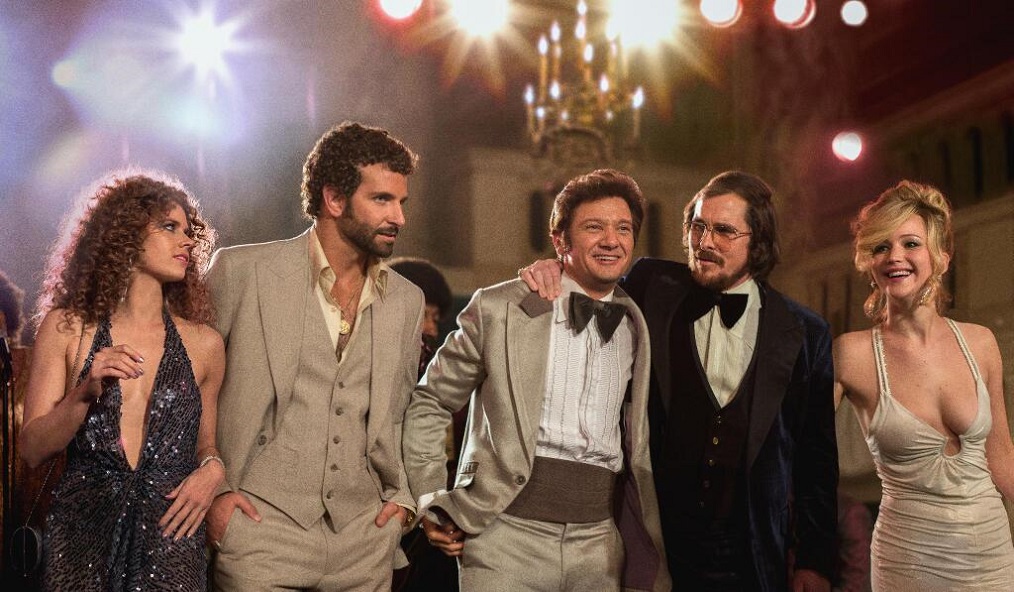
For his latest, American Hustle, Russell wisely cherry-picks castmates (a couple of Oscar winners among them) from his last two efforts to populate the world of 1978 and Abscam – the FBI sting that took down some corrupt public officials. And, as the screen announces just before the first disco-tastic image, “Some of this actually happened.”

One desperately ambitious FBI agent (an unhinged and glorious Bradley Cooper) pinches two con artists (Christian Bale, Amy Adams – both outstanding) and insists they help him finger other white collar criminals. But his dizzying hunger for significance pushes their con to untenable extremes, and soon these low-flying hustlers are eyeball deep in politicians, Feds and the mafia.

Russell orchestrates con upon con, braiding loyalty with opportunism with showmanship, and providing his dream cast with everything they need to erupt onscreen.

Joining the stellar performers mentioned are the always reliable Jeremy Renner and the reliably brilliant Jennifer Lawrence. As an unpredictable spitfire, Lawrence is right at home. She excels, and Russell teases the absolute most out of her every moment of screen time (it makes no sense now but trust me, you’ll never call a microwave oven by its correct name again).

Louis CK – in his second strong cinematic turn this year (alongside Blue Jasmine) – is a great onscreen curmudgeon, and he offers such a perfect foil for Cooper’s combustible lead that their scenes together are a scream.

Honestly, with the electricity on screen whenever Lawrence or Cooper appear, it’s almost possible to overlook Bale and Adams, but what a mistake that would be! Bale crawls into this character, as he does every character, and convinces us of the sleazy but good-hearted schlub inside this grifter.

Likewise, Adams – a performer so expressive with just a look – keeps you on your toes. It’s her flawless work as Edith (or is that Sydney?) that keeps all the cons spinning at once, and you never know exactly where her loyalties lie. In fact, you’re pretty sure she isn’t certain. Unless she’s just playing you.

While Russell’s fondness for Goodfellas colors the entire running time, there’s no question that his creation finds its own way and becomes something unique and fantastic. The writing is exceptional, the performances volcanic, and the result is the sharpest and most explosively funny movie in Oscar contention.


Verdict-4-5-Stars


The Brothers’ Soulful Look Inside

Inside Llewyn Davis

by Hope Madden

In some circles, a new Coen brothers‘ film is more hotly anticipated than the next Batman. Those are my people. Joel and Ethan Coen have crafted among the most impressive set of movies of any American filmmakers. Though there are certain thumbprints that mark a film as theirs, they never cease to surprise in the art they produce – which, as often as not, is art for art’s sake. And this is the very theme of their latest effort, Inside Llewyn Davis.

An immersive experience that takes you directly to the heart of the 1961 Greenwich Village folk scene, the film shadows the titular, beleaguered artist for just a few days as he tries to survive both winter and his chosen field.

The film opens onstage, as Llewyn (a fantastic Oscar Isaac) sings in the smoky Gaslight Club. It’s an intensely intimate segment, and Isaac performs not a snippet, but an entire number. His performance is exceptional, and it tells you more about Llewyn than the next 90 minutes are bound to share.

Isaac and the brothers offer a superbly nuanced character study, so understated as to be almost hypnotic. Isaac’s world-wearied stare and infrequent songs do the majority of the work, but his adventure – as brilliantly written as anything you’d expect from the Coens – captures your attention.

Enough can’t be said about Isaac’s performance, both as an actor and as a musician, because the role requires much from both. He shoulders nearly every second of screen time, offering enough self-destructiveness, tenderness and ego to keep you believing in his trials and almost reluctantly rooting for him.

He’s aided by enigmatic performances in wonderfully odd roles. Coen regular John Goodman adds color as an aging jazz man, while Carey Mulligan spits inspired insults, and Justin Timberlake plays convincingly against type as the group’s square.

It’s not just the performances or the writing that make this film so languidly watchable, but the magically depicted setting – so unerringly authentic that you feel you’re inside a Bob Dylan album cover. Between that and the music – so, so many points made simply with the music – the film shines.

But what sets Llewyn Davis apart from the rest of the Coen stash is its lack of cynicism. Sure, with some battered years under his belt as a musician, not to mention his deeper scars and struggles, Llewyn holds a defensively cynical outlook. But he’s hopelessly true to his art. Can’t imagine where he got that.


Verdict-4-5-Stars


The ‘Stache Takes Manhattan


by George Wolf


According to facebook comments, there are humans out there who don’t think Will Ferrell is funny, and say they don’t understand all the fuss about Anchorman 2, and you know what was really funny? Delta Farce.

I am not one of those people.

Look, I’m not going to tell you The Legend Continues is as funny as the original, because , Great Odin’s Raven!, you’d know I was lying. But it is funny, sometimes downright eye-wateringly hilarious.

The swinging 70s have given way to 1980, as Ron Burgundy (Ferrell) and his news team move to New York to join GNN, the very first 24 hour news network. After finding themselves on the graveyard shift, Ron, Brick (Steve Carell), Brian (Paul Rudd) and Champ (David Koechner) set their sights on moving into primetime and taking down the network golden boy (James Marsden).

Ferrell and co-writer Adam McKay (who also directs) get more pointed in their satire of TV news in round two, which seems a natural progression. Occasionally, things get a tad too obvious, but the overall subject of the sad state of broadcast journalism is still so ripe for ridicule that the film is always able to recover pretty quickly.

Two curious plot points hold this new Burgundy adventure back from striking ratings gold, one involving Ron’s health and another concerning his strange choice of new pet (don’t worry, Baxter’s still around). Both subplots fall flat, bloating the film by at least twenty self-indulgent minutes that were better relegated to the deleted scenes section of the DVD.

The other 100 minutes, though, are chock full of nutty goodness. The four core actors again excel at this rapid fire, improv-heavy brand of comedy (especially Koechner, who jumps up a notch this time) and the new faces (Kristin Wiig, Meagan Good, Greg Kinnear) blend in well. Expect some inspired sight gags (keep an eye on that news ticker), well-played homages to the best moments from part one, a litany of welcome cameos, and a small reprise at the end of the credits.

While this Anchorman lamp may not be quite as lovable, you’ll like this lamp, you’ll really like this lamp.


Verdict-3-5-Stars


He May Already be a Winner


by George Wolf


After a string of charmingly insightful films such as About Schmidt, Sideways, and The Descendants, Alexander Payne has joined that group of filmmakers whose every effort is met with winning expectations.

His latest is Nebraska, and it exceeds them all.

The film follows the trail of Woody Grant (Bruce Dern), an aging booze hound in Montana who gets a contest solicitation in the mail. Convinced he’s already won the million-dollar sweepstakes, Woody is determined to make the required trip, on foot if necessary, to the contest office in Omaha where his prize awaits.

To appease his stubborn father, Woody’s son David (SNL vet Will Forte) steps in, and the estranged pair hit the highway for Nebraska. Along the way, they stop off in the small town where Woody grew up, reconnecting with old friends and family who have differing reactions to Woody’s new “millionaire” status.

As is his custom, Payne is able to convey much with graceful direction and an intelligent, restrained script. Artfully filming in black and white, Payne often lets wide shots linger, utilizing exquisite cinematography from Phedon Papamichael to create scenes brimming with a stark beauty. Similarly, the faces and facades of Woody’s hometown reveal the dark corners shared by any of a thousand communities weakened by hard times.

Dern is smart enough to realize what he has with Woody, and he doesn’t waste the role of a lifetime. With an awkward gait and world-weary countenance, Dern digs into the dimensions of his character, delivering a deeply touching performance sure to get attention in the coming award season.

Though casting MacGruber opposite the legendary Dern does seem surprising, Forte shows some nice dramatic chops, allowing us to relate with David as he slowly begins to see his father in a new light.

Scene- stealing honors go to June Squibb, who’s a flat-out riot as Woody’s cantankerous wife Kate, and the venerable Stacy Keach as a long lost friend who may not be so friendly after all. Keep an eye out, too, for Angela McEwan. In limited screen time as Woody’s old girlfriend, she breaks your heart in the best possible way.

In many ways, Nebraska seems to be Payne’s most personal film, which is ironic considering it is the rare directorial effort that Payne didn’t also write. Bob Nelson gets that credit, and his debut screenplay is layered with poignancy and humor. It clearly spoke to Payne, and his vision for fleshing it out is impeccable.

Nebraska is infused with a subtle longing, a wistfulness for what you’ve left behind. That may sound like a recipe for rampant sentimentality, but Payne and Nelson have other plans. There’s also a rambunctious, often downright nutty spirit at work here, and it makes sure Nebraska leaves you smiling, even as it hits you squarely in the heart.


Verdict-4-0-Stars


Suffering Middle Child Syndrome

The Hobbit: The Desolation of Smaug

by Hope Madden

The fantasy film genre boasts some great sequels, even when those films are little more than bridges from Episode 1 to 3. While the second born may lack closure, it doesn’t bear the burden of exposition that tends to weigh down any first episode, and it lacks the need to tidy up every minute detail that sometimes derails a final installment.

The Empire Strikes Back is the classic example, but the genre offers many others. The Hunger Games sequel, for instance, far surpasses the first. Even the wingnut Peter Jackson’s first Tolkien trilogy offered the swiftly paced and satisfying center, The Two Towers.

His next Middle Earth middle child, the beardtastic The Hobbit: The Desolation of Smaug, hits screens this week, and it, too, benefits from a groundwork set in the first installment, and the freedom to end without tidying up.

And Arkenstone be damned, Ian McKellen is the gem of this franchise. Once again, he brings the right mix of humor and gravitas to make Gandalf the coolest guy – excuse me, wizard – in the realm.

Martin Freeman is also spot-on as Bilbo – a perfect mix of humility, courage, and British manners. His Bilbo is very easy to relate to, which is rarely the case in a Tolkien production. Still, many of the million-ish supporting turns, though universally one-dimensional (regardless of cinematic presentation), animate the tale appropriately.

There’s a lot holding it back, though.

Mainly, it suffers from the same condition as An Unexpected Journey, which is that there is no defensible reason to make three films out of the novel The Hobbit. The Lord of the Rings was conceived by Tolkien as a trilogy, where The Hobbit is a single volume, so Jackson had to carve it into three, padding and elongating here and there to accomplish this mission. Because if there’s one thing Tolkien needs, it’s more stuff.

The needless bloat is an obstacle to enjoying all that’s right about the film, because the story just becomes tedious too soon and too often. The fact that you realize there will be no satisfying conclusion does not make the pace seem any less leaden, and the result feels more like a rip-off than a cliffhanger.

Yes, the dragon looks cool, the Orcs continue to frighten, and as a tourist video for New Zealand, the location shooting works miracles. But many filmmakers, Jackson included, have been devoted enough to the stepping-stone sequel to craft a film that succeeds where the rest of the franchise fails. This time around, Jackson just adds filler and cashes checks.

Verdict-2-5-Stars


Tough Time for a Brother’s Keeper

Out of the Furnace

by Hope Madden

Just in time for the holidays, a bleak look at desperation, blood ties, masculinity and loyalty. Welcome to Braddock, PA and Out of the Furnace.

Part Deer Hunter, part Winter’s Bone, Scott Cooper’s new film casts a haunted image of ugliness scarring natural beauty, whether it’s the steel town petering out and leaving a rusted carcass in a Pennsylvania valley, or the human nastiness up in the hills on the Jersey border.

The tale follows a pair of beleaguered brothers in America’s disappearing rust belt. It’s a deceptively simple story of being your brother’s keeper, but Cooper’s meandering storyline keeps you guessing, often entranced. Nothing is as simple as it seems, although there is an inevitability to everything that makes it feel strangely familiar.

Cooper’s camera evokes a palpable sense of place, and his script positions the film firmly and believably – but without a heavy hand – in a clear time period. The setting itself is so true and absorbing that many of the film’s flaws can almost be forgiven.

At the core of Furnace’s many successes are some powerful performances. Both Christian Bale and the endlessly under-appreciated Casey Affleck, as Russell and Rodney Baze, respectively, dig deep to uncover the anguish and resilience at the heart of the siblings’ relationship and struggles. Bale, in particular, smolders with a tenderness and deep love that is heartbreaking.

On the other hand, Woody Harrelson is just plain scary. As the villain (and excellently named) Harlan DeGroat, Harrelson goes all out, leaves nothing behind. Harlan is a Bad MoFo, no doubt, and Harrelson leaves no scenery unchewed.

Cooper stumbles here and there with his storytelling, though. There is some heavy-handed symbolism, and a letter written from one brother to another that’s almost too clichéd and trite to accept in the otherwise articulate piece of filmmaking.

Just four years ago, in his feature film debut Crazy Heart, Cooper led Jeff Bridges to his first Oscar, and Maggie Gyllenhaal to her first nomination. His sophomore effort is less assured, as if he’s trying too hard. His ability to conjure such a vivid place and time impresses, and both Bale and Affleck are characteristically wonderful, but the director can’t seem to reign in the entire cast, and he borrows too freely from other (excellent) movies.

While the stumbles aren’t crippling, they keep Out of the Furnace from the greatness it otherwise might have reached.


Verdict-3-5-Stars


Why Do New?

Oldboy

by Hope Madden

When contemplating Spike Lee’s new film Oldboy, don’t ask yourself why central character Joe Doucett  was set free. It’s pointless to even ask why he was imprisoned in the first place. The real question is: why remake this movie?

Seriously, what was it about the experience of watching Chan-wook Park’s 2003 masterpiece of punishment that made Spike Lee want to make his own version? Did he see things he thought needed improvement? Thought the US audience wouldn’t sit through subtitles? Or more likely, thought we needed a watered down, moralistic version?

The thing about the original Oldboy it that you just can’t unsee that film. There’s no way to watch the reboot without comparing. If you haven’t seen the original, then you still have the fresh perspective on the mystery unraveling, as Joe finds himself strangely incarcerated for 20 years, then even more mysteriously set free.

But if you have seen the original, then you, like me, may have wailed aloud the first time you heard someone planned to make an English language version, certain as you were that they would gut the tale, sterilize it, tidy it up, give it heart.

But then you saw the first couple ads for Lee’s version, and you thought – well, good cast (Josh Brolin, Sam Jackson, Elizabeth Olsen, Sharlto Copley). And the ads suggested a very close approximation to the original. But in your heart you knew Brolin was no Min-sik Choi and Lee is no Chan-wook Park.

Obviously, both are extremely talented, but the film is a mismatch to their particular gifts. Lee struggles to find a tone, and while Brolin’s transformation impresses, it feels stale and safe when compared to the mania Choi brought to the role.

Most damagingly, screenwriter Mark Protosevich is not up to the task of adapting the original screenplay, or the manga that spawned it.

No, apparently we need a heart. We need a hero. We need a straightforward story where, though details are lurid, lessons are learned. Tidied where it shouldn’t be, sloppy elsewhere (Copley could really have dialed down the Dr. Evil), Oldboy has trouble on every front.

Plot summary for a review of Oldboy will not stand. Even a neutered, disappointing retread deserves to keep all its secrets intact. But Lee and Protosevich pull punch after punch that Park landed with relish, and their reigned-in, moralistic mess of a film won’t satisfy newcomers or fans.

Verdict-2-0-Stars


http://www.youtube.com/watch?v=Vd20pywMXuY

Sayles’s Sisters Deserved Better

Go For Sisters

by Hope Madden

Writer/director John Sayles has built a career on character driven independents and stories that tell uniquely American tales. His latest, Go for Sisters, is a simply stated effort about the value of hard-won relationships.

LisaGay Hamilton plays Bernice, a no-nonsense parole officer who bends her strident ways when her childhood friend Fontayne (an exceptional Yolanda Ross) becomes her client. Fontayne recently found herself in the company of a felon, which breaks her parole. But where Fontayne lives, felons are just about the only company possible to keep.

Fontayne knows the score, predicting Bernice’s thoughts based on prior experience. “This sorry girl ain’t got her shit together. We gon’ have to lock her up some more.”

To Fontayne’s surprise, Bernice relents. But where Bernice should reassign Fontayne to another parole officer, instead she enlists her help to find her own missing son, an ex-soldier gone missing and likely mixed up in something dodgy.

Though both performances, and that of Edward James Olmos as the retired cop helping them track the missing man, are very strong, Sayles strings together scenes with no panache at all, creating something akin to TV detective show. The plot is so plainly laid out that it becomes an afterthought, no doubt because Sayles’s interest lies with the characters, not their adventure. But the audience has to feel compelled by both.

The adventure contains too many clandestine meetings and coincidences for the investigation to carry the weight of authenticity, and Sayles never mines for real plot-driven tension. It’s far too light a touch given the circumstances of the kidnapping.

Instead, Sayles wonders about the reasons the two women lost each other twenty years ago, and the paths they took to such different lives, and then come back to each other. Theirs is a poignant and probably very familiar kind of struggle, and it deserves our attention. It’s just too bad Sayles had to drag us all across the American Southwest and into Mexico to discover it.


Verdict-2-5-Stars

http://www.youtube.com/watch?v=5w0mA6Sg_gs