Category Archives: New In Theaters

Reviews of what’s out now

Look What the Cat Dragged In

Cats

by Christie Robb

People say that you’re either a cat person or a dog person. I’m a cat person, but definitely not a Cats person. But if you are, there’s a lot to enjoy in the new film version of Andrew Lloyd Webber’s 1981 musical based on poems by T.S. Eliot.

How else could you possibly get tickets to see a show with this cast? Taylor Swift. Idris Elba. Rebel Wilson. James Corden. Jennifer Hudson. How else can you watch a feline Dame Judi Dench curl up convincingly in a basket? Or glimpse Sir Ian McKellen lap from a bowl of milk?

A movie is a very egalitarian way to enjoy a Broadway musical. This one is about an assemblage of cats who have gathered together under the full moon to decide which one of them will be chosen to be reborn into a new life. Their best life. They pitch their case by singing the song of themselves. There’s very little in the way of traditional narrative structure although director Tom Hooper (Les Misérables) does tinker around with the play a bit to try to tease one out. It’s more like a musical revue designed around a central theme.

Initially concerned about falling into the uncanny valley of CG feline effects on the actors’ familiar faces, after some early creepy moments I got used to it. The realistic tail twitches and subtle changes in the angle of an ear serve to give additional cues as to the interior life of a cat that mere facial expressions alone can’t provide. (The opportunity to see emotional reactions through closeups is another advantage of a screen version.)

Occasionally the feline illusion is broken (most often by Swift and Elba) and instead of seeing a cat you are confronted with a dancing furry naked person with Barbie-doll genitalia. But most of the time, it works.

Wilson and Corden are amusing. Watching Francesca Hayward (principal ballerina at the Royal Ballet) dance the role of Victoria is a delight. But the true star of this show is Jennifer Hudson as Grizabella, a former “glamour cat” now old and suffering through hard times.

As in Les Mis, Hooper has his cast sing live, and it is Hudson’s performance of the signature song “Memory” that far outshines every other musical number here. It’s likely what you’ll be humming as you walk out of the theatre, and the one thing you’ll most remember about these Cats.

The End

Star Wars: The Rise of Skywalker

by George Wolf and Hope Madden

Not that long ago in a galaxy near and dear to us, J.J. Abrams brilliantly re-packaged our Star Wars memories as The Force Awakens. Rian Johnson’s The Last Jedi took an opposite approach two years later, bringing a challenging and welcome nerve that sent a clear signal it would soon be time to move on.

Abrams is back as director and co-writer to close the saga with The Rise of Skywalker, which ends up feeling less like a course correction (which wasn’t needed) and more like a sly meeting of both minds. The fan service is strong with this one, indeed, though it never quite smacks of panicked fanboy appeasement.

In fact, the echoes of Johnson’s vision only make Abrams’s franchise love letter more emotionally resonant. We were told this goodbye was coming, and now here it is, so grab hold of something.

And that doesn’t mean just tissues (though you may need them), as Abrams delivers action that comes early and more than often. From deep space shootouts to light saber duals amid monstrous ocean waves, the heart-racing set pieces are damn near non stop and seldom less than spectacular.

But let’s be real, this is the Rey and (Kylo) Ren show.

We knew their fates would collide, we wanted that collision, and here we get it, propelled by two actors in Daisy Ridley and Adam Driver who are able to fully embrace the weight of their respective arcs. As all our questions are eventually answered, Driver and Ridley never let us forget what drives their characters: the closure of identity.

And from a new hope to the last hope, it is precisely those bloodlines and destinies that have always driven this entire franchise. Abrams makes sure he honors that legacy with a satisfying sendoff bursting with fandom in nearly every frame.

Yes, you’ll find some awkward dialogue and underused characters, but that’s not a bad scorecard considering all that The Rise of Skywalker throws at us. From welcome hellos (Lando!), to sad goodbyes (Carrie Fisher’s is handled with heroic grace), political relevance (“there’s more of us” in the resistance) to stand up and cheer moments, this is a one helluva farewell party.

Hero Takes A Fall

Richard Jewell

by George Wolf

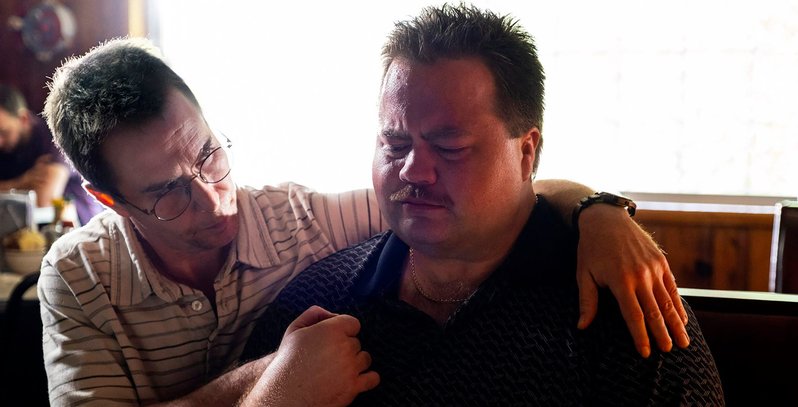
Richard Jewell is a film Clint Eastwood has reportedly been trying to direct for years, and no wonder. It’s the story of a heroic man forced to fight against bureaucrats and parasites who question his heroism, which seems to be Clint’s favored genre.

Jewell, of course, was a hero at the Centennial Park bombing during the Atlanta olympics in 1996. A security guard who first spotted the bomb and was helping clear the scene when it exploded, Jewell was later named as the FBI’s prime suspect, and had his life turned upside down for months until the feds gave up.

It’s a pretty clear case of a man wronged, and a compelling story clearly worthy of a film. But while Eastwood and writer Billy Ray tell much of it well, their zeal for painting broad-stroked villains is hard to overcome.

After years of standout supporting roles (I, Tonya, Black KkKlansman) Paul Walter Hauser takes the lead as Jewell and grounds the film with a terrific and often touching performance. As suspicion around Jewell grows, the bonds created with his lawyer and his mother (Sam Rockwell and Kathy Bates, both great) show Eastwood and Ray at their nuanced best.

The law and the press don’t get off so easy. That’s not to say they should get a pass, far from it, but Atlanta Journal reporter Kathy Scruggs is drawn so one dimensionally, Olivia Wilde might as well be twirling a mustache every time she’s onscreen.

The Journal is currently threatening legal action over the depiction of Scruggs (now deceased, as is Jewell) trading sexual favors to an FBI agent (Jon Hamm) for info, but the film’s slut-shaming isn’t reserved for just one reporter. They’re all whores.

And in case you miss the strategically placed sticker in the lawyer’s office that reads “I fear the government more than I fear terrorism,” Eastwood returns to it more than once. That’s grandstanding, not character development, and ends up undercutting a layer we could have gotten so much more intimately solely through Rockwell’s performance.

Richard Jewell‘s story is a good one, a tragic one, and a cautionary tale that deserves telling. And the film it deserves – the one where a common man finds the will to fight for his dignity – is in here, you just have to wade through some blanket scapegoating to find it.

Bro Down

Black Christmas

by Hope Madden

In the history of cinema, the number of bad, misogynistic horror movies is too high to count. I literally cannot count that high. So, even though Black Christmas is not a good horror movie, it’s somehow comforting to know there is now at least one bad feminist horror flick.

Co-writer/director Sophia Takal (writing alongside April Wolfe) puts a new spin on Bob Clark’s seasonal classic. (Well, Clark also directed A Christmas Story, but I’m talking about his 1974 original Black Christmas.)

Christmas break is upon the Hawthorn College campus and students are slowly trickling home. Any sorority sisters left at school will wish they’d made other plans.

Clark’s bloodier yuletide gem remains relevant because it’s a pre-slasher slasher, meaning that it doesn’t entirely follow the formula because there was no formula for slashers in 1974. Many consider Black Christmas to be the first of that sub-genre, so it subverts expectations because, when it was made, there were none. Fun!

The second reason people return to it annually is the creepy ass phone calls that still somehow manage to be chilling.

Takal definitely frustrates with phones, although not to nearly the same chilling effect. But she does manage to give the formula a switch-up.

Imogen Poots leads the cast as Riley, and we know Riley is the film’s hero because she has the most to overcome. Poots is a reliable performer, though she struggles to give Riley much character. Still, you see flashes of her talent, especially in an infuriating conversation with campus police.

Aleyse Shannon leaves a more interesting impression as activist/bestie Kris, and Cary Elwes makes a welcome, oily visit as the professor you really, really hate.

Unlike the ’74 original or the unwatchable 2006 reboot, Takal’s Black Christmas is PG13, so don’t expect any real scares or envelope-pushing violence. Where Takal takes chances is with the message that rape culture has to be burned to the ground.

The film is a blunt instrument, but there are moments in the dialog that are both cathartic and funny. Female characters are treated with sincere scrutiny and empathy (except in the film’s prologue, which is just disappointing).

And yet, the leap in logic between “let’s go to the cops” and “here’s my supernatural theory” is so grand, so bold, so ludicrous that you almost have to admire it. It absolutely sinks the movie, but there’s something applause worthy in the wrong-headedness of it.

The plot ends up killing Black Christmas, which is too bad. Takal threads some audacious take downs of bro culture throughout a film with a lot of insight. It’s just not a very good movie.

Diamonds in the Soles

The Kingmaker

by Hope Madden

Is there anything more dangerous than a sense of entitlement? This belief in being owed something unearned—a theme that’s played in a number of filmmaker Lauren Greenfield’s documentaries about the absurdly wealthy—takes on a more sinister stench in her latest, The Kingmaker.

With surprising access and intimacy, Greenfield delivers a behind-the-scenes look at the Marcos family’s return to power in the Philippines. It’s a dark, almost surreal image of what passes for reality in this post-truth world and it is depressing A.F.

We spend most of our time with Imelda Marcos, best known for being the first lady of the Philippines during Ferdinand Marcos’s dictatorship, and for owning thousands of pairs of shoes.

“Martial law, that was the best years of Marcos because that’s the time he was able to give the Philippines sovereignty, freedom, justice, human rights,” Imelda wistfully remembers of the period during which 14 of 15 newspapers closed, 70,000 people were incarcerated—half of them tortured—and 3200 people were killed.

But according to Imelda, “There are so many things in the past that we should forget. In fact, it’s no longer there.”

These days, Marcos devotes herself to supporting her son Ferdinand “Bongbong” Marcos’s political aspirations. As Greenfield follows along on Bongbong’s vice presidential campaign, she frequently pauses to reiterate some salient points from the last time a Marcos ran that country.

Two journalists and a teacher share their stories of torture, including rape, under the regime. In an almost surreal yet bracingly telling piece of filmmaking, Greenfield also spends time with the islanders most effected by Imelda’s fondness for exotic animals.

Marcos reframes her capacity to loot her nation to serve her own pathological spending habits as mothering, love. Indulgence is love. Grotesque, criminal self-indulgence at the expense of her nation’s citizens? Well, she claims that never happened, but if that Monet painting that she definitely did not purchase with ill-gotten money has been found, can she get it back?

The corruption hangs from this family like a mink stole, and The Kingmaker doesn’t deliver the same empathetic shock value to be found in Greenfield’s 2012 doc The Queen of Versailles. Instead, we watch as a nation forgets its horrifying history and, swept up in the “everybody loves a bully” philosophy that seems to have overtaken the entire world, sits complicit as a family of criminals and looters takes its seat again at the head of the nation’s table.

https://www.youtube.com/watch?v=Udbf4xQwWag

Extra Life

Jumanji: The Next Level

by George Wolf

Recent box office totals have sent a pretty clear message: if you want a butts-in-seats reboot, you gotta come with a strong new hook.

Jumanji: Welcome to the Jungle got it right two years ago, and now most of that gang is back for The Next Level, which is smart enough to add a few new wrinkles (plus some trusty old ones) for freshness.

We catch up with our four young heroes a year removed from high school and trying hard to keep in touch. Over Christmas break from college, Spencer (Alex Wolff), Martha (Morgan Turner), Bethany (Madison Iseman) and Fridge (Ser’Darius Blain) make plans for a meetup, but Spencer doesn’t show.

Hearing those familiar drums, the other three quickly figure out he’s been sucked back into Jumanji, and decide to go after him. I mean, they beat it once, right?

New game, new rules, brand new hook.

Bethany is left behind, but two new players aren’t: Spencer’s grandpa Eddie (Danny DeVito) and Eddie’s ex-best friend Milo (Danny Glover). Know what else? Everyone gets a new avatar.

Well, not Martha, she’s still badass Ruby Roundhouse (Karen Gillan). But this time, it’s Eddie who gets the smoldering heroic intensity of Dr. Bravestone (Dwayne Johnson), while Fridge is portly Professor Shelly Oberon (Jack Black), Milo is diminutive zoologist Moose Finbar (Kevin Hart) and Spencer is newly-added cat burglar Ming Fleetfoot (Awkwafina).

The next level mission: free Jumanji from the evil clutches of Jurgen the Brutal (GOT‘s Rory McCann), or die trying. Game on!

Watching the four adult stars channel teenagers in the first film was a blast, but the avatar switches here are the smart plays, and the body swaps don’t stop once the game begins. Some of the gags do settle for low hanging fruit (i.e. old people are easily confused) but plenty others are clever and inspired.

The film itself even gets in on the switcheroo spirit, with fewer solid laughs but a markedly better adventure. Welcome to the Jungle’s riffs on The Breakfast Club make way for director Jake Kasdan’s set piece homages to Mission Impossible, Indiana Jones, Kingsman and even Peter Jackson’s King Kong in a thrilling escape from angry mandrills.

Writers Chris McKenna and Erik Sommers do not return, which I’m guessing is a major reason the life lesson feels don’t land as smoothly this time. But Kasdan and his team hit the big shots. They give us a reason to be interested in a return to Jumanji, and plenty of fun once we get there.

Just the Two of Us

The Two Popes

by Hope Madden

How funny is it that Hannibal Lecter is playing Pope Benedict XVI?

That’s not the only sly jab Brazilian director Fernando Meirelles (City of God) takes at the pomp and scandal of the papacy in his latest, but the punches come early and make way quickly for a tone of reconciliation.

Indeed, The Two Popes may be more forgiving than many people will appreciate. Or accept.

But it’s hard to fault the casting.

Anthony Hopkins is better here than he’s been since his Oscar turn as the flesh eater. Frail and humorless (but trying!), Pope Benedict becomes a recognizable figure, one whose solitude and study have isolated him from the people he’s meant to protect and lead.

Jonathan Pryce is perhaps better than he has ever been. An ever reliable “that guy,” Pryce has built a career on versatility, never so showy he outshines the lead, never so unfussy as to be easily ignored. That facility with chemistry elevates his performance here, and as the “everyman’s” pope, Pryce becomes the vehicle for the audience.

Together the two banter back and forth, easily turning Anthony McCarten’s lofty theological and spiritual dialog into passionate conversations between two peers.

The Two Popes offers considerably more nuance than The Theory of Everything, Darkest Hour or Bohemian Rhapsody, although McCarten will never be chastened for writing an unforgiving screenplay.

What he’s done with this script is imagine what the dialog between these two men might have been like as Catholicism moved headlong toward a pivotal event unseen for 600ish years. A bit like The Two of Us, Michael Lindsay-Hogg’s 2000 fictional conversation between Lennon and McCartney (a pair the popes mention more than once), this film is a smartly crafted fantasy of the behind closed stained glass meetings that might have led to the changeover.

The humor is undoubtedly the brightest surprise the film has in store, but Meirelles keeps the film quick and interesting, his filmmaking simultaneously intimate and elegant. The missteps come as he refocuses attention on the future Pope Francis’s rocky past. These sequences drag, boasting neither the visual flair nor the vibrancy of the modern footage.

It’s hard not to also mark as a weakness the way the film simultaneously admonishes and reflects the Church’s tendency to be too forgiving of clergy.

Still, The Two Popes is hard to resist. In the end – especially at the end – the film is almost criminally charming.

Parentification

Mickey and the Bear

by Christie Robb

In a nuanced coming-of-age story, writer/director Annabelle Attanasio delicately maps the rocky emotional landscape of  high-school student Mickey Peck (Camila Morrone).

Mickey balances school and work, and endures the clumsy advances of a needy boyfriend, all while running the household and performing the emotional labor for her widowed, oxy-addicted, veteran dad (James Badge Dale).

It’s mostly a thankless job. For every tender moment Mikey and her dad Hank share, there’s a real fear that any moment he’ll lob a bowl of beef-a-roni at her head (or worse). And there’s no hope of it ever getting better.

As her high school graduation approaches, Mikey grapples with which path to take toward her future. Continue to parent her dad? Get pregnant and engaged like her friend Beth? Strike out for California and college with the cute British new kid?

Morrone and Dale are excellent in their roles as daughter and dad. The actors are able to keep up with each other as they shift from emotional vulnerability to volatility and back again. The pair could have easily wandered into stereotype or melodrama, but between the actors’ subtle skill and Attanasio’s writing, the characters present a multifaceted realism that is riveting.

There’s no unnecessary exposition and little dialogue that could be paired away.  The final act has all the more impact for the understated matter-of-fact way that it is treated.

An impressive film, I anticipate great things to come from Attanasio, Morrone and Dale.

https://www.youtube.com/watch?v=kJ6fDHro3Rk

Lady in Red

In Fabric

by Hope Madden

My last note after watching In Fabric: “Well, that was weird.”

Weird in a good way.

Nobody blends giallo’s surrealistic seduction with dry British wit (two elements that, to be honest, should not fit together at all) like Peter Strickland. Subversive and playful while boasting a meticulous obsession with the exploitation films of the Seventies, Strickland creates vintage-futuristic fantasies that live outside of time and evoke both nostalgia and wonder.

His latest follows a red Ambassadorial Function Dress and the havoc it wreaks on its wearers.

This sounds like Yong-gyun Kim’s 2005 Japanese horror The Red Shoes, but Strickland has something far less sensible, less predictable, and more memorable in store for you.  (Quick PSA: If you can be less sensible than a Japanese ghost story horror and still make a watchable, even fascinating, film, you are at the top of your game.)

We meet Sheila (Marianne Jean-Baptiste), lonely fiftysomething bank teller just finding her way back into the dating pool and in need of a new dress. She heads, during sales season, to Dentley & Soper, where a coven of sales women led by Strickland favorite Fatma Mohamed (she owns this movie) will do what they can to usher clients toward a “transaction of ecstasy.”

The dress, a “a double dream, diamond wrapped,” says the catalog, is “body sensual, captivating, candlelight glances, canape conversations.”

This heightened perfume-ad speak also spills from the department store sales women—each a cross between a Victorian witch and a mannequin—hinting at the fetishistic nature of the entire film.

Strickland, apparently, is about as fond of consumerism as Romero or Cronenberg. He’s also as fond of the color red as Argento. Unlike the giallo films that clearly inform Strickland’s aesthetic, here commerce, not violence itself, is the seductive, sexualized element.

Sheila is a good egg waiting to crack played with working class grace by Jean-Baptiste (Secrets and Lies). In the tradition of the genre, we root that good egg Sheila will somehow outwit the killer dress her saleswitch conned her into purchasing.

Sheila’s story represents the first half of In Fabric, a peculiar but somewhat straightforward horror film. At the film’s halfway mark, Strickland makes a quick left turn into full blown absurdity, which awaits you in the second half.

Not a frame, not a glance, not a bizarre line of dialog is wasted or misplaced in a bold vision that’s stylized nearly to death. In a good way. Strickland’s audacious anti-consumerism fantasy must be seen to be believed.

High Tension

The Aeronauts

by George Wolf

Director Tom Harper wastes little time in taking The Aeronauts into the wild blue, but I’m not complaining. Once we’re up there, I didn’t want to come down, no matter how many knots my stomach was twisting into.

Based on some of the true-life events outlined in Richard Holmes’ book Falling Upwards: How We Took to the Air, screenwriter Jack Thorne imagines how a spunky daredevil balloon pilot heroine might have helped pioneering London meteorologist James Glaisher break the world altitude record in 1862.

Oscar winner Eddie Redmayne crafts Glaisher as a politely determined man out to prove to his shirt-stuffed, muttoned-chopped colleagues that it just might be possible to predict the weather.

What Glaisher needed was to take temperature and humidity readings at the highest level of the atmosphere. If he failed, the ribbings from the boys at the Royal Society would be fierce. But if he prevailed, he would take the first step toward scaring the shit out of your mom on the 6 o’clock news.

And yeah, also make a huge scientific advancement.

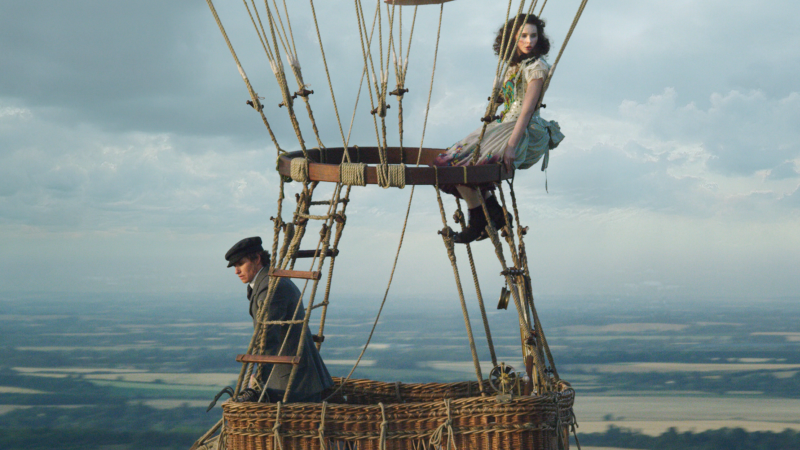
While history remembers Glaisher’s partner was actually balloonist Henry Coxwell (hello, ladies), for these narrative purposes it is defiant aeronaut Amelia Wren (Felicity Jones). She’s haunted by a tragic memory from the past, but won’t let that – or the usual boys club baffoonery – deny her destiny as a “creature of the sky.”

I take no issue with the liberties taken. This isn’t a documentary, Jones is an Oscar nominee who shares a sweet brother/sisterly chemistry with Redmayne, and her character adds a welcome layer of mischief to a backstory that badly needs it.

Most importantly, as the focus quickly settles on two people in a balloon gondola, Amelia brings a sharp contrast to James that just makes the ride more fun and – thanks to the breathless visual gymnastics – sometimes downright terrifying.

Seriously, this film should come with a trigger warning for acrophobics, because Harper (Wild Rose, TV’s Peaky Blinders) and cinematographer George Steel unveil some truly awe-inspiring, anxiety-inducing set pieces begging for IMAX, or 70mm, whatever you can find.

The Aeronauts may give gentle reminders about the importance of science, but it pounds a visual fist in defense of the big screen. The film’s ultimate calling card is not the story but the ride (in real time, no less!), and a smaller canvas just will not do it justice.

Strap in tight, and enjoy the thrill.