Category Archives: New In Theaters

Reviews of what’s out now

Sheep’s Clothing

Wolf

by George Wolf

More metaphorical than Cuckoo’s Nest, more elusive than Girl, Interrupted, and with less satirical bite than The Lobster, Wolf brings a few other films to mind. But like many of her characters, writer/director Nathalie Biancheri is committed to her own different animal.

George MacKay is hypnotic as Jacob, a young man suffering from species dysphoria. He believes he is a wolf trapped in a human’s body, and when we first meet Jacob, his distraught parents are dropping him off for an extended stay at a treatment center promising a cure.

Once inside, Jacob meets others in similar circumstances: Parrot (Lola Petticrew), German Shepard (Fionn O’Shea), Duck (Senan Jennings), Horse (Elsa Fionuir) and Wildcat (Lily-Rose Depp) – all patients under the domineering thumb of The Zookeeper (Paddy Considine).

Though enemies in the wild, Wolf and Wildcat become drawn to each other within the confines of the treatment center. She’s mysterious, with privileges the other patients don’t enjoy, which comes in mighty handy when Wolf starts resisting The Zookeeper’s increasingly harsh methods.

Biancheri’s metaphor for conversion therapy certainly isn’t hard to pick out, but on a wider scale, her film speaks not only to ignorance toward the LBGTQ+ community, but to a universal push for conformity across all lanes of society. To The Zookeeper, a happy and productive life comes only when you accept what is expected of you, and while Biancheri often juggles different tones within this theme, she is able to craft several moments of powerful humanity, including a structured lesson on laughing that will just about break your heart.

MacKay (1917, The True History of the Kelly Gang) is such a wonderful actor, and it’s no surprise that he’s able to uncover Jacob’s inner conflict with a touching, understated depth. But even beyond that, his command of the role’s animal physicality is powerful and striking.

As Wolf and Wildcat grow closer, MacKay and Depp (also impressive in a comparatively underwritten role) often seemed locked in to an acting school exercise on primal instincts that left the rest of the class in the dust.

There’s more than enough here – from the narrative core to the stellar ensemble to the clinical production design and beyond – for a compelling and thought provoking parable. But while Biancheri’s ambitions are bold and worthy, her second feature (after 2019’s Nocturnal) can’t quite settle on a species.

Such commitment to a unique identity is certainly thematically consistent, but a more streamlined focus may have made the finale feel less abrupt, and brought more clarity to Wolf‘s high concept vision.

Sister Act

Benedetta

by Hope Madden

In 17th Century Italy, a nun challenged the church as well as social and sexual norms, rallying a town around her. Was she a charlatan? Was she a saint? Regardless, she seems to be a fascinating image of early feminism. You’ll have to imagine that yourself, though, because her story has been brought to the screen by Paul Verhoeven, which means her story is now soft-core porn.

Who would have thought that the director behind Showgirls would eventually make a hot lesbian nun movie? I mean, besides everyone.

Verhoeven challenged preconceptions about himself as a filmmaker (mine, anyway) in 2012 when he released the most discombobulating rape-revenge thriller, Elle. A masterstroke of a performance by Isabelle Huppert certainly helped.

With Benedetta, Verhoeven takes another shot at ogling the female form inside a context that suggests that ogling is really empowering.

Benedetta (Virginie Efira) was dedicated to the Virgin Mary as a young child by her wealthy father and has been at the convent since she was 10. She’s content, a devoted disciple. As an adult, though, the sexual awakening triggered by new novice Bartolomea (Daphne Patakia) coincides with ecstatic visions of both righteous and demonic leanings.

Is Benedetta crying out for attention and power, or is something supernatural truly afoot?

That right there — the question of the source of these visions, whether the result of a lust for power, true divine intervention, or undiagnosed schizophrenia — might have given Verhoeven’s film a cogent central conflict.

Naturally, his interest is in the sexual awakening.

Which is fine, if uninspired. You might be surprised by how many films you can find that depict shockingly attractive sisters engaging in nun-on-nun action. (I recommend Alucarda.)

At well over two hours, the film feels remarkably self-indulgent. There are the requisite nods toward the corruption of the church, but Verhoeven, who co-wrote an adaptation of Judith Brown’s book with David Birke, earns points for sidestepping the demonizing of the Mother Superior and the other nuns.

Instead, the always luminous Charlotte Rampling portrays Mother Superior as a wise, graceful and respectable businesswoman working within a profoundly misogynistic system. Scenes between Rampling and Lambert Wilson, as the ambitious and crooked head of the regional church, spark with wit and cynicism.

Still, the director cannot pass up the opportunity to fetishize an act of church-sanctioned torture. One step up, two steps back and all that.

If you’re longing for a film about women and the historical, hysterical afflictions they faced because they were women, but you really miss seeing these lessons from a leeringly male perspective, I have a hard time imagining a film that better suits your mood than Benedetta.

Everybody Be Cool, This Is a Robbery

Blonde. Purple

by Christie Robb

The story of a bank heist gone awry, writer/director Marcus Flemmings’ Blonde. Purple owes a great deal to Quentin Tarantino’s Pulp Fiction. Both films share a nonlinear structure, include references to pop culture, have a dark sense of humor, include characters speaking in verbose monologues quoting Great Works of Literature, and have key scenes taking place in a little diner.

In the case of Blonde. Purple, there is more of an identifiable A storyline. Julian Moore-Cook’s bank robber has retreated into a mortgage lender’s office at the bank he was trying to rob after his partner was shot by the cops. In his attempt to flee, he left the cash behind but grabbed a 16-year-old girl as a hostage (Ellie Bindman).

Soon a police crisis manager calls him on the phone to try to negotiate next steps.

How the various elements came together to get both the robber and hostage to this point are covered in the other sequences preceded by intertitles.

Moore-Cook and Bindman are not particularly strong actors. Their banter is ok, but their more emotional moments tend to be somewhat over the top—more appropriate to the stage than the screen.

Adam J. Bernard does strand out as Nath, the partner who was shot. His performance in the flashbacks is more natural and a monologue he gives on the difference between films and movies citing Nicholas Cage projects is charming.

Overall though, the movie is weak with some scenes that seem included simply to give more actors parts to play rather than to contribute to the plot. Also somewhat jarring is the fact that about half of the actors speak with British accents. It gives the film a bit of a Guy Ritchie vibe but adds to a sense of confusion as to the setting.

If the fun of Pulp Fiction was its post-modern remix of pop culture tropes, Blonde. Purple feels like a copy of a copy of a copy, unfocused and messy. It lacks the sense of innovation and the style that made Tarantino’s work so groundbreaking in the 90s.

Hard Candy Christmas

The Advent Calendar

by Hope Madden

Who needs a new Christmas horror story?

I do. Y’all can have your Hallmark romances but give me a little yuletide carnage and I’m filled with holiday cheer.

This Christmas season, writer/director Patrick Ridremont comes through with the Belgian horror The Advent Calendar.

It’s been three years since the accident that put Eva (Eugénie Derouand) in a wheelchair, but it’s still sometimes tough for her to tolerate the ableism and ignorance of those around her. Luckily her bestie Sophie (Honorine Magnier) cheers her with a visit and a gift — an antique wooden advent calendar she picked up in Germany.

There are rules. There is candy. There will be blood. (But there is candy, so how bad can it be?)

The “be careful what you wish for” storyline is as vintage as the ornate and impressive prop, but cursed object horror can be powerful when done well. Ridremont does it well, allowing time for his ensemble to develop their characters. And though the film skirts cliché, Ridremont respects his audience’s ability to keep up. We’re not spoonfed.

Better still, Eva has depth enough as a character that when she finally moves willingly toward doing the wrong thing, you feel her resignation more than her selfishness.

Derouand portrays Eva’s bitterness and longing so clearly that the film never has to bow to montage or flashback. And when the time comes to get spooky, The Advent Calendar delivers.

There’s plenty of blood, but it’s the way it’s meted out that ramps up tensions. We start off with people we’re trained to want to see picked off, but viewer beware: there’s a beautiful mutt in danger here as the cursed object worms its way into Eva’s life.

The FX are not as impressive as the performances, unfortunately, but the creature itself is creepy as hell. Better still, his existence and the origin of the Advent Calendar are left a bit to the imagination. It’s a clever sleight of hand, Ridremont taking advantage of our familiarity with his subgenre when he needs to, while still leaving behind the tangy taste of mystery.

The Impossible Dream

14 Peaks: Nothing is Impossible

by George Wolf

Nirmal “Nims” Purja likes to keep a positive outlook.

“I’m not going to die today. Maybe tomorrow, but not today.”

And while tomorrow isn’t promised to any of us, Nims tends to tempt fate more than most. A mountaineer, adventurer and former member of the Special Forces in Nepal, Nims feels most alive when he’s dreaming big and living life on the edge.

Netflix’s 14 Peaks documents his biggest dream: summiting all 14 of the world’s 8,000 meter + peaks (26, 247 feet and above) in just 7 months. To put that in proper context, the previous record for achieving the feat was 7 years. And Reinhold Messner – one of the greatest legends in all of climbing – took 16 years to ascend all 14.

So the plan that Nims dubbed “Project Possible” was ambitious, to say the least, and Messner himself sets the stakes for us. To Messner, climbing these wonders of the world “is not fun.” It is a practice filled with pain, danger and death.

That said, Nims sure seems to be enjoying himself, and part of that is helping to document his own journey.

If you come to 14 Peaks only for the breathtaking visuals, you will not be disappointed, especially if you can view it on a wide screen. Director/co-writer Torquil Jones takes us above the clouds over and over again, utilizing sparkling, absolutely thrilling footage often taken by Nims himself (including his incredible shot of a 300-person Mt. Everest traffic jam that quickly went viral).

But Jones also mines tension through the attempts at fundraising for the project (where Nims admits “I sound like a lunatic’) and getting the clearance from the Chinese government to climb in Tibet. Intimacy comes from getting to know Nims himself, who turns out to be a fascinating and endearing subject. We see his preparations and the tests that reveal him to be genetically gifted for enduring high altitude/low oxygen environments, as well as Nim’s commitment to to helping fallen comrades on the mountain, and to getting recognition for the oft-nameless Sherpas who are invaluable to visiting climbers.

And, Jones lets us meet Nims’s family, establishing a touching contrast between his apparent lack of fear and the feeling of failure that comes from being away from his ailing mother as he climbs.

14 Peaks will help you discover both a man and a mission. Separately, they’re pretty compelling. Together, they’re a force of nature.

Ground and Pound

Bruised

by Hope Madden

It isn’t exactly Michelle Rosenfarb’s writing you’ll remember after viewing the MMA drama Bruised. The story itself offers a rehash of sports cliches that make the film anything but memorable. Still, there is something about it that sticks.

Part of that is the way director Halle Berry embraces the bleakness beneath the underdog sports story. Berry stars as Jackie Justice, one-time octagon phenom who lost it all and found herself drunk and cleaning toilets post-stardom.

Here’s where Berry — both behind the camera and in front — digs into something we did not get with Rocky Balboa or Maggie Fitzgerald or any of the other earnest, down-on-their-luck prizefighters in cinema. There is no scrappy optimism, no unquenchable ambition, no romantic dream.

And Justice only gets back in the game for the money.

It’s a risky move, giving us a less-than-likable protagonist and still asking for us to root for her, but Berry’s up to the task as a performer. She convinces. Justice is weary, angry, vacant and just one step ahead of all the trauma that made her fighting mad in the first place.

Here, again, is where the writing lets Berry down. Random scenes of exposition are wedged in periodically where none is needed, while other information remains weirdly—though sometimes intriguingly—vague. But certain scenes are brilliant, charged with emotion and brutality, and sometimes tenderness.

Bruised also contains a slew of really strong performances, the most interesting of which is delivered by Sheila Atim as the sage mentor/manager. Adriane Lenox, Adan Canto and Shamier Anderson also shine in supporting turns, as does Danny Boyd Jr., who has the unenviable task of creating a character out of a shameless trope. He manages.

There are workout montages. There are emotional subplots. There is backsliding and heartbreak. It wouldn’t be an underdog sports film without them. But every so often, Berry gives us something raw and surprising. The performance makes you realize her range is wider than we may have expected. The film points out that her talent is greater than expected, too.   

Nuthin’ But a G Thang

House of Gucci

by George Wolf

Just four years ago, director Ridley Scott deconstructed the Getty family’s wealth of dysfunction in the masterful All the Money in the World. House of Gucci shows he’s still got money on his mind, and his mind on the rot that can take root in such mind-altering luxury.

Based on the true events detailed in Sara Gay Forden’s bestseller, the film dissects the complete unraveling of the Gucci family dynasty, a fuse seemingly lit by the unlikely relationship between Muarizio Gucci (Adam Driver) and commoner Patrizia Reggiani (Lady Gaga).

Though the Gucci name gets Patrizia’s attention at their first introduction, Muarizio didn’t seen to have much interest in the empire shared equally by his father Rodolfo (Jeremy Irons) and uncle Aldo (Al Pacino). But once he puts a ring on it, the mix of Patrizia’s ambition and Aldo’s invitations finally bring Maurizio into the family business.

Aldo’s own son Paulo (Jared Leto in some nifty makeup) is the Fredo in this clan, and it isn’t long before Paulo is trying to form his own back door alliance with Rodolfo, and Patrizia is Lady Macbeth-ing it everywhere from Italy to New York (complete with bewitching help from Salma Hayek as psychic Pina Auriemma).

You may have noticed that this is a pretty impressive cast. True, and even with their wheel-of-accents there’s little doubt that watching them all try to out-Italian each other in this trashy mash of The Godfather, I, Tonya, Shakespeare and The Real Housewives of Milan is the film’s biggest pleasure. But Scott and screenwriters Becky Johnston and Roberto Bentivegna can never establish a consistently compelling tone (overly random soundtrack choices don’t help, either), and the two and a half hour run time takes on curious contrasts. Even as the overall narrative has moments that drag, Maurizio’s transformation to the dark side still feels too rushed and convenient.

But Gaga proves worthy of another Oscar nom, and though the film never reaches the level of crackling relevance Scott mined in his look at the Gettys, she proves a fascinating window for the legendary director’s latest foray into an iconic family’s arc of greed, suspicion, betrayal and worse.

And if your Thanksgiving ends up going completely off the rails, House of Gucci is a star-powered and entertaining way to feel a whole lot better about your own family.

Tick, Tick, Boo!

Autumn Road

by Cat McAlpine

Riley Cusick does it all. He is the writer, director, and plays two leads in Halloween-themed horror Autumn Road. The film focuses on twin brothers Charlie and Vincent (Cusick), running a haunted house in their small hometown, and struggling actress Laura (Lorelei Linklater, Boyhood), who returns home for the anniversary of her sister’s disappearance.

Cusick establishes a wonderfully quiet but chaotic tone for his film. As a director, he has a great eye for establishing his shots, wonderfully capturing a small town filled with lonely people. A long shot of a spinning cup of cocoa. A lingering look at a dark parking lot. A masked man sprinting down a sunny highway. Cusick leaves a strong visual mark painted in warm tones.

It’s a good feature film debut done on the indie scale. But there’s room for growth. The script is weak, resulting in unrealistic dialogue that performs poorly paired with a handful of mostly wooden performances. Meanwhile, Cusick’s owl theme is haunting but heavy-handed.

Autumn Road still shines though, mostly when Cusick allows himself to become a little unhinged or when his monologues have time to ramp up into the insane. One such moment is when Vincent holds auditions for the haunted house. The scene is just the right mix of silly, campy, and genuinely disturbing.

Linklater does best with the more realistic dialogue, which allows her to be vulnerable and broken. She glows in a flashback scene with her sister. But she’s often saddled with difficult moments like suddenly mentioning her roommate’s recent death while making it about herself. “I’ve got bad luck in my bones. It follows me around like a dark cloud.” She says, conflating the disappearance of her sister with her roommate’s violent end.

Despite the genre, the violence of Cusick’s film is always shocking. Much of that violence never meets a resolution. In fact, most of the tension in the film remains unresolved, both painting a bleak picture and leaving the watcher unsatisfied. There seem to be no real-world consequences for the actions in Autumn Road.

Ultimately, Cusick’s feature-length debut is a fine effort. But his future endeavors may be best served if he dedicates his focus to a single role.

Every Little Thing She Does

Encanto

by Hope Madden

No one wants to believe themselves ordinary. Not even calm, supportive Mirabel Madrigal (Stephanie Beatriz). But ordinariness happens to be her defining quality because she is the first Madrigal in three generations who has no magical gifts.

Her mother can heal with food. Her sister has super strength. Her cousin can shape shift. But when the day came for Mirabel to receive her magical gift, nothing happened. When the magic of the Madrigal family — magic that has kept the entire town of Encanto in peaceful enchantment for decades — starts to crack, is it all because of Mirabel?

One of many reasons that Disney’s 60th feature Encanto charms is that this unsure adolescent does not find out she’s secretly a princess. She has no makeover. It isn’t romance that helps her see her own specialness. Thank God.

Lin-Manuel Miranda’s music is another reason. Infectious, upbeat and surprisingly insightful, the songs in Encanto speak to individual insecurities in a way that hardly suggests the magical nature of the film. Lyrics illustrate sincere worries about letting people down, living up to expectations and other universal and yet intimate worries.

If you worry the film sounds a bit drab and reasonable, fear not because the vibrant color, lush landscapes, intricate interiors and clever, high-energy animation keep the magic popping. Set in Colombia, Encanto reflects the magical realism favored in the literature of the land and that, too, makes for a unique cartoon experience.

John Leguizamo and Maria Cecilia Botero join Beatriz in a voice cast that brims with pathos, love and energy, just like the family they depict. Much about the complex interactions within the family feels like honest if uncharted territory for a Disney outing — flawed heroes, loving villains, and the notion that selfishness and selflessness as equally problematic.

The flip side of that coin is that the world of Encanto doesn’t feel very big and the stakes don’t feel very high. If that were the only drawback to co-directors Jared Bush, Byron Howard and Charise Castro Smith’s approach it would hardly be worth mentioning. Unfortunately, they undermine the complexity they find in familial love with a too-tidy ending that robs Encanto and its inhabitants of some hard-won lessons.

Leader of the Pack

The Power of the Dog

by George Wolf

Deliver my soul from the sword; my darling from the power of the dog.

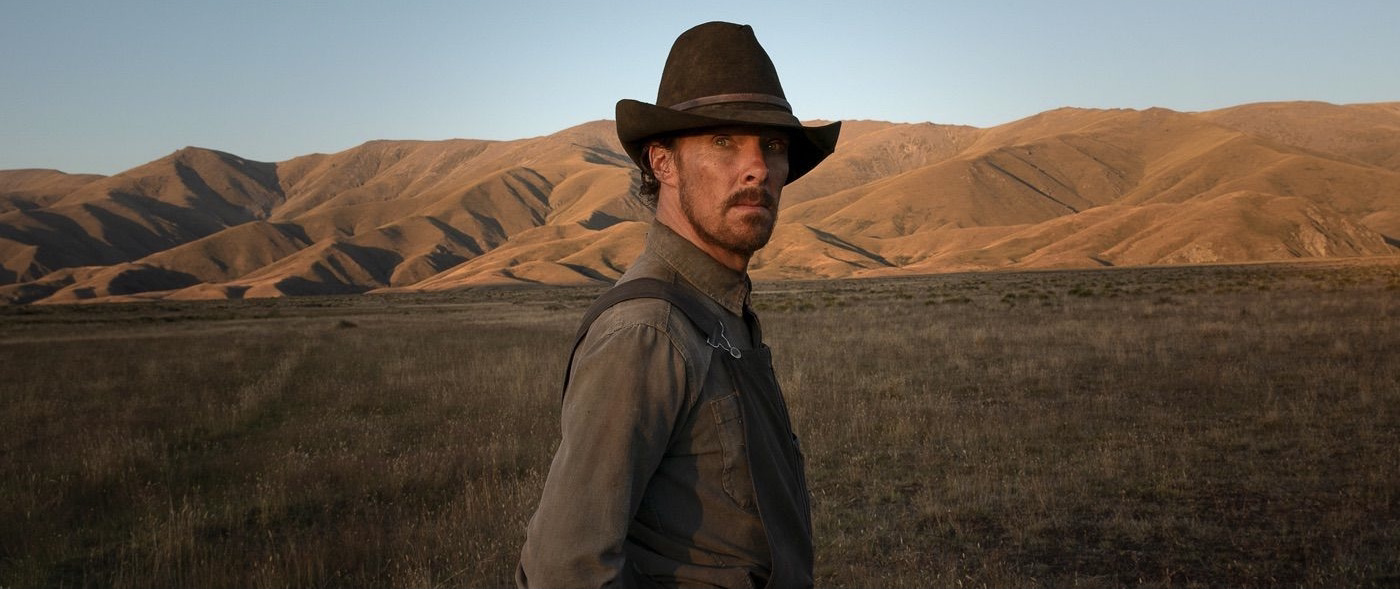
Psalm 22:20 pleads for protection from pack animals that attack the vulnerable. And in the first film in 12 years from writer/director Jane Campion, the leader of the pack is Phil Burbank (Benedict Cumberbatch).

Phil and his brother George (Jesse Plemons) are wealthy ranchers in 1925 Montana. George is soft spoken, well-dressed, polite and empathetic. Phil is none of those things.

So Phil is nothing but resentful when their family dynamic is upended by George bringing home Rose (Kirsten Dunst) and introducing her as his new wife. Though Phil doesn’t hide his suspicions of the new Mrs. Burbank, it is Rose’s son Peter (Kodi Smit-McPhee), that becomes his new favorite target.

Peter is quiet, gentle, and artsy, the perfect foil for Phil to belittle in front of his ranch hands. A master at exposing vulnerabilities, Phil doesn’t hesitate to loudly question Peter’s masculinity and his worth at the ranch – if not in the world.

So it surprises everyone – most notably the resilient, cautious Rose – when Phil seems to reverse course and take the young man under his wing. Peter needs new skills to be accepted into the ranch life, and Phil begins taking extra time to personally mentor him, passing on lessons that Phil himself learned at the feet of local legend Bronco Henry.

Even if you haven’t read the celebrated source novel by Thomas Savage, Campion’s adaptation unfolds with enough subtle poetry to convince you that it must be a wonderful read. Onscreen, the Oscar-winning Campion (The Piano) contrasts the vast majesty of the American West (kudos to cinematographer Ari Wegner) with delicate details that shift the nature of love, trust and strength within a family.

Campion gives Plemons, Dunst and Smit-McPhee the room to craft indelible characters, and they each respond with tenderly restrained excellence. But Cumberbatch is also the leader of this pack, delivering a magnificent, completely immersive performance sure to get awards season attention. Phil is unclean, both physically and spiritually, and Cumberbatch makes him a darkly compelling character, a feeling that directly feeds the unease that comes when Phil reasses his relationship with Peter.

What made Phil such an unforgiving brute? Are his new intentions truly kind, or is Peter in danger? And maybe Peter is seeing Phil more clearly than we realize.

The Power of the Dog finds its own power in what it shows but never truly tells. It’s a film that is hauntingly lyrical and masterfully assembled, with a beauty that lingers like an echo in the Montana wilderness.