Tag Archives: Thandiwe Newton

Snake Charmer

Anaconda

by Hope Madden

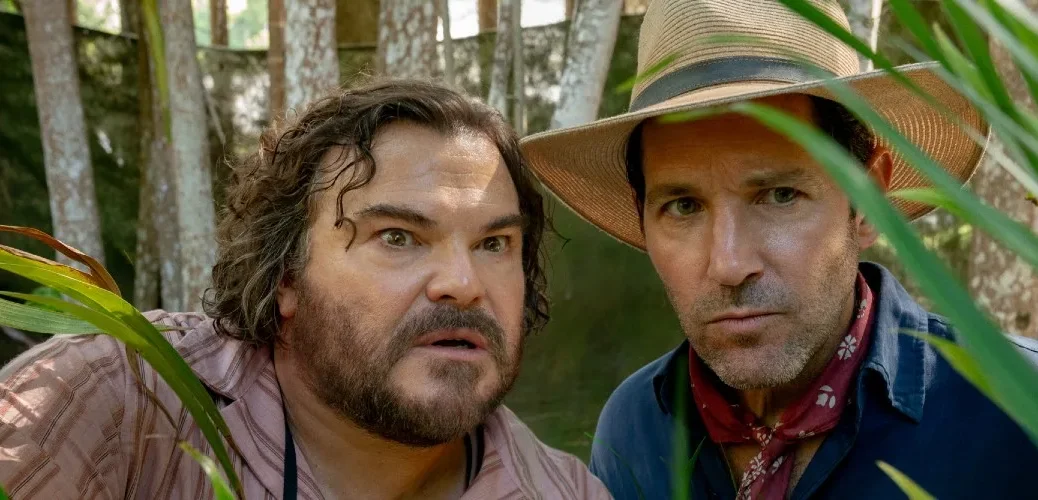
Upon first seeing the trailer for Anaconda, the Jack Black/Paul Rudd spiritual sequel to the 1997 JLo vehicle, my husband George said, “This will either be incredibly funny or unwatchable.”

I banked on the first. How could this lose?! Not only because of the upbeat comedy gold of Black and Rudd, but forever favorite Steve Zahn, plus Thandiwe Newton classing up the joint. With Tom Gormican, the madman behind The Unbearable Weight of Massive Talent, co-writing and directing, it seemed like Anaconda couldn’t go wrong.

Anyway, I wouldn’t call it unwatchable.

Black, Rudd, Zahn and Newton were high school besties, brought together again by a dream: to make a reboot/sequel/reimagining of the giant snake movie they’d watched dozens of times when they were young and idealistic.

It’s a funny premise!

One script, a lead on a snake handler, and 42 grand later, the friends head to Brazil to shoot this thing and salvage something of what they’d hoped to be when they grew up.

There are some funny bits. Selton Mello is joyously weird as Santiago, the snake handler. Cameos, descriptions, and bits of dialog from the original Anaconda inject a bit of mischievous fun. I will be using the term “Buffalo sober” in my future.

But as inarguably charming as this cast is, it can’t elevate the many stretches of film without a joke. Though lots of scenes are humorous, very few are laugh-out-loud funny. Both Rudd and Black fall back on schtick and timing to make up for the spare comedy of the script, and Newton is given nothing at all to do for 99 minutes.

Every scene goes on a beat or two too long, it takes the film forever to get to the jungle, and too little happens once we’re there. The fact that the film owes almost as much to a classic Black comedy Tropic Thunder as the original Anaconda only leaves you longing for something funnier to happen.

It’s watchable. It’s even mildly entertaining. But it felt like it could have been more.

Divided We Fall

God’s Country

by George Wolf

It’s only September, but I’m taking out my Oscar scorecard, and writing in Thandiwe Newton. With a pen.

Because if she doesn’t get noticed for her astounding performance in God’s Country, there’s somerthing wrong with all of us.

The film is also an incredibly assured sophomore effort from director and co-writer Julian Higgins, expanding on the themes and insight hinted at nearly twenty years ago in his feature debut Mending Wall.

Newton stars as Cassandra Guidry, a professor at a small college near the mountain wilderness. The grief from her mother’s recent death is deep, but she’s committed to teaching her students the importance of persistence in the strive for change.

“Sandra” hopes that leaving a note on the truck windshield will change the behavior of two hunters (Joris Jarsky, Jefferson White), who trespass on her property. It does not, and a battle of wills slowly escalates into a powder keg that Higgins uses to comment on the divides in this country that often seem impossible to navigate.

While Sandra struggles with the reaction from the local sheriff (Jeremy Bobb), we learn more about her past, and about things that make her keenly aware of where this situation could he headed. And as Higgins advances the narrative with onscreen text marking off the days, Sandra’s belief that “we all gotta play by the same rules if this is gonna work” can also apply to her push for diversity in the university’s search for a new Dean.

Higgins’s camerawork is barren and cold, buoyed by starkly beautiful cinematography from Andrew Wheeler. His script treads with care and precision. Nothing feels like a cliche, even though God’s Country lives in areas where cliches often roam freely. These characters and their flaws feel familiar, but Higgins finds intimate ways to offer hope for redemption, if only for the briefest of exchanges.

And why won’t Sandra let the parking thing go? Newton makes it achingly personal, carrying the weariness of swimming against the current in her every steely glare. Her final scene, though nearly dialog-free, is exquisitely devastating and sure to follow you home.

Just how many “no big deals” are allowed before there is indeed a big deal? And who decides?

God’s Country is full of the persistent ugliness that plagues ours. Yet none of its issues are raised with a heavy hand. Measured and often visual storytelling is at work here, carried on the shoulders of a sensational lead performance.

Whack a Mole

All the Old Knives

by George Wolf

Blending a modern worldview with a slow-burn vibe, All the Old Knives reveals itself as a well-constructed thriller that often recalls those classic espionage yarns from the 70s.

The underrated Chris Pine gives another standout performance as Henry Pelham, a CIA vet who’s directed by his boss (Laurence Fishburne) to reopen a painful case from the past.

Back in 2012, they both were stationed in Vienna when counter-terrorism efforts to thwart a hijacking went tragically wrong. But new information has emerged that suggests the terrorists had help from a fellow agent, so Henry must revisit members of the team – including his old flame Celia (Thandiwe Newton) – to root out the mole.

Based on the best seller by Olen Steinhauer (who also pens the script), the film is admittedly heavy on dialog, but director Janus Metz (Borg vs. McEnroe, True Directive, Armadillo) proves masterfully adept at fleshing out important contrasts in past and present.

His camera remains purposefully static for the modern settings, while a more free-flowing approach to the flashbacks helps to offset all the descriptive recollections by pulling us into crisply detailed reenactments.

The ensemble (which also includes the great Jonathan Pryce) is top notch. Each actor digs in to the intelligent wordplay, picturesque locales and shadows of doubt on the way to crafting complex humans with something to lose.

The third act may bog down just a touch, with a hand that’s tipped perhaps a beat or two early, but none of that keeps the film from sticking its landing. There’s plenty of blame to go around in the often nasty business of global politics, and All the Old Knives makes that history lesson personal.

