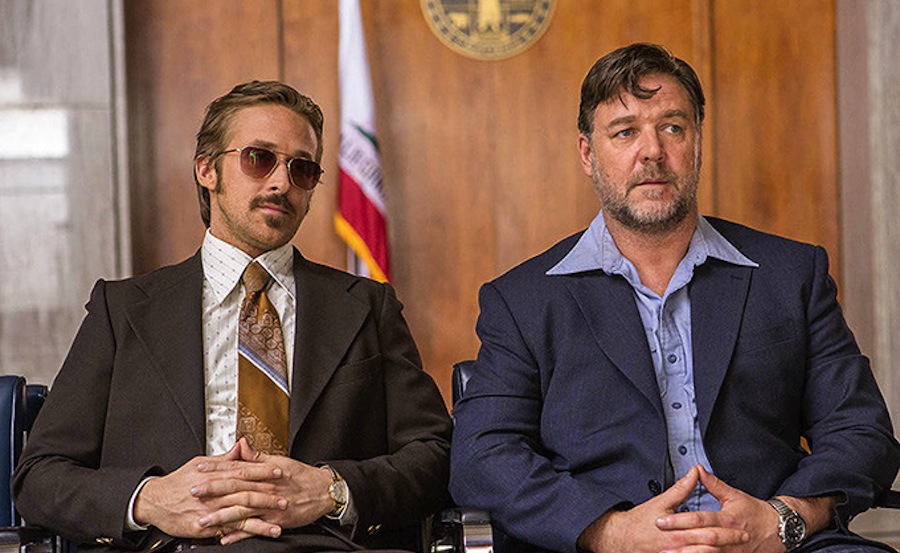
Tell me you’ve seen any of the countless trailers for Shane Black’s new action comedy The Nice Guys. Funny! I haven’t had such high expectations for a new film yet this year.
Ever since Black announced his presence with authority, penning ‘87’s iconic buddy cop action flick Lethal Weapon, he’s been one to watch. Kiss Kiss Bang Bang, his directorial debut, suggested he might even be keeping his best stuff for himself. But after a while, his tics and tendencies grow tiresome.
The Long Kiss Goodnight, anyone?
And though his newest effort absolutely revisits most of the filmmaker’s by-now obvious predilections, his craftsmanship and casting have never been better.
Hey girl, guess what – Ryan Gosling is a hoot! No, no, I didn’t say he’s hot (as that goes without saying). He’s a hoot. And if you found his scene-stealing performance in last year’s gem The Big Short a refreshing and joyous change of pace for the award-bedecked actor, you will surely enjoy this masterpiece of comic timing and physicality.
Gosling plays Holland March, an alcoholic PI with questionable parenting skills who reluctantly teams up with muscle-for-hire Jackson Healy (Russell Crowe). What begins as a low-rent missing persons case snowballs into an enormous conspiracy involving porn, the government, and the all-powerful auto industry. (It is 1977, after all.)
Aah, 1977 – when everybody smoked, ogled women, and found alcoholism a laugh riot. Black puts this time machine quality to excellent use in a film that would have felt stale and rote during his Eighties heyday, but today it serves as an endlessly entertaining riff on all that was so wrong and so right about the Seventies.
A brightly lit (if smog-choked) Southern California noir-turned-buddy-action comedy, The Nice Guys does a surprisingly good job at finding its tone. All the lurid, twisty plot fodder could easily weigh the film down in gritty drama, but Shane’s heart is in the budding, unsanitized bromance.
Gosling’s impeccable hilarity is custom-made for Black’s machine gun fire dialog, but Crowe also manages to get comfortable in the script, allowing both the conversation and action to breathe and take shape. The pair’s chemistry is a joy to watch, and is aided immeasurably by Angourie Rice’s flinty, intelligent turn as March’s disappointed daughter, Holly.
Who’s looking for a psychosexual acid trip? Well, it’s your lucky day because Belladonna of Sadness – Eiichi Yamamoto’s 1973 animated cult flick – gets new theatrical life thanks to a 4K restoration.
Based on Satanism and Witchcraft – a 19th Century text by Jules Michelet about seduction, witchcraft, and female empowerment – the film tells the story of a newly married couple and their troubles in feudal Europe.
Jean and Jeanne attempt to sidestep the law of the land allowing a baron to deflower a bride, but their pleas fall on sadistic ears. Yamamoto’s vivid depiction of the gang rape that follows is not only a sudden visual eruption in the dreamy watercolor style that precedes the scene, but a hint at the unsettling imagery that will punctuate the entire balance of the film.
The story pits feminine power against the systemic misogyny of the time as an allegory of modern feminism – well, modern in 1973. Jeanne slowly comes to the realization that embracing Satan to break from the repressive nature of bureaucratized Christianity may be her only road to personal power.
On one hand, this particular theme of revolution is older than Michelet’s work and as contemporary as Robert Eggers’s modern genre masterpiece The Witch. And yet, it’s a startling revelation, subversive in many ways, most of which are depicted in this film with wild abandon. As genitalia morphs into lion mouths and giraffe heads during extended, orgiastic sequences, Yamamoto equates sexual liberation with personal empowerment.
And yet, this is a Nineteenth Century text penned by a man, which has been reimagined and rendered – animated, written, directed, and scored – by men. It may be less than surprising to find that Satan (the empowerer) is depicted as a small but growing anthropomorphic penis.
Though Belladonna of Sadness finds tragedy in the repression and objectification of women, the film seems at a loss as to how to express its themes without objectifying Jeanne.
The film certainly can’t be dismissed entirely because of its somewhat conflicted sense of female empowerment, though. Yamamoto’s hypnotic yet jarring visual style, rupturing panoramic still drawings with bursts of movement and color, looks like nothing else onscreen. The aesthetic meshes with Masahiko Sato’s psychedelic score to create the trippiest film to open on national screens since the Age of Aquarius.
It’s a fascinating, disturbing, imaginative piece of animation that looks and feels like nothing else.
There have been a number of movies based on video games. From 1993’s Super Mario Brothers to the upcoming Tomb Raider movie, Hollywood has not shied away from mining video games as source material for film.
One of the latest in the video game to movie genre is The Angry Birds Movie, a film that seeks to explain why those birds who love to launch themselves at green pigs with enormous slingshots are so angry.
The focal character of the movie is Red, voiced by Jason Sudekis, an already angry bird living in a community of happy birds. Red’s anger gets him in trouble and he finds himself placed in anger management where he meets Bomb, Chuck, and Terence.
The arrival of a large number of green pigs to the birds’ island sets off warning bells for Red, but the other birds are happy to welcome the newcomers and chastise Red for his quickness to antagonism.
The major problem with Angry Birds is the lack of story. At 97 minutes, the movie has a lot of time to fill, and in the first half, the audience has to sit through quite a few montage sequences that are boring even for the youngest viewer. It isn’t until the second half of the movie, when the pigs reveal their true motives for landing on the birds’ island, that the movie starts to pick up. Where the first 45 minutes of the movie drag, the second 45 minutes make up for it with the action we know and love from the video game. The plot comes together, and children and their parents can both find something to enjoy.
The voice actors are myriad and lend their talents well to the film. Danny McBride as Bomb, and Peter Dinklage as Mighty Eagle, both stand out in their roles, providing much needed humor throughout. Jason Sudekis manages to carry a lot on his shoulders as the leading angry bird, but far too often the jokes he’s given to work with fall flat.
It’s unfortunate that the film isn’t 20 minutes shorter, as it might have been more appealing to both young and old had the screenwriters recognized the limitations of their source material.
Back in 2005, Aussie filmmaker Greg McLean set the genre world ablaze with his merciless Outback horror Wolf Creek. An amazingly disturbing and well-crafted film, it seemed to mark a strong new presence in horror.
Nearly a dozen years later, McLean hasn’t been able to reproduce that success, although he tries once again with this PG-13 terror starring Kevin Bacon.
Bacon is Peter Taylor, and while Pete and his family were vacationing in the Grand Canyon, his autistic son picked up a handful of ancient Anasi demons and brought them home.
Back at the ranch, family members turn on each other while the dog next door barks incessantly, and a once promising director falls back on tired clichés and unconvincing FX. All this in an attempt to lead us to the conclusion that something supernatural is afoot.
Once the drama in the house sets in, The Darkness becomes a wearisome riff on Poltergeist.
Since it is now mandatory in all “is it evil or am I crazy” storylines, you can expect close-ups of computer screens as the concerned and beleaguered google ridiculous phrases and uncover incredible evidence. The mom (McLean favorite Radha Mitchell) googles “strange smells” and finds a link between autism and the spirit realm. I swear to God.
This is the filmmaker who once taught us that we do not want to play “head on a stick,” and he is now contenting himself with diluted, formulaic, toothless scares? WTF?
That’s not to say that you can’t make a good horror movie without an R-rating. The Ring was the scariest movie of 2002, PG-13 tag and all. Hell, the MPAA gave Jaws a PG and that film scared every person who saw it.
It can be done, and ten years ago I would have believed a talent like McLean would be the next filmmaker to succeed.
If you think a movie about math can’t be thrilling, well, The Man Who Knew Infinity won’t prove you wrong.
Writer/director Matt Brown’s painfully earnest biopic of Indian mathematical genius Srinivasa Ramanujan (Dev Patel) seeks to tackle divine inspiration, institutional racism, culture clash, colonialism, and mathematical proof against the backdrop of WWI Britain. Unfortunately, the film feels far more hemmed in by cinematic tradition than inspired by historical events.
Brown’s approach is certainly by-the-numbers, and a stifling respect for the subject hamstrings the effort. Ramanujan is never more than an utterly wholesome, godlike presence. A lead turn by Patel does nothing to burst through the clichés. As has been the case in each of his films, Patel’s performance is broadly drawn and lacking depth.
He isn’t given much to work with, truth be told. Brown’s screenplay offers little more than saintly suffering. Look how nobly he endures taunts, cultural misunderstandings, loneliness, illness!
The scenes at home in India are even more appallingly respectful, everything quaintly simple and yet admirable. It’s as if Brown distrusts the audience with any complexity or information on Ramanujan they might deem offensive. (Like, for instance, that his wife was a 10-year-old when they married.)
As Ramanujan’s Cambridge mentor G.H. Hardy, Jeremy Irons, of course, shines. A veteran of the melancholy Englishman role, Irons inhabits this academic with emotional rigor mortis, occasionally lapsing into the most charming flashes of vulnerability and ardor. The subtlety and sly tenderness of his performance suggests a longing that nearly revives the film from its terminal anemia.
A handful of supporting turns – Toby Jones, Jeremy Northam – almost add layers, but Brown’s screenplay relies so heavily on the rote of Traditional British Cinema that the film never gets the chance to breathe.
I’m willing to bet that Srinivasa Ramanujan was a flawed and fascinating person – geniuses so often are. Too bad Brown is content to see him as a romantic mystery.
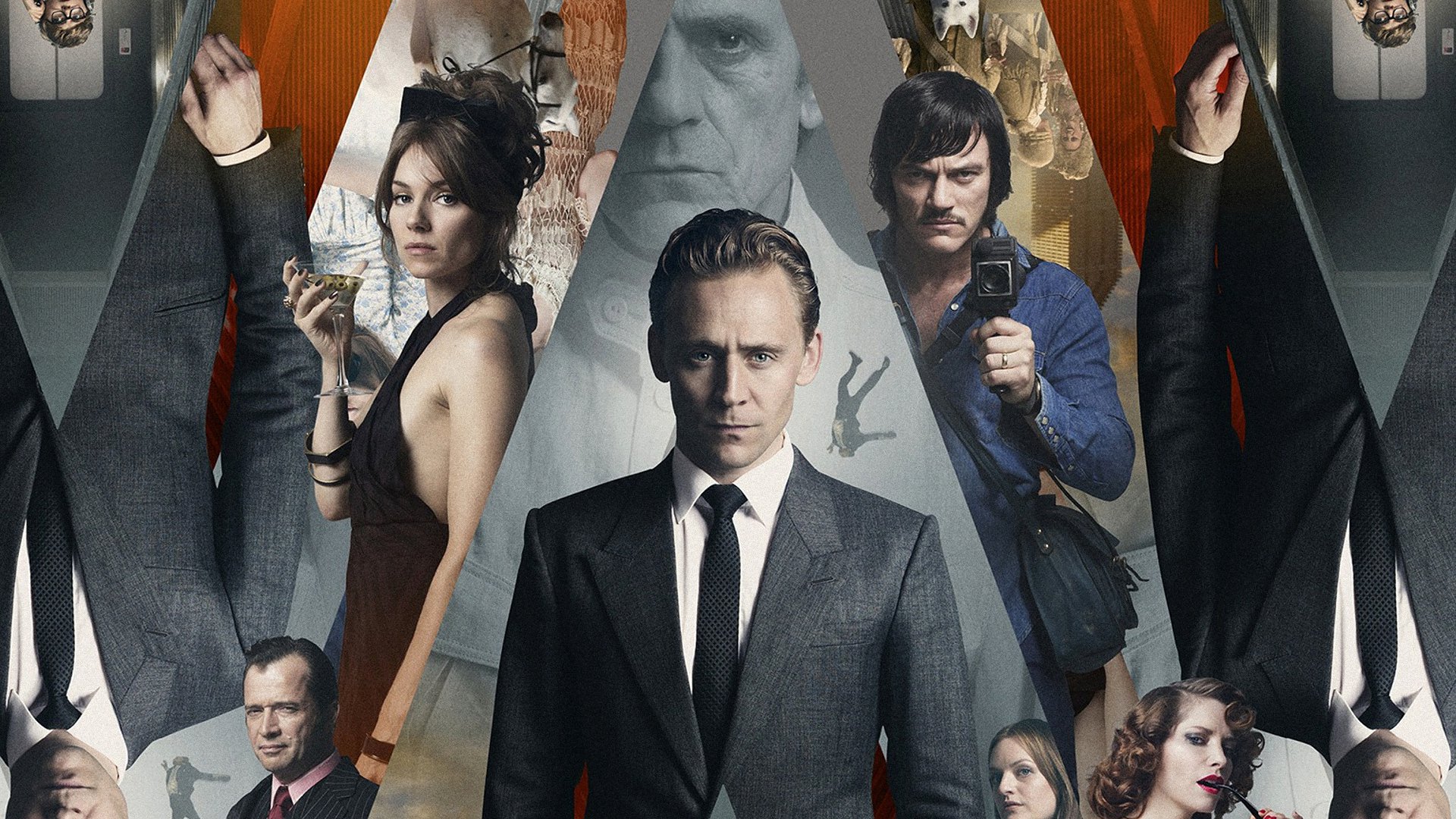
Set inside a skyscraper in a gloriously retro London, Ben Wheatley’s adaptation of J.G. Ballard’s High-Rise is a dystopia full of misanthropic humor.
Laing (Tom Hiddleston) narrates his own story of life inside the “grand social experiment” – a high rise where the higher the floor, the higher the tenant’s social status. Laing lives keenly alone, somewhere in the middle floors. Socialite Charlotte (a fantastic Sienna Miller) lives one floor above; put upon wife and philandering husband Helen and Wilder (Elizabeth Moss and Luke Evans, respectively) live near the bottom. And at the tippy top, The Architect (Jeremy Irons, magnificent as always).
The film treads some of the same ground as Fritz Lang’s Metropolis, only Ballard’s feelings were less respectful of the lowly. The author’s interest was always in peeling that last layer that separates civility from savagery in every member of every class. No one is blameless, no one is incorruptible. It can make his material difficult because no character is entirely sympathetic, which is certainly the case in High-Rise.
Our protagonist holds himself at a distance from all tenants, seeing himself as that singular soul that can fit almost anonymously within every strata, when, in fact, he fits nowhere. And as chaos descends and carnality and carnage, it’s very hard to decide whether anyone is worth rooting for.
The film brings to mind David Cronenberg’s gem, Shivers. The Canadian auteur’s first film saw a high end high rise taken down from within by a parasite that turned its victims into voracious pleasure seekers. Always the Ballard enthusiast (Cronenberg adapted the author’s Crash into a chilly NC-17 adaptation in 1996), the filmmaker’s 1975 flick eerily predicted the British cult novelist’s plot of the same year.
High-Rise’s performances range from slyly understated (Hiddleston, Moss) to powerful (Miller, Evans) to alarmingly hammy (James Purefoy), but each contributes entertainingly to this particular brand of dystopia.
Ballard’s prose is tough to bring to life on the big screen. While Cronenberg’s 1996 adaptation breathed the author’s chilly, disgusted detachment, Wheatley’s version mines Ballard’s humor in a film that is wildly alive but terrifically flawed.
The class war has not waned since Ballard set its microcosm inside his London skyscraper. Its flame burns as bright and toxic today as it ever has, but somehow Wheatley’s film lacks that heat. It’s a fascinating mess without the punch of relevance.
Still, the wicked humor and wild chaos will certainly keep your attention.
Who’s up for a little B&E? We are, that’s who! That particular fear of violation – that someone can harm you inside your own home – is universal enough that it hits a nerve with nearly everybody. And there are a lot of options, many of them really great, which means we had to leave a bunch behind. Sorry about that, but just to be fair, it’s a fuzzy math countdown. So, let’s hit it! Today we stroll through some of the most unsettling and affecting home invasion horror.
Don’t let the title fool you. While there is, indeed, a kidnapping in Miguel Angel Vivas’s Spanish film, the real horror is happening back at home.
It’s moving day, and a family is still unpacking boxes in their new home when three masked men break in. There are certainly familiar threads that run through the films on this list, but Kidnapped is terrifying because it is wholly believable.
The family feels real. The perpetrators seem real. No sadistic toying in Halloween masks, their goal is specific, and yet, these are not good men.
Viva allows tensions to build until they occasionally burst in fits of violence. And while the workaday motives of these villains may make other entries in the genre seem more colorful, there is something uncomfortable, even terrifying, in seeing a situation so believably articulated.
https://www.youtube.com/watch?v=CNn-OKqR87Q
4. The Strangers (2008)
Writer/director Bryan Bertino creates an awful lot of terror in a gem of a horror flick that made an impression on horror fans. You can see that in the number of movies that stole the unsettling image of adults in children’s masks.
Bertino beautifully crafts his first act to ratchet up suspense, with lovely wide shots that allow so much to happen quietly in a frame. This is a home invasion film with an almost unbearable slow burn. Bertino creates an impenetrably terrifying atmosphere of not just helplessness, but sadistic game playing. The film recalls Michael Haneke’s brilliant Funny Games, as well as the French import Them, but Bertino roots the terror for his excruciating cat and mouse thriller firmly in American soil, with scratchy country blues on the turntable, freshly pressed Mormon youth on bicycles, and rusty Ford pick-ups hauling folks in kids’ Halloween masks.
His image is grisly and unforgiving – part and parcel with the horror output of the early 2000s – but The Strangers is a cut above other films of its decade.
3. Ills/Them (2006)
For another look at what can happen when you’re trapped inside a house, there’s Ills/Them. Brisk, effective and terrifying, Them is among the most impressive horror flicks to rely on the savagery of adolescent boredom as its central conceit.
Writers/directors/Frenchmen David Moreau and Xavier Palud offer a lean, unapologetic, tightly conceived thriller that never lets up.
A French film set in Romania, Them follows Lucas and Clementine, a young couple still moving into the big rattling old house where they’ll stay while they’re working abroad. It will be a shorter trip than they’d originally planned.
What the film offers in 77 minutes is relentless suspense. I’m not sure what else you want.
Creepy noises, hooded figures, sadistic children and the chaos that entails – Them sets up a fresh and mean cat and mouse game that pulls you in immediately and leaves you unsettled.
2. Straw Dogs (1971)
Sam Peckinpah had a complicated relationship with his notion of manhood, and his notion of womanhood was even harder to define (some would say stomach). He explored these issues in many films, perhaps never more graphically than in 1971’s Straw Dogs.
A sincere product of its time, Peckinpah’s film swam the dangerous waters of the era’s culture clashes. Love it or hate it, you remember it.
Dustin Hoffman’s schlubby American mathematician David returns to his hot young wife’s (Susan George) hometown in rural England to encounter not-so-subtle attacks on his masculinity from the more traditionally manly townies, who remember his wife Amy as a hometown trophy they seem determined to reclaim.
Peckinpah’s film generates dread like few others. As is his way, he crafts heroes that are more flawed than heroic. Hoffman’s character is as cowardly as the townies suggest, and their taunting does not bring out his better side.
Essentially a Western, Straw Dogs leads to a phenomenally violent home invasion sequence that highlights the rotty human underbelly Peckinpah finds so appealing. Survival, but at what cost?
1. Funny Games (1997, 2007)
Michael Haneke is a genius, an amazing creator of tension. Everything he’s done deserves repeated viewing. With Funny Games, he makes it easy because he made it twice.
A family pulls into their vacation lake home to be quickly bothered by two young men in white gloves. Things deteriorate.
Haneke begins this nerve wracking exercise by treading tensions created through etiquette, toying with subtle social mores and yet building dread so deftly, so authentically, that you begin to clench your teeth long before the first act of true violence.
Haneke is hardly the first filmmaker to use adolescent boredom as a source of frightening possibility. Kubrick mined Anthony Burgess’s similar theme to icy perfection in A Clockwork Orange, perhaps the definitive work on the topic, but Haneke’s material refuses to follow conventions.
His teen thugs’ calm, bemused sadism leaves you both indignant and terrified as they put the family through a series of horrifying games. And several times, they (and Haneke) remind us that we are participating in this ugliness, too. That we’ve tuned in to see the family tormented. Sure, we root for them, but we came into this with the specific intention of seeing harm come to them. So, the villains rather insist that we play, too.
The concept of the fairy tale has been sterilized over the centuries, evolving mainly into capitalistic cautionary tales with overt morals meant to guide our youth toward a socially accepted line of thinking. But that’s not what they were always about. Fairy tales began as oral entertainment benefitting adults, their lurid magic often aimed at critiquing the powerful and finding absurd amusement in the helplessness of the majority.
Director Matteo Garrone returns to these early principles with his moody, atmospheric film based on the work of 16th Century Neapolitan poet Giambattista Basil. The yarns he spins are about narcissistic royals, unwise subjects, dark magic, and human brutality.
His braid of stories possesses a particularly dark and dreamy nature: Salma Hayak wants to have a baby; Vincent Cassel wants to bed a mysterious woman; Toby Jones wants to spend some alone-time with a giant flea.
OK!
Cinematographer Peter Suschitzky, David Cronenberg’s regular collaborator, brings that elegant chill to certain frames, rarely but effectively punctuated with scenes boasting an especially flamboyant and lush look. The imagery meshes with another brilliant Alexandre Desplat score, aurally and visually supporting Garrone’s absurdist rethinking of the classic fairy tale structure.
Garrone’s cast is uniformly solid. Hayek embraces the haughty nature of her queen, but she allows just enough sympathy to creep into the characterization to create the necessary heartache as her story climaxes. John C. Reilly’s touching tenderness in a small role as a supportive spouse and king is especially wonderful.
Christian and Jonah Lees beguile as magical siblings, Franco Pistoni cuts a wondrously dark image as the film’s necromancer, and Cassel is characteristically excellent.
The real surprises in the film lie in Jones’s tale, though, which begins as something especially weird, then unravels into the darkest and most savage of the stories.
Certain moments lumber along, making the film feel longer than it is. Tale of Tales also comes up mildly lacking when compared to Garrone’s blisteringly brilliant Gomorrah. But the filmmaker deserves credit for bringing a delightful bit of madness, in character and filmmaking, back to the fairy tale.
Cap (Chris Evans) and his besties battle their own in a fight to save the Avengers. In-fighting is rarely this entertaining.
Who would have guessed that the best stand-alone Avengers series would be Captain America’s? He lacks the edge of Iron Man or the SciFi sex appeal of Thor. Still – whether it’s because the series remains true to the nature of the character, or because Christopher Marcus and Stephen McFeely know how to pen a compelling superhero flick – Steve Rogers shoulders the most reliable Avengers franchise.
Civil War even manages to succeed where most superhero sequels fail by squeezing in a fully ridiculous number of characters without over-burdening the narrative. Minimizing the number and presence of villains helps, because, while there is a baddie in Civil War, the majority of combat comes courtesy of Hero V Hero.
The film begs comparison to the much maligned DC superhero standoff Batman V Superman for obvious reasons. Our heroes are mad at each other; collateral damage and the need for oversight are to blame; mommy issues run deep. Certainly, Civil War handles the material better, but part of that is because of the film’s affection for established characters.
McFeely and Marcus’s humorous screenplay allows the natural chemistry among the players to shine brighter than their individual star power.
Directors Anthony and Joe Russo – following up their success with theWinter Soldier – lens many of the action sequences with great movement and punch, but the climactic battle between the biggies should feel bigger. The camera captures individual pairings to make the most of character expression, one-liners, and fun, but the brothers behind the camera never step back far enough to give us a look at at the larger-than-life battle taking place.
Are there other flaws? Sure. I mean, you and I know that it’s pointless to disbelieve or distrust Captain America. Of course he’s right – he’s the conscience of the Marvel universe. So why doesn’t Tony Stark (Robert Downey, Jr.) know it? Also, Scarlet Witch (Elizabeth Olsen) and Vision (Paul Bettany) never find a groove as characters, but the new Black Panther (Chadwick Boseman) and a wildly enjoyable Spider-Man (Tom Holland) more than make up for that. Plus, Ant Man (Paul Rudd) is a hoot, regardless of the fact that he clearly has no idea why he’s fighting against other good guys.
Civil War stands out as certainly the biggest of the stand alones, and among the best because of what it has in common with the better films in the Marvel universe: the conflict is deeply human, told humorously, and best enjoyed if you don’t overthink it.
Don’t you love Jason Bateman? And if not, why not?
His enviable comic timing guarantees his own success in any film, no matter how weak or how strong the material, but films like The Gift and State of Play clarify his underappreciated ability with dramatic roles.
Bateman’s directorial debut in 2013, Bad Words, showcased his capability at the helm, as well – muscles he flexes once more in his darkly comic take on novelist Kevin Wilson’s tale of eccentric, artistic familial dysfunction, The Family Fang.
Bateman plays Baxter Fang. Baxter and his sister Annie (Nicole Kidman) – or Child A and Child B, as their folks call them – were raised by a duo of performance artists. The present-day Mr. and Mrs. Fang are gamely played by Christopher Walken and Maryann Plunkett, with Kathryn Hahn and Jason Butler Harner filling in for flashbacks.
The adult siblings are struggling artists all their own – she a semi-working actor, he an author two years behind schedule on his third novel. It would appear that being the object and subject of their parents’ art throughout childhood has had an adverse effect on the pair as adults.
If you’re worried that you cannot sit through another indie film about the sins of the parents visited on their self-indulgent and/or damaged offspring, fear not.
Adapting Wilson’s text for the screen, David Lindsay-Abaire prunes and pares to offer a wise but tender rendering of the family pathos. But credit Bateman for ably maneuvering tonal shifts with a beautifully understated approach that keeps the film from ever veering into quirkiness or maudlin bitterness.
His cast (himself included) certainly never let him down. Both Plunkett and Hahn offer heartbreaking nuance as they animate the conflicted loyalty of mother/wife/artist Camille Fang. They join a full slate of admirable supporting performances.
Meanwhile Kidman and Bateman create a sweetly believable set of siblings, giving the relationship a lived in and hard won familiarity that feels both refreshing and familiar.
Big surprise, Christopher Walken is the shiniest gem in this treasure chest. At turns jocular and hostile, his narcissistic artist/father is delivered with both authenticity and panache.
A murder mystery of sorts, The Family Fang surprises and engrosses without ever feeling like the sleight of hand that made the Fangs famous.
Occasionally heartbreaking, often curious, cleverly structured and thoughtfully executed, this impressive sophomore directorial effort from Bateman keeps you guessing – at how things will work out for the Fangs, and at what may be next for this impressive filmmaker.