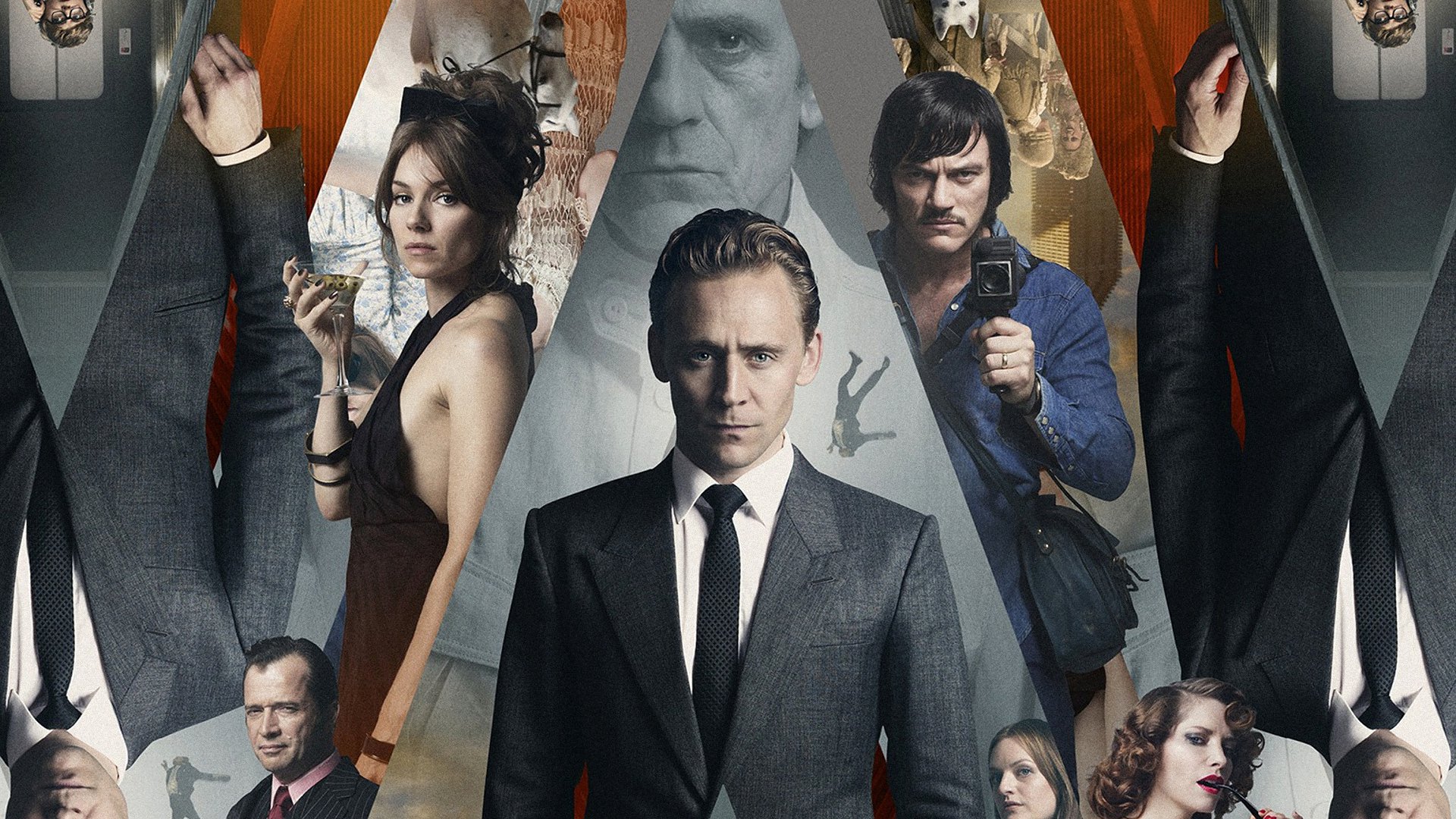
Set inside a skyscraper in a gloriously retro London, Ben Wheatley’s adaptation of J.G. Ballard’s High-Rise is a dystopia full of misanthropic humor.
Laing (Tom Hiddleston) narrates his own story of life inside the “grand social experiment” – a high rise where the higher the floor, the higher the tenant’s social status. Laing lives keenly alone, somewhere in the middle floors. Socialite Charlotte (a fantastic Sienna Miller) lives one floor above; put upon wife and philandering husband Helen and Wilder (Elizabeth Moss and Luke Evans, respectively) live near the bottom. And at the tippy top, The Architect (Jeremy Irons, magnificent as always).
The film treads some of the same ground as Fritz Lang’s Metropolis, only Ballard’s feelings were less respectful of the lowly. The author’s interest was always in peeling that last layer that separates civility from savagery in every member of every class. No one is blameless, no one is incorruptible. It can make his material difficult because no character is entirely sympathetic, which is certainly the case in High-Rise.
Our protagonist holds himself at a distance from all tenants, seeing himself as that singular soul that can fit almost anonymously within every strata, when, in fact, he fits nowhere. And as chaos descends and carnality and carnage, it’s very hard to decide whether anyone is worth rooting for.
The film brings to mind David Cronenberg’s gem, Shivers. The Canadian auteur’s first film saw a high end high rise taken down from within by a parasite that turned its victims into voracious pleasure seekers. Always the Ballard enthusiast (Cronenberg adapted the author’s Crash into a chilly NC-17 adaptation in 1996), the filmmaker’s 1975 flick eerily predicted the British cult novelist’s plot of the same year.
High-Rise’s performances range from slyly understated (Hiddleston, Moss) to powerful (Miller, Evans) to alarmingly hammy (James Purefoy), but each contributes entertainingly to this particular brand of dystopia.
Ballard’s prose is tough to bring to life on the big screen. While Cronenberg’s 1996 adaptation breathed the author’s chilly, disgusted detachment, Wheatley’s version mines Ballard’s humor in a film that is wildly alive but terrifically flawed.
The class war has not waned since Ballard set its microcosm inside his London skyscraper. Its flame burns as bright and toxic today as it ever has, but somehow Wheatley’s film lacks that heat. It’s a fascinating mess without the punch of relevance.
Still, the wicked humor and wild chaos will certainly keep your attention.
Who’s up for a little B&E? We are, that’s who! That particular fear of violation – that someone can harm you inside your own home – is universal enough that it hits a nerve with nearly everybody. And there are a lot of options, many of them really great, which means we had to leave a bunch behind. Sorry about that, but just to be fair, it’s a fuzzy math countdown. So, let’s hit it! Today we stroll through some of the most unsettling and affecting home invasion horror.
Don’t let the title fool you. While there is, indeed, a kidnapping in Miguel Angel Vivas’s Spanish film, the real horror is happening back at home.
It’s moving day, and a family is still unpacking boxes in their new home when three masked men break in. There are certainly familiar threads that run through the films on this list, but Kidnapped is terrifying because it is wholly believable.
The family feels real. The perpetrators seem real. No sadistic toying in Halloween masks, their goal is specific, and yet, these are not good men.
Viva allows tensions to build until they occasionally burst in fits of violence. And while the workaday motives of these villains may make other entries in the genre seem more colorful, there is something uncomfortable, even terrifying, in seeing a situation so believably articulated.
https://www.youtube.com/watch?v=CNn-OKqR87Q
4. The Strangers (2008)
Writer/director Bryan Bertino creates an awful lot of terror in a gem of a horror flick that made an impression on horror fans. You can see that in the number of movies that stole the unsettling image of adults in children’s masks.
Bertino beautifully crafts his first act to ratchet up suspense, with lovely wide shots that allow so much to happen quietly in a frame. This is a home invasion film with an almost unbearable slow burn. Bertino creates an impenetrably terrifying atmosphere of not just helplessness, but sadistic game playing. The film recalls Michael Haneke’s brilliant Funny Games, as well as the French import Them, but Bertino roots the terror for his excruciating cat and mouse thriller firmly in American soil, with scratchy country blues on the turntable, freshly pressed Mormon youth on bicycles, and rusty Ford pick-ups hauling folks in kids’ Halloween masks.
His image is grisly and unforgiving – part and parcel with the horror output of the early 2000s – but The Strangers is a cut above other films of its decade.
3. Ills/Them (2006)
For another look at what can happen when you’re trapped inside a house, there’s Ills/Them. Brisk, effective and terrifying, Them is among the most impressive horror flicks to rely on the savagery of adolescent boredom as its central conceit.
Writers/directors/Frenchmen David Moreau and Xavier Palud offer a lean, unapologetic, tightly conceived thriller that never lets up.
A French film set in Romania, Them follows Lucas and Clementine, a young couple still moving into the big rattling old house where they’ll stay while they’re working abroad. It will be a shorter trip than they’d originally planned.
What the film offers in 77 minutes is relentless suspense. I’m not sure what else you want.
Creepy noises, hooded figures, sadistic children and the chaos that entails – Them sets up a fresh and mean cat and mouse game that pulls you in immediately and leaves you unsettled.
2. Straw Dogs (1971)
Sam Peckinpah had a complicated relationship with his notion of manhood, and his notion of womanhood was even harder to define (some would say stomach). He explored these issues in many films, perhaps never more graphically than in 1971’s Straw Dogs.
A sincere product of its time, Peckinpah’s film swam the dangerous waters of the era’s culture clashes. Love it or hate it, you remember it.
Dustin Hoffman’s schlubby American mathematician David returns to his hot young wife’s (Susan George) hometown in rural England to encounter not-so-subtle attacks on his masculinity from the more traditionally manly townies, who remember his wife Amy as a hometown trophy they seem determined to reclaim.
Peckinpah’s film generates dread like few others. As is his way, he crafts heroes that are more flawed than heroic. Hoffman’s character is as cowardly as the townies suggest, and their taunting does not bring out his better side.
Essentially a Western, Straw Dogs leads to a phenomenally violent home invasion sequence that highlights the rotty human underbelly Peckinpah finds so appealing. Survival, but at what cost?
1. Funny Games (1997, 2007)
Michael Haneke is a genius, an amazing creator of tension. Everything he’s done deserves repeated viewing. With Funny Games, he makes it easy because he made it twice.
A family pulls into their vacation lake home to be quickly bothered by two young men in white gloves. Things deteriorate.
Haneke begins this nerve wracking exercise by treading tensions created through etiquette, toying with subtle social mores and yet building dread so deftly, so authentically, that you begin to clench your teeth long before the first act of true violence.
Haneke is hardly the first filmmaker to use adolescent boredom as a source of frightening possibility. Kubrick mined Anthony Burgess’s similar theme to icy perfection in A Clockwork Orange, perhaps the definitive work on the topic, but Haneke’s material refuses to follow conventions.
His teen thugs’ calm, bemused sadism leaves you both indignant and terrified as they put the family through a series of horrifying games. And several times, they (and Haneke) remind us that we are participating in this ugliness, too. That we’ve tuned in to see the family tormented. Sure, we root for them, but we came into this with the specific intention of seeing harm come to them. So, the villains rather insist that we play, too.
The concept of the fairy tale has been sterilized over the centuries, evolving mainly into capitalistic cautionary tales with overt morals meant to guide our youth toward a socially accepted line of thinking. But that’s not what they were always about. Fairy tales began as oral entertainment benefitting adults, their lurid magic often aimed at critiquing the powerful and finding absurd amusement in the helplessness of the majority.
Director Matteo Garrone returns to these early principles with his moody, atmospheric film based on the work of 16th Century Neapolitan poet Giambattista Basil. The yarns he spins are about narcissistic royals, unwise subjects, dark magic, and human brutality.
His braid of stories possesses a particularly dark and dreamy nature: Salma Hayak wants to have a baby; Vincent Cassel wants to bed a mysterious woman; Toby Jones wants to spend some alone-time with a giant flea.
OK!
Cinematographer Peter Suschitzky, David Cronenberg’s regular collaborator, brings that elegant chill to certain frames, rarely but effectively punctuated with scenes boasting an especially flamboyant and lush look. The imagery meshes with another brilliant Alexandre Desplat score, aurally and visually supporting Garrone’s absurdist rethinking of the classic fairy tale structure.
Garrone’s cast is uniformly solid. Hayek embraces the haughty nature of her queen, but she allows just enough sympathy to creep into the characterization to create the necessary heartache as her story climaxes. John C. Reilly’s touching tenderness in a small role as a supportive spouse and king is especially wonderful.
Christian and Jonah Lees beguile as magical siblings, Franco Pistoni cuts a wondrously dark image as the film’s necromancer, and Cassel is characteristically excellent.
The real surprises in the film lie in Jones’s tale, though, which begins as something especially weird, then unravels into the darkest and most savage of the stories.
Certain moments lumber along, making the film feel longer than it is. Tale of Tales also comes up mildly lacking when compared to Garrone’s blisteringly brilliant Gomorrah. But the filmmaker deserves credit for bringing a delightful bit of madness, in character and filmmaking, back to the fairy tale.
Cap (Chris Evans) and his besties battle their own in a fight to save the Avengers. In-fighting is rarely this entertaining.
Who would have guessed that the best stand-alone Avengers series would be Captain America’s? He lacks the edge of Iron Man or the SciFi sex appeal of Thor. Still – whether it’s because the series remains true to the nature of the character, or because Christopher Marcus and Stephen McFeely know how to pen a compelling superhero flick – Steve Rogers shoulders the most reliable Avengers franchise.
Civil War even manages to succeed where most superhero sequels fail by squeezing in a fully ridiculous number of characters without over-burdening the narrative. Minimizing the number and presence of villains helps, because, while there is a baddie in Civil War, the majority of combat comes courtesy of Hero V Hero.
The film begs comparison to the much maligned DC superhero standoff Batman V Superman for obvious reasons. Our heroes are mad at each other; collateral damage and the need for oversight are to blame; mommy issues run deep. Certainly, Civil War handles the material better, but part of that is because of the film’s affection for established characters.
McFeely and Marcus’s humorous screenplay allows the natural chemistry among the players to shine brighter than their individual star power.
Directors Anthony and Joe Russo – following up their success with theWinter Soldier – lens many of the action sequences with great movement and punch, but the climactic battle between the biggies should feel bigger. The camera captures individual pairings to make the most of character expression, one-liners, and fun, but the brothers behind the camera never step back far enough to give us a look at at the larger-than-life battle taking place.
Are there other flaws? Sure. I mean, you and I know that it’s pointless to disbelieve or distrust Captain America. Of course he’s right – he’s the conscience of the Marvel universe. So why doesn’t Tony Stark (Robert Downey, Jr.) know it? Also, Scarlet Witch (Elizabeth Olsen) and Vision (Paul Bettany) never find a groove as characters, but the new Black Panther (Chadwick Boseman) and a wildly enjoyable Spider-Man (Tom Holland) more than make up for that. Plus, Ant Man (Paul Rudd) is a hoot, regardless of the fact that he clearly has no idea why he’s fighting against other good guys.
Civil War stands out as certainly the biggest of the stand alones, and among the best because of what it has in common with the better films in the Marvel universe: the conflict is deeply human, told humorously, and best enjoyed if you don’t overthink it.
It’s nearly Mother’s Day, and what better way to celebrate than to reminisce on the hell that is pregnancy? Oh, what our mothers go through just for us! The handicapping size, the fear of demonic possession, zombiism, blood-thirstiness…well, the list just goes on forever. And so do the horror movie options. Lucky for you (and your mom!), we’ve pruned that list to just the five best.
5. Jug Face (2013)
Writer/director Chad Crawford Kinkle brings together a fine cast including The Woman’s Sean Bridgers and Lauren Ashley Carter, as well as genre favorite Larry Fessenden and late-life scream queen Sean Young to spin a backwoods yarn about incest, premonitions, kiln work, and a monster in a pit.
As a change of pace, Bridgers plays a wholly sympathetic character as Dawai, village simpleton and jug artist. On occasion, a spell comes over Dawai, and when he wakes, there’s a new jug on the kiln that bears the likeness of someone else in the village. That lucky soul must be fed to the monster in the pit so life can be as blessed and peaceful as before.
Kinkle mines for more than urban prejudice in his horror show about religious isolationists out in them woods. Young is particularly effective as an embittered wife, while Carter, playing a pregnant little sister trying to hide her bump, a jug, and an assortment of other secrets, steals the show.
https://www.youtube.com/watch?v=WGSvhDcimJg
4. The Brood (1979)
Dr. Hal Ragland – the unsettlingly sultry Oliver Reed – is Hal’s a psychiatrist leading the frontier in psychoplasmics. His patients work through their pent-up rage by turning it into physical manifestations. Some folks’ rage turns into ugly little pustules, for example. Or, for wide-eyed Nola Carveth (Samantha Eggar), rage might turn into bloodthirsty, puffy coated spawn. This is Cronenberg’s reimagining of procreation, and it is characteristically foul.
Cronenberg is the king of corporeal horror, and The Brood is among the best of the filmmaker’s early, strictly genre work. Reed and Eggar both are unseemly perfection in their respective roles. Eggar uses her huge eyes to emphasize both her former loveliness and her current dangerous insanity, while Reed is just weird in that patented Oliver Reed way.
But it’s the climactic image of procreation – of motherhood and childbirth – and the way the filmmaker and his leading lady subvert that life-giving moment, turning it into something beastly, that will stick with you.
https://www.youtube.com/watch?v=RVQkJJxjdIM
3. Sheitan (2006)
The fantastic Vincent Cassel stars as the weirdest handyman ever, spending a decadent Christmas weekend with a rag tag assortment of nightclub refugees. After Bart (Olivier Barthelemy) is tossed from the club, his mates and the girls they’re flirting with head out to spend the weekend at Eve’s (a not-shy Roxane Mesquida). Way out in rural France, they meet Eve’s handyman, his very pregnant wife, and a village full of borderline freaks.
It’s a ripe scene: sinners sinning at Christmas, inbred freaks, creepy dolls, impending childbirth.
The film is savagely uncomfortable and refreshingly unusual. Cassel’s performance (or, performances, so to speak) offer the work of lunatic genius, and his time onscreen is never less than memorable. It’s the kind of horror movie you’ll only find in France.
2. Inside (2007)
Beatrice Dalle’s insidious performance is hard to shake. Fearless, predatory, pitiless and able to take an enormous amount of abuse, her nameless character stalks a very, very pregnant Sarah (Alysson Paradis). Sarah lost her husband in a car crash some months back, and now, on the eve of Christmas, she sits, enormous, uncomfortable, and melancholy about the whole business. She’s grown cynical and despondent, more depressed than excited about giving birth in the morning.
Alexandre Bustillo’s film seeks to change her mind, make her want that baby. Because Dalle’s lurking menace certainly wants it. Her black clad silhouette is in the back yard, smoking and stalking – and she has seriously bad plans in mind.
Bustillo and directing partner Julien Maury swing the film from intelligent white collar angst to goretastic bloodfest with ease. The sadistic humor Dalle brings to the performance adds chills, and Paradis’s realistic, handicapping size makes her vulnerability palpable.
1. Rosemary’s Baby (1968)
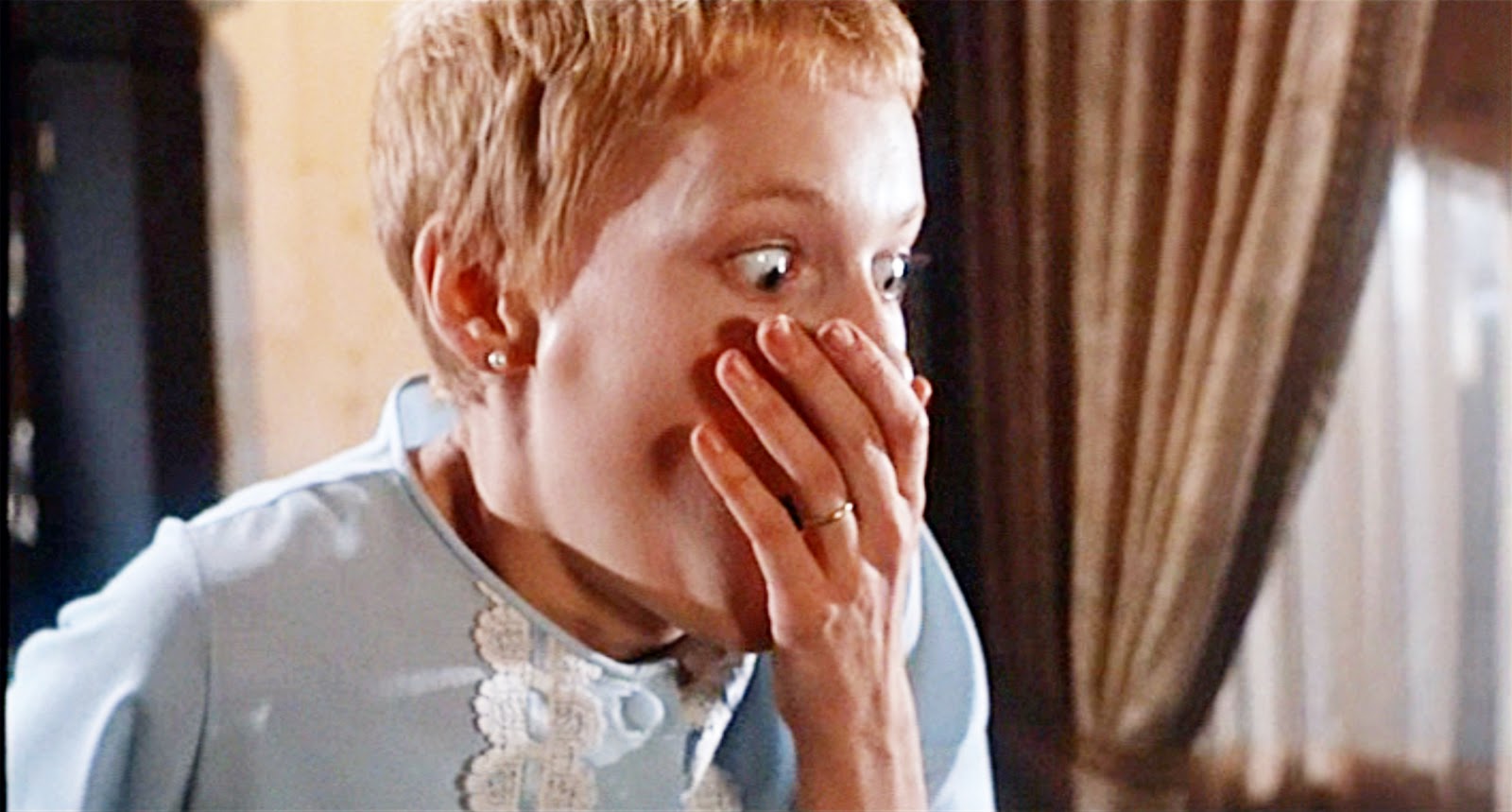
Rosemary’s Baby remains a disturbing, elegant, and fascinating tale, and Mia Farrow’s embodiment of defenselessness joins forces with William Fraker’s skillful camerawork to cast a spell. Along with Repulsion (1965) and The Tenant (1976), Rosemary’s Baby is part of Polanski’s “apartment trilogy” – disturbing films of tension and horror in which metropolitan life and nosey neighbors conspire to drive a person mad.
Working from Ira Levin’s novel, Polanski takes all the glamour out of Satanism – with a huge assist from Ruth Gordon, who won an Oscar for her turn as the highly rouged busybody Minnie Castevet. By now we all know what happens to poor Rosemary Woodhouse, but back in’69, thanks much to Mia Farrow’s vulnerable performance, the film boiled over with paranoid tension. Was poor, pregnant Rosemary losing it, or was she utterly helpless and in evil hands?
If you’re a bit skeptical at the news of two more sketch comedy stars taking their act to the big screen, who can blame you? The track record is hardly stellar, but one bad ass kitten is here to put a paw print in the win column.
Okay, the impossibly cute feline isn’t the only thing driving Keanu. There’s also sharp writing, fluid action sequences, strong characters, winning performances, and… what else you want? Look at that kitty!
After five solid years on Comedy Central’s Key & Peele, Keanu is the feature team up for Keegan-Michael Key and Jordan Peele, who display a keen self-awareness about how to pivot from short sketches to ninety minutes of solid laughs.
Peele, who also co-wrote the script, plays Rell, who’s sulking alone in his apartment after a sudden breakup. By the time his best friend Clarence (Key) arrives to console him, Rell’s frown has been turned upside down by the arrival of a stray cat. Rell names him Keanu, becoming an obsessively doting pet owner until…..Keanu is gone.
Turns out this kitten has more than claws, it has a history with drug dealing gangs, and Keanu has fallen into the clutches of the 17th Street Blips.
“Where are they?”
“17th Street!”
With that, Clarence and Rell go from arguing about who took more beatings in high school to infiltrating the Blips as bonafide gang bangers Shark Tank and Techtonic, aka the “Allentown Boys” who carry a rep as mysterious and legendary as Kaiser Soze’s.
Ridiculous situations ensue, driven by the leads’ multiple shifts from minivan-drivin’ suburbanites to pipe-hittin’ gangstas and back again. Key, in particular, delivers some riotous moments, including a classic sequence where Shark Tank must defend all that George Michael on his iPod.
One or two dry spells aside, director Peter Atencio keeps the inspired bits strung together with a surprisingly engaging narrative, tossing in some clever odes to The Matrix, Kill Bill, The Shining and more, plus a nod to K&P’s TV past with a well-placed”Liam Neesons!”
The best of Key and Peele’s work on Comedy Central was as smart as it was funny. Keanu is proof they haven’t gone soft by going Hollywood.
The 2013 revenge thriller Blue Ruin heralded writer/director Jeremy Saulnier as a filmmaker bursting with the instincts and craftsmanship necessary to give familiar tropes new bite. In Green Room his color scheme is horror, and the finished work is equally suitable for framing.
Young punk band the Ain’t Rights is in desperate need of a paying gig, even if it is at a rough private club for the “boots and braces” crowd (i.e. white power skinheads). Bass guitarist Pat (Anton Yelchin) eschews social media promotion for the “time and aggression” of live shows, and when he accidentally witnesses a murder in the club’s makeshift green room, Pat and his band find plenty of both.
Along with concertgoer Amber (a terrific Imogen Poots), they’re held at gunpoint while the club manager (Macon Blair from Blue Ruin) fetches the mysterious Darcy (Patrick Stewart, gloriously grim) to sort things out. Though Darcy is full of calm reassurances, it quickly becomes clear the captives will have to fight for their lives.
As he did with Blue Ruin, Saulnier plunges unprepared characters into a world of casual savagery, finding out just what they have to offer in a nasty backwoods standoff. It’s a path worn by Straw Dogs, Deliverance, and plenty more, but Saulnier again shows a knack for establishing his own thoughtful thumbprint. What Green Room lacks in depth, it makes up in commitment to genre.
He drapes the film in waves of thick, palpable tension, then punctures them with shocking bursts of gore and brutality. Things get plenty dark for the young punkers, and for us, as Saulnier often keeps light sources to a minimum, giving the frequent bloodletting an artful black-and-white quality which contrasts nicely with the symbolic red of certain shoelaces.
And yet, Saulnier manages to let some mischievous humor seep out, mainly by playing on generational stereotypes. Poots, barely recognizable under an extreme haircut and trucker outfit, has the most fun, never letting bloody murder alter Amber’s commitment to bored condescension. Love it.
Only a flirtation with contrivance keeps Green Room from classic status. It’s lean, mean, loud and grisly, and a ton of bloody fun.
Don’t you love Jason Bateman? And if not, why not?
His enviable comic timing guarantees his own success in any film, no matter how weak or how strong the material, but films like The Gift and State of Play clarify his underappreciated ability with dramatic roles.
Bateman’s directorial debut in 2013, Bad Words, showcased his capability at the helm, as well – muscles he flexes once more in his darkly comic take on novelist Kevin Wilson’s tale of eccentric, artistic familial dysfunction, The Family Fang.
Bateman plays Baxter Fang. Baxter and his sister Annie (Nicole Kidman) – or Child A and Child B, as their folks call them – were raised by a duo of performance artists. The present-day Mr. and Mrs. Fang are gamely played by Christopher Walken and Maryann Plunkett, with Kathryn Hahn and Jason Butler Harner filling in for flashbacks.
The adult siblings are struggling artists all their own – she a semi-working actor, he an author two years behind schedule on his third novel. It would appear that being the object and subject of their parents’ art throughout childhood has had an adverse effect on the pair as adults.
If you’re worried that you cannot sit through another indie film about the sins of the parents visited on their self-indulgent and/or damaged offspring, fear not.
Adapting Wilson’s text for the screen, David Lindsay-Abaire prunes and pares to offer a wise but tender rendering of the family pathos. But credit Bateman for ably maneuvering tonal shifts with a beautifully understated approach that keeps the film from ever veering into quirkiness or maudlin bitterness.
His cast (himself included) certainly never let him down. Both Plunkett and Hahn offer heartbreaking nuance as they animate the conflicted loyalty of mother/wife/artist Camille Fang. They join a full slate of admirable supporting performances.
Meanwhile Kidman and Bateman create a sweetly believable set of siblings, giving the relationship a lived in and hard won familiarity that feels both refreshing and familiar.
Big surprise, Christopher Walken is the shiniest gem in this treasure chest. At turns jocular and hostile, his narcissistic artist/father is delivered with both authenticity and panache.
A murder mystery of sorts, The Family Fang surprises and engrosses without ever feeling like the sleight of hand that made the Fangs famous.
Occasionally heartbreaking, often curious, cleverly structured and thoughtfully executed, this impressive sophomore directorial effort from Bateman keeps you guessing – at how things will work out for the Fangs, and at what may be next for this impressive filmmaker.
SciFi and horror don’t always play well together, but our one commonality will forever bridge the waters separating our nerdiness: creature features. For whatever reason, tales of oversized monsters, generally unleashed at the hands of mad science, appeals to both crowds even more than a marauding serial killer in a Shatner mask. Today we celebrate that common ground by counting down the five best creature features in horror.
After a couple of interesting, if un-medical films, the great David Cronenberg made a triumphant return to the laboratory of the mad scientist in his most popular film to date.
But it’s not just Cronenberg’s disturbed genius for images and ideas that makes The Fly fly; it’s the performance he draws from Jeff Goldblum.
Goldblum is an absolute gift to this film, so endearing in his pre-Brundlefly nerdiness. He’s the picture’s heartbeat, and it’s more than the fact that we like his character so much. The actor also performs heroically under all those prosthetics.
He and Geena Davis make the perfect pair, with their matching height and mullets, and their onscreen chemistry does give the film a level of human drama traditionally lacking from the Cronenberg canon. Atop that, there’s the transformation scene in the bathroom – the fingernails, the pustules – all classic Cronenberg grotesquerie, and still difficult to watch.
https://www.youtube.com/watch?v=7BzwxJ-M_M0
4. The Descent (2005)
The film begins with an emotionally jolting shock, quickly follows with some awfully unsettling cave crawling and squeezing and generally hyperventilating, then turns dizzyingly panicky before it snaps a bone right in two.
And then we find out there are monsters.
Long before the first drop of blood is drawn by the monsters – which are surprisingly well conceived and tremendously creepy – the audience has already been wrung out emotionally.
Writer/director Neil Marshall makes incredible use of the story’s structure. Between that and the way film and sound editing are employed, Marshall squeezes every available ounce of anxiety from the audience.
The grislier the film gets, the more primal the tone becomes, eventually taking on a tenor as much like a war movie as a horror film. This is not surprising from the director that unleashed Dog Soldiers – a clever and frightening werewolf adventure. But Marshall’s second attempt is far scarier.
For full-on horror, this is one hell of a monster movie.
3. The Thing (1982)
John Carpenter’s remake of the 1951 SciFi flick The Thing from Another World concocts a thoroughly spectacular tale of icy isolation, contamination, and mutation.
A beard-tastic cast portrays a team of scientists on expedition in the Arctic who take in a dog. The dog is not a dog, though. Not really. And soon, in an isolated wasteland with barely enough interior room to hold all the facial hair, folks are getting jumpy because there’s no knowing who’s not really himself anymore.
This is an amped up body snatcher movie benefitting from some of Carpenter’s most cinema-fluent and crafty direction: wide shots when we need to see the vastness of the unruly wilds; tight shots to remind us of the close quarters with parasitic death inside.
The story remains taut beginning to end, and there’s rarely any telling just who is and who is not infected by the last reel. You’re as baffled and confined as the scientists.
https://www.youtube.com/watch?v=F7t-919Ec9U
2. Alien (1979)
Director Ridley Scott’s other masterpiece, Alien, traps a crew aboard a rickety, dark, workingman’s spacecraft with the coolest monster perhaps ever.
After a vagina-hand-sucker-monster attaches itself to your face, it gestates inside you, then tears through your innards. Then it grows exponentially, hides a second set of teeth, and bleeds acid. How much cooler could this possibly be?
Compare that to the crew, and the competition seems unreasonably mismatched. The sunken-chested Harry Dean Stanton, the screechy Veronica Cartwright, the sinister Ian Holm, the mustachioed Tom Skerritt, even the mulleted Sigourney Weaver – they all seem doomed before we even get to know them.
Much ado has been made, rightfully so, of the John Hurt Chest Explosion (I loved their early work, before they went commercial). But Scott’s lingering camera leaves unsettling impressions in far simpler ways, starting with the shot of all those eggs.
1. Jaws (1975)
Twentysomething Steven Spielberg’s game-changer boasts many things, among them one of the greatest threesomes in cinematic history. The interplay among the grizzled and possibly insane sea captain Quint (Robert Shaw), the wealthy young upstart marine biologist Hooper (Richard Dreyfuss), and the decent lawman/endearing everyman Brody (Roy Scheider) helps the film transcend horror to become simply a great movie.
It’s John Williams’s iconic score; it’s Bill Butler’s camera and Verna Fields’s editing, capturing all the majesty and the terror, but never too much of the shark; it’s Spielberg’s cinematic eye. It all works, together with very fine performances, to mine for a primal terror of the unknown, of the natural order of predator and prey.
Spielberg achieved one of the rare adaptations that betters the source material. Though Peter Benchley’s nautical novel attracted droves of fans, Spielberg streamlined the text and surpassed its climax to craft a sleek terror tale.
Jaws is the high water mark for animal terror. Likely it always will be.
On December 21, 1970, Elvis Presley made an unexpected visit to the security checkpoint outside the White House, hoping security would deliver his hand written letter to President Nixon.
He really, really wanted a badge.
It’s a profoundly absurd story – the drug addled King of Rock and Roll hoping to meet Nixon and become a Federal Agent at Large, going undercover to infiltrate different groups (like Beatles fans) who were “bringing down the country.”
Director Liza Johnson (Hateship Loveship) celebrates the absurdity by taking the driest approach to telling the story.
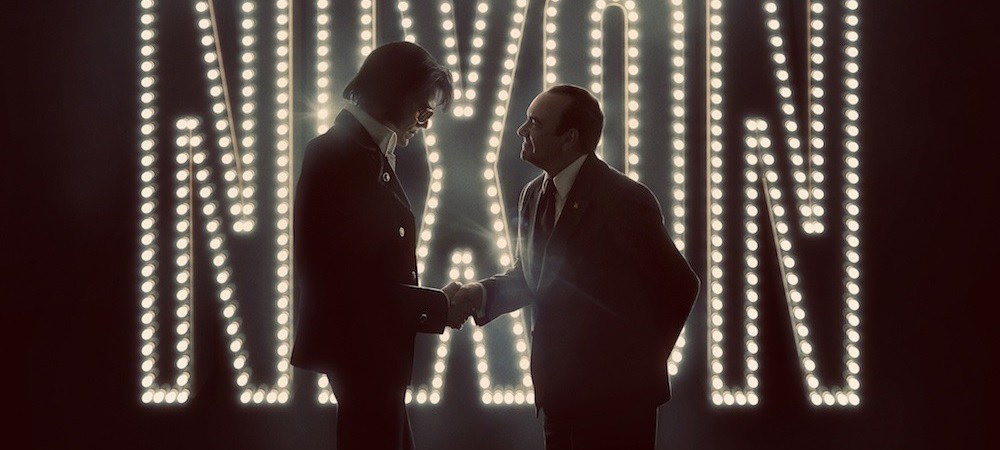
First of all, Michael Shannon plays Elvis. Now, Shannon is undeniably talented – he’s among the most reliable and impressive actors working today, capable of comedy, drama, and everything in between. But the tall, hard, grim looking actor is not a top-of-mind prospect when casting for Elvis.
Likewise, Kevin Spacey makes for an unusual choice as Nixon. These are two of the world’s most imitated, most recognizable presences. Kudos to Johnson for kicking the wicked comedy off before the opening credits even role with casting choices that seem like a clever joke.
Both actors are fun to watch, especially as they play off each other and off Nixon aides Elgin and Dwight Chapin, ably handled by Colin Hanks and Evan Peters, respectively.
Shannon, in particular, gives a nuanced and dialed-down performances as the King, both comical and sad.
Alex Pettyfer’s character, Elvis’s longtime friend (and film executive producer) Jerry Schilling, is meant to flesh out Elvis’s loneliness and offer a regular man’s point of view inside this relentlessly weird story.
To be fair, Pettyfer is better in Elvis & Nixon than he has ever been. Keep in mind, the actor has sucked out loud in every film up to now, so that is not necessarily high praise. But he does keep the film tenderly grounded.
The screenplay remains somewhat superficial, though. It leaves the film feeling like an overly long, if abundantly amusing, sketch. The fact that this all actually happened is genuinely amazing, which begs the question, why does the film settle for wryly amusing?