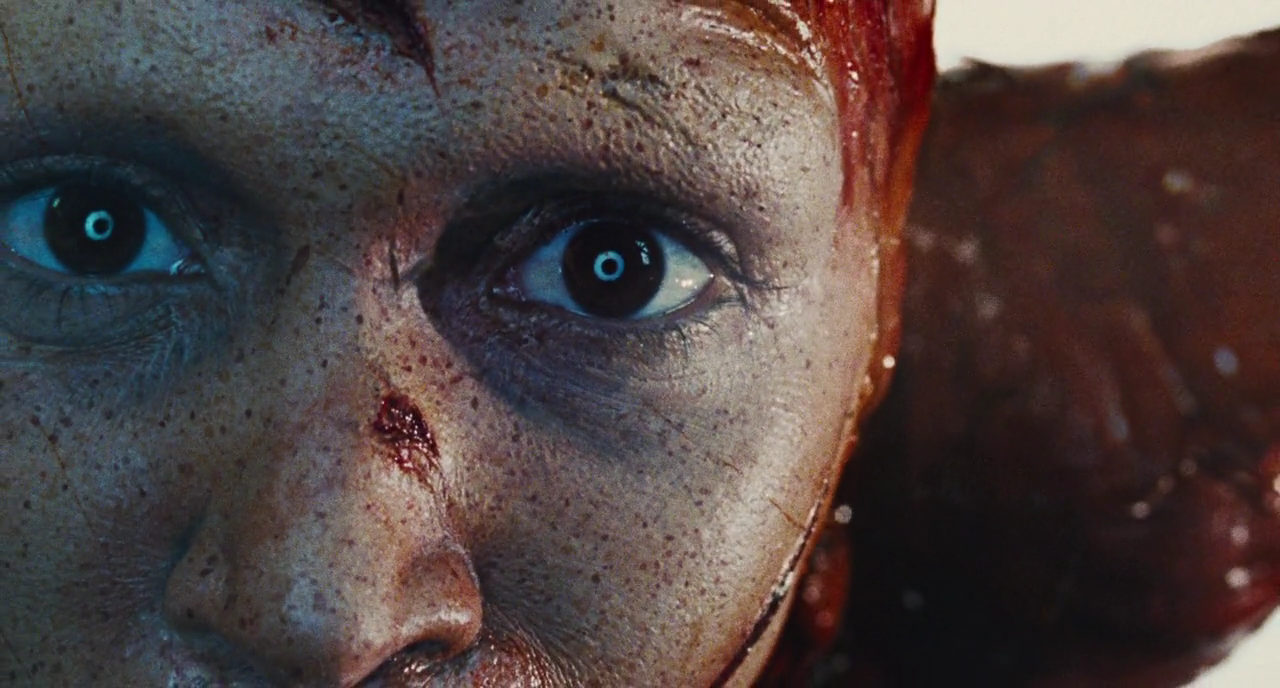
Funny and scary, smartly written and confidently directed as to take full advantage of both, this is a film that makes few missteps and thoroughly entertains from beginning to end.
Gerard Johnstone writes and directs, though his brightest accomplishment may be casting because Morgana O’Reilly’s unflinching performance holds every moment of nuttiness together with brilliance.
O’Reilly plays Kylie, a bit of a bad seed who’s been remanded to her mother’s custody for 8 months of house arrest after a recent spate of bad luck involving an ATM and a boyfriend who’s not too accurate with a sledge hammer.
Unfortunately, the old homestead, it seems, is haunted. Almost against her will, she, her hilariously chatty mum (Rima Te Wiata) and her deeply endearing probation officer (Glen-Paul Waru) try to puzzle out the murder mystery at the heart of the haunting. Lunacy follows.
Kylie’s disdain for every single person and event in this film is beautifully animated – O’Reilly constantly looks as if she’s just smelled something foul. But her expressions also share those fleeting moments of regret that make her utterly, admirably human.
Good horror comedies are hard to come by, but Johnstone manages the tonal shifts magnificently. You’re nervous, you’re scared, you’re laughing, you’re hiding your face, you’re screaming – sometimes all at once. And everything leads up to a third act that couldn’t deliver better.
The film is so much fun it all but begs to be seen with a group.
Listen weekly to MaddWolf’s horror podcast FRIGHT CLUB. Do it!
Four years ago Tom Cruise pissed off Lee Child fans when he put on the rumpled jeans and tee of the 6’5” drifter with mad military skills. In the serviceable thriller Jack Reacher, Cruise’s character puzzled through a homicide set up with the help of an inappropriately dressed defense lawyer.
Nowadays, though, maybe Jack is subconsciously looking to settle down. He meanders back to DC to talk with the Major who is now in command of his old post – the overtly fierce Samantha Turner (Cobie Smulders). Sparks?
Well, there might have been except Major Turner’s been incarcerated, there’s a highly trained sociopath with an alpha complex and a fancy pair of leather gloves, and an at-risk teen is in need of guidance.
The action’s far less interestingly choreographed, the humor is nonexistent, the villain is far blander (it was Werner Herzog last go-round, for lord’s sake!).
With the right combination of vulnerability, brattiness and savvy, Danika Yarosh provides the rare bright spot as the wayward teen. Smulder’s indignant badass is all but intolerable. Meanwhile, Cruise seems paralyzed as he tries to relay confused and conflicted paternal tendencies.
Edward Zwick’s stale direction isn’t helping. The closest thing to panache comes by way of the now de rigueur chase across urban rooftops. Yawn.
Still, Zwick’s greater crime may be the screenplay he co-wrote with Richard Wenk and Marshall Herskovitz, adapted from the Child novel. There is a difference between streamlining text and discarding character development, plot movement and sense. You spend 30% of the film thinking, “Well, that was certainly convenient.”
Incompetent plotting, weak catch phrases and a shocking lack of chemistry among any and all actors will keep a project from succeeding. Hopefully everyone involved – including the audience – can leave the film and never go back.
If you’ve seen Korea’s awe-inspiring 2003 export Oldboy, you know actor Min-sik Choi can take a beating. He proves his masochistic mettle again in I Saw the Devil.
Choi plays Kyung-Chul, a predator who picks on the wrong guy’s fiancé.
That grieving fiancé Soo-hyeon Kim is played by Byung-hun Lee (The Magnificent Seven), whose restrained emotion and elegant good looks perfectly offset Choi’s disheveled explosion of sadistic rage, and we spend 2+ hours witnessing their wildly gruesome game of cat and mouse.
Director Jee-woon Kim, working with Hoon-jung Park’s screenplay, breathes new life into the serial killer formula. Seven years earlier he helmed the deep, murky and intensely female horror of Tale of Two Sisters, but Devil breathes masculinity.
With the help of two strong leads, he upends the old “if I want to catch evil, I must become evil” cliché. What they’ve created is a percussively violent horror show that transcends its gory content to tell a fascinating, if repellant, tale.
Kyung-Chul – part time school bus driver, full time psychopath – butchers Kim’s gal, but rather than killing the murderer when he gets the chance, Kim beats him within an inch of his life (in very graphic fashion), then implants a microphone and tracking device. Regardless of the mayhem this lunatic will unleash as soon as he recovers from his wounds, Kim’s content to simply wait, follow, and beat him up again.
Park’s plot takes a number of unexpected, even absurd, turns. It’s as if this particular movie stops off quickly to visit a couple of completely separate horror films. The result doesn’t always work, but it certainly shakes up expectations.
Truth be told, beneath the grisly, far-too-realistic violence of this unwholesome bloodletting is an undercurrent of honest human pathos – not just sadism, but sadness, anger, and the most weirdly dark humor.
If you can see past the outrageously violent images onscreen, you might notice some really fine acting and nimble storytelling lurking inside this bloodbath.
Listen weekly to MaddWolf’s horror podcast FRIGHT CLUB. Do it!
Aah, the precarious position of the alpha male. Oh should I say Aaaaaaaah!? Because that is the delightfully appropriate title of Steve Oram’s feature directorial debut.
An absurd horror comedy, the film offers no dialog at all, just grunts, as humans – devolved into ape mentality – go about their poop-throwing, territory marking, television smashing daily existence.
It’s the kind of overly clever premise you expect to wear thin, but honestly, it doesn’t. Much credit goes to a game cast (including Oram) that sells every minute of the ridiculousness, and to Oram again as director. He keeps the pace quick, his images a flurry of insanity you need to see more than once to fully appreciate.
Oram has more in store than a wickedly bloody send up, though. His film wisely deconstructs our own human preoccupations and foibles in a way that’s strangely touching, even sad at times.
The lack of dialog suits the experiment in the same way Steven Soderbergh’s meta-dialog suited his weirdly personal 1996 effort Schizopolis, or the way Miroslav Slaboshpitsky’s use of unsubtitled sign language fits his brilliant film The Tribe. While Aaaaaaaah! is far lighter and more madcap than either of these, it still asks you to use another means of understanding character actions, which allows you to see humanity on a more jarringly primal level.
It wouldn’t even be a horror movie were it not for all those severed penises.
Oram and his appealing cast keep you interested as seemingly divergent stories blend and reshape, and domestic hierarchies shift. Lucy Honigman is particularly compelling, but every actor has surprising success in articulating a dimensional character with nary a word to help.
A familiar face in British comedy, Oram stood out in Ben Wheatley’s 2012 horror comedy Sightseers. He’s playing against type here as the threatening male presence, but he’s equally hilarious. The talent has to rely primarily on sight gags, obviously, and Oram has a flair for presentation. His quick 79 minute running time helps, but there’s never a dull moment in this jungle.
Listen weekly to MaddWolf’s horror podcast FRIGHT CLUB. Do it!
There’s a concept in the northern countries of Europe that helps the people there combat the rigors of the long, frigid, winter nights. It’s called gemütlichkeit in German, hygee in Danish, and mysig in Swedish and loosely translates as “cozy.” But it’s not just a sitting in front of a crackling fire, blanket on lap, warm drink in hand kind of physical cozy. The concept encompasses emotional coziness—friendliness, peace of mind, social acceptance. The Swedish film A Man Called Ove, exudes mysig.
It’s the story of a cantankerous old widower who has recently been counseled out of his 40+ year job. His life has shrunk to the point where his days are spent patrolling his neighborhood enforcing homeowners’ association rules, yelling about where dogs can answer the call of nature, and tossing junk at stray cats. His plan is to wrap up the loose ends of his existence, and then join his wife by taking his own life. But the plan is delayed by the young family that moves into the house across the street, running into his mailbox in the process.
And you probably know where the movie is going to go from there. You’ve seen versions of this story before: Dr. Seuss’ How the Grinch Stole Christmas!, Up, St. Vincent, etc. Crabby old guy softened by the connections made with a youngster. But that doesn’t make Ove any less charming.
In Hannes Holm’s adaptation of Fredrik Backman’s bestselling novel, Rolf Lassgård manages to make even the angriest, most nihilistic version of Ove seen in the first portion of the film somehow likable despite his rudeness. And, in flashback sequences that occur each time Ove attempts suicide, his life story is fleshed out, revealing past events that have contributed to his current demeanor. This makes his subsequent, often bumbling, attempts at increased connection more poignant. And the family that provides a catalyst for his change is helmed by the fantastic Parvaneh (Bahar Pars)—friendly, decent, very pregnant, and taker of absolutely zero-shit from anyone.
It’s the kind of movie that makes you appreciate the beauty in the small details in life, the mysig: a well-cared-for green plant perched in front of a frosty window, a child’s drawing, neighbors that know your name and wave to you from across the street, a car ride with your dad. It’s the kind of movie that you’ll appreciate as the temperature dips, the dark comes creeping ever earlier, and the sky takes on the appearance of soiled sidewalk. It’s the kind of movie that might be best enjoyed with a small group of good friends and a warm beverage.
Unlike any film of its time – horror or otherwise – Henry: Portrait of a Serial Killer depicts an unforgivingly realistic portrayal of evil. A deeply disturbing Michael Rooker plays serial killer Henry (based on real-life murderer Henry Lee Lucas). We follow him through his humdrum days of stalking and then dispatching his prey, until he finds his own unwholesome kind of family in the form of prison buddy Otis (Tom Towles) and Otis’s sister Becky (Tracy Arnold).
Director John McNaughton’s picture offers a uniquely unemotional telling – no swelling strings to warn us danger is afoot and no hero to speak of to balance the ugliness. He confuses viewers because the characters you identify with are evil. Even when you think you might be seeing this to understand the origins of the ugliness, he pulls the rug out from under you again by creating an untrustworthy narrative voice. His film is so nonjudgmental, so flatly unemotional, that it’s honestly hard to watch.
What’s diabolically fascinating, though, is the workaday, white trash camaraderie of the psychopath relationship in this film, and the grey areas where one crazy killer feels the other has crossed some line of decency.
Rooker’s performance unsettles to the bone, flashing glimpses of an almost sympathetic beast now and again, but there’s never a question that he will do the worst things every time, more out of boredom than anything.
Re-released in time for its 30th anniversary with a 4K scan and restoration from its original 16mm camera negatives, Henry now boasts an even grittier, more unseemly quality. The world McNaughton invites you into feels even more alien and yet lived-in – a world you never imagined existed, but one that feels so authentic you’ll truly believe it does.
For evocative, nerve jangling, demonic horror, you will not find better than The Exorcist.
Slow-moving, richly textured, gorgeously and thoughtfully framed, The Exorcist follows a very black and white, good versus evil conflict: Father Merrin V Satan for the soul of an innocent child.
But thanks to an intricate and nuanced screenplay adapted by William Peter Blatty from his own novel, the film boasts any number of flawed characters struggling to find faith and to do what’s right in this situation. And thanks to director William Friedkin’s immaculate filming, we are entranced by early wide shots of a golden Middle East, then brought closer to watch people running here and there on the Georgetown campus or on the streets of NYC.
Then we pull in a bit more: interiors of Chris MacNeil’s (Ellen Burstyn) place on location, the hospital where Fr. Karras’s mother is surrounded by forgotten souls, the labs and conference rooms where an impotent medical community fails to cure poor Regan (Linda Blair).
Then even closer, in the bedroom, where you can see Regan’s breath in the chilly air, and examine the flesh rotting off her young face. Here, in the intimacy, there’s no escaping that voice, toying with everyone with such vulgarity.
The voice belongs to Mercedes McCambridge, and she may have been the casting director’s greatest triumph. Of course, Jason Miller as poor, wounded Fr. Damien Karras could not have been better. Indeed, he, Burstyn, and young Linda Blair were all nominated for Oscars.
So was Friedkin, the director who balanced every scene to expose its divinity and warts, and to quietly build tension. When he was good and ready, he let that tension burst into explosions of terrifying mayhem that became a blueprint for dozens of films throughout the Seventies and marked a lasting icon for the genre.
Remember the stories of moviegoers fleeing the theatre, or fainting in the aisles midway through this film? It seemed like hype then, but watch it today, experience the power the film still has, and you can only imagine how little the poor folks of the early 1970s were prepared.
Even after all this time, The Exorcist is a flat-out masterpiece.
Listen weekly to MaddWolf’s horror podcast FRIGHT CLUB. Do it!
This is one you may need to prepare yourself for. Equal parts orphanage ghost story, suburban revenge fantasy, and medical experimentation horror flick, the whole of Martyrs is a brutal tale that is hard to watch, hard to turn away from, and worth the effort.
On the surface we follow Lucie’s (Mylene Jampanoi) descent into madness after escaping, as a child, from an abandoned warehouse where she’d been tortured by unknown hands.
Mining the heartbreaking loneliness of abandoned, damaged children, the film follows the profound relationship between Lucie and the only friend she will ever have, an undeterrably loving Anna (Morjana Alaoui).
Constantly subverting expectations, including those immediately felt for Anna’s love, writer/director Pascal Laugier makes a series of sharp turns, but he throws unforgettable images at you periodically, and your affection for the leads keeps you breathlessly engaged.
The third act offers the most abrupt change of course as well as tone, and the proceedings are tough to stomach, but well conceived and equally skillfully executed. It holds some gruesome imagery, and though the climax may not be pleasing, it certainly doesn’t disappoint.
Listen weekly to MaddWolf’s horror podcast FRIGHT CLUB. Do it!
John Carpenter’s remake of the 1951 SciFi flick The Thing from Another World is both reverent and barrier-breaking, losing a bit of the original’s Cold War dread, but concocting a thoroughly spectacular tale of icy isolation, contamination and mutation.
A beard-tastic cast portrays the team of scientists on expedition in the Arctic who take in a dog. The dog is not a dog, though. Not really. And soon, in a cut-off wasteland with barely enough interior room to hold all the facial hair, folks are getting jumpy because there’s no knowing who’s not really himself anymore.
This is an amped up body snatcher movie benefitting from some of Carpenter’s most cinema-fluent and crafty direction: wide shots when we need to see the vastness of the unruly wilds; tight shots to remind us of the close quarters with parasitic death inside.
Rob Bottin’s FX, especially for the time, blew minds. That spider head move – woo-hoo!
The story remains taut beginning to end, and there’s rarely any telling just who is and who is not infected by the last reel. You’re as baffled and confined as the scientists.
The film was an inexplicable bomb with audiences and critics alike when it opened, but it’s gone on to become a must see.
Seriously, you must see it.
Listen weekly to MaddWolf’s horror podcast FRIGHT CLUB. Do it!
Prepare to be pissed off. Why? Well, because we’re going to explore the best zombie comedies today and there are hundreds of options. We guarantee that we will leave something off this list that you want to see on it. There’s really no question about it. Probably at #5. So just know that we know that there are at least a dozen great zombie comedies that we do not address here, given that we’ve limited our list to five.
And here they are!
5. The Return of the Living Dead (1985)
Why Return of the Living Dead? Because it was one of the very first zombie comedies, mainly. But its pedigree is impressive. The original story – one of bumbling warehouse employees who unwittingly unleash the very biochemical that caused the Night of the Living Dead in the first place – was conceived by Russell Streiner, producer of the Romero zombie classic.
Also, Dan O’Bannon, writer behind Alien and Total Recall, co-wrote and directs.
The film also introduced into the genre the abiding zombie trait of brain eating, and is the first film in which zombies grown braaaaiiiinnnnssss.
Plus, the great Linnea Quigley Leg Warmer Dance Scene, a fun 80s punk rock soundtrack, Clu Gulagar and a lot of campy fun – all of this combined to create one of the more memorable and weirdly important zombie comedies.
4. Dead Snow (2009)
Nazi zombies, everybody! Hell yes!
Like its portly nerd character Erlend, Dead Snow loves horror movies. A self-referential “cabin in the woods” flick, Dead Snow follows a handsome, mixed-gender group of college students as they head to a remote cabin for Spring Break. A creepy old dude warns them off with a tale of local evil. They mock and ignore him at their peril.
But co-writer/director/Scandinavian Tommy Wirkola doesn’t just obey these time-honored horror film rules. Like Scream and The Cabin in the Woods, Dead Snow draws your attention to them. It embraces our prior knowledge of the path we’re taking to mine for comedy, but doesn’t give up on the scares. Wirkola’s artful imagination generates plenty of startles and gore by the gallon.
Spectacular location shooting, exquisite cinematography, effective sound editing and a killer soundtrack combine to elevate the film above its clever script and solid acting. Take, for example, the gorgeous image of Norwegian peace – a tent, lit from within, sits like a jewel nestled in the quiet of a snowy mountainside. The image glistens with pristine outdoorsy beauty – until it … doesn’t.
The unapologetically faithful image of the traditional American horror film, Dead Snow is funny and scary, utterly gross and thoroughly enjoyable.
3. Juan of the Dead (2011)
By 2011, finding a zombie film with something new to say was pretty difficult, but writer/director/Cuban Alejandro Brugues managed to do just that with his bloody political satire Juan of the Dead.
Breathtakingly and unapologetically Cuban, the film shadows slacker Juan and his layabout pals as they reconfigure their longtime survival instincts to make the most of Cuba’s zombie infestation.
I’m sorry – dissidents. Thankfully the Cuban media is on top of this situation, letting the faithful patriots know that the violent, flesh-hungry villains outside are all dissidents. Your old, fat auntie? Dissident. Paperboy, missing a foot and dragging himself toward that priest? Dissident.
One of a thousand hilarious touches is that the word zombie is used only once, by a non-Cuban – even Juan and his friends thoughtlessly refer to the mayhem-happy characters as dissidents. It’s a whole new approach to the zombiepocalypse – not to mention social satire – and it’s entirely entertaining.
It’s such a clever, eye-opening film with some added oomph via soundtrack and closing credits animation. Juan of the Dead promises one killer dia de los muertos!
2. Shaun of the Dead (2004)
This is a hard movie not to like. Writer/director Edgar Wright teams with writer/star Simon Pegg to lovingly mock the slacker generation, 80s pop, and George Romero with this riotous flesh-eating romance. But what is easy to overlook is the genuine craftsmanship that went into making this picture.
Every frame of every scene is so perfectly timed – pauses in conversation synchronized with seemingly random snippets of other conversations, or juke box songs, or bits from the tele. (The movie will turn you British. By the end you’ll be saying holiday instead of vacation, spelling colour with a u and saying, “How’s that for a slice of fried gold?” even though you don’t really know what that means.)
Shaun offers such a witty observation of both a generation and a genre, so well told and acted, that it is an absolute joy, even if you’re not a fan of zombie movies. As social satire, it is as sharp as they come. It also manages to hit the bull’s eye as a splatter horror film, an ode to Romero, a buddy picture, and an authentic romantic comedy. And it’s more than just a remarkable achievement; it’s a fresh, vivid explosion of entertainment. It’s just a great movie.
1. Zombieland (2009)
Zombieland is quite possibly the perfect movie. Just when Shaun of the Dead convinced me that those Limey Brits had created the best-ever zombie romantic comedy, it turns out they’d only created the most British zom-rom-com. The Yank counterpart is even better, and with this amount of artillery, it’s certainly a more American vision.
Let’s start with the writing. Rhett Reese and Paul Wernick take the tried-and-true zombiepocalypse premise and sprint with it in totally new and awesome directions.
And the cameo. I cannot imagine a better one. I mean that. I’m not sure a walk on by Jesus himself could have brought me more joy.
That’s not true. Plus, in zombie movie?! How awesome would that have been?!
Jesse Eisenberg anchors the film with an inspired narration and an endearing dork characterization. But Woody Harrelson owns this film. His gun-toting, Twinkie-loving, Willie Nelson-singing, Dale Earnhart-number-wearing redneck ranks among the greatest horror heroes ever.
I give you, a trip to a loud and well-lit amusement park is not a recommendation Max Brooks would make during the zombiepocalypse. Still, you’ve got to admit it’s a gloriously filmed piece of action horror cinema.