Welcome to the desk in the den, home to our hero, Spencer. Spencer is a mechanical pencil, and you’re invited to his life story. Life in the pen cup is not always fun, but Spencer makes the best of every situation.
Spencer + Penny, Forever, the charming short film from writer/director/star/editor/cinematographer Eric Boso, is an inventive and emotionally satisfying look at life, love, art and friendship.
A master class in visual storytelling, Spencer + Penny, Forever works like the best kind of picture book. The words are telling you one thing, but the visuals not only provide all the necessary context, but they also deliver additional essential information. And again, as is the case with the best picture books, the balance between words and visuals is constructed in the most delightful way.
Boso builds tension that threatens outright heartbreak, but the delivery is liltingly playful. The tone itself may be the film’s greatest feat, balancing on a slim line between childlike wonder and melancholy.
Boso’s own voicework as Spencer is top notch – touched with optimism, humanity and pain. His performance is balanced with a bright, lovely turn from Samantha Martin Hospodar as the new pencil on the desk, Penny. Their performances are sweet and inviting, the tenderness promising an emotional journey that is surprisingly poignant.
Given the subject matter, Boso wisely sidesteps sentimentality or even campy humor, but the absolute lack of cynicism in his direction is refreshing and heartbreaking. Spencer + Penny, Forever is a unique and beautiful vision from a talented filmmaker.
It’s amazing how often the beauty of unconquered land is met with the ugliness of conquest in film, as deceptively tranquil images of vast, open space underscore the heinous brutality of colonialism.
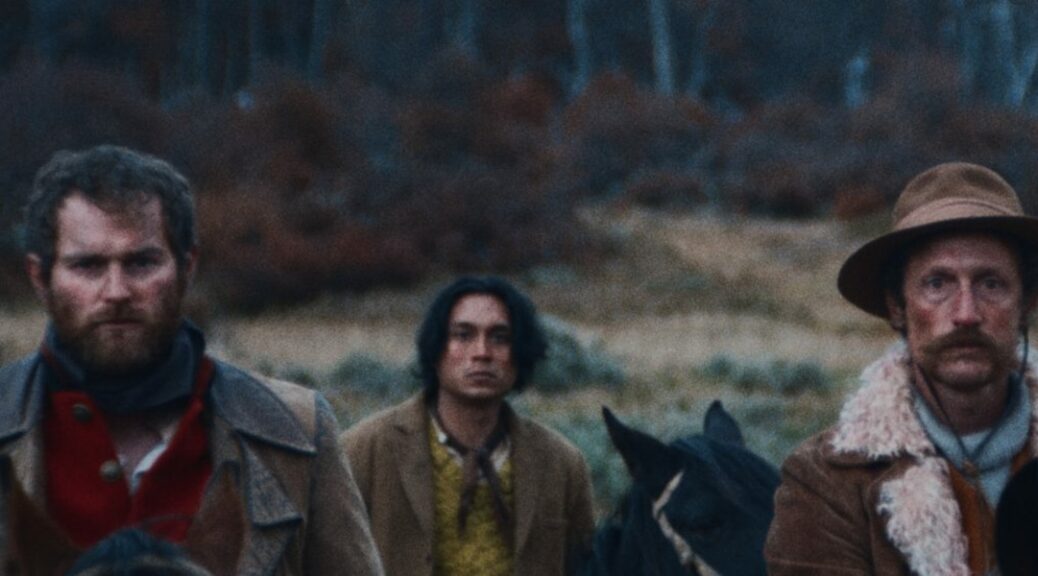
Co-writer/director Felipe Gálvez Haberle (with a massive assist from cinematographer Simone D’Arcangelo) draws you in with the same aesthetic for his gripping and ruggedly gorgeous indictment of Chile’s history in The Settlers.
An artful and unflinching portrait of atrocities inflicted on South America’s Ona people, The Settlers is a historical indictment not unlike Jennifer Kent’s 2018 study in tension and colonial horror, The Nightingale.
Three men set off across a wealthy landowner’s vast property in 1901: one Scottish soldier (Mark Stanley), one Texan gun-for-hire (Benjamin Westfall), and one native tracker (Camilo Arancibia). Their stated mission is to clear a path for the landowner’s sheep to the ocean. Their actual goal, as tracker Segundo would soon realize, is the sweeping slaughter of all indigenous people on the land.
Act one keeps its distance. There’s little dialog and scenes are mostly shot from afar, Chile’s inhospitable vastness on display. Act two brings the camera and us a little closer to the action, and the cinematic vision morphs from art-Western to something closer to horror.
The third act pivot feels more jarring. The austerity of a chamber piece sets the film on its side, but Gálvez Haberle never loses control. Indeed, it is control itself he is depicting, and the effect is chilling.
These bold shifts in structure and tone do less to undermine the tension than to alter it, set it in another direction. The safer Haberle makes the situation feel, the more institutional the horror becomes. When capitalism, politics and religion work together to redirect and rewrite history, the ugliest things are possible.
Arancibia’s performance is mainly silent, the horror of the unprovoked slaughter registering little by little across his guarded expression. Even more stunning is Mishell Guaña as a indigenous woman who becomes part of the expedition. Guaña wears a lifetime of distrust and injustice so wearily, so angrily on her face.
The true story of one nation’s history of genocide, The Settlers is unsettling universal. What Gálvez Haberle does so effectively is take it to the next step, where a nation’s brutally criminal past becomes its sanctified, sanitized history.
2023 was a great year for great movies, great screenplays, great performances, and great craftsmanship. Many of this year’s categories are stacked with deserving nominees., and overall, it was not a bad job by the Academy.
But we do have a few nits to pick.
Best picture
“American Fiction”
“Anatomy of a Fall”
“Barbie”
“The Holdovers”
“Killers of the Flower Moon”
“Maestro”
“Oppenheimer”
“Past Lives”
“Poor Things”
“The Zone of Interest”
Solid, but we would put “Godzilla Minus One” and “The Color Purple” in for “Past Lives” and “The Zone of Interest.”
Best actor
Bradley Cooper, “Maestro”
Colman Domingo, “Rustin”
Paul Giamatti, “The Holdovers”
Cillian Murphy, “Oppenheimer”
Jeffrey Wright, “American Fiction”
All great choices.
Best actress
Annette Bening, “Nyad”
Lily Gladstone, “Killers of the Flower Moon”
Sandra Hüller, “Anatomy of a Fall”
Carey Mulligan, “Maestro”
Emma Stone, “Poor Things”
These are strong, but we would have loved to see Fantasia’s performance in “The Color Purple ” in Bening’s spot.
Best supporting actor
Sterling K. Brown, “American Fiction”
Robert De Niro, “Killers of the Flower Moon”
Robert Downey Jr., “Oppenheimer”
Ryan Gosling, “Barbie”
Mark Ruffalo, “Poor Things”
All good here.
Best supporting actress
Emily Blunt, “Oppenheimer”
Danielle Brooks, “The Color Purple”
America Ferrera, “Barbie”
Jodie Foster, “Nyad”
Da’Vine Joy Randolph, “The Holdovers”
Very strong list.
Best director
Jonathan Glazer, “The Zone of Interest”
Yorgos Lanthimos, “Poor Things”
Christopher Nolan, “Oppenheimer”
Martin Scorsese, “Killers of the Flower Moon”
Justine Triet, “Anatomy of a Fall”
No Bradley Cooper? No Greta Gerwig.? We take umbrage, and would put them in over Glazer and Triet.
International feature film
“Io Capitano,” Italy
“Perfect Days,” Japan
“Society of the Snow,” Spain
“The Teachers’ Lounge,” Germany
“The Zone of Interest,” United Kingdom
Very nice.
Animated feature film
“The Boy and the Heron”
“Elemental”
“Nimona”
“Robot Dreams”
“Spider-Man: Across the Spider-Verse”
Not a great year for animation, but these are worthy.
Adapted screenplay
“American Fiction”
“Barbie”
“Oppenheimer”
“Poor Things”
“The Zone of Interest”
We’d put “Barbie” in Original Screenplay and add “The Color Purple,” but okay.
Original screenplay
“Anatomy of a Fall”
“The Holdovers”
“Maestro”
“May December”
“Past Lives”
Good choices.
Visual effects
“The Creator”
“Godzilla Minus One”
“Guardians of the Galaxy Vol. 3”
“Mission: Impossible – Dead Reckoning Part One”
“Napoleon”
Nice to see the relatively low budget “The Creator” included here.
Original score
“American Fiction”
“Indiana Jones and the Dial of Destiny”
“Killers of the Flower Moon”
“Oppenheimer”
“Poor Things”
All strong, but where’s “Godzilla Minus One”? Criminal.
Original song
“It Never Went Away” from “American Symphony”
“I’m Just Ken” from “Barbie”
“What Was I Made For?” from “Barbie”
“The Fire Inside” from “Flamin’ Hot”
“Wahzhazhe (A Song For My People)” from “Killers of the Flower Moon”
We would have loved to see Road to Freedom from “Rustin” included in this category.
Documentary feature film
“20 Days in Mariupol”
“Bobi Wine: The People’s President”
“The Eternal Memory”
“Four Daughters”
“To Kill a Tiger”
“Anselm” should be here, and maybe “Still: A Michael J. Fox Story.”
Cinematography
“El Conde”
“Killers of the Flower Moon”
“Maestro”
“Oppenheimer”
“Poor Things”
So great to see “El Conde” on this stellar list. It was beautiful, and hopefully this nomination will cause people to seek it out.But, to be honest, we’d have given its spot to “Barbie.“
Costume design
“Barbie”
“Killers of the Flower Moon”
“Napoleon”
“Oppenheimer”
“Poor Things”
Animated short film
“Letter to a Pig”
“Ninety-Five Senses”
“Our Uniform”
“Pachyderme”
“War Is Over! Inspired by the Music of John & Yoko”
Live action short film
“The After”
“Invincible”
“Knight of Fortune”
“Red, White and Blue”
“The Wonderful Story of Henry Sugar”
Documentary short film
“The ABCs of Book Banning”
“The Barber of Little Rock”
“Island in Between”
“The Last Repair Shop”
“Nǎi Nai & Wài Pó”
Film editing
“Anatomy of a Fall”
“The Holdovers”
“Killers of the Flower Moon”
“Oppenheimer”
“Poor Things”
We’d probably go with “Barbie” over “The Holdovers” here.
Sound
“The Creator”
“Maestro”
“Mission: Impossible – Dead Reckoning Part One”
“Oppenheimer”
“The Zone of Interest”
Production design
“Barbie”
“Killers of the Flower Moon”
“Napoleon”
“Oppenheimer”
“Poor Things”
Makeup and hairstyling
“Golda”
“Maestro”
“Oppenheimer”
“Poor Things”
“Society of the Snow”
The 96th Academy Awards, hosted by Jimmy Kimmel, will air on ABC on Sunday, March 10, live from the Dolby Theatre at Ovation Hollywood.
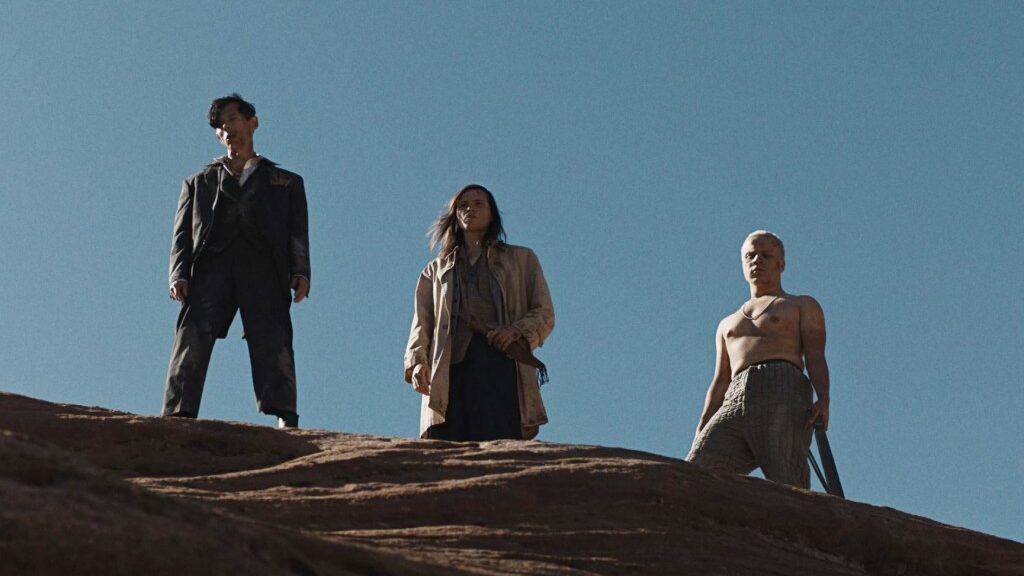
Writer/director Barnaby Clay reimagines Hiroshi Teshigahara’s Oscar nominated 1964 classic The Woman in the Dunes as a Pacific Northwestern horror in The Seeding.
A man (Scott Haze, What Josiah Saw, Antlers) drives out to the desert for the best possible photos of a solar eclipse. He leaves his car, hikes a good way, gets the photos, and heads back to his car, but he’s sidetracked by a boy crying that he’s lost. The boy then gets the man lost. Eventually, alone and thirsty, the man climbs down a rope ladder into a gorge to ask a woman (Kate Lyn Sheil, She Dies Tomorrow) in the lone house for aid.
Next thing you know, the rope ladder is gone.
Like Teshigahara’s film, The Seeding examines the existential crisis of purposelessness and lack of freedom. But Clay’s film is definitely American in that the roots of the entrapment speak more of something monstrous and primal in the wilds of the nation’s last unconquered spaces.
This works to an extent. Haze is solid, if not particularly sympathetic, as frustration turns to terror, then to horror. Sheil’s enigmatic performance suits a character whose motivation and perspective are concealed.
The couple’s story is complicated by the taunts from a gaggle of sadistic boys roaming the rim of the gorge. Here Clay veers from Teshigahara’s path and into something closer to The Hills Have Eyes and declares the film horror. There’s also some vaguely Lovecraftian imagery, as if these feral desert dwellers worship something far older and more cosmic than this man could understand.
It sounds like an interesting meshing of ideas, but if comes off as a bit of a sloppy mess.
Clay, known primarily for directing music videos, nabs a handful of really impressive shots. And both leads benefit from a single opportunity to outright break down, which both do quite impressively.
But the film is too impatient. Clay reexamines an existential nightmare addressed many times (I’m Not Scared, John and the Hole) and turns to a mixed bag of horror tropes to limit its impact.
When you watch a Gabriela Cowperthwaite movie, you never fully forget her background in documentary. And while none of her narrative films possess the same vitality of her 2013 doc Blackfish, each film’s lived-in detail gives it authenticity that serves a purpose.
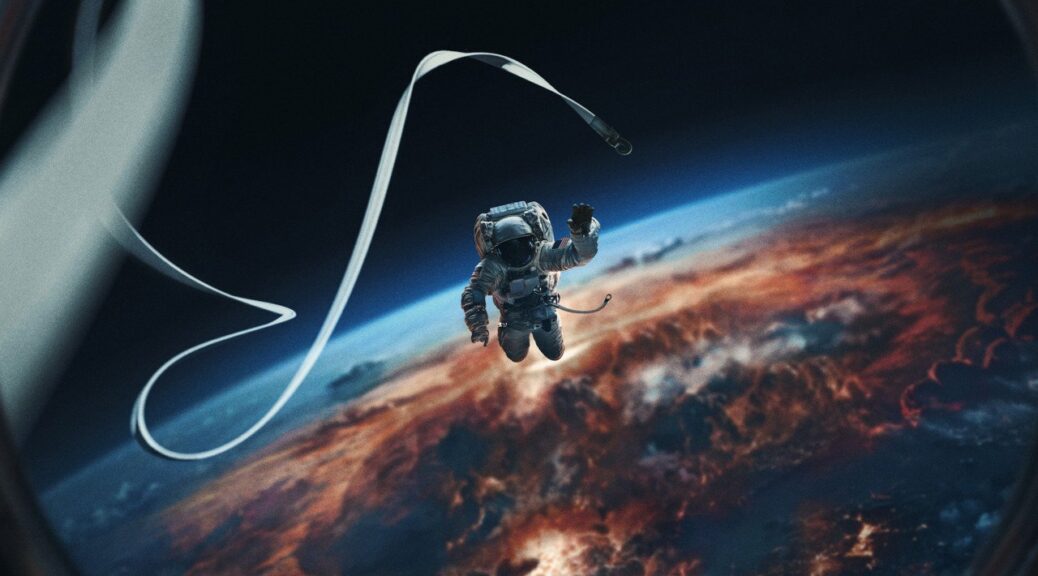
Her latest seals you up inside the International Space Station with three Russian cosmonauts and three American astronauts as the world below devolves into a nuclear battle between the two nations.
I.S.S. introduces new science officer Dr. Kira Foster (Ariana DeBose) to a close-knit group who’s shared cramped quarters for years. First Officer of the American unit Gordon (Chris Messina) is levelheaded and caring. Weronika (Masha Mashkova) and Gordon move quickly to help Kira feel at home.
Until word comes from below. Each side has been ordered to “take I.S.S. under any circumstances.” In cramped confines and awkward conditions, a handful of people hide and seek and figure out who can and can’t be trusted.
Tight space, small group, big stakes – it seems like an excellent premise, but Cowperthwaite, from a script by Nick Shafir, doesn’t have a lot of spare parts to work with.
She makes up for much of what’s missing with camera work. She and cinematographer Nick Remy Matthews (Hotel Mumbai) employ simple but effective tricks to ramp up tension.
Matthews’s camera floats in and around the zero-gravity quarters while security footage – stable and in b/w – makes you feel as if you’re sneaking a peek at something that you’re not supposed to see. The two styles collaborate to generate dread and a sense of helplessness.
Footage of the brief adventure outside the craft is generally quite impressive – it’s no Cuarón, but it does look good.
Messina and Pilou Asbæk (as conflicted cosmonaut Alexey) deliver the most complete performances, full of regret and humanity.
DeBose is hamstrung between heroism and naivete. Her dialog is often less logical than it is convenient. Jim Gallagher Jr. telegraphs his position in the shifting drama from his first moment onscreen.
Worse still, somehow the whole film feels anticlimactic. The danger never feels real, and the pointlessness of success is never even addressed. It’s a misfire from a reliable filmmaker and a middling effort in the “terror in space” subgenre.
Loneliness can be self-imposed, but that doesn’t make it any easier to overcome.
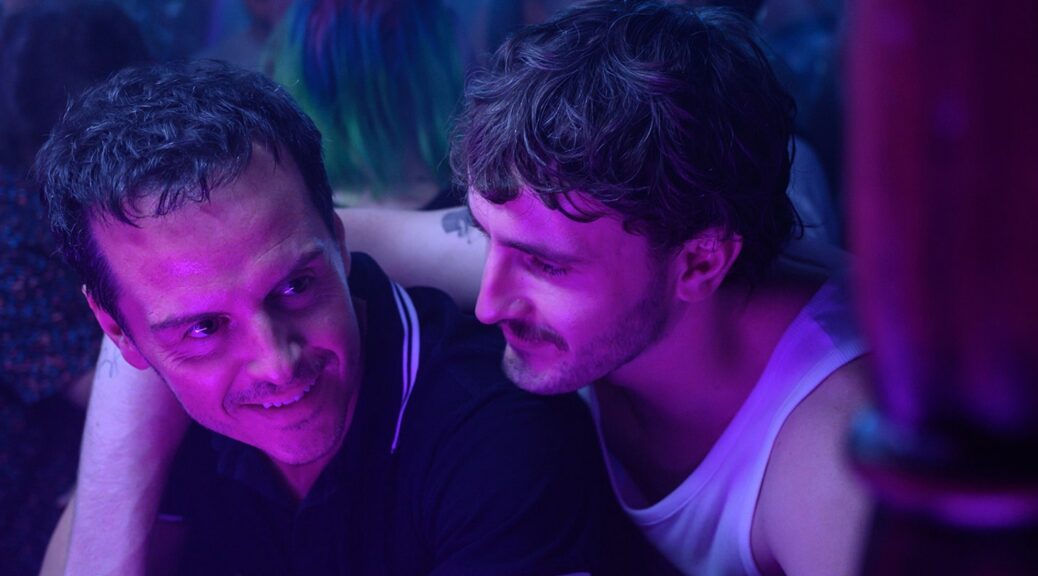
Adam (Andrew Scott) is alone. A writer living in a London high rise that’s still under construction, his solitary days bleed into his solitary nights, 80s hits on video and vinyl his main companions.
Adam is trying to write about his parents, so he decides to leave his flat, take a train, and revisit his old neighborhood. And soon his solitary days turn into afternoons spent with his parents (Claire Foy and Jamie Bell) and nights spent with his only neighbor, Harry (Paul Mescal).
What follows is a beautiful, melancholy meditation on reconciling your love for someone who has failed you, recognizing their love for you and their failure.
Scott doesn’t anchor the film as much as he haunts it with a turn that’s achingly tender and forgiving. Meanwhile, Mescal delivers another beautifully wounded performance, raw with emotion and sensuality.
Foy is a delightful change of pace, conflicted and unsure, and Bell stands out as the dad you really want him to be: honest, culpable, sorry, deeply loving.
Writer/director Andrew Haigh (45 Years) expertly weaves the lonesomeness of childhood traumas, as misunderstood and overwhelming as they can be, with personal identity. What of your traumas created who you are? What of who you are created your traumas?
Though never illogical, logic itself is far from the driving principle in Haigh’s storytelling. Emotional honesty, perhaps. Desire, certainly.
All of Us Strangers is a tough film to summarize and even tougher to categorize. It exists in a dream state bound by loss and isolation. Naturally, the only way to puncture that atmosphere is with love.
In many ways, this film should not work. Genre elements litter the script that, told by any other filmmaker, would run either maudlin or cheesy. But Haigh’s hypnotic touch creates a tone equally honest and obscure yet full of wonder. It’s also utterly devastating.
It’s one of the oldest tropes in horror: an unexpected knock at the door. Maybe the visitors are in danger: The Texas Chain Saw Massacre, The Human Centipede, The Old Dark House and countless others. Or, maybe it’s the folks inside who should be afraid: Knock, Knock; Brimstone and Treacle. For our 10th anniversary special, we count down the best “unexpected guest” horror.
5. The Eyes of My Mother (2016)
The Eyes of My Mother will remind you of many other films, and yet there truly is no film quite like this one.
First time feature writer/director Nicolas Pesce, with a hell of an assist from cinematographer Zach Kuperstein, casts an eerie spell of lonesome bucolic horror.
Shot in ideal-for-the-project black and white, an Act 1 event could come from any number of horror films. A mother looks out her window to see her young daughter, playing alone in the front lawn, talking with a stranger. There is something clearly wrong with the stranger, and things take a bad turn. But for Pesce, this simple, well-worn set-up offers endless unexplored possibilities. Because this bad man doesn’t realize that the isolated farm family he’s come to harm is very comfortable with dissection.
4. The Strangers (2008)
“Is Tamara home?”
Writer/director Bryan Bertino creates an awful lot of terror beginning with that line.
A couple heads to an isolated summer home after a wedding. It was meant to be the first stop on their life together, or so we gather, but not all worked out as James (Scott Speedman) had planned. As he and what he’d hoped would be his fiancé, Kristen (Liv Tyler), sit awkwardly and dance around the issue, their very late night is interrupted by a knock and that immediately suspicious question.
Bertino beautifully crafts his first act to ratchet up suspense, with lovely wide shots that allow so much to happen quietly in a frame. This is a home invasion film with an almost unbearable slow burn.
3. Funny Games (1997, 2007)
A family pulls into their vacation lake home, and are quickly bothered by two young men in white gloves. Things, to put it mildly, deteriorate.
Writer/director Michael Haneke begins this nerve wracking exercise by treading tensions created through etiquette, toying with subtle social mores and yet building dread so deftly, so authentically, that you begin to clench your teeth long before the first act of true violence.
But it is the villains who sell the premise. Whether German actors Arno Frisch and Frank Giering or Americans Brady Corbet and Michael Pitt for his 2007 English language remake, the bored sadism that wafts from these kids is seriously unsettling, as, in turn, is the film.
2. The Rocky Horror Picture Show (1975)
I would like, if I may, to take you on a strange journey.
Two young, ordinary, healthy kids left Denton that fateful evening on a night out. It was a night out they were going to remember for a very long time.
Brad Majors (asshole) and Janet Weiss (slut) get themselves in a bit of a pickle on a rainy night and need to seek a telephone at that castle they past a few miles back. I think you know the rest.
1. The Black Cat (1934)
Rocky Horror owes a tremendous debt to Edgar G. Ulmer’s bizarre horror show. The film – clearly precode – boasts torture, tales of cannibalism, and more than the hint of necromancy.
Plus Bela Lugosi and Boris Karloff?! What is not to love?
Loosely based on Poe’s The Black Cat – so loose in fact that it bears not a single moment’s resemblance to the short – the film introduces Lugosi’s Dr. Vitus Werdegast. He’s come to seek vengeance on Karloff’s mysterious Hjalmar Poelzig, if only Werdegast can overcome his all-consuming terror of cats!