Welcome to The Screening Room. This week we take a look at new theatrical releases Coco, Three Billboards Outside Billing, Missouri, Roman J. Israel, Esq., Novitiate and I Remember You. Plus, we’ll help you pick through new home entertainment.
This line, slyly delivered shortly into co-writer/director Óskar Thór Axelsson’s
film I Remember You, let’s you know that you are not really watching the movie you think you are.
Indeed, the Icelandic thriller weaves two separate stories together using this missing child as the thread.
As the line is delivered, Freyr (Jóhannes Haukur Jóhannesson 0, a psychiatrist, is filling in for a medical doctor at the site of a suicide. An elderly woman hung herself in an old church, writing the word “unclean” on the wall and vandalizing the building before taking her own life.
Though he’s only a fill-in, Freyr begins working with local authorities on the case, which begins as an apparent suicide but quickly turns into something sinister, perhaps supernatural.
Meanwhile, the film spends time with a trio—a man, his wife and her friend—refinishing a would-be bed and breakfast on an isolated Icelandic island.
What does Freyr’s son Benni, who vanished three years ago, have to do with all of it?
To be honest, Axelsson has trouble really clarifying that point. It takes a medium (who also happens to be a lawyer for no reason I can discern) to begin to explain Benni’s connection, but the truth is that these three tales of human misery—the suicide, the DIY trio and the mourning father— are spinning disconnected around us and no amount of spiritual mumbo jumbo can truly bring them all together
Still, I Remember You offers plenty of fine performances. Though Freyr behaves in ways no psychiatrist would (having his ex-wife point that out does little to remedy the problem), Jóhannesson’s caring but distrusting turn gives the film a center of gravity.
The three fixer-uppers (Anna Gunndís Guðmundsdóttir, Thor Kristjansson and Ágústa Eva Erlendsdóttir) offer the most tender and believable performances, and the ghost story itself sits best with them on that secluded island.
There’s also an effectively foreboding score and the endlessly imposing if beautiful Icelandic backdrop. The biggest issue is that Axelsson, working with Ottó Geir Borg to adapt Yrsa Sigurðardóttir’s novel, can’t bring the most intriguing threads to the surface and tie them together.
It’s a movie that refuses to stay with you. The final image is provocative, but even that won’t help you remember I Remember You.
Pixar is probably still the best bet in animation, though they followed up their 2015 high point Inside Out with the somewhat mediocre The Good Dinosaur and Finding Dory, and finally the underwhelming third installment in their least impressive series, Cars 3.
Can Coco, a story of finding your place between family and dreams, between this world and the next, set things right?
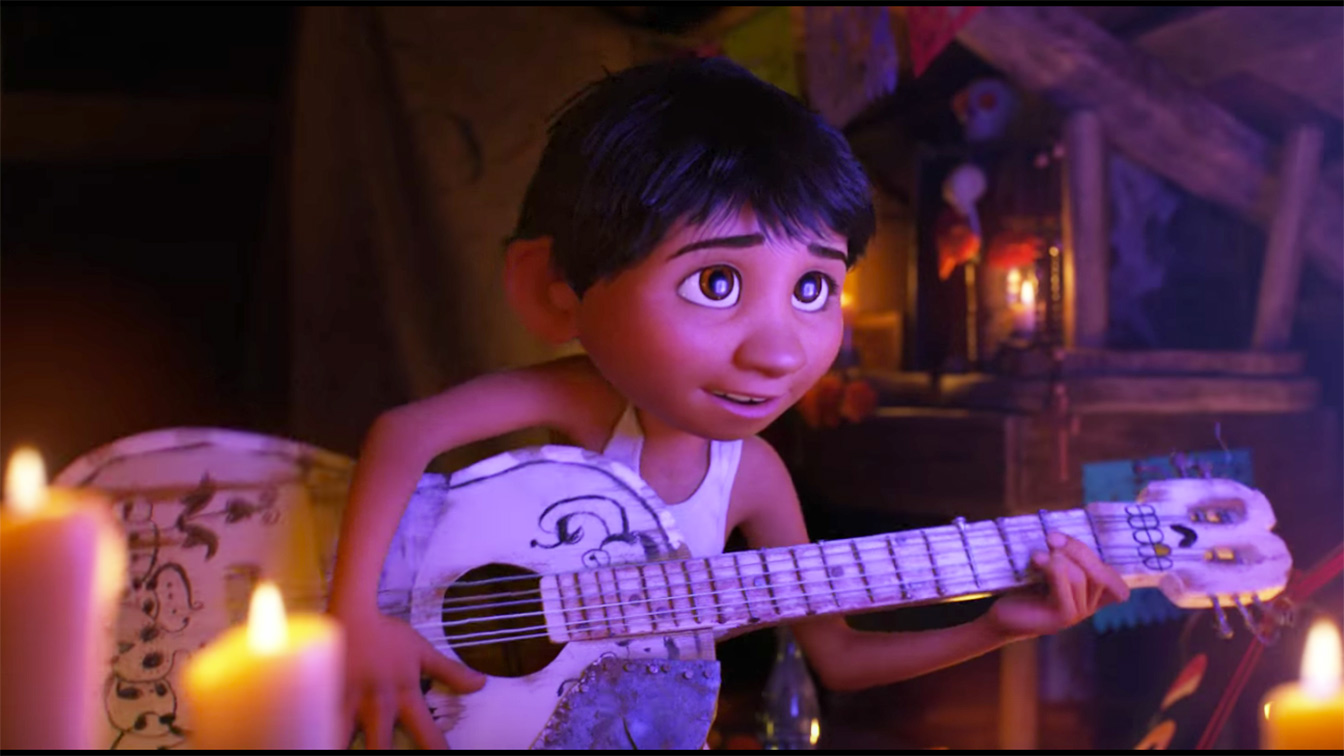
The film follows Miguel (well voiced by young Anthony Gonzalez), a musician, like his great-great-grandfather. The one no one is allowed to mention. The one whose face has been torn from the family photo. The one the whole family is supposed to forget.
Instead of being a musician, Miguel is supposed to make shoes, like the great-great-grandmother who taught herself to make shoes when her husband left her to pursue his dreams of being a musician.
But Miguel prefers music—who wouldn’t?—and “borrows” the guitar of the great, long-dead hometown hero Ernesto de la Cruz (Benjamin Bratt) so he can play in the talent show during the Dia de los Muertos celebration.
One thing leads to another and Miguel finds himself in the Land of the Dead.
There are a number of things Coco does quite right. Though its themes are reminiscent of other Pixar films—Ratatouille, in particular—the cultural execution is a welcome change in a long and Euro-centric list of movies.
The film is also characteristically gorgeous, many frames spilling over with vivid color and imagery.
Coco also tells a satisfying story that packs an emotional wallop. Like the animation giant’s 2009 masterpiece Up, Coco invests in elderly characters and celebrates death as a tragic but inevitable consequence of life.
The structure by now has become common, with too many notions borrowed from other Pixar films. Worse, the laughs are rarely hearty and the genuine emotion is saved for the climax leaving too much time spent with little serious audience connection.
That’s the tough thing about being Pixar, though, isn’t it? We’ve become so accustomed to treasures that we disregard a lovely, heartfelt piece of family entertainment. Coco is no Toy Story, but it’s a lovely film.
Damn, a lot of movies come out this week. I guess if you have to drown out the yammering of family or just sit still for a long while and digest, you have your pick of movies to help you accomplish your laudable goals. Let us help you pick!
Join us in The Screening Room to talk through this week’s new releases in theaters and home entertainment. We break down Justice League, Wonder, Lady Bird, The Square, Poor Agnes and Frank Serpico, plus the week’s BluRay, DVD and streaming releases.
Small town sociopath, isolated farmhouse on land littered with rusted out car carcasses, a basement freezer full of human heads—Poor Agnes has all the trappings of your garden variety serial killer flick.
All but one: Lora Burke.
Burke plays Agnes, a woman who knows what she likes.
The film plays out like the origin story of some unstoppable slasher, and that works pretty well. Director Navin Rameswaran complicates his narrative and Agnes’s life with a side trip into Stockholm syndrome territory.
Agnes spends her days either chopping wood or injecting men with a concoction featuring “rat poison, mostly.” But she takes a liking to would-be victim Mike (Robert Notman), a low-rent private investigator whom no one will miss.
Rather than dispatching him quickly, Agnes indulges her inclination to play God and see how well she can re-mold Mike in her own image. Things seem to go smoothly until their twosome becomes a threesome.
While Burke’s unapologetically convincing, Notman’s performance is less so. Maybe his metamorphosis is too truncated by James Gordon Ross’s script, or maybe Notman can’t manage to sell the transformation. Whichever, too often his behavior feels utterly false. What we needed out of Notman was a version of Patty Hearst, but his face is a blank slate, his actions inauthentic.
That’s a real problem for this film because a tangy villain can only carry a story so far. Burke’s turn commands attention. She’s unafraid to be profoundly unlikeable, but she’s never over-the-top. It’s an alarmingly natural, more alarmingly believable portrait of a psychopath.
On its surface, Wonder is about feeling like an outsider.
Auggie Pullman (Jacob Tremblay, proving that his remarkable turn in Room was no fluke) is about to start middle school. There’s anxiety enough in that, but this will be Auggie’s first “real school,” having spent his formative education being homeschooled by his more than capable mother (Julia Roberts).
But there’s more. Auggie suffers from a congenital malady which, after dozens of surgeries, leaves him with an unusually misshapen and scarred face. This is why he prefers to wear a space helmet whenever he’s in public.
To its enormous credit, Wonder makes Auggie’s plight universal. Doesn’t everyone entering middle school desperately fear some kind of ostracism? Doesn’t every parent fear the same for their tender youngster?
How much worse will it be for Auggie? Few parents will not recognize the sincerity in his mom’s plea as she sends her son off to his first day of real school: “Please, God, let them be nice to him.”
Roberts, whose work in recent years has radically outshone everything from the first couple decades of her career, offers a strong and believable center of gravity for both the Pullman family and the film.
Director Stephen Chbosky also co-wrote this adaptation of R.J. Palacio’s popular juvenile fiction book. Chbosky waded into similarly angst-ridden waters when he directed the screen version of his own novel Perks of Being a Wallflower, but with Wonder he manages to find an emotional truthfulness missing from his previous film.
Wonder is surprisingly—almost amazingly—understated, given the content. The film avoids many a tear-jerking cliché and sidesteps sentimentality more often than you might expect.
It’s also dishonest— well-meaning, but wildly dishonest. Conflicts are easily resolved, lessons quietly learned, comeuppance generally had and loose ends carefully tied.
Wonder is about as wholesome a movie as you will see, lacking even an ounce of cynicism, which certainly makes Auggie’s ordeal easier to bear. But it’s still a cinematic cop out.
Lady Bird, written and directed by Greta Gerwig, may be the most delightfully candid and refreshingly forgiving coming-of-age film I’ve seen.
The great Saoirse Ronan—because honestly, is there now or has there ever been a more effortlessly talented 23-year-old?—plays Christine “Lady Bird” McPherson. Uniformed senior at Sacramento’s Immaculate Heart, Lady Bird is a work in progress.
Ronan is surrounded by talent. Lucas Hedges (Manchester by the Sea) shines as a sweetly gawky budding thespian while, as Lady Bird’s devoted bestie Julie, Beanie Feldstein (Neighbors 2) is heart-achingly wonderful.
Tracy Letts, playwright turned go-to character actor, proves again his natural ability in his newer profession as LB’s softie father. But it’s Laurie Metcalf who matches Ronan step for step.
As Lady Bird’s tough, even scary, mother, Metcalf is near-perfect. I wouldn’t be surprised to see the Rosanne star nab her first Oscar nomination for a turn that’s brave, funny, hard to watch and painfully authentic.
Lady Bird’s greatest desire is to escape Sacramento—“the Midwest of California”—in favor of someplace, anyplace, with culture. Preferably a liberal arts college in NYC. But her grades, her mom and her family’s financial situation present some (often hilarious) obstacles.
Though the film is hardly a straight-up comedy, its irreverent humor is uproarious. I laughed louder and more often during Lady Bird than any film this year.
The plot and the comedy are less the point here than you might expect. They are really just a device Gerwig uses to explore adolescence and its characteristic stage of reinvention. She throws in the surprisingly accurate image of a family’s financial struggle to boot, just to make sure we never mistake this for a John Hughes film, or, God forbid, Perks of Being a Wallflower.
No, this is not a cheese-clothed indictment of all the ills facing adolescents. It’s Rushmore with less camp and more authenticity, and that’s got more to do with Gerwig than her formidable cast.
Though Lady Bird’s landscape is littered with coming-of-age tropes, there is wisdom and sincerity in the delivery. Gerwig offers genuine insight rather than nostalgia or, worse yet, lessons to be learned. The result ranks among the best films of the year.
We’re afraid of the woods. We likely always have been—the Brothers Grimm may have collected wooded tales of witches, elves and wolves both big and bad during the 1800s, but those stories had been passed down for generations.
Those who told the old fairy tales saw the forest as a mysterious place of wonder, temptation, confusion and danger.
Writing/directing team George Popov and Jonathan Russell follow that same bumpy trail into the woods with their first feature, Hex.
Made on little more than a thousand dollars, Hex proves the duo to be a competent set of craftsmen and effective storytellers.
Two soldiers separated from their companies in the 17th century during England’s Civil War chase each other into a deep forest. The rebel Thomas (William Young) is young, soft and open to the dark poetry and doom of witchcraft. He’s not long in the woods before he sees his true enemy is not the countryman behind him with his sword drawn.
Richard (Daniel Oldroyd) fights for King and Country, strident and single-minded, logic keeps him from believing until he has little choice.
Hex draws quick comparisons to Ben Wheatley’s 2013 experiment A Field in England, but where that film felt fanciful and indulgent (though entertaining), Hex feels a bit more like a stage play taken to the woods.
The film is slow-moving, sometimes frustratingly so. Though Popov and Russell’s technical skills are solid, their instincts for pacing and tension-building are less honed. The slight plot relies immensely on an atmosphere of supernatural dread for its success, but it’s here that the filmmakers have some trouble.
The flaw is hardly insurmountable. Even with sometimes obvious budget restrictions, the film looks good. Popov and Russell let light from a campfire spark the imagination, edging frames with shadowy dangers.
Hex sounds great, too, working the nerves with the effective noise of blades unsheathed or the diabolical tinker of a nearby brook, all enriched with Nino Russell’s appropriately bewitching score.
There is more happening here than you realize, and it’s to the filmmakers’ credit that you only recognize the film’s purpose when they are ready for you to do so. The result is a satisfying tale with more power than just magic.
That might be one of many iconic lines from The Blues Brothers, but it speaks to some of the great storylines in horror—sometimes misdirected, sometimes well-intentioned, always scary. Here we pick through the many, including the dozens of tried and true exorcism flicks, to zero in on those that are truly faithful to their calling to serve God, no matter the generally disastrous, often bloody results.
5. Red State (2011)
I actually got to talk to Kevin Smith about a year before Red State was released. Our official topic was his Smodcasts, but given my particular weakness for genre filmmaking, I veered the questions toward his forthcoming entrance into horror.
He told me: “For years I’ve called myself a filmmaker, but it’s not really true. Really I just make Kevin Smith movies. I’m at that stage where I could make a Kevin Smith Movie with my eyes closed. Let me see if I can make another movie.”
That other movie was Red State – an underrated gem. Deceptively straightforward, Smith’s tale of a small, violently devout cult taken to using the internet to trap “homos and fornicators” for ritualistic murder cuts deeper than you might expect. Not simply satisfied with liberal finger-wagging, Smith’s film leaves no character burdened by innocence.
Pastor Abin Cooper spellbinds as delivered to us by Tarantino favorite Michael Parks. Never a false note, never a clichéd moment, Parks’s award-worthy performance fuels the entire picture.
There’s enough creepiness involved to call this a horror film, but truth be told, by about the midway point it turns to corrupt government action flick, with slightly lesser results. Still, the dialogue is surprisingly smart, and the cast brims with rock solid character actors, including John Goodman, Stephen Root, Melissa Leo and Kevin Pollak.
Smith said at the time: “I think we have something. It’s creepy and very finger-on-the-pulse and very much about America.”
Agreed.
4. The Conjuring (2013)
Welcome to 1971, the year the Perron family took one step inside their new home and screamed with horror, “My God, this wallpaper is hideous!”
Seriously, it often surprises me that civilization made it through the Seventies. Must every surface and ream of fabric be patterned? Still, the Perrons found survival tougher than most.
Yes, this is an old-fashioned ghost story, built from the ground up to push buttons of childhood terror. But don’t expect a long, slow burn. Director James Wan expertly balances suspense with quick, satisfying bursts of visual terror.
Ghost stories are hard to pull off, though, especially in the age of instant gratification. Few modern moviegoers have the patience for atmospheric dread, so filmmakers now turn to CGI to ramp up thrills.
But Wan understands the power of a flesh and blood villain in a way that other directors don’t seem to. He proved this with the creepy fun of Insidious, and surpasses those scares with this effort.
Claustrophobic when it needs to be and full of fun house moments, The Conjuring will scare you while you’re watching and stick with you after. At the very least, you’ll keep your feet tucked safely under the covers.
http://www.youtube.com/watch?v=Vjk2So3KvSQ
3. Nothing Bad Can Happen (2013)
This film is tough to watch, and the fact that it is based on a true story only makes the feat of endurance that much harder. But writer-director Katrin Gebbe mines this horrific tale for a peculiar point of view that suits it brilliantly and ensures that it is never simply a gratuitous wallowing in someone else’s suffering.
Tore (Julius Feldmeier) is an awkward teen in Germany. His best friend is Jesus. He means it. In fact, he’s so genuine and pure that when he lays his hands on stranded motorist Benno’s (Sascha Alexander Gersak) car, the engine starts.
Thus begins a relationship that devolves into a sociological exploration of button-pushing evil and submission to your own beliefs. Feldmeier is wondrous—so tender and vulnerable you will ache for him. Gersak is his equal in a role of burgeoning cruelty. The whole film has a, “you’re making me do this,” mentality that is hard to shake. It examines one peculiar nature of evil and does it so authentically as to leave you truly shaken.
2. Frailty (2001)
“He can make me dig this stupid hole, but he can’t make me pray.”
Aah, adolescence. We all bristle against our dad’s sense of morality and discipline, right? Well, some have a tougher time of it than others.
Bill Paxton (who also directs) stars as a widowed country dad awakened one night by an angel—or a bright light shining off the angel on top of a trophy on his ramshackle bedroom bookcase. Whichever—he understands now that he and his sons have been called by God to kill demons.
Whatever its flaws— too languid a pace, too trite an image of idyllic country life, Powers Boothe—Frailty manages to subvert every horror film expectation by playing right into them. We’re led through the saga of the serial killer God’s Hand by a troubled young man (Matthew McConaughey), who, with eerie quiet and reflection, recounts his childhood with Paxton’s character as a father.
Dread mounts as Paxton drags out the ambiguity over whether this man is insane, and his therefore good-hearted but wrong-headed behavior profoundly damaging his boys. Or could he really be chosen, and his sons likewise marked by God?
1. The Exorcist
For evocative, nerve jangling, demonic horror, you will not find better than The Exorcist.
Slow-moving, richly textured, gorgeously and thoughtfully framed, The Exorcist follows a very black and white, good versus evil conflict: Father Merrin V Satan for the soul of an innocent child.
But thanks to an intricate and nuanced screenplay adapted by William Peter Blatty from his own novel, the film boasts any number of flawed characters struggling to find faith and to do what’s right in this situation. And thanks to director William Friedkin’s immaculate filming, we are entranced by early wide shots of a golden Middle East, then brought closer to watch people running here and there on the Georgetown campus or on the streets of NYC.
Then we pull in a bit more: interiors of Chris MacNeil’s (Ellen Burstyn) place on location, the hospital where Fr. Karras’s mother is surrounded by forgotten souls, the labs and conference rooms where an impotent medical community fails to cure poor Regan (Linda Blair).
Then even closer, in the bedroom, where you can see Regan’s breath in the chilly air, and examine the flesh rotting off her young face. Here, in the intimacy, there’s no escaping that voice, toying with everyone with such vulgarity.
The voice belongs to Mercedes McCambridge, and she may have been the casting director’s greatest triumph. Of course, Jason Miller as poor, wounded Fr. Damien Karras could not have been better. Indeed, he, Burstyn, and young Linda Blair were all nominated for Oscars.
So was Friedkin, the director who balanced every scene to expose its divinity and warts, and to quietly build tension. When he was good and ready, he let that tension burst into explosions of terrifying mayhem that became a blueprint for dozens of films throughout the Seventies and marked a lasting icon for the genre.