Tag Archives: entertainment

Classic Case

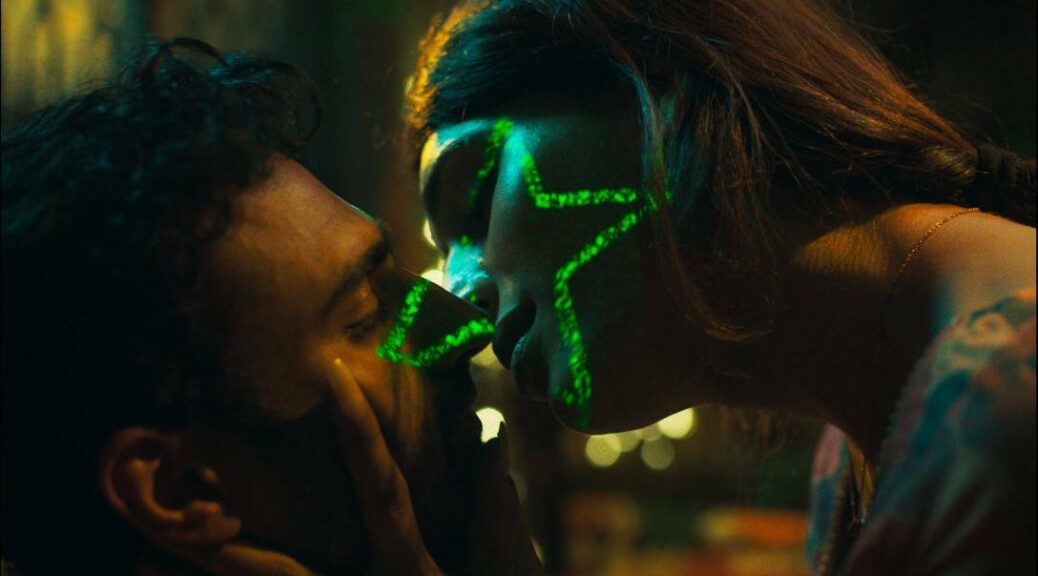
Carmen

by George Wolf

For this latest reimagining of the classic story, director Benjamin Millepied credits inspiration from Prosper Mérimée’s original novella from 1845, and Alexander Pushkin’s poem “The Gypsies” from 1824.

Flashing more modern vibrancy through culturally rich music and dance, this new Carmen arrives as a wonder of visionary composition that struggles to find an equally compelling connection to its characters.

The writing team of Loic Barrere, Alexander Dinelaris and Lisa Loomer crafts a surface-level tale of lovers on the run. Aidan (Paul Mescal) is a troubled Marine veteran volunteering on a night patrol along the Mexican border, while Carmen (Melissa Barrera) is trying to cross after the death of her mother. A violent altercation leads to casualties, and the two are soon trying to stay one step ahead of authorities.

Millepied (choreographer and co-star of Black Swan) knows his way around a dance number, getting an assist from flamenco specialist Marina Tamayo for sequences that sport some thrilling fluidity. The acclaimed talents of cinematographer Jörg Widmer (The Tree of Life, V for Vendetta) and composer Nicholas Britell (Moonlight, If Beale Street Could Talk) are also on full display, rounding out a veteran stable of technical skill that consistently lifts the film’s imagery and scope.

Mescal (Aftersun) continues to show a gift for quiet nuance, Barrera (In the Heights, Scream, Scream VI) finally breaks out of her reliance on posing, and the veteran Rossy de Palma (various Almodóvar projects) steals scenes as a savvy nightclub owner, but the script seems content to keep depth at a distance.

Pushkin’s centuries-old themes of noble savages and the tragedy of life are too often given a heavy hand, needing a rescue by the visual poetry on display.

This Carmen tells us “dancing will you heal you.” Indeed, it’s one of the cures for what ails a less than passionate romance.


CrackBerry to WhackBerry

BlackBerry

by George Wolf

So, a voice on the line says, “You have a collect call from ‘What the f%& is happening’!”

That’s not really the caller’s name.

He’s actually Jim Balsillie (a terrific Glenn Howerton), co-CEO of BlackBerry Limited, and he’s having yet another temper tantrum. The pairing of Balsillie’s bare-knuckled business sense with the tech genius of other CEO Mike Lazaridis (Jay Baruchel, perfectly awkward) made the company an early leader in the cell phone game, but things have started to unravel. Fast.

It’s a wild and often unhinged rise and fall, told with gleeful abandon by BlackBerry director and and co-writer Matt Johnson, who also co-stars as Doug Fregin, Lazaridis’s original business partner.

While operating a Canadian tech supply company called Research in Motion in 1996, Lazaridis and Fregin hatched the idea of utilizing North America’s unused bandwidth for a cellphone with built-in capability for email and messaging.

Balsillie, a Harvard-educated d-bag with self promotion tunnel vision, knew what the geeks had, and gave them his business street smarts in exchange for a big piece of the pie.

Johnson (Operation Avalanche) draws the battle lines early, framing the unfocused nerds with jittery, The Office-style camerawork amid chaotic workplaces while the calculating, take-no-prisoners suits live within crisp lines, confident movement and unforgiving architecture.

The colliding of worlds is engaging enough, but the delightfully sharp humor and first-rate ensemble (also including Michael Ironside) turn these based on true events into a rollicking, can’t-look-away slice of history.

There’s so much here that resonates – friendship, ambition, cutthroat capitalism and just feeling like an outcast. And at the root is the push and pull of commerce (Balsillie: “Are you familiar with the saying, ‘perfect is the enemy of good?”) vs. science (Lazaridis: “Well, ‘good enough’ is the enemy of humanity.”)

BlackBerry is a fast, funny and often thrilling ride, one that ends up worthy of both time spent and time capsule.

The Future Is Now

Still: A Michael J. Fox Movie

by George Wolf

For seven years after his initial diagnosis at the age of 29, Michael J. Fox was committed to hiding the signs of Parkinson’s disease.

He’s not at all interested in hiding anymore, and the inviting nature of his candor is a major reason why Apple TV’s Still: A Michael J. Fox Movie connects on such a warmly human level.

That really shouldn’t be a surprise. Since he rocketed to sitcom fame with Family Ties in the 1980s, Fox has remained a relentlessly likable guy. Short of stature but long on charm and comic timing, Fox hit superstardom with 85’s Back to the Future, then navigated the hits and misses to remain a staple of the big and small screen for decades.

Director Davis Guggenheim (An Inconvenient Truth, Waiting for Superman) anchors the film via his Q&A session with Fox, bringing life to the life story with a mix of subtle recreations and nimble editing.

As Fox reflects on his path to the Big Time, editor Michael Harte weaves in carefully selected scenes from Fox’s TV, movie and talk show work that illustrate the anecdotes with entertaining precision. It’s all a slick counterpoint to the reality of Fox’s health, which is acknowledged from the film’s opening minutes, when Fox tells of waking up with a trembling pinky and a “message from the future.”

His present now includes frequent physical therapy sessions, as well as numerous falls and injuries, but he accepts it with grace and self-effacing humor (which includes a priceless bit from an appearance on Curb Your Enthusiasm).

Fox also recounts his love story with wife Tracy Pollan, and the slices of his current home life with Tracy and their children make it easier to understand Fox’s eternally grateful attitude about how his life has turned out.

Fox has no use for pity. And he makes sure that your time spent with A Michael J. Fox Movie will only be inspiring and uplifting.

Merely Players

The Innocent

by George Wolf

With The Innocent (L’innocent), director/co-writer/co-star Louis Garrel takes Shakespeare’s declaration that “all the world’s a stage” to some clever and literal ends.

Or, he mines madcap laughs from a man trying to catch his mother’s new husband in a lie.

Or, he builds tension from a “sure thing” heist sure to go wrong.

Or maybe he’s just trying to comment on the needless games we sometimes play for love.

Really, the film’s biggest hurdle is keeping the whiplash at bay as it juggles all of these tones for just over 90 minutes. And for the most part its balancing act is successful, crafting a breezy and amusing take at all the untrue stories we tell.

Sylvie (Anouk Grinberg) teaches drama to prison inmates (as Garrel’s own mother did for many years), and falls in love with the incarcerated Michel (Roschdy Zem). They marry, which doesn’t thrill Sylvie’s adult son Abel (Garrel, who you may remember as Theo from The Dreamers), and once Michel is released, Abel sets out to prove to his mother that Michel is still up to no good.

Meanwhile, Abel and Clémence (Noémie Merlant, so good in Tár and Portrait of a Lady on Fire) stand delicately on the last rung of the friend zone, each seemingly waiting for the other to jump off.

Garrel blurs the line between acting and lying (to others and ourselves) with a slyly comical hand, amid pauses to remind us how crucial sincerity is to successful relationships.

Okay, that’s enough, now back to this zany caviar robbery!

American audiences may find The Innocent to be more of an acquired taste than those in Garrel’s native France, but anyone who dives in shouldn’t bail too quickly. Give this splendid cast time to pull all the threads together, and they’ll build a stage big enough for comedy, drama, romance and heart.

Come and Get Your Love

Guardians of the Galaxy Vol. 3

by Hope Madden and George Wolf

Even if James Gunn had forgotten that his Guardians of the Galaxy formula was plenty familiar, the way Dungeons and Dragons just repackaged it would serve as a winning reminder.

So for the finale of the Guardians trilogy, writer/director Gunn smartly adds some unexpected layers to the good-natured humor and superhero action.

How unexpected? Well, if you had existential tumult and Return of the Jedi homages on your bingo card, congratulations to you. But if you figured Peter Quill (Chris Pratt) as the catalyst, think again.

Gunn wants us to know that this whole story has been Rocket’s all along.

Peter is indeed still hurting from losing Gamora (Zoe Saldana) to memory loss, but it’s a threat to the life of Rocket (voice of Bradley Cooper) that gets him back with Drax (Dave Bautista), Nebula (Karen Gillan), Groot (voice of Vin Diesel) and Mantis (Pom Klementieff) – with yes, help from Gamora – for one last ride.

The mission? Stop the “High Evolutionary” (Chukwudi Iwuji) on his quest to program evolution until perfection is achieved. The themes are heady, with both echoes of the past and callouts to the current “burn it all down” crowd, but Gunn still finds plenty of room for goofy laughs, warm camaraderie, and real heart.

Plus, mean Gamora is so much more fun than righteous Gamora. Drax and Mantis continue to be a joyous mismatch of besties and Gillen’s deadpan delivery is maybe more funny in this episode than any other.

Gunn’s MCU sendoff retains his trademark mischievous humor and fondness for raucous violence. The action sequences here match anything Gunn has done previously, while Rocket’s origin story packs Volume 3 with an unexpected emotional wallop.

When Gunn joined the MCU for 2014’s first GoG episode, he made his silly mastery of the blockbuster known. With ruffian charm, Rocket and the gang deliver deeper, more believably touching chemistry now than they did then. Volume 3 is a fitting, emotional, madcap swan song.

George of the Rumble

Big George Foreman: The Miraculous Story of the Once and Future Heavyweight Champion of the World

by George Wolf

Sixteen words in that title, leaving little room for nuance or any shred of mystery about the tale being told. And it’s a perfect fit for a film that is content to just summarize a life like a Wikipedia timeline, choosing the safest, most easily digestible path.

After a brief flashback segment, director and co-writer George Tillman Jr. (Soul Food, Men Of Honor, Notorious, The Hate U Give) just ticks off the events of George Foreman’s life in simple, linear fashion.

He grew up poor in Houston, started boxing during his time in the Jobs Corps, won an Olympic Gold in 1968, won the heavyweight belt from Frazier in ’73, lost to Ali’s “rope a dope” strategy in ’74’s Rumble in the Jungle, quit to be full-time preacher in ’78, came back to the ring 10 years later and won the heavyweight championship again in 1994 at the age of 45.

All of that info is always a search engine away, but Tillman Jr. just regurgitates it onscreen, never embracing the chance to dig deeper or deliver any new insight.

And there are two great opportunities here. The first is George’s relationship with longtime mentor “Doc” Broadus, portrayed with heart and sensitivity by Oscar-winner Forest Whitaker. The second is Foreman’s conversion to a Man of God. Either one of these could have given the film a strong foundation to build around, and an easier route to getting audiences closer to the real Big George.

Khris Davis (Judas and the Black Messiah) beefed up considerably to play Foreman, and while he looks the part, fight sequences range from lackluster recreations to the WTF choice of a deep-faked Davis being inserted into real footage from Foreman’s 1991 bout with Evander Holyfield. Comical portrayals of both Muhammad Ali and Howard Cosell only feed a longing for the historical relevance of the 1996 doc When We Were Kings.

George’s rise to gold medals, heavyweight belts and best-selling grills has indeed been extraordinary. It deserves better than the ordinary treatment that comes from Big George Foreman.

Grown Up Girl and Boy Land

Joyland

by George Wolf

The feature debut from director and co-writer Saim Sadiq unveils an assured and often masterful technician, one able to convey a deep affection for the lives of his meaningful characters.

Joyland is a smart and deeply human drama, a treat for both the eye and the heart.

Haider (Ali Junejo) is the youngest son in a traditional Pakistani family. After a long period of unemployment, he finally lands a job. But while this seems like good news, it signals a seismic shift in his multi-generational family dynamic at home, starting with the family’s decision for Haider’s wife Mumtaz (Rasti Farooq) to give up the salon job she loves so she may stay home and assist with keeping house and children.

Haider will be joining the backup dancers in a Bollywood-style show led by the strong-willed Biba (Alina Khan), a trans woman. The pay is good, but Haider will have to tell his conservative father (Salmaan Peerzada) that he’ll be managing the theatre, not dancing in it, and avoid any mention of the star of the show.

But Haider’s biggest secret is his infatuation with the magnetic Biba, and the relationship that is budding between them.

Sadiq’s camera moves slowly and confidently, filling frames that are frequently static with mesmerizing dances of color, shadow, and light. Just what he does with a decorative light fixture’s effect on the room where Haider and Biba grow closer is a thrilling wonder of shot choreography.

Similarly, Sadiq’s script (co-written with Maggie Briggs) often speaks loudly through the silence of things left unsaid. Haider isn’t the only one here keeping secrets, and the film begins to ache with the longing for lives that seem hopelessly out of reach.

And yet somehow, the gripping conclusion arrives without any of the melodrama you might expect. And when it does, Joyland leaves a mark that also signals the arrival of its visionary and insightful filmmaker.

Black Magic Woman

The Love Witch

by Hope Madden

Anna Biller, everybody. Holy shit.

Wes Anderson with a Black Mass fetish and a feminist point of view, Biller wrote/directed/produced/edited/set-designed/costume-designed/music-supervised the seductive sorcery headtrip The Love Witch.

Elaine (Samantha Robinson – demented perfection) needs a change of scenery. Driving her red convertible up the seacoast highway toward a new life in northern California, her troubles – and her mysteriously dead ex-husband – are behind her. Surely, with her smart eyeshades and magic potions, she’ll find true love.

Shot in dreamy 35mm and produced in lurid Technicolor, the film achieves a retro aesthetic unparalleled in modern cinema. And yet, a mid-film cell phone and third act DNA evidence pulls you from the hip Sixties spell of burlesque shows and tea rooms – but don’t mistake this for anachronism. Instead, it fits perfectly into a narrative that sees a deranged lunatic embrace archaic gender roles with the rage of one already ruined by them.

Enough cannot be said for Biller’s imagination for detail – from the contents of a “witch bottle” to the retro look of every actor, the era-evoking flatness in line delivery to the excruciating art adorning Elaine’s walls.

The orgy of colors, textures and dessert treats signifies the sensual madness eating away at poor, narcissistic Elaine.

Biller’s casting sense is as keen. Every actor not only fully embraces the weirdness of Biller’s spell, but each looks like they just walked out of a Sears Roebuck catalog circa 1968.

Expect a loose confection of a plot, as Elaine molds herself into the ideal sex toy, winning and then tiring of her trophies. This allows Biller to simultaneously reaffirm and reverse gender roles with appropriately wicked humor.

Biller pulls thematically from her 2007 film Viva, but her epic knowledge of the sexual revolution era Black Magic Woman flicks (Oh, there are plenty: Mephisto’s Waltz, Season of the Witch, The Velvet Vampire) and her clear growth in her craft help The Love Witch exceed all expectations.


Fight the Team

Imagining the Indian: The Fight Against Native American Mascoting

by George Wolf

“We’ve been used for entertainment for so long, most Americans don’t even question it.”

Imagining the Indian is a documentary with a clear agenda and a specific target audience. It isn’t really interested in preaching to the choir, and it seems to realize there are those on the opposite side who view even broaching the subject as threatening some God-given right to tell others how to feel.

But in the middle, there’s a group that may indeed have never questioned why Native American team names and mascots need to be changed.

Imaging the Indian makes a clear and very convincing case.

In short, “It’s either racist or it’s not.” True enough, but directors Aviva Kempner and Ben West follow that early declaration with multiple historical and uniquely personal perspectives that repeatedly drive the point home.

Like Kempner’s 2019 doc The Spy Behind Home Plate, the approach is far from stylish, but heavy on substantial persuasion, usually from those most directly affected by the demeaning mascots, team names and group cheers.

While veteran sports journalist (and co-producer) Kevin Blackistone finds no shortage of sports fans who dig in their cleats and yell “It’s just a name!,” we see a series of Native Americans who have receipts. And they say it honors nothing but a continued “white fantasy” of a people swept out of the way for hundreds of years.

“I’m so past arguing. This is life and death for us.”

Really? Life or death? Yes, expect more receipts.

Kempner and West also highlight the leadership of Native American activist (and 2014 Medal of Freedom winner) Suzan Shown Harjo, and offer solid rebuttals to the frequent charges of “erasing history” and those misleading polls which seem to suggest Native American support for the controversial mascots.

I’m actually writing this review while a Cleveland Guardian’s game plays in the other room. And while it’s encouraging to note that the Cleveland Indians/Chief Wahoo die-hards are becoming less and less vocal, I know first hand that plenty still proudly resist the name change as some heroic stand against “wokeness.”

But with the Washington football team finally ditching “Redskins” (a name singled out as the most blatantly offensive of all), progress is being made, which is why it may be the most opportune time for Imaging the Indian to get this wider release.

Can a documentary actually be the tipping point for a new conventional wisdom, and a catalyst for permanent change?

Ask Sea World.

Donna Corleone

Mafia Mamma

by George Wolf

So a suburban L.A. mom named Kristin (Toni Collette) is handpicked to be the new boss of a mafia family in Italy? Man, that’s crazy. How’d that happen?

“They made me an offer I couldn’t refuse.”

It’s actually surprising Kristin doesn’t say that in Mafia Mamma, a film that’s built on exactly that same type of obvious, forced humor.

Kristin has barely had to time to cry about her son leaving for college when she catches her husband Paul (Tim Daisch) in the act with a younger woman. Then, while her head is spinning about the future of her marriage, Kirstin hears from the mysterious Bianca (Monica Belluci).

Turns out Kristin’s estranged grandfather was head of the Balbano crime family, and was just assassinated by the rival Romano clan. But Kristin (maiden name: Balbano) is only told grandpa is dead, and she must come to Italy to settle his affairs.

As Jenny (Sophia Nomvete), the oversexed best friend (c’mon, you knew there’d be an oversexed best friend) implores Kristin to have an “Eat, pray, f@#k” vacation, she’s quickly juggling suave suitors and surprising truths.

Bianca was General for Don Guiseppe Balbano (Alessandro Bressanello), and she’s committed to carrying out the Don’s last order: that Kristin take over the family.

Fish-out-of-water hijinx ensue, with director Catherine Hardwicke weakly juggling the mob tropes amid some well-intentioned but heavy handed reminders about how workplace culture disrespects aging women.

Collette is likable as always, and Belucci is smoldering as always, but the script they’re given can’t rise above the TV backgrounds of the writing team. Convoluted, nonsensical and never more than mildly amusing, Mafia Mamma is about as lively as Luca Brasi.