Be Prepared

Scouts Guide to the Zombie Apocalypse

by Hope Madden

“Do you know what’s cooler than cool? Scouting!”

OK, maybe not, but Boy Scouts are exactly the people you need on your zombie survival team. Who doesn’t know that? They know how to tie knots properly, they can forage, find their way around in the woods, and they’re handy. They’re prepared. Duh.

Director Christopher Landon, working with a team of writers, puts this wickedly logical premise into action with his new horror comedy Scouts Guide to the Zombie Apocalypse.

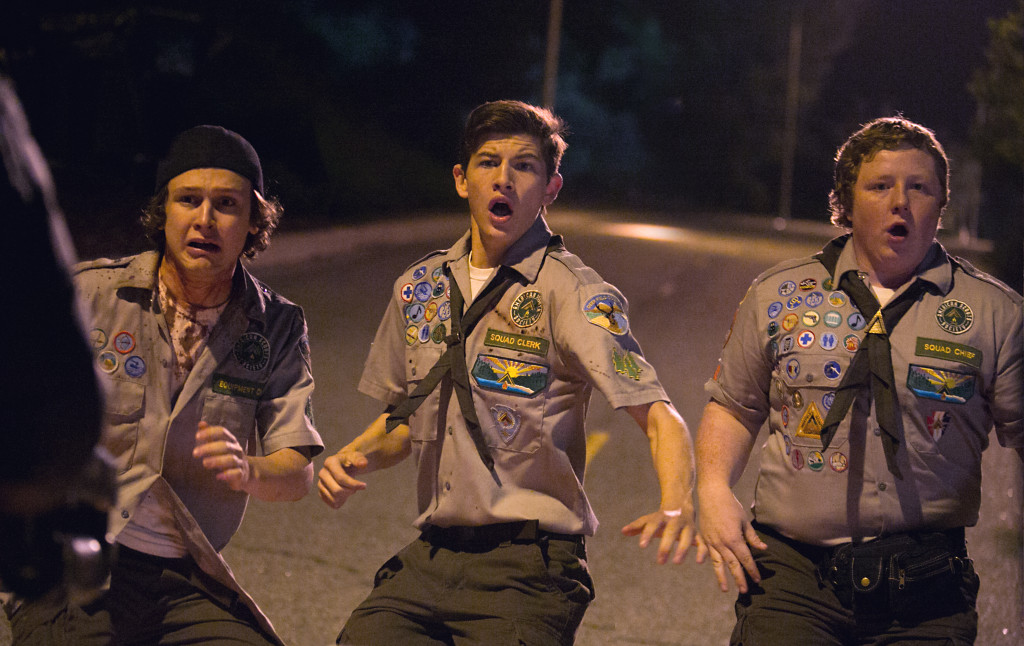
The only three scouts left in Scout Leader Rogers’s (a characteristically wacky David Koechner) troop are at a crossroads. Augie (Joey Morgan) thinks scouting is the best. “Scouts forever!”

Carter (Logan Miller) wants to ditch the uniforms and badges before their high school reputations are ruined forever. “Junior year is the year all the girls become sluts!”

Ben (Tye Sheridan) is torn between both really convincing arguments.

And then zombies overrun the town and they’re glad 1) they weren’t invited to the super-secret cool kids’ party, and 2) they have mad scouting skills.

After a series of really impressive dramatic turns (The Tree of Life, Mud, Joe), Sheridan shoulders the lead in this coming-of-age comedy quite well. He’s a talented actor, able to fill out what could have been a one-dimensional good guy role.

Both Miller and Morgan fit the bill as the goofball sidekicks, while pros like Koechner and Cloris Leachman fill out the rank and putrid ensemble. (Not the actors – their characters.)

The film will win no feminism badges, but a story told from the point of view of three 15-year-old boys should probably be preoccupied with boobs and other assorted whatnot.

This is not a family film, though – make no mistake. This is definitely an R-rated movie, but for all its juvenile preoccupations and vulgar body horror, a childlike sweetness runs through it that keeps it forever fun to watch.

Says Augie upon entering a girl’s bedroom, “It smells like pixie stix and hope in here.”

Cleverly written, directed with a keen eye toward detail and pacing, brimming with laughs, gore, friendship, and dismembered appendages – but utterly lacking in cynicism or irony – it’s a blast of a film with a lot to offer.

Verdict-3-5-Stars

Simply Complex

The Prime Ministers: Soldiers and Peacemakers

by George Wolf

Director Richard Trank follows up 2013’s The Pioneers with part two of his The Prime Ministers documentaries, Soldiers and Peacemakers, a less theatrical but equally determined look at Israeli history.

In truth, it is a film which stretches the definition of “documentary” to the breaking point. Calling it a lecture or presentation might be more suitable, as it consists entirely of thoughts from Israeli diplomat and author Yehuda Avner punctuated with historical still photos and news footage.

Trank eschews the celebrity voiceovers he utilized in The Pioneers for a more basic approach, which amounts to both a positive and a negative. While there’s no distracting gimmickry of Sandra Bullock providing the voice of Golda Meir, hearing from anyone other than Avner eventually becomes long overdue.

From the creation of separate Jewish and Arab states in 1947 to more latter-day tensions with Syria, Avner, and only Avner, dissects how the different Israeli Prime Ministers have made their historical marks.

That’s not to throw shade at his credentials, but when you hear Avner stress how complicated the Middle East situation is, you realize a great way to illustrate that would be to include other viewpoints.

Trank doesn’t, and Soldiers and Peacemakers becomes a detailed, overlong sermon to the choir.


Verdict-2-5-Stars


Day 30: The Exorcist

The Exorcist (1973)

For evocative, nerve jangling, demonic horror, you will not find better than The Exorcist.

Slow-moving, richly textured, gorgeously and thoughtfully framed, The Exorcist follows a very black and white, good versus evil conflict: Father Merrin V Satan for the soul of an innocent child.

But thanks to an intricate and nuanced screenplay adapted by William Peter Blatty from his own novel, the film boasts any number of flawed characters struggling to find faith and to do what’s right in this situation. And thanks to director William Friedkin’s immaculate filming, we are entranced by early wide shots of a golden Middle East, then brought closer to watch people running here and there on the Georgetown campus or on the streets of NYC.

Then we pull in a bit more: interiors of Chris MacNeil’s (Ellen Burstyn) place on location, the hospital where Fr. Karras’s mother is surrounded by forgotten souls, the labs and conference rooms where an impotent medical community fails to cure poor Regan (Linda Blair).

Then even closer, in the bedroom, where you can see Regan’s breath in the chilly air, and examine the flesh rotting off her young face. Here, in the intimacy, there’s no escaping that voice, toying with everyone with such vulgarity.

The voice belongs to Mercedes McCambridge, and she may have been the casting director’s greatest triumph. Of course, Jason Miller as poor, wounded Fr. Damien Karras could not have been better. Indeed, he, Burstyn, and young Linda Blair were all nominated for Oscars.

So was Friedkin, the director who balanced every scene to expose its divinity and warts, and to quietly build tension. When he was good and ready, he let that tension burst into explosions of terrifying mayhem that became a blueprint for dozens of films throughout the Seventies and marked a lasting icon for the genre.

Remember the stories of moviegoers fleeing the theatre, or fainting in the aisles midway through this film? It seemed like hype then, but watch it today, experience the power the film still has, and you can only imagine how little the poor folks of the early 1970s were prepared.

Even after all this time, The Exorcist is a flat-out masterpiece.

Listen weekly to MaddWolf’s horror podcast FRIGHT CLUB. Do it!

So Much for Brand Names

Our Brand is Crisis

by Hope Madden

In 2005, with her film Our Brand is Crisis, documentarian Rachel Boynton unveiled the puppeteering that American political-strategists-for-hire undertake the world over. Her film followed James Carville’s team as they set their sights on putting their candidate in office during Bolivia’s 2002 presidential elections. With insight, cynicism, mirth and horror she detailed their “no wrong but losing” efforts – and its bloody aftermath – breathtakingly painting the way competition utterly eclipsed the good of a nation.

Director David Gordon Green takes a stab at updating Boynton’s tale, adapted by the generally quite wonderful Peter Straughan (Frank, Tinker Tailor Soldier Spy). They enlist Sandra Bullock as “Calamity” Jane Bodine, a longtime political strategist who, after a series of embarrassing losses and a spate of even more embarrassing behavior, has retired from the biz.

But she’s pulled out of retirement – What? No way! What’s the lure? It’s not the lame duck Bolivian presidential candidate supported by former colleague Nell and her partner Ben (Ann Dowd and Anthony Mackie – both embarrassingly underused). No, it’s the involvement of old nemesis Pat Candy (Billy Bob Thornton – the spitting image of Carville), lead strategist for the leading candidate.

An unkempt Bullock and slickly creepy Thornton offer fiery chemistry, and as long as they share the screen, Our Brand is Crisis captivates. But the film can’t decide whether it’s a political comedy, a change-of-heart drama, or an underdog thriller.

While Straughan is an almost sure bet, Green’s unpredictable thumbprint as director is more of a question mark. His best films blend comedy and drama with an almost poetic balance, but he cannot find his footing here.

Straughan’s uncharacteristically muddled writing sinks sharply comical jabs at our political machinery with an undercooked conscience, a patronizing representation of Bolivians, and an oh-so-tired White Savior routine.

Although Scoot McNairy is a hoot.

In retrospect, it’s hard to explain the hot mess that is Our Brand is Crisis. It had all the elements it needed to be a winner – talented director, wonderful writer, heavy-hitting cast. Sometimes, though, even a sure bet comes up a loser.

Verdict-2-5-Stars

Day 29: The Woman

The Woman (2011)

OK, Halloween’s almost here. It’s time to get real. And by that we mean real nasty.

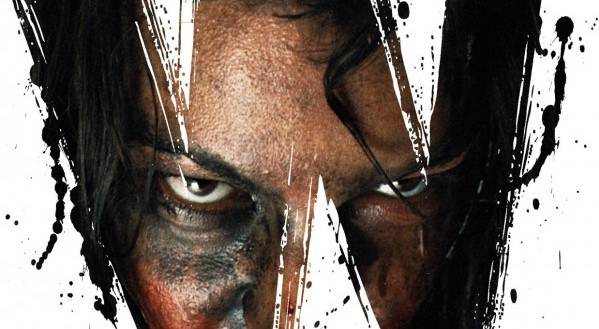
There’s something not quite right about Chris Cleese (an unsettlingly cherubic Sean Bridgers), and his family’s uber-wholesomeness is clearly suspect. This becomes evident once Chris hunts down a feral woman (an awesome Pollyanna McIntosh), chains her, and invites the family to help him “civilize” her.

The film rethinks family – well, patriarchy, anyway. Notorious horror novelist and co-scriptor Jack Ketchum may say things you don’t want to hear, but he says them well. And director Lucky McKee – in his most surefooted film to date – has no qualms about showing you things you don’t want to see. Like most of Ketchum’s work, The Woman is lurid and more than a bit disturbing. Indeed, the advanced screener I watched came in a vomit bag.

Aside from an epically awful performance by Carlee Baker as the nosey teacher, the performances are not just good for the genre, but disturbingly solid. McIntosh never veers from being intimidating, terrifying even when she’s chained. Bridgers has a weird way of taking a Will Ferrell character and imbibing him with the darkest hidden nature. Even young Zach Rand, as the sadist-in-training teen Brian, nails the role perfectly.

Nothing happens in this film by accident – not even the innocent seeming baking of cookies – nor does it ever happen solely to titillate. It’s a dark and disturbing adventure that finds something unsavory in our primal nature and even worse in our quest to civilize. Don’t even ask about what it finds in the dog pen.

Listen weekly to MaddWolf’s horror podcast FRIGHT CLUB. Do it!

Miss Wiig If You’re Nasty

Nasty Baby

by George Wolf

So, does Nasty Baby live up to its title?

No, not really.

You won’t find any devil child on a bloody rampage, or any precocious toddler cracking dirty jokes with the help of a celebrity voiceover.

Instead, writer/director Sebastian Silva (The Maid, Crystal Fairy and the Magical Cactus) delivers a semi-autobiographical slice of adulthood that keeps you cleverly off balance until it makes a drastic narrative decision that is likely to win it as many detractors as it does converts. Indeed, Silva has said the Toronto Film Festival was so turned off by the third act, it rejected the film entirely.

The “Nasty Baby” is actually a video project that Freddy (Silva) is hoping to debut at a New York gallery. But lately, he’s been trying to secure a different sort of arrival.

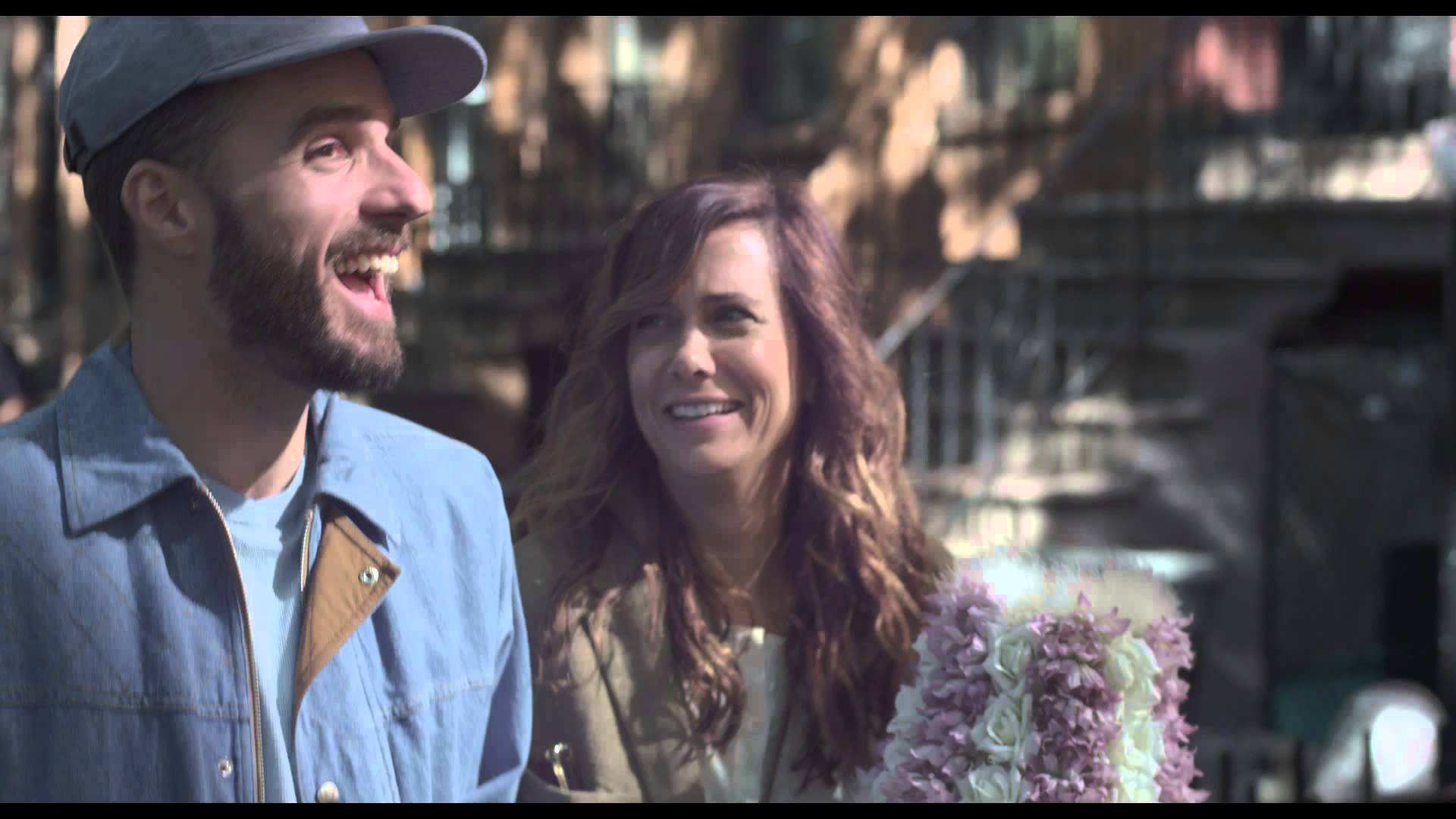
Freddy and his live-in boyfriend Mo (Tunde Adebimpe) want a baby, and their friend Polly (Kristen Wiig) wants to help, but after several tries at artificial insemination, Freddy’s sperm count is found to be a bit low. The obvious answer is for Mo to step up, but he is having reservations about such a commitment.

Meanwhile, a small annoyance in their Brooklyn neighborhood is slowly turning into something bigger. A local resident who calls himself “The Bishop” is making noise much too early in the morning, shouting at Freddy, and getting aggressively friendly with Polly.

Is he a harmless nut fighting gentrification, or a potentially dangerous threat?

The gradual manner in which The Bishop affects the lives of the three main characters is Silva’s skillful device for upsetting the conventions usually seen in this genre. Nasty Baby may be a difficult film to love, but that is precisely what makes it effective.

A loose, improvisational script, subtle direction and finely drawn performances draw you into a recognizable neighborhood where you feel comfortable – until you don’t.

There are countless films you want badly to like, but know in your heart they don’t earn it. Nasty Baby sits proudly on the opposite pole, inviting your scorn until you realize it’s gotten completely under your skin.

Verdict-3-5-Stars


… or Consequences

Truth

by Hope Madden

James Vanderbilt’s Truth is hardly the first film to point out the folly of marrying journalism and profit. From Sidney Lumet’s 1976 masterpiece Network to last year’s creepily spectacular Nightcrawler, cinematic history is littered with brilliant examples of this disastrous partnership.

Truth stands apart for two reasons. 1) The recent history lesson is, in fact, a real life event, and 2) Cate Blanchett stars.

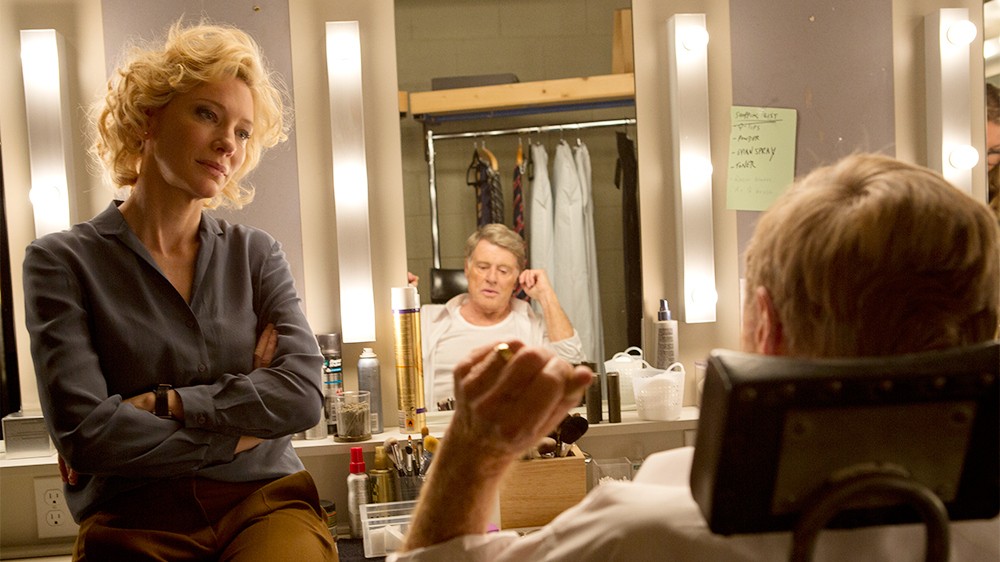
The film is at its best as an excavation of the bits and pieces of a 2004 story produced by Mary Mapes (Blanchett) and reported by Dan Rather (Robert Redford) for Sixty Minutes II, a now-defunct Wednesday night airing of the CBS news program.

In 2004, Mapes – having recently broken the story of Abu Ghraib prisoner abuse – chose to dig in to George W. Bush’s less-than-impressive Texas Air National Guard records. It was the middle of an election during which his opponent John Kerry’s military record was being “swift boated.” It was also the dawn of an age in journalism: make enough noise about an inconsequential detail and the story itself becomes nothing but background noise.

Vanderbilt’s screenplay, based on Mapes’s book “Truth and Duty: The Press, the President, and the Privilege of Power,” chronicles both the details of the reporting and the larger machinations of political power-wielding and corporate gutlessness, landing on some tragic consequences for a population interested in the truth.

Conservative bloggers insisted Mapes used forged documentation – a fact that could never be 100% corroborated or dispelled – and in one of the ugliest scenes of corporate media overreaction and cowardice, CBS fired Mapes and her team and forced Dan Rather into disgraced retirement.

Like Vanderbilt’s screenplay for the David Fincher film Zodiac, Truth is alive with details. Unfortunately, Fincher’s skill behind the camera gave Zodiac the compelling pull of a mystery, where Vanderbilt’s focus waffles between minutia and big picture without an elegant flow.

There are moments of real greatness here, especially as the story begins to crumble before Mapes’s eyes, and decisions made in the heat of story construction come back to haunt her. Basically, Blanchett is perfect, even when the writing fails her, even when the direction feels underwhelming. She’s fiery and raw, creating a character who is naturally in battle at all times.

Redford, on the other hand, comes casually to Dan Rather. He does not look the part. He looks like Robert Redford, which is curious given that he’s playing a public figure. But it isn’t long into the performance that you find an understated, dignified man whose professionalism and scruples have fallen out of fashion.

The film is a scary, flawed, but fascinating look at a frighteningly flawed and fascinating business.

Verdict-3-5-Stars

Day 28: Alleluia

Alleluia (2015)

For a lot of horror fans, French cinema is the way to go. But just north of that border is a country making a name for itself in genre filmmaking, thanks in part to the work of Belgian writer/director Fabrice Du Welz.

In 2004 he released the exquisite Calvaire, marking himself a unique artist worth watching. Ten years later he revisits the themes of that film – blind passion, bloody obsession, maddening loneliness – with his newest effort, Alleluia. Once again he enlists the help of an actor who clearly understands his vision.

Laurent Lucas plays Michel, a playboy conman who preys upon lonely women, seducing them and taking whatever cash he can get his hands on. That all changes once he makes a mark of Gloria (Lola Duenas).

Fans of Calvaire may remember that name. Is there a connection? Du Welz is tantalizingly vague about the specific relationship between Alleluia and Calvaire, although certain sets (a rustic, wooden cross, for instance) beg loads of questions.

Like 1969’s Honeymoon Killers and 2006’S Lonely Hearts, Alleluia is loosely based on the acts of American serial killers Martha Beck and Raymond Fernandez.

Lucas looks like an entirely different man this time around, and Du Welz’s close camera and off angles exaggerate the actor’s teeth, nose and height in ways that flirt with the grotesque. Likewise, the film dwells on Duenas’s bags and creases, heightening the sense of unseemliness surrounding the pair’s passion.

Duenas offers a performance of mad genius, always barely able to control the tantrum, elation, or desire in any situation. Her bursting passions often lead to carnage, but there’s a madcap love story beneath that blood spray that compels not just attention but, in a macabre way, affection.

Slow, atmospheric, and shot in grainy 16mm, Alleluia asks for your patience, but it repays you for that investment. It’s a film busting with desperation, jealousy, and the darkest kind of love.

Listen weekly to MaddWolf’s horror podcast FRIGHT CLUB. Do it!

Day 27: Kill List

Kill List (2011)

Never has the line “Thank you” had a weirder effect than in the genre bending adventure Kill List.

Hitman Jay (a volcanic Neil Maskell) is wary to take another job after the botched Kiev assignment, but his bank account is empty and his wife Shel (an also eruptive MyAnna Buring) has become vocally impatient about carrying the financial load. But this new gig proves to be seriously weird.

Without ever losing that gritty, indie sensibility, Ben Wheatley’s fascinating film begins a slide in Act 2 from crime drama toward macabre thriller. You spend the balance of the film’s brisk 95 minutes actively puzzling out clues, ambiguities and oddities. (The often impenetrable accents don’t exactly help with this sleuthing). The “What the hell is happening?” response to a film is rarely this satisfying.

As Kill List drifts toward its particular flavor of horror, Wheatley pulls deftly from some of the most memorable films of a similar taste. But because the less you know about this film the more fascinating it is, I won’t cover those here except to say: Nicely done!

Performances are disconcerting but well played. Michael Smiley, in particular, offers an outstanding supporting turn as the likeable mate. His longing, good nature, and conflicted religious leanings make not only for an intriguing gun-for-hire, but also an emotional anchor for the film.

For those looking for blood and guts and bullets, Kill List will only partially satisfy and may bewilder by the end. But audiences seeking a finely crafted, unusual horror film may find themselves saying thank you.

Listen weekly to MaddWolf’s horror podcast FRIGHT CLUB. Do it!

Day 26: The Orphanage

The Orphanage (2007)

Some of the world’s best horror output comes from distant lands – like this gem from Spain.

Laura (Belén Rueda) and her husband reopen the orphanage where she grew up, with the goal of running a house for children with special needs – children like her adopted son Simón, who is HIV positive. But Simón’s new imaginary friends worry Laura, and when he disappears, it looks like she may be imagining things herself.

This may seem like a well worn tale at first glance: Is the distraught mother losing her mind, as those around her assume, or is something supernatural afoot? But it’s director Juan Antonio Bayona’s understated approach, along with Rueda’s measured performance and Óscar Faura’s superb cinematography, that buoy the film above the ordinary ghost story.

A scary movie can be elevated beyond measure by a masterful score and an artful camera. Because Bayona keeps the score and all ambient noise to a minimum, allowing the quiet to fill the scenes, he develops a truly haunting atmosphere. Faura captures the eerie beauty of the stately orphanage, but does it in a way that always suggests someone is watching. The effect is never heavy handed, but effortlessly eerie.

The Orphanage treads familiar ground, employing such iconic genre images as the lighthouse, scary dolls, scarecrows, a misshapen child – not to mention the many and varied things that go bump in the night – but it does so with an unusual integrity. Creepy images from early in the film are effectively replayed in the third act to punctuate the very real sense of dread Bayona creates throughout the film. While most of the horror is built with slow, spectral dread, there are a couple of outright shocks to keep the audience guessing.

One of the film’s great successes is its ability to take seriously both the logical, real world story line, and the supernatural one.

Screenwriter Sergio Sánchez doesn’t shortchange his characters or the audience by dismissing Laura’s anguished state of mind, or by neglecting the shadowy side of his tale. The Orphanage is reminiscent of producer Guillermo del Toro’s The Devil’s Backbone, as well as The Others, and even of the classic The Innocents.

The Orphanage has more than the unsettling spectral images of children in common with these films; it boasts a sustaining, powerful female performance. Rueda carries the film with a restrained urgency – hysterical only when necessary, focused at all times, and absolutely committed to this character, who may or may not be seeing ghosts.

A good ghost story is hard to find. Apparently you have to look in Spain.

Listen weekly to MaddWolf’s horror podcast FRIGHT CLUB. Do it!

Hope Madden and George Wolf … get it?