Category Archives: Outtakes

Movie-related whatnot

A Mission Not Worth Taking

Resurrection Road

by Daniel Baldwin

Genre mash-ups are a tricky thing. A consistent tone is hard enough to maintain when one is working in one genre, but once you add any additional genres into the mix, the odds of things going off of the rails increase exponentially. More often than not, they tend to fall apart. After all, for every From Dusk Till Dawn or Sinners, you have a Cowboys & Aliens or an Abraham Lincoln: Vampire Hunter.

Writer/director Ashley Cahill’s Resurrection Road is a genre mash-up, melding a Civil War men-on-a-mission tale with a heavy dose of supernatural horror. A squad of Black Union soldiers is tasked with a deadly clandestine mission to take out the heavy cannons at a nearby fort so that the army can safely approach it a few days later. It’s effectively a suicide mission and one that the men are blackmailed into accepting. One that would be impossible enough on its own in a standard war actioner but is now made even more impossible with the additional supernatural threat at work.

Malcolm Goodwin (iZombie, Reacher) is our lead and, as always, his presence alone elevates the material. His protagonist, Barrabas, is the most complex and interesting character in the film and Goodwin does everything in his power to carry Resurrection Road across the finish line. It’s not enough.

This isn’t the first time someone has attempted to craft a Civil War-era horror/action hybrid. Alex Turner’s Dead Birds attempted something similar a couple decades back. Making any sort of period piece on a low budget is a tall order, as one has to not only get the dialogue right, but also the production design. Resurrection Road unfortunately comes up short in both areas.

Fans of the ever-underrated Goodwin might still want to check this out, as he gives it his all. Folks who really enjoy period piece horror might also find something of interest here. Otherwise, it is a hard film to recommend. There’s always something to be admired in a project that’s reach exceeds its grasp, but in the end, this film just doesn’t measure up.

Stab Me With a Spoon

Fear Street: Prom Queen

by George Wolf

If you’ve been waiting for Netflix to bring their bloody Fear Street fun to the 1980s, Prom Queen is here to gag you with a spoon (or stab you with a hatchet). But after some satisfying time traveling to the 90s, the 70s, and 1666, part four of the series proves the devil is in the details.

Really, one big detail.

After adapting the original trilogy of R.L. Stine’s Fear Street books, writer/director Leigh Janiak gets only an executive producer credit here, and her absence stands out like a new zit on the night of the big dance.

It’s 1988 in the cursed town of Shadyside, and outcast Lori Granger (India Fowler) tells us she is running for Prom Queen. Seems the town is still whispering about what Lori’s Mom did to her Dad years ago, and Lori wants to prove her worth. Standing in the way? Only Queen Bee Tiffany (Fina Strazza) and her “Wolfpack.”

That, plus the masked, red poncho-wearing marauder who starts picking off the Prom Queen candidates one by one.

Director and co-writer Matt Palmer provides the requisite kills, but can never capture the fun that has made Fear Street such a blast to visit. To start with, the time stamp is off. Where’s the big hair, the slang and the fashions from the late 80s? The production has also switched music supervisors, leaving us with needle drops that are a few years off the mark.

The homages to classic horror, Heathers and Mean Girls seem to be here more as an expected requirement than an understood assignment. Plus, the killer’s identity is not much of a surprise while solid performers such as Katherine Waterston and Lily Taylor are wasted with shallow, throwaway roles.

Is there an After Prom? Maybe that’s where the fun is.

Get Your Drink On

Fountain of Youth

by George Wolf

Knock, knock.

Who’s there?

Bab’s uvula.

Bab’s uvula who?

I don’t know, Babs, but I do know this: if you’re going to decipher the map to the fountain of youth, you’ve got to raise the wreck of the Lusitania and grab the long-lost Rembrandt painting that’s still in the ship’s safe.

So they do that, just like it was a random Tuesday, which clues you in to how ridiculous Apple TV’s Fountain of Youth can get. But it is pretty fun ridiculousness, at least for a while.

Years ago, Luke Purdue (John Krasinski) and his sister Charlotte (Natalie Portman) went on many adventures with their archeologist Dad. But now Charlotte is a divorced Mom working as an art curator who – according to her brother – could use a bit of excitement.

And Luke has just the thing. Billionaire Owen Carver (Domhnall Gleeson) has hired Luke to locate the Fountain of Youth. Owen is dying of liver cancer, and since he can afford health care, he’s financing the expedition in hopes of finding a cure and drinking from it.

So they’re off to raise wrecks and piece together clues, with Luke cracking wise, Charlotte struggling to be the voice of reason, and the whole team trying to stay one step ahead of the super sexy Esme (Eiza González) and her group committed to protecting the legendary Fountain.

Yes, James Vanderbilt’s script is lousy with Indiana Jones, National Treasure and Da Vinci Code inspirations – along with the explanatory dialog that seems required of streaming releases. But, director Guy Ritchie’s snappy direction and the chemistry of this veteran cast break down your impulse to write the whole thing off. There’s action, derring-do, mystery solving, and enough archeological super-heroics to make you wonder if this was some discarded idea for an Indy sequel.

And as you’re wondering how they’re going to get out of the adventure corner they’ve painted themselves into, along comes act three to deliver a pretty shameless Raiders of the Lost Ark imitation. I know, that was decades ago, but come on.

Stanley Tucci’s late cameo cements the intention to continue these adventures with future films, which could be promising. Krasinski makes a likable hero, his flirting with González gives off frisky sparks and Portman classes up the script’s attempts to just make her the wet blanket.

Keep the action and the will-they-or-won’t-they sparring between Luke and Esme, beef up Charlotte’s character and for Lord’s sake stop raiding the crypts of other classic adventure films.

Then you might just have something, Babs.

That’s His Name, Don’t Wear it Out

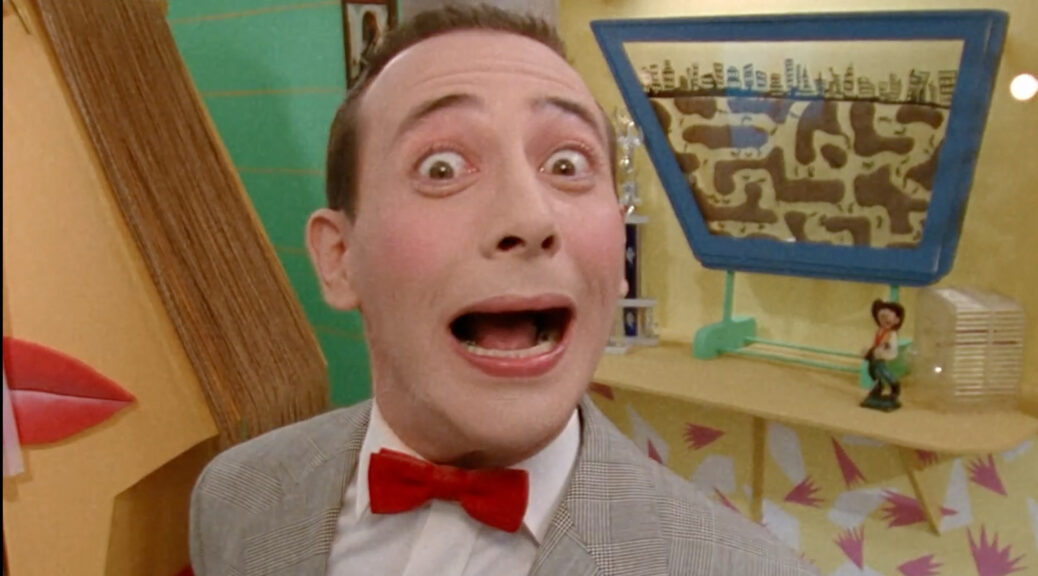
Pee-wee as Himself

by Hope Madden

If there’s one thing Matt Wolf’s 2-part documentary Pee-wee as Himself does, it reminds you what a cultural phenomenon Pee-wee Herman was in the 80s. Movies to TV to MTV to toys to talk shows, he was everywhere and he was beloved by children, college kids, and adults alike.

Who would have guessed that this goofy, bow-tied man-child could steal so many hearts? Or how decidedly and abruptly it could all have ended?

The filmmaker walks an interesting line. The Pee-wee story seems custom-made for a rags-to-riches-to-rags doc, but that’s clearly not what either Wolf or Paul Reubens—the man behind the bowtie—wants.

Unbeknownst to Wolf, during the filming of the documentary, Reubens was in the midst of the 6-year battle with cancer he would lose on July 30, 2023. Knowing now what he did not know then, Wolf lingers over weighty turns of phrase.

Charmingly acerbic but often candid, Reubens is openly reluctant to hand over control of his image after so many years of calculating every detail of his public life. Part of what makes the film so electric is how early and often the two butt heads over which of them ought to be in control of the documentary. This conflict itself paints a portrait of the artist more authentic than any amount of historical data ever could.

Wolf pulls from 40 hours’ worth of interviews with Reubens, who is playful, funny, and occasionally confrontational and annoyed—mainly with Wolf. The filmmaker flanks those conversation snippets with family photos and video from the actor’s massive collection.

The utterly delightful Episode 1 introduces a Paul Reubens unknown even to his most ardent fans (of which I am most certainly one). We’re privy to the foundational yearnings and explorations, choices and happenstances that led the eccentric and creatively gifted young Reubens toward abandoning himself entirely to his adorably oddball alter ego.

These clues to the early budding of the genius are as fascinating as clips from his work on The Gong Show and with The Groundlings are joyous. And for those who’ve loved Pee-wee since childhood, footage from his HBO special, early Letterman appearances, and of course, Pee-wee’s Big Adventure thrill to the point of tears.

Episode 2 could be called Post Adventure. P.W.  Herman was at the top of the world and still climbing. One blockbuster film under his white belt, Pee-wee was about to conquer, of all things, children’s television. Wolf reminds his audience—those who may not know and those who may have forgotten—of the show’s subversive genius.

The inevitable tragic downfall haunts the second film from its opening shot, but neither the filmmaker nor Reubens play the victim card. Whether recounting the collateral damage of his fame (partnerships fractured and friends lost), his career missteps (Big Top Pee-wee), or the immediate and deafening public reaction to his 1991 arrest, both Wolf and Reubens are clear eyed.

You may not be as the second film comes to its close. Wolf lets Reubens have the last word, maybe because he had no choice at all, but again, it’s that conflict itself that best defines the consummate performance artist. Paul Reubens decided who got to know what.

Pee-wee as Himself is revelatory, nostalgic, glorious viewing for Pee-wee fans. That’s me. Maybe that’s not you. Maybe you think I’m a big dummy for loving Pee-wee like I do.

I know you are, but what am I?

Simply Resistible

Another Simple Favor

by George Wolf

Five years ago, A Simple Favor delivered a pretty delicious slice of satire for the angsty modern woman/wife/mother. Buoyed by the chemistry of stars Anna Kendrick and Blake Lively, it mixed B-movie trappings with in-the-moment irony for a fun, twisty tale of gaslighting, betrayal, murder, and mommy vlogs.

Amazon Prime brings the two stars back together for Another Simple Favor, along with director Paul Feig and screenwriter Jessica Sharzer (sharing screenplay credit this time with Laeta Kalogridis). And while the mischievous spark is still there, it struggles for air under narrative excess.

Since putting the conniving Emily (Lively) away, Stephanie (Kendrick) has become a successful author still milking her role in the tabloid-ready murder mystery. So imagine everyone’s surprise when, who comes vamping in to Stephanie’s latest book reading but Emily herself, out on appeal with an appeal of her own.

She’s headed overseas to marry the dashing Dante Versano (Michele Morrone)! And Stephanie simply must come to Capri and be her Maid of Honor!

Why not? They’ll be gorgeous locales, incredible food, beautiful people, and there’s no way Emily could have cooked up some elaborate plan for revenge, right? Right?

It gets elaborate, all right, and not always in a fun way. Emily’s ex (Henry Golding) and Stephanie’s agent (Alex Newell) both come along for some arguably necessary reasons, and the introductions of Aunt Linda (Allison Janney) and Mom Margaret (Elizabeth Perkins) seem overly convoluted.

Much like Golding when his character is drunk, most everything about this sequel just screams “trying too hard.” If some secrets are good, more secrets must be better! And the mafia, yeah, throw some mafia family feuding in there, too! The longer we’re away from Steph and Emily, the more it drags.

But Lively and Kendrick always keep it watchable. They’ve got these roles down cold, and their snappy interplay remains frisky and fabulous. Together, they’re still simply irresistible. It’s the rest of Another Simple Favor that makes it easier to resist.

Miracle Misfortune

The Gullspang Miracle

by Brandon Thomas

For devoutly religious sisters Kari and May, miracles are as real as the air we breathe. Thirty years after the death of their older sister Lita, Kari and May believe they witness their own miracle while sitting in a real estate office in Sweden. Before them sits a woman that looks identical to their long-dead sister. This woman, Olaug, shares the same birthday as Lita, grew up in roughly the same area in Northern Norway as the sisters, and most importantly: shares DNA. As the story of Lita and Olaug’s separation unravels, so does the relationship between the initially ecstatic sisters and their newly found family member.

Maria Fredrikkson’s The Gullspang Miracle seemingly jumps out of a daytime soap storyline. At first, the story does seem too good to be true. How on Earth could two sisters randomly run into the twin of their long-dead sister all while trying to purchase an apartment nearly 1,000 miles from where they grew up? Oddly enough, the tale gets even more shocking and revelatory from there. 

As the story of Lita and Olaug’s birth unfolds – the two were separated during World War 2 due to the Nazi’s fascination with twins – the stark differences between Lita’s family and Olaug become more clear. While Kari, May and the rest of their family are deeply religious, Olaug does not share their views. In fact, she’s quite resentful of their faith and her belief that they are trying to convert her. As the film progresses, Olaug’s overall view of her new family becomes more and more negative. The change in feelings – on both sides – from joy to disappointment and resentment is quick and at times becomes cruel.

Fredrikkson crafts the film with an odd assortment of reenactments using the real sisters and their family, archival footage, and even outtakes. One of the best moments in the film involves Fredrikkson crying out from behind the camera about how she’s starting to question the believability of what the sisters are telling her. The nature of the truth and what that really is – and more importantly – what people want it to be is ultimately at the heart of The Gullspang Miracle. The truth of family is always complicated even when death and miraculous discovery isn’t a part of it. The harshness of the truth can be freeing for some and crippling for others.

Like the recent documentary Three Identical Strangers, The Gullspang Miracle is a riveting look at how being a family is about more than just blood and DNA.

Not All Who Wander Are Lost

A Desert

by Adam Barney

The desert is a scary place and for good reason – it’s easy to get lost, there are poisonous reptiles underfoot, the conditions will kill you, and you might even run into the most dangerous thing – strangers who choose to live out there.

Alex (Kai Lennox, Green Room) is a landscape photographer traveling around the American Southwest trying to recapture a spark from his early career. He likes to shoot abandoned buildings, but he has a burgeoning attraction to shooting portraits of the desert’s denizens.

He takes an interest in Renny (Zachary Sherman) and Susie Q (Ashley Smith), a drifter couple staying next door at his cheap motel. After too many drinks, they promise to be his tour guides and show him some hidden sights in the desert, places that no photographer has ever seen. Bad decisions are made.

After his daily check-ins stop, Alex’s wife Samantha (Sarah Lind, A Wounded Fawn) hires a P.I. (David Yow, Dinner in America, Under the Silver Lake) to go looking for her husband and retrace his steps. What follows is a sun-drenched, neo-noir mystery that may be a little thin on narrative but delivers on atmosphere and vibe.

The film sprinkles in some supernatural elements on the fringes like a creepy old movie theater and an abandoned scientific facility. Is there something more going on here or is that just the desert playing tricks on your mind? Don’t expect it to be Lost Highway or Southbound, but these otherworldly touches add a welcome surreal layer.

Director Joshua Erkman and co-writer Bossi Baker clearly have an affection for noir. They enhance the basic “man gone missing” mystery through their setting, which creates a pervasive and nightmarish sense of dread.

If you enjoy a good slow burn mystery, A Desert is a trip worth taking.

Ballet of Bullets

Havoc

by George Wolf

If you’ve seen The Raid or The Raid 2, you’re plenty familiar with the Gareth Evans brand of Gun Fu. With Havoc, he brings the same breakneck blood sport to Netflix. And by the time he’s done, you’ll be amazed none of that splatter got on your sofa.

Expect violence, turned up to eleven.

Tom Hardy takes the lead as Walker, a hardened detective in a seedy, unnamed metropolis. It’s clear Walker has taken part in his share of dirty dealings, and he’s looking for a way to finally get clear of owing local politician Lawrence Beaumont (Forest Whitaker) anything at all.

Walker gets his chance when Beaumont’s estranged son Charlie (Justin Cornwell) is part of a drug deal gone way wrong, and quickly earns a death sentence from a vengeful crime lord.

If Walker can get Charlie out of the city alive, all debts to Daddy Beaumont will be settled.

His forthright partner Ellie (Jessie Mei Li) brings the integrity Walker gave up long ago, and together they sort through increasing levels of goons, guns and corruption to complete the mission.

Yes, levels. Yes, like a video game. Writer/director Evans is careful to craft the setting as a familiar but ambiguous cesspool where escape will only be possible via wave upon wave of martial arts homages, frenetic camerawork and relentless bloodletting.

When it doubt, keep shooting.

Does it get ridiculous? Damn right it does, but Hardy keeps it grounded in anti-hero righteousness, a game supporting cast (including the always welcome Timothy Olyphant and Obstacle Corpse standout Gareth Tidball) fleshes out all the edges, and Evans brings the visual calling cards that anchor a savage ballet of bullets.

Is Havoc deep? Not at all. But does it hit the target? Yes it does, and anything else that might be in the vicinity.

Please Won’t You Be?

Neighborhood Watch

by Hope Madden

Director Duncan Skiles’s latest, Neighborhood Watch, delivers a tense and unpretentious thriller about a young man debilitated by childhood trauma who witnesses a kidnapping. When the police don’t believe him, he teams up with a disgraced campus security guard to find the victim.

Jack Quaid (Novocaine, Companion) is Simon, so crippled by his childhood that he hallucinates, his every thought accompanied by a running commentary in the voice of his abusive father. He can’t convince the police of what he’s seen, and in his desperation, drags his unpleasant and reluctant neighbor Ed (Jeffrey Dean Morgan) into the mystery.

Neighborhood Watch is a buddy comedy without the comedy, and it is funny how stripping away the humor allows the relationship between these two lonely men to breathe in very human ways.   

Morgan’s a spitfire, but one you recognize—your dad, your uncle, your neighbor, somebody who’s fighting the feeling of uselessness with condescension and inappropriate action. It would have been very easy to overplay Ed. Instead, Morgan nails a good-humored bitterness that gives way, little by little, to compassion and genuine usefulness.

Quaid works fiercely against easy, tropey characterization. There’s nothing cloying or patronizing in the performance. Rather, Simon is a frustrated, intelligent, decent person trying to do what’s right. The unselfconscious humility in both performances allows even the most overwritten moments of bonding to feel earned.

Sean Farley’s script includes a few too many plot conveniences, to the point that sometimes Neighborhood Watch feels like a network drama. Except that our focal points are not the police investigators, but two damaged nobodies with nothing better to do. Something about that helps the film transcend cliché.

Neighborhood Watch is an example of direction and performance elevating a script. The plot itself is far from unique. Indeed, its central mystery has become Hollywood shorthand for feel good heroism.

But Skiles looks past knee jerk, self-congratulatory action in favor of context, his camera lingering on the blight of old suburbia. In this unglamorous world of perms and coupons, polyester and bus passes, two losers that life passed by just try to do one good thing. The humble simplicity is surprisingly moving.

Fatherhood of the Future

Daddy

by Rachel Willis

In a sterile conference room, a man speaks to a disembodied voice coming from a speaker. The voice is trying to determine if the man is the right kind of person to go on a government retreat that will decide if he would make a suitable father. If he’s not chosen, he will instead receive a vasectomy. So begins the dystopian comedy, Daddy.

Writers/directors Neal Kelley and Jono Sherman have crafted a new kind of hellscape with their look at toxic masculinity, the fear of vulnerability, and the competition that springs from the kind of scarcity that would lead a government to screen potential parents.

As four men arrive at the scenic mountain home, we’re given bits and pieces of the world that has given rise to such a scenario.  Mo (Pomme Koch) tells the others his girlfriend is at the female version of the retreat. The two decided to be screened at the same time. But while the men are housed in the lap of luxury, the women are apparently put through a more intense screening process. The subtle details that we pick up during the film’s run time make what we see on screen more interesting.

The men begin to descend into paranoia, leading to a certain amount of comedy as they try to decide what will make them seem like they’d be good fathers. The discovery of a realistic baby doll amps up the comedy.

Each actor brings a certain rigidity to their character that plays well with the idea that men have a hard time embracing their emotions. Scenes when the characters do display some vulnerability feel awkward – perfectly encapsulating how difficult some men find it to open up to other men.

When the film remembers that there is humor to be mined from such a situation, it shines. When it forgets, it becomes tedious.

However, it’s not hard to imagine this world, and Kelley and Sherman have fun wondering how men might react to the absurdity of it all.