Category Archives: New In Theaters

Reviews of what’s out now

Makes the Dream Work

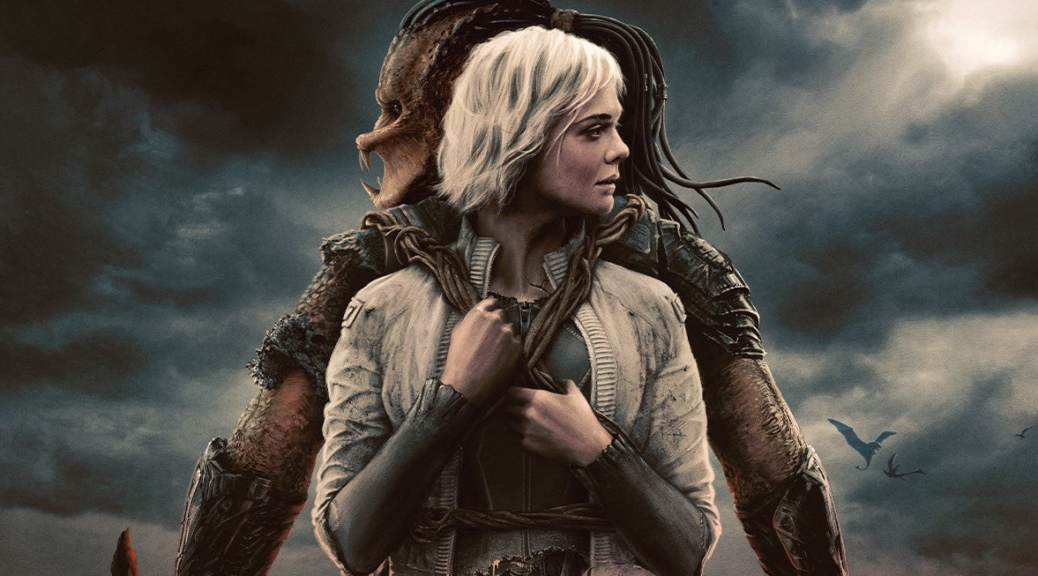
Predator: Badlands

by Hope Madden

Whenever anybody ranks the Predator films—or the Alien films, for that matter—most episodes hold up moderately to well, except for those crossovers. Well, it appears filmmaker Dan Trachtenberg, who’s asked us to rethink so much about the Predator franchise, wants us to revisit that as well.

And why not? In 2022, the co-writer/director of Prey brought new life to a fun action thriller series that seemed to have worn itself out. And then, as we all waited patiently for his next sequel, he dazzled us with the bloody fun animated anthology, Predator: Killer of Killers.

Now Trachtenberg betrays a love of this franchise and a seemingly endless inspiration for its universe as he takes us on a trajectory begun when Paul W. S. Anderson first pitted the two most badass alien lifeforms against each other in 2004’s AVP: Alien vs. Predator. Because it was in this installment, weak as it was, that the rogue hunter learned the value of teamwork.

Predator: Badlands introduces Dek (Dimitrius Schuster-Koloamatangi), runt of his Yautja clan, banished unless he can return with his trophy: the Kalisk of Genna. But do you remember when Tom Hiddleston and his band of misfits landed on Skull Island in search of Kong, only to find out that everything on the island wanted to eat them? Genna is like that, and Dek is so full of rage, daddy issues, and insecurity that all he can think to do is beat his chest and lash out.

Luckily, what’s left of a synthetic being named Thia (Elle Fanning) knows the lay of the land and can help Dek survive the planet and find his trophy, so long as he carries her back to her legs.

Thia’s a bit of a Chatty Cathy, a personality tic that allows Trachtenberg and his co-writers, Patrick Aison and Jim Thomas, to clue viewers in on the planet, its creatures, and her own backstory as the budding frenemy relationship develops the film’s themes.

It’s fun. Fanning’s charmingly garrulous sidekick brings more lightheartedness to this installment than we’ve seen in previous episodes, but the action is fun and frequent. Expect plenty of bloodshed regardless of the PG-13 rating (it’s mostly beasties, some of them green blooded).

The film is often frustratingly dark, limiting the enjoyment of many set pieces, but the score is amazing and the depth of character is an unexpected pleasure. Predator: Badlands is not the best of the franchise, nor is it as ground breaking as Prey, but it’s a ton of fun.

Mystery Girl

Die My Love

by Hope Madden

Earlier this year, filmmaker Michael Shanks and real-life marrieds Alison Brie and Dave Franco examined man’s fear of losing his identity to couplehood in the weirdly romantic horror, Together.

Lynne Ramsay’s latest, Die My Love, looks at it from a slightly more skewed perspective.

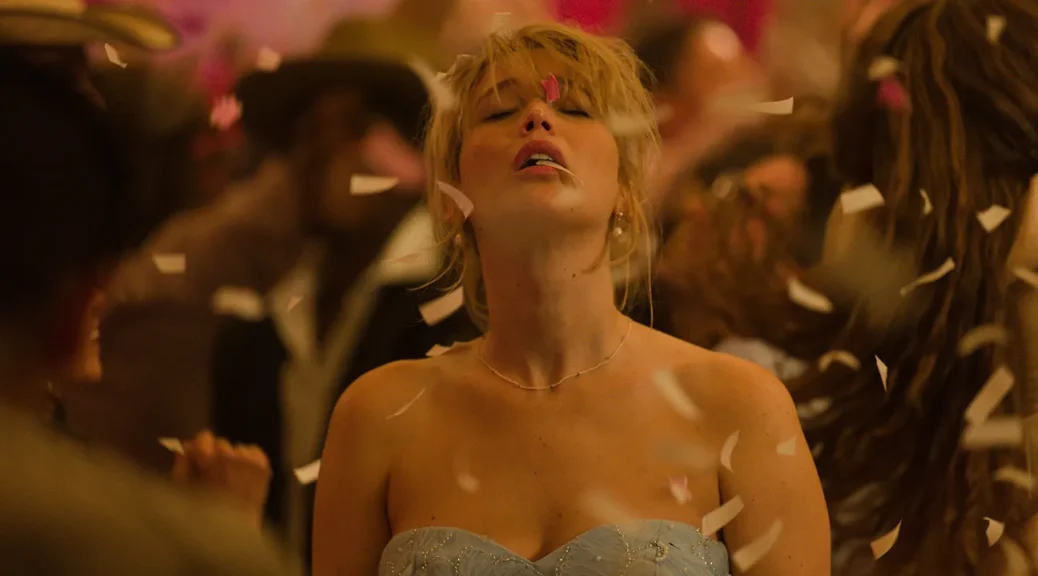
For Grace (Jennifer Lawrence), the horror seems to be gradual disappearance, a total loss of who you were with no new version to take its place. A new home—well, old home inherited by boyfriend Jackson (Robert Pattinson)—in a new and isolated spot, and a new baby all seem to leech from Grace whatever it was that had held her together. Her attempts to contend with this vanishing, this mundane nonexistence, are a volcanic, often hilarious and just as often terrifying wonder from a phenomenal talent in top form.

The inimitable Ramsay, along with Enda Walsh and Alice Birch, adapts Ariana Harwicz’s novel. The loosely constructed narrative presents atmosphere and context more than plot. Grace and Jackson move into the now-vacated Montana home. It’s perhaps not ideal, but who cares? It’s theirs, it’s free, and Grace can write all day.

But she doesn’t, nor does she fit in (or try) with Jackson’s family. Boredom, new motherhood, sexual frustration, a negligent husband, and isolation all weigh on Grace, and in every instance, her reaction startles and fascinates.

Lawrence is fearless— that’s nothing new—but here she is alive, on fire. Funny and heartbreaking, fierce and merciless, aching but rarely vulnerable, Lawrence’s command of this film is breathtaking.

An impressive ensemble—Pattinson, Sissy Spacek, Nick Nolte, LaKeith Stanfield—exist more to offer opportunities for Lawrence to react than to craft full characters. But few directors can craft an individual scene, or string together scene after scene after scene, as transfixing as those conjured by Ramsay.

And her dreamlike creations seem always to nurture an unparallelled performance from some of the greatest actors working: We Need to Talk About Kevin’s Tilda Swinton, You Were Never Really Here’s Joaquin Phoenix, and now, Die My Love’s Lawrence, whose raw sensuality, anger, and sadness command attention.

The film’s lack of cohesion, of clear path or plot, weaken the effort. Die My Love is more character study than story, but Grace is a character that can’t be known. This is her burden and her glory, but an unknowable character makes for a tough study.

But, though you may walk away from Die My Love wondering what it is  you just watched, you’ll not likely forget what you saw.

Everything Else Is Cleveland

Lost & Found in Cleveland

by Hope Madden

Tennessee Williams once said, “America has only three cities: New York, San Francisco, and New Orleans. Everything else is Cleveland.”

The indie charmer Lost & Found in Cleveland wisely opens with that text on the screen, both signaling the film’s deeply midwestern sense of self-deprecating humor, and the universality of its set of small stories.

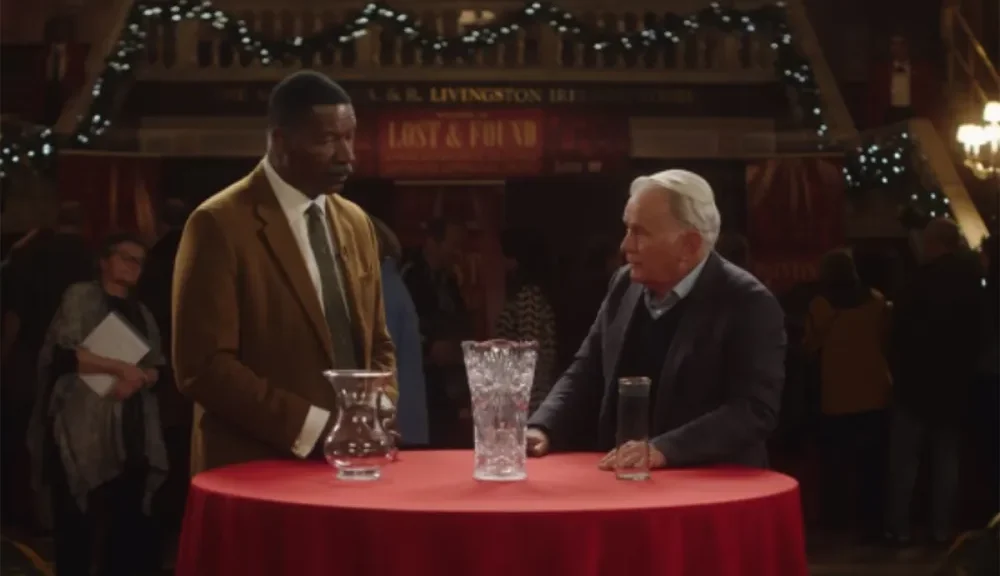
Filmmakers Keith Gerchak and Marisa Guterman spin intersecting tales of a handful of Clevelanders whose paths cross when the Antiques Road Show inspired program Lost & Found comes to town.

Nine-year-old Charlie (Benjamin Steinhauser), struggling to come to terms with his dad’s death and his mom’s new boyfriend, is desperate to authenticate a hand-written letter from President William McKinley. Mr. and Mrs. Sokolowski (Stacy Keach and June Squibb) have some plates to appraise. Mail carrier Marty (Dennis Haysbert) collects vases and longs to open a high-end restaurant in remembrance of his mother. Nouveau riche Sophie Mathers (Liza Weil) cannot wait until her newly acquired piece, an enormous sculpture of the goddess Juno, is belle of the Lost & Found ball. And Gary (Santino Fontana) needs to come to terms with the enormous and mortifying Aunt Jemima collection his Nana Noni left him.

Tennessee Williams may not have thought much of it, but Gerchak and Guterman clearly love Cleveland. You’ll recognize some landmarks from Superman, but this film isn’t pretending The Arcade or the Hope Memorial Bridge belong anywhere other than The Land. With equal parts humility and humor, the film glories in everything that makes the town so very Cleveland.

This roots the tales in authenticity, while performances and storylines allow each a bit of zaniness. Sometimes the writing crosses the line to sit-com simplicity, and not every performance convinces. And one dance sequence is a real head scratcher.

But with talent like Squibb, Keach and Haysbert, plus supporting comedic gold from Dot-Marie Jones, it’s tough to hang on to any hard feelings. Somehow the amateurish moments feel right. Accepting them is like accepting every burning river, horrendous sports season, missed opportunity and freak snowstorm. Anything more polished just wouldn’t be Cleveland.

Tear the Fascists Down

Nuremberg

by Hope Madden

There were many reasons to be hopeful for James Vanderbilt’s Nuremberg, chief among them its modern-day resonance and the satisfaction of watching Nazis suffer the consequences of their actions.

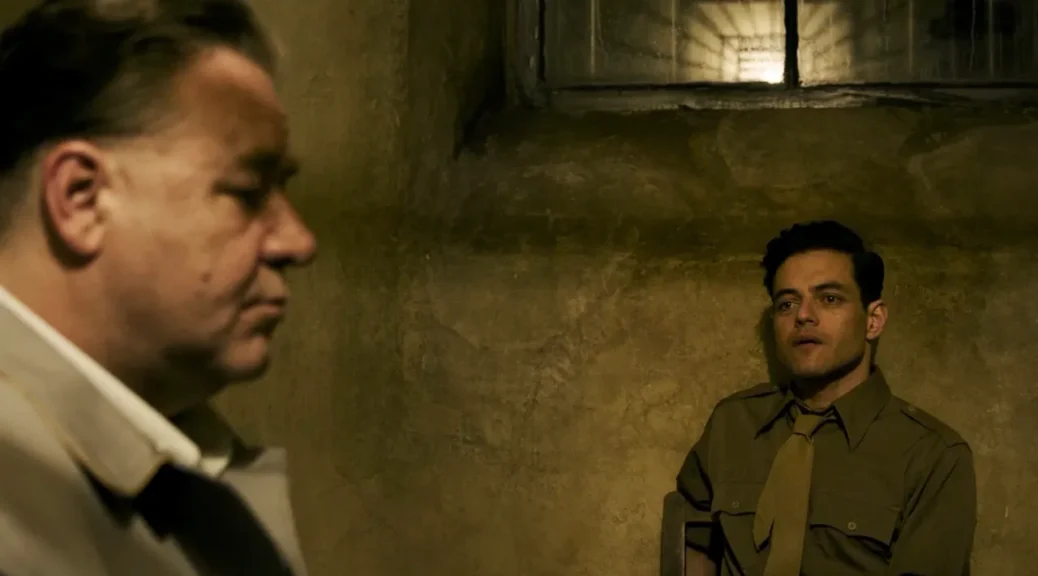
Vanderbilt’s impressive ensemble tells the true story of the global court case trying the Nazi high command for crimes against humanity. Russell Crowe delivers an almost fanciful turn as Hermann Göring, sparring with army doctor Douglas Kelley (Rami Malek), assigned to help the prosecution get inside the mind of the monster.

Vanderbilt adapts Jack El-Hai’s book The Nazi and the Psychiatrist, developing the relationship between these two characters as the film’s primary plot. A parallel storyline following Justice Robert Jackson (Michael Shannon) grounds the film in the importance of the trial and its single desired result: to annihilate pro-Nazi sentiment and the white supremacist authoritarianism that fueled it.

Richard E. Grant, John Slattery, Colin Hanks, and Mark O’Brien deliver solid performances, though the film would not have suffered by streamlining both O’Brien and Hanks entirely out of the movie.

Nuremberg‘s problem is not so much its length as its cumbersome scripting. To add the full (and imperative) B-story, the events and characters that orbit the psychiatrist and the Nazi should have been pruned.

Vanderbilt chooses showy direction throughout, cutting from one scene to the next with gimmicks that call to mind classic screwball comedies—a wild, almost horrific mismatch with the material.

There’s such obviousness to the telling of the tale, and not because we know the outcome of the trial but because the character points we shouldn’t know are telegraphed.

Now and again one brilliant line of dialog bursts through, which is almost as frustrating as the otherwise ostentatious script because there’s something here. Something worth telling, in need of telling.

But Vanderbilt buries it under forced emotion (when certainly none needs to be forced) and flamboyant staging. Hard as Nuremberg tries to connect the dots from past to present, it offers no insight. And that’s what’s most frustrating.

Fight Like a Girl

Christy

by George Wolf

No matter what you think of Sydney Sweeney the celebrity glamour girl, you’ve got to give her props for not resting on her sexy laurels. I’m not saying her turn in the bikini-friendly Anyone But You didn’t show fine comic timing, but in five of her last seven films, Sweeney has chosen roles that downplayed her curves and provided the chance to challenge herself as an actress.

Okay, so Echo Valley, Eden, American, Immaculate and Reality didn’t make the box office buzz, but Christy continues Sweeney’s ambitious trend. And right on the cusp of awards season, she doesn’t waste the opportunity to impress, leading a stellar ensemble in giving some well-deserved flowers to a trailblazer in women’s sports.

In 1989, Christy Salters was a bored girl from West Virginian who played a very physical brand of basketball and bristled when her mother (Merritt Weaver) obsessed over the whispers about Christy’s relationship with girlfriend Rosie (Jess Gabor). After winning $300 in a local Toughman contest, Christy is introduced to boxing trainer/future husband Jim Martin (Ben Foster), who guides her, exploits her and violently abuses her on Christy’s path toward becoming Don King’s “Coal Miner’s Daughter,” the first woman to headline a PPV undercard.

Boxing films may carry the most inherent cliches of all sports stories and director/co-writer David Michôd can only steer Christy around them about half the time. As Christy’s fame and fortune grew, the level of abuse she suffered only intensified, to a level that will surprise many. And when Michôd (Animal Kingdom, The Rover) finds small moments to accentuate with a dramatic camera angle or well-timed edit, the performances from Sweeney and Martin find resonant depth.

We’re used to exemplary work from Foster, and here he makes Jim Martin a slippery, violent gas-lighter with just enough relatable edges to avoid caricature. Sweeney responds with committed grit, and Christy’s battles both in and out of the ring elicit sympathy, respect and admiration.

Even so, the biggest challenge to telling a story so personal is the temptation of throwing too many formulaic haymakers. When Christy can do that, it becomes a film worthy of Martin’s fight.

Winner by split decision.

What Price Vengeance

It Was Just an Accident

by George Wolf

Driving home one night with his wife and daughter, a man strikes and kills a stray dog that runs into the road. It is simply an accident, an innocent mishap.

But accidents and innocence are seldom part of Iranian filmmaker Jafar Panahi’s intricate parables, and 2025 Palme d’Or winner It Was Just an Accident quickly becomes the latest searing indictment of injustice and corruption in his homeland.

After hitting the dog, Eghbal (Ebrahim Azizi) takes his car in for service. At the shop, Vahid (Vahid Mobasseri) instantly thinks he recognizes Eghbal as the intelligence officer who brutalized Vahid and his fellow political prisoners years before.

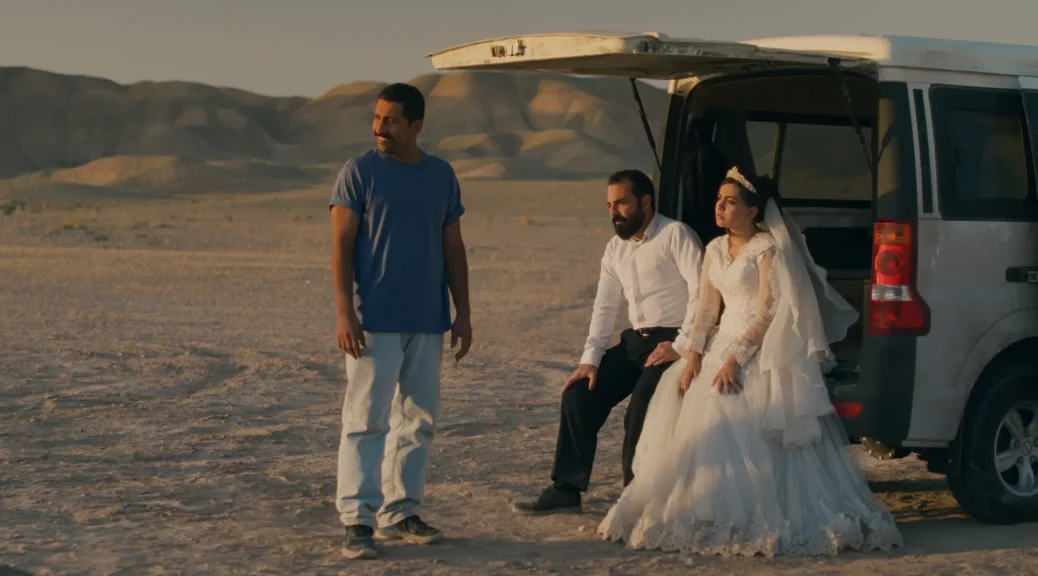
Vahid kidnaps Eghbal and is on the verge of killing him, when doubt creeps into his mind. Loading the unconscious Eghbal in the back of his van, Vahid heads out to find his fellow ex-inmates and some help in an airtight identification. The compatriots (including a bride, a groom, and a wedding photographer) react with a mixture and rage and uncertainty, and their travel over the course of one day allows Panahi to organically detail the abuse they once suffered and the casual corruption they still navigate daily.

This is the first film for Panahi (No Bears, Taxi, Closed Curtain) since Iran lifted his decade-long filmmaking and travel ban, and while he’s no longer filming himself in secret, Panahi’s storytelling still bursts with intimacy and courage.

The first rate ensemble makes the anger palpable, and Panahi masterfully weaves it into the mystery surrounding Eghbal’s guilt to create a thriller of simmering tension, comic sidebars and complex moralities.

If Eghbal is indeed their tormentor, is vengeance justified? And even if it is, would mercy actually bring them more peace?

True to form, Panahi closes with a shot that seems to close one chapter and open another, and the fade to black may require a few minutes to decompress.

But that’s the kind of effect Panahi’s films can have. It Was Just an Accident is more proof that he is one of the true modern-day masters, with a clear and distinctive voice that demands attention.

The Bees Knees

Bugonia

by Hope Madden

Humanity can be, individually and collectively, disappointing. No one picks that scab quite like Yorgos Lanthimos.

The filmmaker followed up his 2023 Oscar winner Poor Things, arguably his most hopeful and certainly his most mainstream film, with the blistering 3 hour anthology skewering the human condition, Kinds of Kindness.

Bugonia, his latest, reins in some of the excesses of Kindness, but the filmmaker’s observational insights on wasted, wounded humanity are as sharp as ever.

Emma Stone is Michelle Fuller, a pharmaceutical company CEO hailed on Forbes and Time and dozens of other framed magazine covers for her leadership and innovation. Jesse Plemmons is Teddy, the broken, broke, bumbling conspiracy theorist convinced she’s an alien. Teddy kidnaps the CEO/alien and drags Michelle back to the lonesome home where he grew up. The goal is not ransom, but to convince her to take him to the mother ship where he’ll persuade the aliens—responsible, as they are, for the obvious crumbling of human society—to leave earth in peace.

The script from Will Tracy and Jang Joon-hwan offers Lanthimos and his small but savvy cast fertile ground for the bleak absurdism the filmmaker does so well. Bugonia treads tonal shifts magnificently, slipping from comedy to thriller to horror and back with precision. Lanthimos’s control over audience emotion has never been tighter.

The same can be said for both Stone and Plemmons, who manage the absolutely impossible with these two characters. Their chemistry is without peer, each wrestling the audience’s sympathies from the other, both always horrifying and vulnerable.

Stone is the picture of leadership qualities. Even shorn and chained in a filthy basement, Michelle acts from a reserve of superiority and calm. Stone is utterly convincing as a survivor and fearless negotiator.

Plemmons’s range is breathtaking and Lanthimos takes advantage. Sad sack Teddy contains multitudes. He’s pathetic, terrifying, cruel, tender, manipulative, loving—all of it seamlessly integrated into a single character. Plemmons should be remembered come awards season.

The film’s final act is brazenly bizarre, but also startlingly emotional. It’s an about face that wouldn’t have worked in most films. But most films are not Yorgos Lanthimos films.

You Bet Your Life

Ballad of a Small Player

by George Wolf

Many fans of Lawrence Osborne’s 2014 book Ballad of a Small Player won’t be surprised to learn how long the film adaptation was stuck in development. The tale presents a tricky narrative tone, mixing metaphor, dark comedy and psychological mind games for a ride of desperate obsession.

Director Edward Berger and star Colin Farrell are all in for the Netflix version, but they leave the final table a little short of the jackpot.

Farrell is Lord Doyle, on the run in the Chinese region of Macau. Doyle needs to settle a $350,000 casino tab in three days or he’ll be arrested. But there are plenty of other glitzy casinos to visit, and Doyle works whatever angle he can to get credit at the baccarat tables, always promising that big score that never comes.

He seems to meet a kindred spirit in Dao Ming (Fala Chen), a casino manager who takes pity on Doyle’s lonesome loser nature. It is the Festival of the Hungry Ghosts in Macau, and Dao Ming may have some surprising burnt offerings in mind.

While the two begin to form a fragile bond, private investigator Cynthia Blithe (Tilda Swinton) is on Doyle’s tail, and may finally force him to confront the secret life he has been hiding.

Farrell brings sympathy to Doyle’s downward spiral in writer Rowan Joffe’s adaptation, making it easier to accept a third act that surprises no one. Swinton carves her usual glory out of limited screen time, and Chen gives Dao Ming the mysterious grace of possible salvation. Kudos as well to Deanie Ip as Grandma, an ultra-rich gambler who has no trouble sizing Doyle up in hilarious fashion.

Berger (All Quiet on the Western Front, Conclave) brings his own air of desperation, filling each frame with a forced showiness that wears out its welcome pretty quickly. There’s no doubt many set pieces are bursting with color and beauty, but the attempts to blur the real and surreal are so forced it begins to detract from the pleasure of watching these actors claw closer to that final reveal.

Ballad of a Small Player has no problem reminding you that the source is probably a great read. Watching it unfold – in select theaters, or on Netflix – is just too frustrating to rise above pretty good.

If I Cannot Inspire Love, I Will Cause Fear

Stitch Head

by Hope Madden

Is there anything more delightful than an animated tale suitable for Halloween? A Nightmare Before Christmas, ParaNorman, Frankenweenie, The Corpse Bride, Wendell & Wild, Coraline, Mad Monster Party­—each one is a fun way to get spooky, with the kids or without.

Steve Hudson extends that list with Stitch Head, a delightful, animated story about embracing your inner and outer monster.

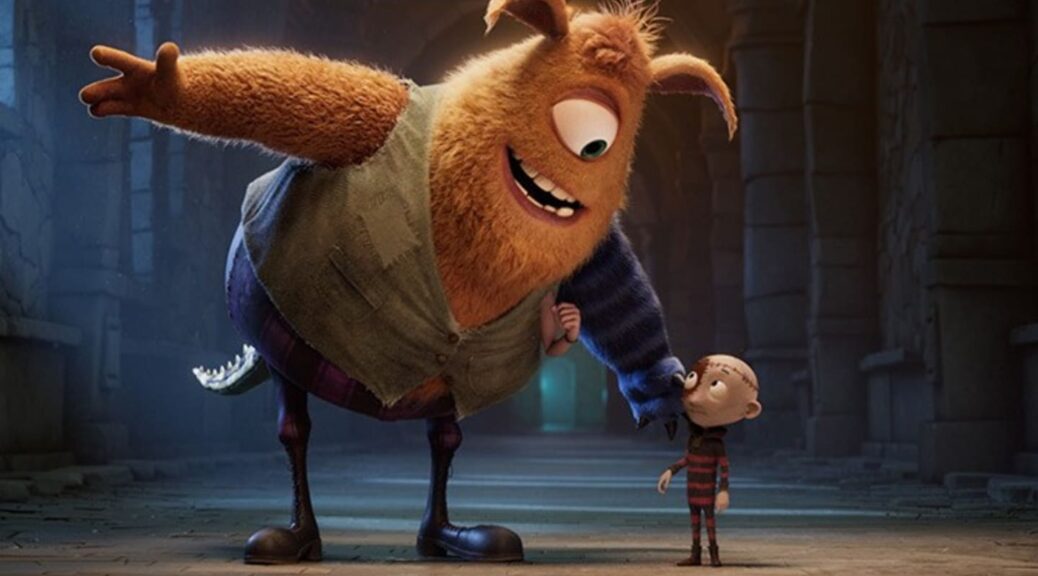
Stitch Head (Asa Butterfield) was the first of the Mad Scientist’s creations. But the creator’s ADHD gets the better of him pretty quickly, and Castle Grotteskew is soon full to brimming with monsters. These include today’s beast, Creature (Joel Fry). Stitch Head’s taken on the eldest child duties around the castle, which includes helping each new beastie adjust their monstrous natures to avoid upsetting the townsfolk below. Don’t draw attention to yourself and you can avoid the angry mob.

“Welcome to almost life,” Stitch Head tells each new monster. “Patent pending.”

The film, especially Nick Urata’s music, certainly conjures Tim Burton. The songs Are You Ready for Monsters and Make ‘em Scream are both dancy fun, but neither are Elfman level memorable. Stitch Head lacks that macabre flavor of a Burton. Castle Grotteskew’s residents feel more akin to the working stiffs of Monsters, Inc. They’re nothing to be afraid of, they’re just different. Which is the point.

There’s also a bit of Pinocchio as Stitch Head, seeking the love he’s not receiving from his negligent parent, leaves the castle in favor of the circus, and finds—as we all must—that capitalism blows.

Butterfield’s delivery and Hudson’s animation create a tender central figure you root for. Fry’s big-hearted performance—plus Creature’s zany design—balance the delicate, tightly wound Stitch Head to create a sweetly peculiar odd couple.

Based on Pete Williamson and Guy Bass’s series of kids’ books, written for the screen by Hudson, Stitch Head delivers fun, eccentric characters, a warm adventure, and genuine lessons about the joys—even the necessity—of nonconformity.

“Just be whoever you’d be if you weren’t afraid.”

Nowhere Man

Springsteen: Deliver Me From Nowhere

by George Wolf

My sister-in-law Ellen still tells the story of when she bought Bruce Springsteen’s new album Nebraska in 1982. She was a college student, and was ready to rock out in her dorm room with the guy who was coming off the top ten singalong smash “Hungry Heart.”

What she got was a collection of stark, acoustic songs about murder, desperation and dead dogs. Not much to dance to.

Why would a rock star on the verge of global superstardom make such an unexpected move?

Writer/director Scott Cooper explores that question with Springsteen: Deliver Me From Nowhere, a heartfelt and emotional story of a man caught between the echoes of his past and the promise of his future.

Jeremy Allan White is sensational as Bruce. The look is right, and White’s playing and singing often get eerily close to the real thing. But even more than that, White captures the tortured soul of a rising phenom seemingly terrified of the success he knew was suddenly within his grasp.

Adapting Warren Zanes’s 2023 book, Cooper revisits some themes from his Oscar-winning Crazy Heart and makes the film a collection of small moments that capture a pivotal snapshot in the life of a living legend.

And none of it pushes too hard. Glimpses of a Flannery O’Connor book, the movies Badlands and Night of the Hunter, and the Suicide song “Frankie Teardrop” quietly tell us much about Bruce’s inspirations for the album. Black and white flashbacks to Bruce’s childhood with a troubled father (Stephen Graham) and a protective mother (Gaby Hoffmann) take a similarly understated approach, effectively layered as the lingering memories they were.

Bruce’s relationship with fictional girlfriend Faye (Odessa Young) begins as an awkward choice amid all this attention to detail, but the device ultimately gives us some insight into his fear of any happiness he felt was undeserved.

Lighter moments do come, almost always with the reactions to Bruce’s new direction. Manager Jon Landau (yet another terrific supporting turn from Jeremy Strong) gently tries to steer him toward the songs that would become Born in the U.S.A., while a record exec (David Krumholtz) throws up his hands in exasperation. And through it all, everyone (including Marc Maron as longtime engineer Chuck Plotkin) keeps wondering where the case is for Bruce’s cassette of homemade demos.

Bruce fans know well that those demos became the album, one now regarded as a seminal statement of untold influence. Those longtime followers will appreciate Cooper’s respectful approach that doesn’t feel the need to explain who people like Jon Landau are and where they fit in.

Because even for people who haven’t listened since 1982, Deliver Me From Nowhere presents a richly satisfying story of inspiration, artistic passion, and finding an inner peace that has long eluded you.

And yes, there’s a bit of “Born to Run” in here, too.