Category Archives: New In Theaters

Reviews of what’s out now

Do You Want to Buy a Snowball?

The Melt Goes On Forever: The Art & Times of David Hammons

by Hope Madden

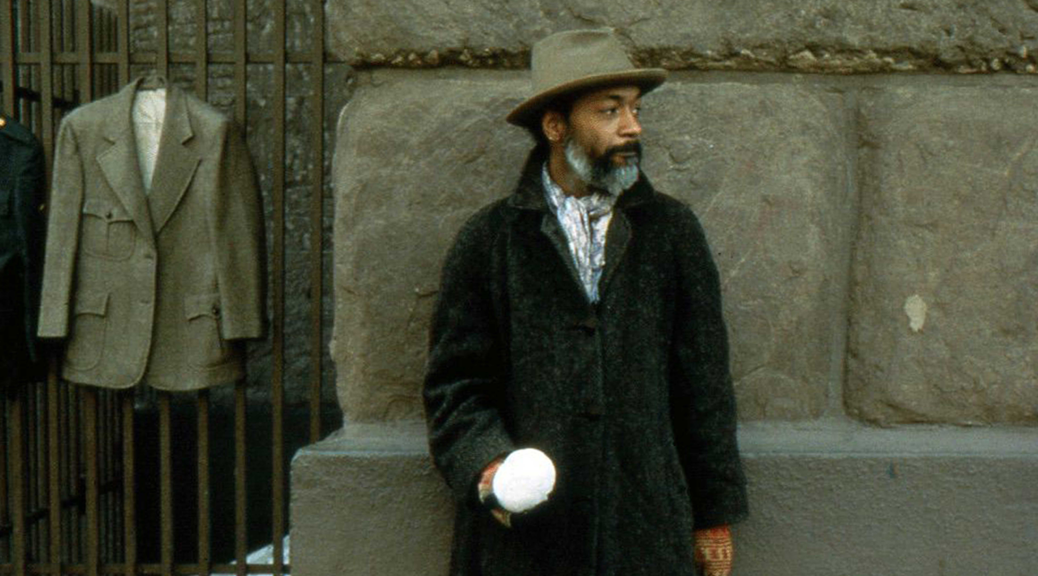
In 1983, a woman buys a snowball from a street vendor. He has many snowballs laid out in a beautiful pattern on a blanket on a wintery New York street, surrounded by other vendors. She thinks she’s helping a homeless man but keeps the snowball in her parents’ freezer in Queens for months before letting her mom toss it.

Decades later she realizes the seller was David Hammons, an American artist who defied boundaries, mocked socially accepted practice, and became one of the most influential voices in art.

I bet she wishes she’d kept the snowball.

Documentarians Harold Crooks and Judd Tully share countless similar anecdotes as they unveil, layer upon layer, something of what Hammons meant to an art world desperately in need of him.

“The more he tells the art world to go fuck itself, the more they want him,” says poet Steve Cannon, whose poem “Rousing the Rubble” offers worthy narration to sections of the film. An ode to Hammons, the poem announces the artist’s many phases, as does the documentary:

            Booomboxes, into bebop, hip hop, scatter shots – lower poles Higher Goals –

            into human hair – into Bottle caps into people and their attributes ­–

Cannon’s interviews, as well as those with art historians, artists, curators and collectors, will have to mainly suffice. Although Hammons himself does appear and speak on a handful of rare occasions, his voice is mainly absent (he prefers not to be interviewed, the doc clarifies).

Those who do talk illuminate the spirit of an artist whose work defies categorization. That work, luckily, we do get to view throughout the film. Provocative, racial, absurd, prescient – the art itself is all of this, and the film points to Hammons’s rejection of the norms of the art world as among his most valuable qualities.

The Melt Goes On Forever celebrates the audacity of Hammons’s  curation, the subversive nature of his exhibition and the humor in his reactions and presentations, but is quick to point out that his lasting impact on art in the U.S. and globally is more a product of the intensity and relevance of the work itself.

The Melt Goes On Forever: The Art & Times of David Hammons screens this weekend only at the Wexner Center for the Arts.


Take Me Down

Asteroid City

by Hope Madden and George Wolf

Welcome to Asteroid City, a grief comedy that may be the most Wes Anderson-y movie Wes Anderson has ever made. Or, welcome to “Asteroid City” – the stage play from famous writer Conrad Earp (Edward Norton) upon which Asteroid City, the film (TV show?) is based. Actively. Brian Cranston will explain as he, the narrator of “Asteroid City”, deconstructs the meticulous framing device Anderson crafts to keep us just one layer further from chaos.

“We are all just characters in a play that we don’t understand.”

As is so often the case, writer/director Anderson painstakingly creates a world – colorful, peculiar, emotionally tight lipped – brimming with characters (equally colorful, peculiar and emotionally tight-lipped). Brimming. About 50 speaking characters stand or sit precisely on their mark, perfectly framed, each one doing their all to keep chaos at bay.

Like Augie Steenbeck (Jason Schwartzman), a widowed war photographer stranded with his teenaged son (scene-stealer Jake Ryan from Eighth Grade) and three daughters in the clean desert nowhereville of Asteroid City, where a “stargazing event” will soon commence. Cinematographer Robert D.  Yeoman’s 360-degree swivel shows all you need to see: diner, roadway cabins, onramp to nowhere, and the garage where the town mechanic (Matt Dillon) has found that Augie’s wagon is now deceased.

Augie’s father-in-law Stanley Zak (Tom Hanks, in the usual Bill Murray role) fires ups his Cadillac and arrives for a rescue, only to find no one can leave Asteroid City on account of the alien.

Yep, an alien! He just came down sure as you please and made off with the city’s prized meteorite! Everybody saw it – including famous actress Midge Campbell (Scarlett Johansson) and all the visiting school kids in Miss June’s (Maya Hawke) class!

So the whole city’s on lockdown, while General Gibson (Jeffery Wright) and Dr. Hickenlooper (Tilda Swinton) assess the situation and Augie realizes he just may have snapped the only photo of an honest to goodness alien.

All the unique and wonderful trademarks of Anderson’s craftsmanship are on display. Both the city itself, and the surrounding stage area where the play is performed, are given distinct aesthetics that benefit equally from Anderson’s commitment to symmetry, palette and depth-of-field.

The wordplay is succinct and witty per usual, dancing through themes of science, art, and Cold War paranoia. But while Anderson’s last film, The French Dispatch, left its procession of indelibly offbeat characters to fend for themselves, this time they’re connected with the sterile humanity that buoys the best of his work.

“You can’t wake up if you don’t fall asleep!”

You’ll hear that several times in Asteroid City, enough to know that Anderson hopes we’re paying attention. Leave yourself open – to what art, and science, is saying – and your world might seem a little more colorful.

Swiss Cheese

Mad Heidi

by Hope Madden

Hard core, low budget genre films tend to seem cheesy: women in prison, boobs, torture, splatter, training montages, katanas. Filmmakers Johannes Hartmann and Sandro Klopfstein embrace the budget constraints, embrace the genre, and absolutely celebrate the cheese with their opus, Mad Heidi.

Their genre sendup returns to Heidi, that cheery Swiss Alps legend, along with her grandfather and Peter the goat herder. But not all is well in Switzerland. The country’s Very Swiss Leader (played with relish by Casper Van Dien) is something out of a bad 1970s exploitation film. Swissploitation, if you will.

So, Heidi (Alice Lucy) must suffer, find her strength, and reclaim her country for the Swiss and the lactose intolerant.

One of the benefits of making a spoof is that no one can hold your ludicrous plot against you. Indeed, the more ludicrous, the spoofier. The plot – what there is of one – exists to move Heidi and her story from one recognizable genre beat to the next. The filmmakers clearly possess a sincere fondness for grindhouse action. Their film never feels mean-spirited, and more importantly, it never feels lazy. Instead, Mad Heidi delivers sometimes inspired set pieces, gags and jokes that land harder if you’re in on them.

It’s also sometimes shockingly beautifully shot.

While the filmmakers are obviously having fun with genre sensibilities, they also showcase genuine cinematic craftsmanship with a clearly low budget. The movie looks great. Gore effects strike the ideal over-the-top practical vibe. Hartman and Klopfstein make their chosen genre’s ludicrous nature, plot holes and unnatural pauses, cartoonish characters, and bloodlust work for them.

Van Dien – so good earlier this year in Daughter and mainly known for maybe the world’s greatest action spoof, Starship Troopers – delivers fun, exaggerated comic timing. In fact, the whole cast bad-acts quite well. Still, even at just 92 minutes, the film feels more than a little bloated around the midsection.

It can’t hurt to watch it, though, assuming you’re in the mood for an awful lot of goopy, sloppy, sticky – dare I say cheesy – action and you’re able to fully unplug your brain.

OK with Age

Aged

by Brandon Thomas

The subject of aging has become a popular trope in the world of horror. Films like M. Night Shyamalan’s Old and the Aussie favorite Relic used our own fears of natural mortality to tap into something more supernatural. Ti West’s X comments on how aging – and the supposed loss of beauty – can have deeper psychological implications. Director Anubys Lopez’s Aged may not reach the highest highs of the aforementioned films, but what it lacks in originality it more than makes up for with old school things that go bump in the night.

Veronica (Morgan Boss-Maltais) has recently taken a temporary job as a caregiver for the elderly Mrs. Bloom (Carla Kidd). Shortly after arriving at Mrs. Bloom’s remote home, Veronica begins to sense a presence in the house. As the strange events in the house escalate, Veronica also begins to suspect that Mrs. Bloom herself might be harboring a sinister secret.

Aged checks a lot of low-budget horror boxes right off the bat. 

Single location? Check. 

Small cast? Check. 

Simplistic story that requires little in the way of production value and special effects? That would be a check. 

These aren’t detriments by any means. The simplicity of Aged is actually the film’s greatest asset… well, except for Kidd’s old-age makeup. That gag is right out of a Spirit Halloween and pretty wince-inducing. 

Lopez aims high with the film’s visuals. The low-budget still manages to shine through here and there, but the emphasis on production design and shooting every nook and cranny of the desolate farm house helps create a real sense of place. Lopez has a good eye – so good, in fact, that it’s a shame much of Aged was filmed in the brightness of day. 

Boss-Maltais and Kidd spend nearly all of their scenes together. Kidd chews up an enormous amount of scenery as the venomous Mrs. Bloom. Boss-Maltais’s Veronica is your standard bland non-personality-having lead. Veronica’s role is to walk the audience through the plot of the movie and not to have any real arc of her own. 

Aged isn’t the first movie you should seek out this weekend – heck it might not even be the 10th – but it is an entertaining enough haunted house flick that’ll keep your attention for 90 minutes.

Some Pig

Peppergrass

by Hope Madden

The pandemic was tough on everybody. Eula (Chantelle Han) lost her grandpa, made a bad decision with her bartender friend (Charles Boyland), and may lose her restaurant if things don’t turn around.

So, at the height of lockdown, these two restauranteurs takeoff into the night with a mysterious letter sent just after Grandpa died by a recluse he saved during the war. They decide to drive that letter 20 hours to the recluse’s acreage where they hope to find him and some truffles.

Really, really valuable truffles.

In the hands of co-directors Han and Steven Garbas, Peppergrass is, on the surface, a kind of backwoods culinary heist movie – which is more than intriguing enough. But the film, which Garbas co-wrote with Philip Irwin, delivers more than that.

The film is beautifully shot, from the somber color and framing of the urban opening act to the purposeful camera and sound work throughout the balance of the forest-heavy second and third acts.

Han’s Eula – in charge, no nonsense, desperate – anchors the film beautifully. The perfect counterbalance, Boyland plays at being the harmless dumbass. Thanks to a lived-in chemistry between the two actors and Boyland’s committed performance, you never root against his Morris no matter how much you want to smack him.

The script is clever, sometimes roughly funny, often surprising. Tonal shifts can be a problem, but generally Garbas and Han move smoothly, their framing and pace matching the swiftly shifting genre. Peppergrass swings from heist to horror to survival tale and back again, losing its footing only rarely.

Fear of contagion timestamps the film, but it also generates a kind of paranoia that heightens tension – the kind of tensions suited to backwoods survival tales. But Peppergrass’s greatest strength is how deftly it tells its real story – the one motivating the heist, which is never discussed outright, though it haunts the film.

Tense, surprising and delightfully unusual, Peppergrass is a gem of a thriller worth seeking out.

Steam Building

Elemental

by Hope Madden

As soon as Ember earns her dad’s trust, he can retire and she’ll run his shop in Fire Town. Unless her hot temper ruins everything. Or she falls for that sweet guy from Water Town. Or both.

Daddy issues. Romance. Coming of Age. There’s a lot about Pixar’s latest, Elemental, that feels familiar. Common, even. And if there’s one thing the animation giant’s managed to avoid for most of its almost 30 years in the business, it’s being predictable.

It doesn’t help that the characters immediately put you in mind of Pixar’s wildly imaginative Inside Out. But there’s little about the film that will strike you as wildly imaginative, although the animation is sometimes breathtaking, beauty spilling off all four sides of the screen. Animators explore and exploit all opportunities to find wonder in the glow and fluidity of characters and the magnificent 3D experience is well worth annoyance of the glasses.

The magic in this story’s telling lies less in an inspired, imaginative plot and more in the nuances of the execution. Ember, a child of immigrants, is seen as a danger to most of the rest of the city. And yet, as she traverses a landscape of people made of water, she’s the one who’s actually in danger.

John Hoberg, Kat Likkel and Brenda Hsueh’s crisp writing deftly navigates microaggressions, misunderstandings, and the anger associated with helpfully advising someone to “water down” their culture.

Back in 2015, Elemental  director Peter Sohn made the unduly overlooked The Good Dinosaur. It was a beautiful piece of visual storytelling, charming and well-acted, although, like this one, the plot itself lacked imagination. I hope more people give Elemental a chance. It lacks the uniqueness of Pixar’s greatest or most enduring efforts, but it’s a touching, gorgeous, emotional and forgiving tale.

Don’t be late ­or you’ll miss perhaps the best reason to see Pixar films, the shorts that precede the feature. In Carl’s Date (which will also appear as episode 1, season 2 of the Disney+ show Dug Days), our beloved Carl (Edward Asner) from Up! needs a little courage to go through with his first date since Ellie. Crushingly lovely.

Moore Than a Woman

Maggie Moore(s)

by George Wolf

Maggie Moore(s) is nestled in a quiet little neighborhood between the Coen Brothers, Taylor Sheridan, and any mid-lfe rom-com. Expect engaging characters getting caught in dangerous games and possible romances, and reacting with clever witticisms, charming flirtatiousness and occasional bursts of violence.

And though the film doesn’t rise to the best of any genre, it patches together enough winning moments for a worthwhile caper-com.

With an opening declaration that “some” of the events actually happened, Paul Bernbaum’s first script since 2007’s Next takes us to a small desert town in Arizona that’s suddenly rocked by two murders in one week.

And both victims are named Maggie Moore. WTF?

Is there a connection between Maggie 1 (Louisa Krause) and Maggie 2 (Mary Holland)?

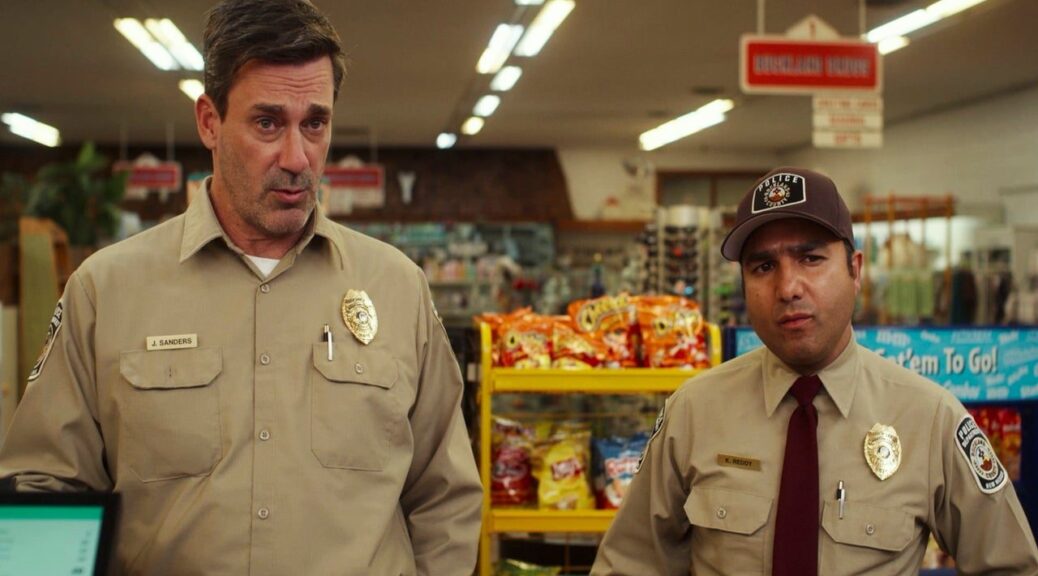
That’s what Police Chief Sanders (Jon Hamm) and deputy Reddy (Nick Mohammed) aim to find out. And pretty soon they’re finding out that Maggie 2’s husband (Christopher Denham) has a girlfriend (Bobbi Kitten) and a life insurance payout coming, while Maggie 1’s man (Micah Stock) has been passing photos for a pedophile food supplier (Derek Basco) in exchange for cheap and moldy cold cuts for his sub shop.

Oh, and Maggie 1’s neighbor Rita (Tina Fey) says the couple’s fights had recently been escalating.

Director John Slattery (God’s Pocket) exhibits fine juggling skills, giving his Mad Men pal Hamm plenty of room to craft Chief Sanders as the easy-to-root-for heart of the film. He’s a widower who takes a creative writing class at night, and his rebuff of a classmate’s overtures only makes us more hopeful when he and the divorced Rita find reasons to meet.

Of course, it helps that Hamm and Fey are real life buddies, with enough natural chemistry and snappy barbs (Him: “Wash your car.” Her: “Wash your ass!”) to make their time together a treat to watch.

Yes, putting a wannabe romance in the middle of Hell or High Fargo can bring a disjointed feel, but the orbit of distinct characters and cutting dialogue around it never lets the crime-solving grow tiresome.

Don’t look to Maggie Moore(s) for trail blazing or ground breaking, it will come up short. But for an hour-and-a-half of breezy, sometimes messy entertainment, it’s plenty capable.

Slip of the Tongue

Persian Lessons

by Rachel Willis

A random trade in the back of a transport van gives Gilles (Nahuel Peréz Biscayart) a chance to survive the Holocaust in Vadim Perelman’s film, Persian Lessons.

The trade – a book in Farsi for a sandwich – seems inconsequential, even poor, but it prevents Gilles’s death when the van is unloaded in a field and everyone is executed. There’s a deputy commandant, Klaus Koch (Lars Eidinger), looking for someone who speaks Farsi, so Gilles is spared – the book used as evidence of his nationality.

The problem is that Gilles is not Persian (Iranian) and doesn’t speak Farsi.

The situation creates immense tension as there are several soldiers who suspect Gilles (known to the soldiers as Reza) is lying. One makes it his goal to reveal the deception. As Gilles tries to create a language to fool Koch, we watch as he struggles to remember the words he’s invented. He keeps them straight using a pneumonic device based on the names of the prisoners entered into a register.

Because of Gilles’s peculiar status, he spends almost equal time with his fellow prisoners and the Nazis around them, but he is a part of neither group. And because of his unique access to Koch, and the fury this incites in some of the soldiers, we spend more time with these men and women than we do the prisoners around Gilles.

We watch as soldiers and officers flirt and gossip and attend parties, humanizing them in a way that makes them more sinister. These are the actions of people you might know – those who view what they do with enthusiasm or indifference. They form relationships with each other while dehumanizing the Jewish people around them. It adds an ominous realism to these characters.

Koch is the most disturbing. He helps Gilles on several occasions, but it’s clear if he were to ever find out Gilles is lying about his identity, the retribution would be swift and cruel. There is no real affection between the two; Gilles is fully aware of his precarious situation, even as he takes advantage of it. Koch is a means for Gilles’s survival, but never a friend.

As the film progresses, there is a constant tension. As prisoners are transferred from one camp to another, Gilles is physically spared, but the emotional toll of watching so many men, women, and children shipped to their death wears on him. His physical and emotional demeanor deteriorates throughout the film.

Perelman’s striking and terrifying portrayal of one man’s experience is one that will resonate for some time.

Tomorrow Is Another Day

Dry Ground Burning

by Matt Weiner

Billing itself as a blend of “documentary and narrative fiction,” Dry Ground Burning succeeds wildly on all fronts, turning the Sol Nascente favela in Brazil into a feminist battleground that mixes light science fiction with immediate real-world consequences.

Léa (Léa Alves da Silva) is just out of prison, and reunites with her half-sister Chitara (Joana Darc Furtado). Chitara has become a local hero as the hardened leader of an all-female gang that makes money refining stolen oil and selling gasoline.

Under Chitara’s leadership, the gang defies local authority, a presence that pervades the characters’ lives even if the direct police response to Chitara is only briefly shown. (The directors make the most of this screentime by giving them and their “state-of-the-art” armored vehicle the full Verhoeven treatment.)

The gang’s ambitions run deeper than just survival, although the film argues that even that is worth celebrating in the face of authoritarian resistance. The women have mounted a political challenge with their People’s Prison Party, advocating a platform that speaks to the needs of the city’s working class and disenfranchised.

Directors and writers Joana Pimenta and Adirley Queirós chose to cast two local women (not actors) to play versions of themselves. The docu side of the docu-drama comes into its sharpest focus when the women are out campaigning. Their voices are sometimes literally drowned out by Bolsonaro supporters. And a political rally for the now former president of Brazil takes on the look of a green and gold descent into the Inferno.

In that scene, and in so many others in Sol Nascente, Pimenta and Queirós allow the narrative part of the story to fade away. Long, uninterrupted shots bring us both the grotesque horrors of a fascist rally and the unbowed joy of a DIY dance party.

There’s also a heartbreaking moment in the story when the narrative suddenly breaks the fourth wall and it is revealed just how many real-life elements from these women have been brought into the film. Despite these setbacks, or in the face of them, Chitara and her gang continue to demand an alternative future for the country that sees them in it.

Speculative documentary, narrative fiction… why not add hopeful dystopia to the genre list?

Let’s Play a Game

The Blackening

by George Wolf

How many kids does Nick Cannon have? Think on it, because your answer could say a lot about you.

It might even keep you alive.

Several friends from college (including Jay Pharaoh, Yvonne Orji, Sinqua Walls, Antoinette Robertson, and the film’s co-writer Dewayne Perkins) are reuniting at a remote cabin for a Juneteenth celebration. It isn’t long before they discover a talking blackface at the center of a board game called The Blackening (“probably runs on racism!”) and fall into a sadistic killer’s plan to pick them off one by one.

The game will test their knowledge of Black history and culture, and demand they sacrifice the friend they deem “the Blackest.” It’s a clever device that Perkins, co-writer Tracy Oliver and director Tim Story use to skewer both well-known horror tropes and well-worn identity politicking.

The old joke about Black people being the first to die in horror films is pretty well-worn, too, but don’t let that poster tagline convince you that the film has nothing new to say. The less “Blacker” these characters seem, the greater chance they have of surviving. That’s some fertile ground for social commentary, and what began as a viral comedy sketch lands on the screen as a refreshing new angle for a horror comedy.

The winning ensemble crafts unique, identifiable characters, and Story (Barbershop, Ride Along) keeps the homages coming, from Scream to Saw to Set It Off and more. But while the film’s brand of fun can be silly and/or bloody, there’s plenty of smart woven into the takes on scary movies, race, and sexual identity (Perkins’s character is openly gay and has some rules of his own).

But seeing that I’m a white man in his fifties, every joke in the film didn’t land for me. And I can respect that. This is a film from Black creators, with a Black cast, that speaks very knowingly to a Black audience while keeping the cabin door open for anyone to join the fun.

Thinking that only a certain type of audience could enjoy The Blackening is exactly the kind of stereotyping the film is eager to put in the crosshairs. And that assumption would be more than wrong.

It would be…dead wrong.