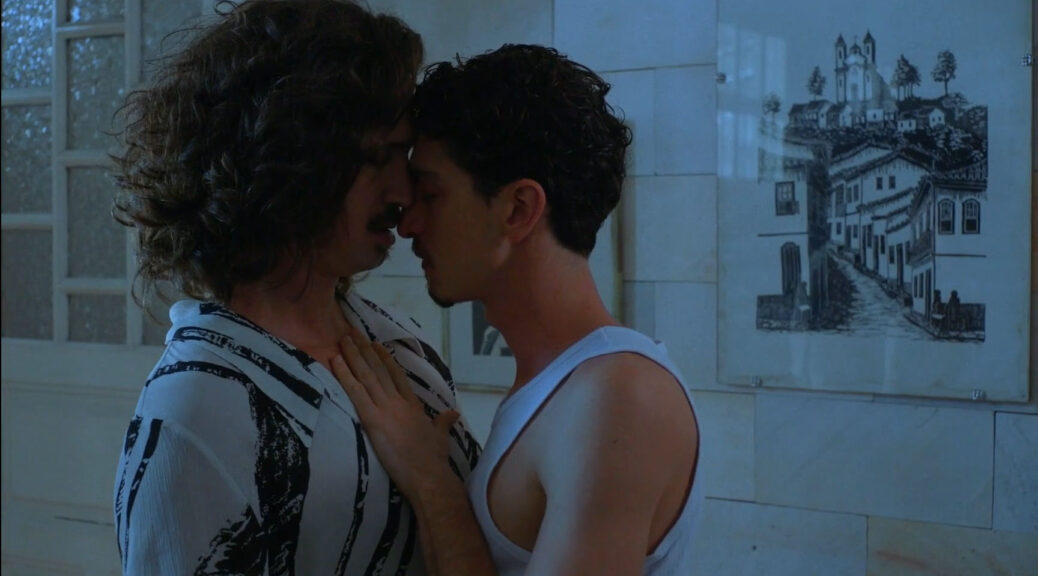
Writer/director Rodrigo de Oliveira shapes a not-so-subtle soldier metaphor for the first victims of the AIDS crisis in his film, The First Fallen.
The film follows biologist Suzano (Johnny Massaro), and his band of friends and family as he navigates the frontlines of a war waged within his body.
The first half of the film is less engaging than the more personal second half. Though we meet several characters over the course of the first hour or so, no one really has much depth – that comes later. Suzano has been away in Paris but has returned to his sister Muriel (Clara Choveaux) and her son Muriel (Alex Bonin) to reconnect. His friend Rose (a transcendent Renata Carvalho) has not only been turned away from the hospital where she seeks care, but they have misgendered her – the indignities of which lend the film its most powerful scene.
Most of the first act is concentrated around boisterous NYE celebrations, ringing in the year 1983. Rose performs for the celebrants at a gay club; Maura and Muriel attend a party. Suzano spends his evening alone.
There is a downheartedness that follows both Suzano and Rose, but it isn’t until the end of the first half that we get confirmation of what causes their sorrow.
A sarcoma on Suzano’s neck is our first hint that several of these characters have fallen victim to the devastating AIDS epidemic. De Oliveira doesn’t spend time catching up those who might not know the history of AIDS and its startling explosion onto the scene in the early 80s, particularly in the gay community. At the time of the film’s events, the medical world didn’t even know the cause of AIDS (HIV would be identified in May of 1983), let alone how to treat it.
Seeking to document how the disease ravages his body, Suzano isolates himself, along with Rose and another afflicted man, Humberto (Victor Camilo). This is where the film excels. We’re privy to an experience not many have witnessed, particularly at a time when fear of the unknown isolated those who suffered most. How Rose, Humberto, and Suzano deal with their illness is at times touching and other times heartbreaking. The film’s home video approach lends authenticity to the experience.
The soldier metaphor is apt. For the first victims of the AIDS epidemic, many became numbers, dehumanized to understand what plagued them. De Oliveria wants us to remember those who fell.
One of the most criminally underseen horror treasures of the 2000s has been restored and re-released, and you really should take advantage.
A paranoid fantasy about the link between progress and emasculation, Calvaire sees a timid singer stuck in the wilds of Belgium after his van breaks down.
Writer/director Fabrice Du Welz’s script scares up the darkest imaginable humor. If David Lynch had directed Deliverance in French, the concoction might have resembled Calvaire. As sweet, shy singer Marc (a pitch-perfect Laurent Lucas) awaits aid, he begins to recognize the hell he’s stumbled into. Unfortunately for Marc, salvation’s even worse.
The whole film boasts an uneasy, “What next?” quality. It also provides a European image of a terror that’s plagued American filmmakers for generations: the more we embrace progress, the further we get from that primal hunter/gatherer who knew how to survive.
Du Welz animates more ably than most our collective revulsion over the idea that we’ve evolved into something incapable of unaided survival –the weaker species, so to speak. Certainly, John Boorman’s Deliverance (the Uncle Daddy of all backwoods survival pics) understood the fear of emasculation that fuels this particular dread, but Du Welz picks that scab more effectively than any filmmaker since.
His film is a profoundly uncomfortable, deeply disturbing, unsettlingly humorous freakshow that must be seen to be believed.
If you haven’t gotten to know filmmaker Colin West, it’s high time you correct that. The writer/director follows up last year’s surreal Christmas haunting Double Walker with a beautiful look at living a fantastic life.
The effortlessly affable Jim Gaffigan plays Cameron, an astronomer in suburban Dayton, Ohio hitting a very rocky path in his middle age. The kiddie show about science that he hosts is failing. Maybe his marriage is, too. New neighbors, a mysterious woman, and increasingly bizarre events have got him wondering. What does it all mean?
West writes a meticulous script that folds in on itself in fascinating ways, keeping you guessing and engaged.
Gaffigan is a far more nuanced actor than you might realize. While his dual roles appear at first to provide comedic opportunities, both Gaffigan and West have more up their sleeves than that.
Gaffigan’s performances and West’s approach are primarily earnest, and it’s that simple grounding that allows the absurd flourishes in the film to take flight without cynicism or irony. The supporting cast, including a wonderful Katelyn Nacon, and Rhea Seehorn, Amy Hargreaves, Tony Shalhoub and Gabriel Rush, surrounds Gaffigan’s turn with sincere, often tender but simultaneously comical performances.
West and cinematographer Ed Wu give the environment a nostalgic, lovely, tactile quality that allows it to feel lost in time. All of these elements — the performances, nostalgia, absurd moments and kitchy aesthetic — blend with the story being told in ways that become clear and powerful by Act 3.
Linoleum’s conclusion is a savvy surprise, one that capitalizes on the investment the audience is sure to make in Cam, his family and his happiness. Thanks not only to those performances but to West’s masterful storytelling, a movie that feels like a light-hearted jaunt becomes an emotional powerhouse that leaves you reeling.
Several years back, someone who deserved a promotion came up with the idea of packaging the year’s Oscar nominated short films into three separate features, and making them available to theaters. Every year, it’s a wonderful chance to get the local big screen experience for films often only available through festivals or smaller screen streaming.
And again this year, the programs are well worth seeking out.
Animated Block
An Ostrich Told Me the World Is Fake and I Think I Believe It Australia 11 mins. Writer/Director: Lachlan Pendragon
It had you at the title, didn’t it? In a bit of Office Space meets Wallace and Grommit absurdity, an online toaster salesman gets red-pilled by a wise flightless bird. A stop-motion gem.
Ice Merchants Portugal 14 mins. Writer/Director: João Gonzalez
In this lovely short, a father and son live in a frigid house attached to a cliff, parachuting down each day to a village where they sell their ice. On its face, a parable on climate change, but works real magic through the abstract nature of a late surprise. Our pick for the hardware.
My Year of Dicks Unted States/Iceland Writer: Pamela Ribon Director: Sara Gunnarsdóttir
Another arresting title. And this nominee, based on Ribon’s memoir, is a charmingly honest look back at one young woman’s attempts to get some. Utilizing a mix of animation styles, the film speaks sweetly to how friendship can often help get us through those awkward years.
Based on an incredibly true event from 1917, a sailor is blown skyward from an accidental explosion, soaring naked as he contemplates life in a state of near-death. The latest from a Palme d’Or-winning duo is eight minutes of surprising profundity.
The Boy, The Mole, The Fox and The Horse United Kingdom 32 mins. Writers: Jon Croker (from the book by Charlie Mackesy) Directors: Peter Baynton, Charlie Mackesy
Was unable to preview this one.
Live Action Block
An Irish GoodbyeIreland 23 mins. Writers/Directors: Tom Berkeley, Ross White
With Banshees of Inisherin all over the feature nominations, this one gives the Emerald Isle some short subject love. In rural Northern Ireland, two brothers reunite after their mother’s passing. One brother wants to quickly sell the house and leave, while the other aims to complete Mom’s bucket list. Two fine performances drive a warm and human tale.
Night Ride(Nattrikken) 15 mins. Norway Writer/Director: Eirik Tveiten
On a very cold winter night, Ebba is force to wait outside for a tram while the driver takes a break. Some unlikely events later, she’s driving the tram and picking up a few other passengers. What begins with hi-jinks becomes a poignant lesson in empathy.
The Red Suitcase 18 mins. Luxembourg Writers: Guillaume Levil, Cyrus Neshvad Director: Cyrus Neshvad
A 16-year old Iranian girl is hesitant to pick up her suitcase from baggage claim at the Luxembourg airport. The new life that the girl’s father has arranged for her is a life she does not want, and the film becomes an effectively tense attempt to evade the man waiting at the gate with flowers.
Ivalu16 mins. Denmark Writers: Anders Walter, Morten Dürr (graphic novel) Directors: Anders Walter, Pipaluk K. Jørgensen
Pipaluk is desperate to find her sister Ivalu, who has suddenly vanished. Though their father seems unconcerned, Pipaluk begins a search through the wilderness, where memories may reveal painful secrets. It’s a bit obvious, but beautifully realized.
Le Pupille 38 mins. Italy Writers: Alice Rohrwacher, Carmela Covino Director: Alice Rohrwacher
From Disney and producer Alfonso Cuarón comes a Christmas story based on a letter that the Italian writer Elsa Morante wrote to a friend. Set in Italy at a Catholic boarding school for girls during WWII, the film employs gentle humor and wonderful performances to comment on religion, power, sacrifice, mercy and the lure of lusciously moist cake. The likely winner.
Documentary Block
The Elephant Whisperers India 41 mins. Writers: Kartiki Gonsalves, Priscilla Gonsalves, Garima Pura Patiyaalvi Director: Kartiki Gonsalves
This touching doc takes us to South India, where a couple raises orphaned elephants as if they were their own children. It’s a beautiful testament to an intelligent and sensitive species, and to the bond possible between humans and the animal world.
Haulout 25mins. United Kingdom/Russia Writers/Directors: Maxim Arbugaev, Evgenia Arbugaeva
For ten years, scientist Maxim Arbugaev made an annual trek to a small hut in the Russian Arctic to observe walrus migration. What he found over the years is heartbreaking, and (hopefully) eye-opening. Haulout stands as an intimate example of just one stark consequence of our warming oceans.
How Do You Measure a Year?29 mins. United States Director: Jay Rosenblatt
From the time his daughter Ella was two, until the day she turned eighteen, Jay Rosenblatt filmed an annual question-and-answer session between them. What is power? What are dreams? What do you want to be when you grow up? Sure, it’s a sweet and personal keepsake of their relationship, bit it’s also a universal look at how our children become their own unique selves. Parents, get ready for the feels.
The Martha Mitchell Effect 40 mins. United States Directors: Anne Alvergue, Debra McClutchy
The title refers to a real psychological term for when a patient’s accurate perception of events is misdiagnosed as delusional. If you don’t remember Martha and her role in the Watergate scandal, this will be a fascinating introduction. And if you lived through those endless news reports, the film is a must-see closeup on an angle you may have glossed over.
Stranger at the Gate 29 mins. United States Director: Joshua Seftel
What happens when a former U.S. Marine meets the very individuals he was planning to kill with a homemade bomb? A simply jaw-dropping story of forgiveness, enlightenment, and how the ignorance of blind hatred can be healed. The Oscar favorite.
In 1953, while writing Casino Royale, Ian Fleming decided to name his hero after an ornithologist who had written a book on Caribbean birds that he enjoyed. That name was Bond. James Bond. You know his name and you know his number, but what about all of the other folks out there who share the same name?
Our names are a part of our identity. Some of us like our names; others don’t. So too it goes for the other souls around the globe who are named James Bond. Matthew Bauer’s documentary The Other Fellow is their story. From an annoyed lawyer to a self-made raconteur to someone fleeing a real-life villain to another accused of murder, these people carry both the pleasure and the pain of being compared to the world’s most famous spy every time they introduce themselves.
Much like the Bond films, this documentary is a globe-trotting affair filled with beauty, grief, suspense, and yes, even product placement. In most hands, this could have been a cheap piece of cinematic fluff meant to grift some money off of Bond fans, but the filmmakers have managed to craft something far more meaningful here. Whether or not you sympathize with the varying trials and tribulations of its different subjects, The Other Fellow is a compelling and human look into identity – be it chosen or not – and how it affects a person as they go through life.
Why would someone intentionally change their name to James Bond? Well, as it turns out, there can be some very good reasons for that. Similarly, there are scenarios in which carrying that name could ruin your entire life because of the baggage it carries. Being Bond comes with a cost, be it a grand one or just the occasional annoying one in the form of bad jokes from strangers. For better or worse, such is the way of things when one shares a name with a celebrity (be they real or fictional), which is something yours truly knows a tiny bit about.
The Other Fellow is an intriguing and insightful look at how our names can shape our personality, our growth, our day-to-day lives, and ultimately our future. It’s an 80-minute dive into identity that, much like its subjects, just happens to evoke a certain 00 agent. It might not leave you shaken and stirred, but it’s worth a look.
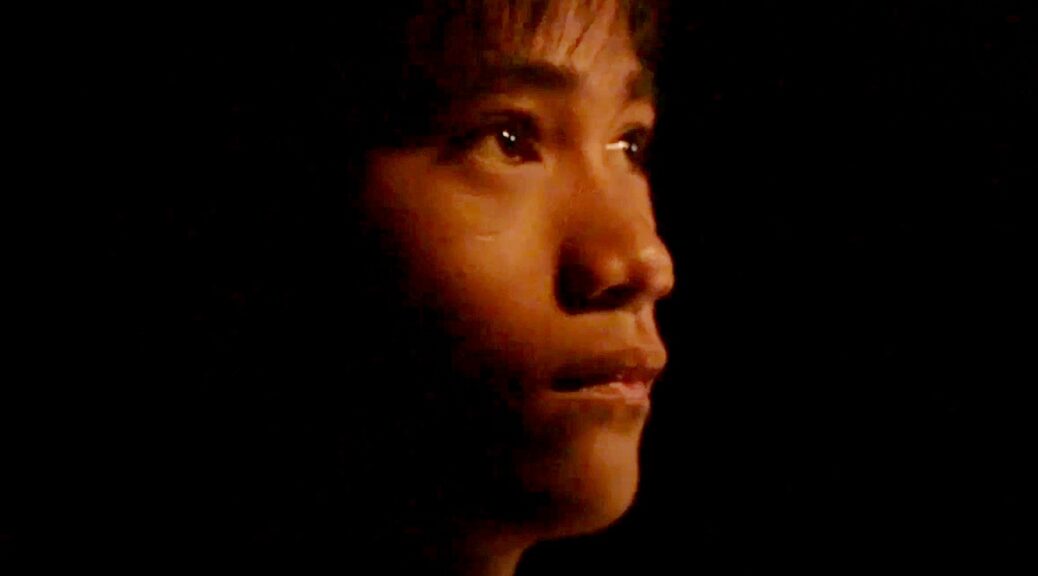
Writer/director S.J. Finlay brings to life the reality facing people living on the island of Mindanao (Philippines) with his feature film, Boy from Nowhere. His focus, in particular, is trained on a young boy named Gary (Gary Jumawan).
Tall and lanky, Gary’s age is never mentioned, but it is clear he is young – likely somewhere between 12 and 15.
Gary’s life revolves around playing basketball with area boys, as well as learning how to fish. He spends his time in the water, learning to observe the environment around him. Though it speaks of a peaceful existence for a young boy, Gary’s world is shattered by the brutality that is often the experience for people in Mindanao.
An island rich in resources, there are several factions vying for control. The island comprises several tribes, and the film’s brief introductory text states that many people have found their livelihoods and cultures threatened by both the government of the Philippines, as well as outside interests. To combat the upheaval to their way of life, rebel factions rely on child soldiers to bolster their numbers.
Finlay’s style is naturalistic. Casting several non-actors in the primary roles serves to underscore the film’s realism. Some are more natural on camera than others, but there is a documentarian feel as Finlay watches Gary navigate the world, often without the presence of adults.
The short run-time hinders the film. When Gary is faced with several choices, we’re not allowed to contemplate them with him, nor are we given much action to help us understand the choices he makes. Instead, Finlay relies heavily on exposition and dialogue to clarify what’s at stake. This choice negates the slice-of-life portrait the filmmaker is trying to paint.
The film best succeeds in its focus on the moral and ethical dilemmas facing the people of Mindanao. While using children to fight a war is unethical, Boy from Nowhere emphasizes the desperation facing people with nothing left to lose. When the entire culture is threatened, isn’t it the duty of the children to fight? Though Finlay’s opinion on this matter is never in doubt, he treats those who resort to such choices with sympathy.
Finlay juxtaposes the images of child soldiers against a breathtaking landscape. The cinematography highlights what people are fighting to protect. One can only hope this way of life might be saved.
Leaving the screening of Winnie the Pooh: Blood and Honey, I overheard another viewer say, “So many questions.” I, too, have a lot of questions. Why do Pooh and Piglet have man hands? Where do they get their clothes? When did they learn to drive? What am I doing at this movie?
No, that last one’s not real. There was no question I was going to see this movie. Like most people, I grew up with Winnie the Pooh and all his friends in the 100 Acre Wood. I loved the illustrations in A.A. Milne’s books. I loved the Disney cartoons. That live-action kids’ show, though, with people in suits – that freaked me out. That was just wrong, and it was the kind of wrong I was hoping for with the film.
Nope.
Though the sound mix is often muddy, the film does boast some technical qualities: production values, set design, lighting – writer/director Rhys Frake-Waterfield gathered a competent crew. The problem is the writing. There’s about enough script for a 30-minute film, and even that would not have been very good.
First, Christopher Robin (Nikolai Leon) returns to his old stomping ground to introduce his beloved to his oldest, dearest friends, only to find that Pooh and the gang have not exactly thrived in his absence.
Meanwhile, Maria (Maria Taylor) follows her therapist’s suggestion to take a break, unplug and relax with her girlfriends. She and her besties head to the same stretch of forest for a quiet weekend of grisly, man-bear related slaughter.
The acting throughout is awful, but it’s hard to slight the actors themselves when each of their scenes is stretched to 4 minutes longer than it should be and they have to just find a way to take up the time. This leads to a lot of inaction when action would be reasonable, and an awful lot of repeated, “Why are you doing this?”
Plus, there’s a gun that appears and disappears scene to scene, and a laugh-out-loud car sequence. But any intentional humor is woefully absent.
Whatever the film’s many – almost countless – flaws, Frake-Waterfield deserves tremendous credit for seeing an opportunity and seizing it. Milne’s catalog fell into the public domain last year, a fact Frake-Waterfield met with an idea. What if Pooh and the gang went feral?
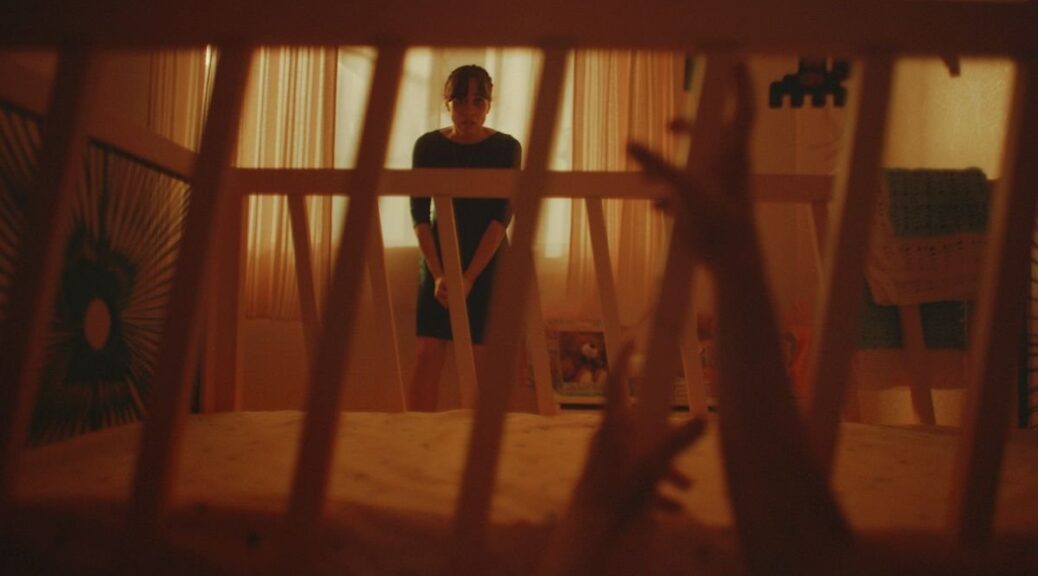
As Huesera: The Bone Woman opens, women climb the 640 steps leading to the world’s largest statue of the Virgin of Guadalupe, located in Ocuilan, Mexico. Valeria (Natalia Solián) and her mother are among the pilgrims, their goal: a blessing leading to Valeria’s fruitful womb.
As writer/director Michelle Garza Cervera’s camera pulls back and back and back, suddenly the 108’ virgin looms like a serene-faced golden Godzilla above a woman who no longer looks so certain about her prayer.
It’s a confident opening to the entirely assured feature debut from Cervera. Her maternal nightmare is bright and decisive, pulling in common genre tropes only long enough to grant entrance to the territory of a central metaphor before casting them aside for something sinister, honest and honestly terrifying.
While it toes certain familiar ground – the gaslighting of Rosemary’s Baby, for instance – what sets Huesera apart from other maternal horror is its deliberate untidiness. Cervera refuses to embrace the good mother/bad mother dichotomy and disregards the common cinematic journey of convincing a woman that all she really wants is to be a mom.
There’s complexity and subtlety in the various relationships as well, elevating the material above standard horror fare. Valeria has real, joyous chemistry with husband Raúl (Alfonso Dosal). And if he’s weak in the face of his mother’s wishes, Valeria is hardly standing up to her own mother or sister. The ways in which we all dodge family conflict feed into the writing, helping ground the larger metaphor in reality.
Solián’s performance weaves effortlessly and authentically from one family dynamic to the next, each presenting only opportunities to submit, to accept or to be ostracized and rejected. Huesera’s metaphor is brave and timely. Brave not only because of its LGBTQ themes but because of its motherhood themes. It’s a melancholy and necessary look at what you give up, what you kill.
It may not be a textbook Rashomon approach, but director/co-writer Benjamin Caron leans on a similar structure in his impressive feature debut for Apple Originals, Sharper.
Set up in chapters named for the main personalities, the film first introduces us to Tom (Justice Smith, from Jurassic World: Fallen Kingdom and Pokémon: Detective Pikachu). Tom owns a struggling bookstore in NYC, and is mostly estranged from his billionaire father, Richard (John Lithgow) and his new wife, Madeline (Julianne Moore).
But when Tom sells a book to PhD student Sandra (The Tender Bar‘s Briana Middleton), a relationship begins. And a few weeks later, Tom is offering to give Sandra thousands of dollars to settle her troubled brother’s debts with some bad guys. He gives her the satchel full of cash, and watches her walk away. Yeah.
So, right away, we’re on Tom’s side. But then, we get Sandra’s backstory, which includes some important details about her life before walking into that bookstore, and about her shady brother.
And then there’s the relationship between Richard and Madeline, which gets plenty complicated with the sudden arrival of Madeline’s ne’er-do-well son, Max (Sebastian Stan).
Caron, from TV’s The Crown, Andor and Sherlock, weaves the agendas together with a fine hand, revealing mysterious secrets just when they can add the most fun to the journey.
And this is an entertaining slice of life on the grift, one leaning more toward gloss and polish than neo and noir. The performances are all stellar, which ironically adds to the film’s slight stumble at the finish line. That final twist will not be hard to sniff out, even for mildly experienced film buffs. But we believe these people know all the angles, and when a character calls out a con midway through, it should only increase the chance that their antenna would be up for this same play later on.
But cons are just fun, aren’t they? And Sharper is a well-crafted and clever one, even with a finale that dulls its edges a bit.