Tag Archives: The Birds

Fright Club: Attics in Horror

We’ve gone exploring to find all our Christmas decorations! It led us to the basement (which we discuss with Jamie Ray over on his amazing Fave Five from Fans podcast), and into the attic! That’s where we stay for a countdown of the best attics in horror movies!

5. 30 Days of Night (2007)

A pod of survivors hides in an attic, careful not to make any noise or draw any attention to themselves. One old man has dementia, which generates a lot of tension in the group, since he’s hard to contain and keep quiet.

There’s no knowing whether the town has any other survivors, and some of these guys are getting itchy. Then they hear a small voice outside.

Walking and sobbing down the main drag is a little girl, crying for help. It’s as pathetic a scene as any in such a film, and it may be the first moment in the picture where you identify with the trapped, who must do the unthinkable. Because, what would you do?

As the would-be heroes in the attic begin to understand this ploy, the camera on the street pulls back to show Danny Huston and crew perched atop the nearby buildings. The sobbing tot amounts to the worm on their reel.

Creepy business!

4. Hereditary (2018)

With just a handful of mannerisms, one melodic clucking noise, and a few seemingly throwaway lines, Ari Aster and his magnificent cast quickly establish what will become nuanced, layered human characters, all of them scarred and battered by family.

Art and life imitate each other to macabre degrees while family members strain to behave in the manner that feels human, seems connected, or might be normal. What is said and what stays hidden, what’s festering in the attic and in the unspoken tensions within the family, it’s all part of a horrific atmosphere meticulously crafted to unnerve you.

Aster takes advantage of a remarkably committed cast to explore family dysfunction of the most insidious type. Whether his supernatural twisting and turning amount to metaphor or fact hardly matters with performances this unnerving and visual storytelling this hypnotic.

3. The Birds (1963)

As The Birds opens, wealthy socialite Melanie Daniels (Tippi Hedren) has followed hottie bachelor lawyer Mitch (Rod Taylor) to little Bodega Bay, his hometown, to play a flirtatious practical joke of cat and mouse. But you know what will eat both cats and mice? Birds.

Hitchcock introduces a number of provocative characters, including Hedren’s not-that-likeable heroine. Suzanne Pleshette’s lovelorn schoolteacher’s a favorite. But whatever the character, the dread is building, so they need to work together to outwit these goddamn birds.

The film is basically an intelligent zombie film, although it predates our traditional zombie by a good many years, so maybe, like every other dark film genre, the zombie film owes its history to Hitchcock. The reason the birds behave so badly is never explained, they grow in number, and they wait en masse for you to come outside. No one’s off limits – a fact Hitch announces at the children’s party. Nice!

Though the FX were astonishing for 1963, the whole episode feels a bit campy today. But if you’re in the mood for a nostalgic, clean cut and yet somehow subversive foray into fairly bloodless horror, or if, like one of us, you’re just afraid of birds, this one’s a classic.

2. The Changeling (1980)

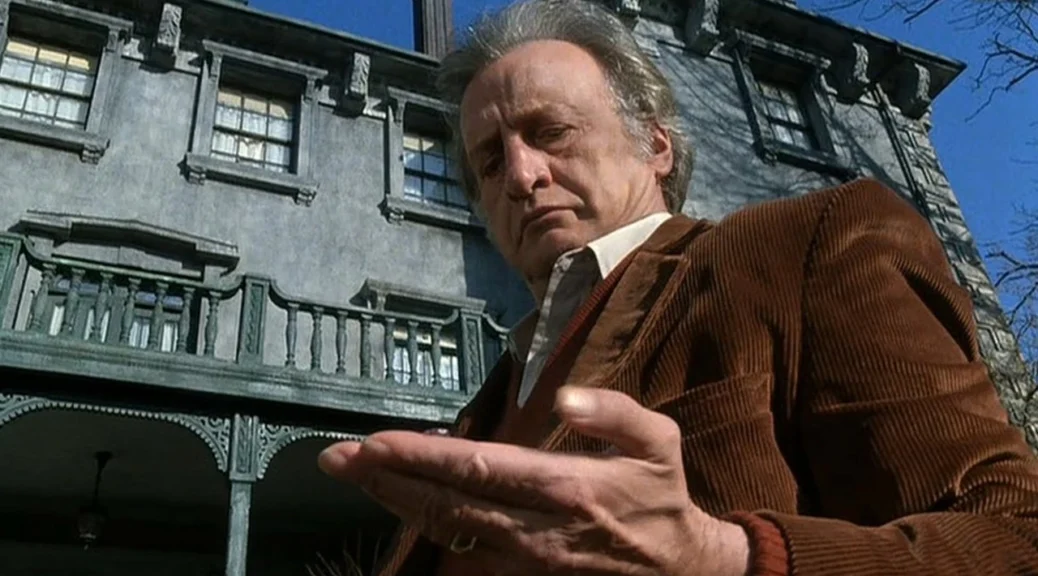
George C. Scott is a grieving father isolating himself in an old mansion. But something in that mansion in Peter Medak’s atmospheric ghost story is drawn to him.

The Changeling is a beautiful, haunting mystery full of melancholy and grief. Scott’s big, gruff performance breaks with vulnerability just often enough to jerk a tear or two in a film that’s spooky, lovely, and satisfying.

1. Black Christmas (1974)

Director Bob Clark made two Christmas-themed films in his erratic career. His 1940s era A Christmas Story has become a holiday tradition for many families and most cable channels, but we celebrate a darker yule tide tale: Black Christmas.

Sure, it’s another case of mysterious phone calls leading to grisly murders; sure it’s another one-by-one pick off of sorority girls; sure, there’s a damaged child backstory; naturally John Saxon co-stars. Wait, what was different? Oh yeah, it did it first.

Released in 1974, the film predates most slashers by at least a half dozen years. It created the architecture. More importantly, the phone calls are actually quite unsettling, there is something fantastically horrifying staring out the window in the attic, and the end of the film is a powerful, memorable nightmare.

Fright Club: When Animals Attack

How is it we haven’t done this one yet? So many to choose from – most of them bad. Grizzly? Or Grizzly 2: The Concert? You know how we feel about Monkey Shines.

But, an animal attack has to be the human’s most primal fear, and it is sometimes mined for real terror when the story is in the right hands. Though there are a handful that fell just off the list – Burning Bright, Black Water, Lake Placid, The Shallows – these made the most lasting impression. They left bite marks.

https://soundcloud.com/frightclub/frightclub87-when-animals-attack

5. Cujo (1983)

A New England couple, struggling to stay afloat as a family, has some car trouble. This naturally leads to a rabid St. Bernard adventure.

But before we get into all that, we’re privy to the infidelities that undermine the marriage of Donna (Dee Wallace) and Vic (Daniel Hugh Kelly). Remarkably, it’s Donna who’s boning elsewhere. You might expect such behavior from her perennially shirtless husband, but no. Apparently dressing like Ma Engle is a real draw for New England boys.

This film is easy to write off. It dates terribly, from the heavy handed set up to the weak exposition to the inescapably Eighties score to Daniel Hugh Kelly’s ridiculous hair. Let’s not even get into this big, friendly St. Bernard covered in Caro Syrup pretending to be a menace, or the hillbilly family running the garage. (Stephen King will be damned if the South gets to corner the market on scary rural folk!)

Still, with all its many, many faults, once Donna and her asthmatic son (pre-Who’s the Boss Danny Pintauro) find themselves trapped in their broken down Pinto (What? Those seem like such reliable cars!) with a rabid dog (bigger than the car) attacking, the film ratchets up the tensions and rewards you for your patience.

Profoundly claustrophobic and surprisingly tense, benefitting immeasurably by Wallace’s full commitment to the role, the third of the film where we’re trapped in the heat inside that Pinto just about makes up for the entire rest of the picture.

4. Rogue (2007)

In 2007, Wolf Creek writer/director Greg McLean returned, again with the intention of scaring tourists out of Australia.

Australia – if I remember my Crocodile Hunter program, you know, before the deadly beasts of Australia finally killed him – is home to more man eating sharks, poisonous snakes, poisonous spiders, crocodiles and alligators than anywhere else on earth. It’s also the spot right under the hole in the ozone. I swear. The thing that seems to fuel McLean’s work is a bone-deep puzzlement over Australia’s tourism draw.

He’s not all anti-Oz, though. The aerial shots of his native nation’s North Territory inspire awe, and much of the film makes the rugged landscape a major character as riverboat tour guide Kate (Radha Mitchell) veers her group off course to answer another craft’s distress signal. Her boat’s quickly grounded when something bumps it, and she and her crew of tourists find themselves banked on a tiny mud island as daylight diminishes. Eventually they realize that inside that murky river is one mammoth crocodile.

One reason this film works as well as it does is that the croc looks cool. Another is that the performances are rock solid – Mitchell and Wolf Creek co-star John Jarratt, in particular, but look out for Sam Worthington in a small role. But the real star is McLean, who can ratchet up tension like nobody’s business. You know what’s coming, and yet still you jump. Every time.

3. Open Water (2003)

Jaws wasn’t cinema’s only powerful shark horror. In 2003, young filmmaker Chris Kentis’s first foray into terror is unerringly realistic and, therefore, deeply disturbing.

From the true events that inspired it to one unreasonably recognizable married couple, from superbly accurate dialog to actual sharks, Open Water’s greatest strength is its unsettling authenticity. Every element benefits from Chris Kentis’s control of the project. Writer, director, cinematographer and editor, Kentis clarifies his conception for this relentless film, and it is devastating.

A couple on vacation (Blanchard Ryan and Daniel Travis) books a trip on a crowded, touristy scuba boat. Once in the water, they swim off on their own – they’re really a little too accomplished to hang with the tourists. And then, when they emerge from the depths, they realize the boat is gone. It’s just empty water in every direction.

Now, sharks aren’t an immediate threat, right? I mean, tourist scuba boats don’t just drop you off in shark infested waters. But the longer you drift, the later it gets, who knows what will happen?

2. The Birds (1963)

As The Birds opens, wealthy socialite Melanie Daniels (Tippi Hedren) has followed hottie bachelor lawyer Mitch (Rod Taylor) to little Bodega Bay, his hometown, to play a flirtatious practical joke of cat and mouse. But you know what will eat both cats and mice? Birds.

Hitchcock introduces a number of provocative characters, including Hedren’s not-that-likeable heroine. Suzanne Pleshette’s lovelorn schoolteacher’s a favorite. But whatever the character, the dread is building, so they need to work together to outwit these goddamn birds.

The film is basically an intelligent zombie film, although it predates our traditional zombie by a good many years, so maybe, like every other dark film genre, the zombie film owes its history to Hitchcock. The reason the birds behave so badly is never explained, they grow in number, and they wait en masse for you to come outside. No one’s off limits – a fact Hitch announces at the children’s party. Nice!

Though the FX were astonishing for 1963, the whole episode feels a bit campy today. But if you’re in the mood for a nostalgic, clean cut and yet somehow subversive foray into fairly bloodless horror, or if, like one of us, you’re just afraid of birds, this one’s a classic.

https://www.youtube.com/watch?v=LrN_U830_Gc

1. Jaws (1975)

What else – honestly?

Twentysomething Steven Spielberg’s game-changer boasts many things, among them one of the greatest threesomes in cinematic history. The interplay among the grizzled and possibly insane sea captain Quint (Robert Shaw), the wealthy young upstart marine biologist Hooper (Richard Dreyfuss) and the decent lawman/endearing everyman Brody (Roy Scheider) helps the film transcend horror to become simply a great movie.

Perhaps the first summer blockbuster, Jaws inspired the desire to be scared silly. And in doing so it outgrossed all other movies of its time. You couldn’t deny you were seeing something amazing – no clichés, all adventure and thrills and shocking confidence from a young director announcing himself as a presence.

Spielberg achieved one of those rare cinematic feats: he bettered the source material. Though Peter Benchley’s nautical novel attracted droves of fans, Spielberg streamlined the text and surpassed its climax to craft a sleek terror tale.

It’s John Williams’s iconic score; it’s Bill Butler’s camera, capturing all the majesty and the terror, but never too much of the shark; it’s Spielberg’s cinematic eye. The film’s second pivotal threesome works, together with very fine performances, to mine for a primal terror of the unknown, of the natural order of predator and prey.

Jaws is the high water mark for animal terror. Likely it always will be.