Tag Archives: Rachel Willis

Eye in the Sky

Whirlybird

by Rachel Willis

If you were paying attention to the news in the early 1990s, you’ve likely seen the aerial footage from Bob (now Zoey) Tur and Marika Gerrard-Tur that came out of Los Angeles. Even now, some of the captured footage is embedded within the American culture.

Collating hundreds of hours of footage, director Matt Yoka has assembled a fascinating and poignant documentary about the quest to be first on the scene of breaking news and about the heartbreak of one family behind the camera.

Zoey Tur talks in-depth about her experiences behind the camera in LA, starting in the late 1970s and running through the late ’90s. Her enthusiasm for the chase – whether following police cruisers in the family car (with wife and children in tow), or hovering over the city in her helicopter – is infectious. It’s not hard to see why she pursued the stories with such zeal.

The other half of the duo, Marika, was instantly caught up in the adrenaline rush after her first date with Tur. She describes Tur as being unlike anyone she had known before – a thrill seeker who sucked her into a world of breaking news.

Yoka is not interested in mining the ethical grey area that surrounded the early days of breaking news. Instead, he is more interested in looking at what happens to the people behind the camera – how are they affected by the crime and violence they capture, sometimes as it’s happening?

One of Tur’s most infamous captures was the beating of Reginald Denny. Broadcast on live television (Tur behind the camera in her helicopter), Denny was dragged from his truck and beaten by several men during the LA riots that followed the acquittal of the four officers responsible for the attack on Rodney King.

Tur cannot help but pass judgment on the violence recorded from above, and this is something Yoka focuses on: the influence, not only of the images captured, but the opinions from those recording the footage, on society.

As we watch the seemingly increasing violence in LA, we also watch it reflected in Tur. Violence and anger well up within her, and she lashes out at her family.

Yoka’s sensitive examination of a family and a culture that hinges on the precipice of breaking news is well worth making time for.

Dan Bites Dog

Danny. Legend. God.

by Rachel Willis

With a title like Danny. Legend. God. you might expect a movie that’s, well, legendary. Unfortunately, writer/director Yavor Petkov delivers something far more banal with his first feature film.

A film crew follows city councilor, Danny (Dimo Alexiev), for a documentary series about money laundering. However, Danny lets them know they won’t be following any kind of script; they’re making “big cinema.” The three-person team gets more than they bargained for as Danny takes them deeper into his shady world.

Danny is a big fish in a little pond, and along with his heavy, Tanko (Emil Kamenov), spends a lot of his time finding ways to impress his importance upon the film crew. Danny’s godson (Borislav Markovski) tags along for a few of his exploits, and it’s a credit to young Markovski that he’s one of the most interesting characters to watch despite having zero lines of dialogue.

But this points to the film’s biggest problem – the lead. For Danny, you need a character who is both repulsive, yet irresistible. Alexiev’s Danny is repulsive, but there is nothing about him – or the film – that compels you to watch. Too much here feels like we’re waiting for something to happen.

There are several scenes in the car that attempt to heighten the tension of being trapped with someone like Danny, but it doesn’t work. No one wants to be in the car with Danny – not the film crew nor the audience. We’re not watching a car crash, but a traffic jam.

There are a few side characters who turn up for a scene or two that help move the film along. Danny’s irritated wife, the documentary producer, and an old flame play off Alexiev with conviction. Seeing Danny from their points of view help sell him as someone dangerous.

As Danny’s more sinister nature begins to reveal itself, the documentary soundman (James Ryan Babson) becomes more uncomfortable with the things they record. He insists “we’re complicit!” but within the context of the film, it’s either an overreaction or a heavy-handed commentary on our societal tendency to sit back and watch while our politicians play fast and loose with the rules.

The movie wants us to wake up and find ourselves uncomfortable with those we put into office, but in the context of the real world, Danny isn’t nearly as disturbing as some of the actual people holding power right now.

Maine Event

Downeast

by Rachel Willis

Coastal Maine is beautiful country, but there is a seedy underbelly of drugs, gambling, and crime that’s explored in director Joe Raffa’s film, Downeast.

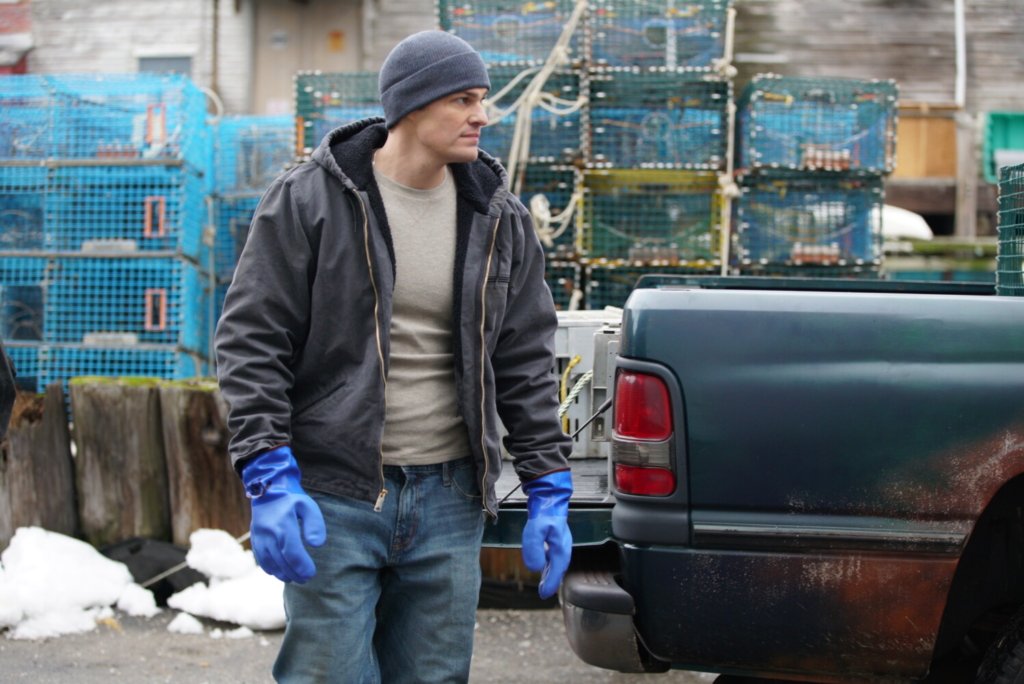
Refining a story written by native Maine resident Greg Finley, Raffa’s focus is on a lobsterman named Tommy (Finley). Following a life-changing incident in which he ran afoul of area mobsters, Tommy tries to live with his head down, following his own moral code. The return of his ex, Emma (Dylan Silver), reopens old wounds.

The ‘townies’ are wary of Emma, whose questions threaten the tenuous balance the mob holds over the residents. Even Tommy’s loyalty lies with the town over his budding relationship.

There aren’t many new stories to tell, and if this one sounds familiar, that’s because it is. However, the film boasts compelling characters and wonderful attention to detail that help keep us invested.

From a technical standpoint, this is a well-made movie. Edwin Pendleton Stevens’s cinematography juxtaposes the coastal vacation town against a gritty, cold world that feels lifeless when summer ends. The empty winter boardwalk seems sinister compared to scenes of a beach crowded with summer tourists.

The actors inhabit their roles so organically that often you feel like you’re sitting with them in the local watering hole. Finley is at home with his character, but the others alongside him are just as natural. The only one who stands out as different is Silver, but it works because Emma is an outsider to this world—she talks tough like the rest of them, but she isn’t one of them, and her world view doesn’t align with the townies.

The film’s biggest issue lies with the characters’ motivations. While things seem straightforward in the beginning, they take a turn toward the unusual. Characters’ decisions make zero sense given what we know of them. Even the background players behave strangely. Plotlines resolve in head-scratching ways. It all detracts from the strong chemistry the actors create as members of a close, if tenuous, community.

There is a lot crowded into the plot, so some characters are shallow compared to others. The mobsters are one-dimensional villains, and while a case could be made that’s the truth in real life, it doesn’t make for compelling storytelling.

Downeast shows how important a strong screenplay is because, without it, you’re left with a beautiful, forgettable film.

Playing God

The God Committee

by Rachel Willis

Based on the play by Mark St. Germain and adapted for the screen by writer/director Austin Stark, The God Committee seeks to provide insight into the fraught decisions behind who lives and who dies when it comes to organ transplants.

A new heart is recently available for the St. Augustine Hospital, a building in disrepair and under renovation, and the transplant committee convenes to decide who among three matches is the worthiest to receive the heart. The committee has a paltry 90 minutes to make their decision or else the heart will be useless.

The initial set-up alone is worthy of an entire film, but the movie isn’t satisfied to stay within the confines of a sterile boardroom. The timeline jumps forward seven years to check-in on our committee, primarily Dr. Andre Boxer (Kelsey Grammer), and how the implications of their decision on that fateful day have affected them.

By moving back and forth between the past and present, the tension of those crucial 90 minutes is often interrupted. However, by weaving the present into the past, we get to know the people behind these decisions.  

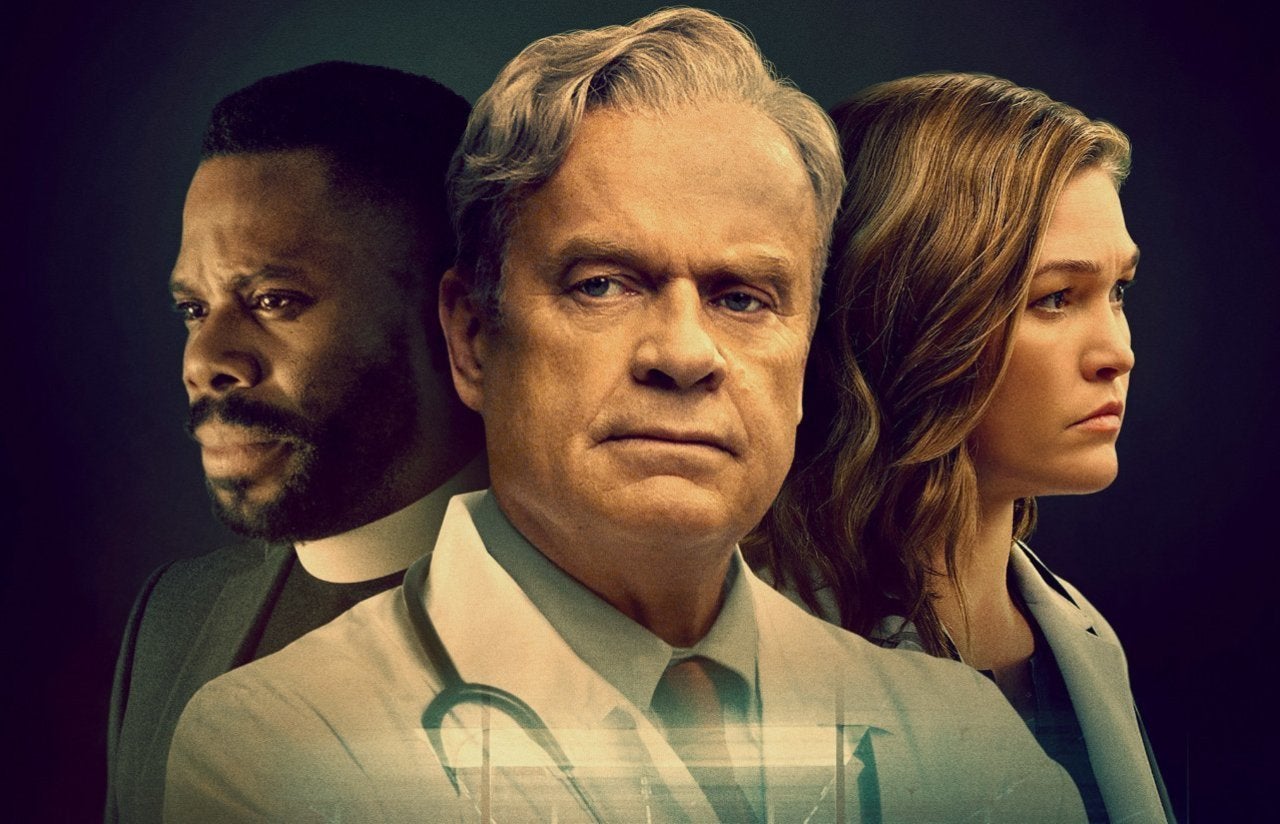
Grammer excels on screen as the pragmatic Boxer, basing his judgments on the medical data rather than emotion. As his foil, Dr. Jordan Taylor (Julia Styles) relies on her heart to guide her decision-making. Unfortunately, Styles can’t quite match the passion of Grammer. The other members of the committee, which include Janeane Garofalo and Colman Domingo, aren’t given as much to work with and don’t resonate on screen in the same way.

The play lends itself well to film, and Stark handily adapts the source material. There are a few moments that remind us this is an adaption of a play – mainly, characters who talk to the screen. This might have worked better had it been transitioned from audience-directed monologue into character-driven dialogue, as it would have heightened the conflict inside the boardroom.

The film touches on numerous thematic issues: the ethics of deciding who is worthy of a transplant, the conjunction of corporatism and life-saving medical research, the inequity of medical care across racial and class lines, black market trade in organs, etc. Unfortunately, The God Committee never settles on any of them, careening across multiple threads without any direction.

If the movie had stuck to a theme and a timeline, it might have been more impactful.

On the Record

Lansky

by Rachel Willis

You might not be familiar with the name Meyer Lansky, but chances are you’re familiar with some of his known associates: Bugsy Siegel and Lucky Luciano. Writer/director Etyan Rockaway decided the time was right to focus on one of the Mafia’s most infamous but un-famous gangsters.

There are quite a few gangster movies, both good (Goodfellas, The Godfather) and bad (Gotti, The Family). Lansky falls somewhere in the center. Never overly imaginative, Rockaway plays it safe with a middling film about a narcissistic mob figure who wants to control the narrative. To do this, an aging Lansky (Harvey Keitel) hires a broke writer, David Stone (Sam Worthington), to pen his tale.

Told in flashbacks within a 1980s framing story, Lansky regales Stone with stories from his childhood, learning to hustle on the streets of – where else? – New York City. However, as Lansky enters adulthood, the tales become violent.

Portraying the Lansky of the past is John Magaro, who makes the character his own while still embracing the inflections and mannerisms of Keitel’s older wise guy. Magaro brings a sinister element, while Keitel embraces the role of a man mellowed by age. It’s a dynamic casting job, and the film’s standout element.

Rockaway’s script glosses over much of Lansky’s past, with large jumps in time, allowing the film to devote equal time to the framing story. Here is where the film tries to carve some new ground. Stone’s story is, in some ways, the more interesting of the two. There’s a moral line Stone must cross to listen to the brutalities in Lansky’s past – especially as he’s bound to secrecy until Lansky has died.

Unfortunately, rather than centering the focus on the ambiguous morality of Stone’s situation, Rockaway’s film instead tries to convince you Lansky is an ‘angel with a dirty face.’

It’s not unheard of to root for the bad guy – Scarface is one of the ultimate examples of this in the genre – but Lansky is not a fictional character. His history is bloody, and his few good deeds hardly outweigh the bad. It’s an odd choice when the true moral crux lies with Stone.

Lansky runs itself ragged trying to cover as many bases as possible, and we’re left with a messy film about one of the most notorious men in Mafia history.

Sex and the Sitter

Deadly Illusions

by Rachel Willis

Something I’ve learned from movies is that if you’re going to hire a nanny, expect some professional lines to be crossed.

Such is the dynamic between Mary (Kristin Davis) and Grace (Greer Grammer) in writer/director Anna Elizabeth James’s erotic thriller, Deadly Illusions.

Mary is a novelist with a series of successful murder mysteries under her belt, but she hasn’t written a new one in a while. Her publisher is desperate to bring her back to pen a new addition. Mary’s reluctant, until her husband’s serious financial blunder makes the decision for her.

But who will take care of her kids while she writes? Enter sweet, innocent nanny, Grace.

The film’s set-up is slow to get going. It’s light on the eroticism and doesn’t feel like much of a thriller. The first act plods along, dropping the pieces into place as if aware we already know where this is going to go. It’s not a very compelling watch.

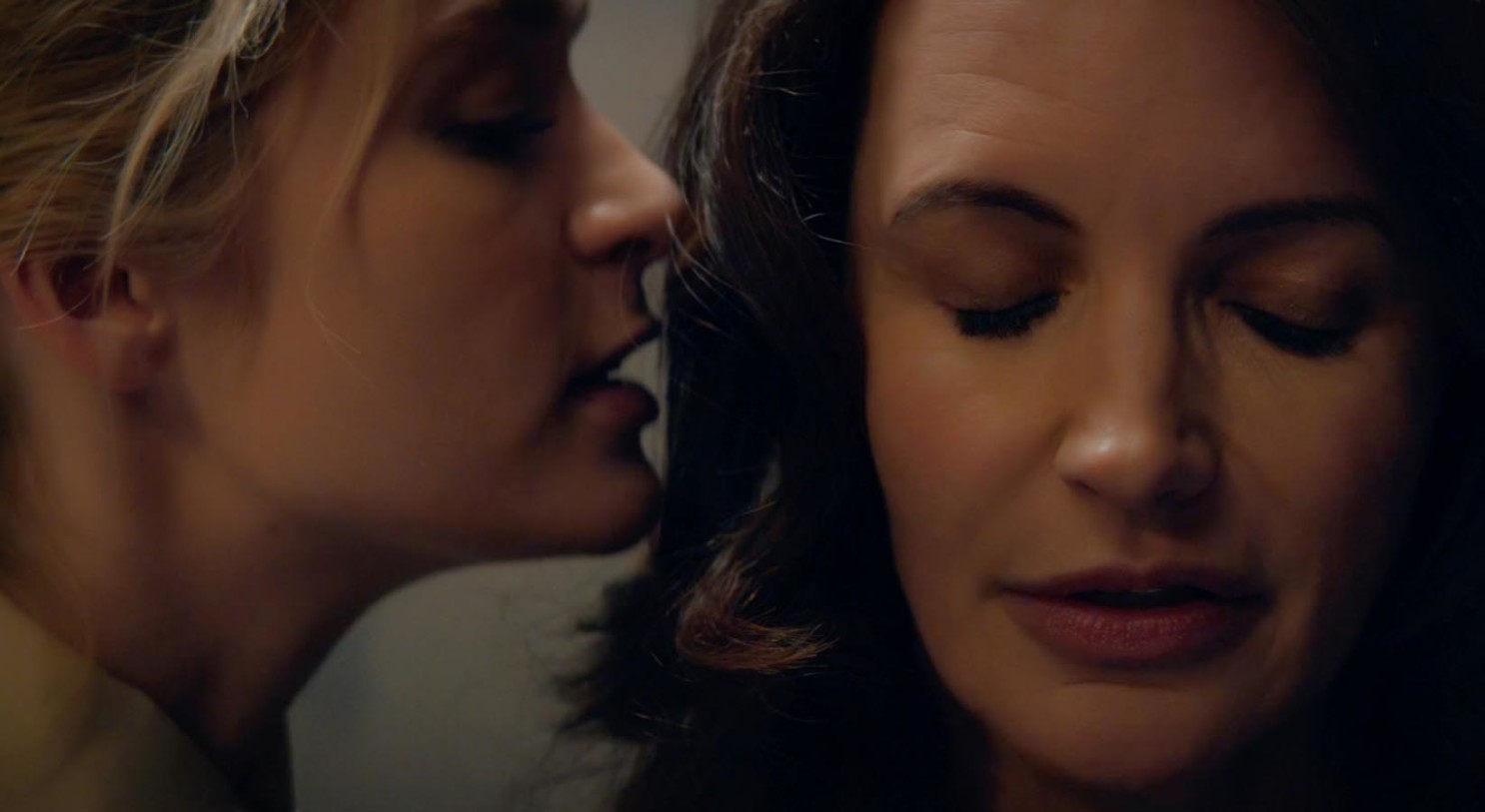
Things heat up in the second act, though not by much. We’re still waiting for the water to boil. The initial relationship between Mary and Grace quickly crosses into inappropriate territory. Mary takes Grace bra shopping and enters the dressing room with her. It’s predatory, though it seems the movie wants us to feel Grace is the aggressor in the scene.

As we simmer through, Mary’s creativity begins to interfere with her reality. As she loses herself in her new novel, she fantasizes about inappropriate activities with Grace. Or do those things really happen?

Things get weirder, and several clunky red herrings are dropped into the mix. This movie wants to keep us guessing, but it’s never enticing enough to make much of an impact.

Along for the ride is Dermot Mulroney as Mary’s husband, Tom. Mulroney is a capable actor, but doesn’t have much to do here – though his contribution to the film is more than that of the children whom Grace is hired to care for. You might forget Grace is a nanny and not Mary’s personal assistant.

Davis and Grammer have some fun with their roles, and their dynamic is curious if not entirely convincing. Grammer doesn’t have the chemistry with Davis that we need to be caught up in their relationship.

There are moments of enjoyment as the situations get stranger and the mystery more absurd, but overall, Deadly Illusions inspires more tedium than thrills.

New World Disorder

This World Alone

by Rachel Willis

Some of the best post-apocalyptic films don’t worry about the event or events that created a dystopian world. The audience is dropped into this landscape along with the characters and expected to adapt to the new rules and challenges.

With director Jordan Noel’s film, This World Alone, there’s an attempt to balance a Before and After centered around an event only known as The Fall. From the bits and pieces we get by way of opening narration, some cataclysmic incident occurred to render certain electronics (or maybe all of them) useless. The narrator, our main character Sam (Belle Adams), lets us know that cell phones, microwaves, and the internet are now obsolete.

It’s assumed that losing cell phones drove everyone crazy (or is that just my assumption?), mankind was nearly wiped out, and the survivors live in a world where it’s everyone for themselves, food is scarce, and you don’t even want to think about having a pet pig.

The problem with trying to construct a new world in reference to the old one is that it’s easy to trap yourself in numerous logical holes. If you have a good story, it’s easy to ignore those holes. If your story isn’t so good, the holes become chasms.

Sam was born in the Before, but only remembers the After. She spends a lot of time telling us about the Before, which is unnecessary since that’s where we live. Time would have been better spent showing us how this new world operates.

The film’s dialogue is often embarrassing, and it never lets us experience things naturally. Like the narration, it tells us a lot. Sam’s mom, Connie (Carrie Walrond Hood), constantly tells her she’s not ready for the world outside their secluded home. However, if the outside world is as dangerous as Connie always implies, wouldn’t she have better prepared her daughter to fight? Rather than waiting until she’s in her 20’s to suddenly goad her about her weaknesses?

There is some beautiful cinematography, courtesy of Trisha Solyn, that helps enhance the characters’ feelings of isolation. Pointed shots help us see how nature has begun to reclaim the earth. Watching these women alone surviving in a dangerous world is interesting, but a short amount of time is given to this setup.

The cinematography and the score are the movie’s highlights, but unless the film is Koyaanisqatsi, you need more than that to carry your film off successfully.

Dr. Feel Bad

Antidote

by Rachel Willis

Imagine going to the hospital for a routine appendectomy and waking up in a hospital that’s a little too Hostel. That’s what happens to Sharyn (Ashlynn Yennie) in director Peter Daskaloff’s film, Antidote.

From the mysterious and gruesome opening, we’re quickly plunged into this warehouse-style hospital where patients are chained to their beds and answers to the question ‘why am I here?’ are in short supply.

We’re not given much information as Sharyn awakens to this nightmarish situation. A mysteriously polite doctor (Louis Mandylor) appears to offer her medicine for her anxiety, leading us down one alley of possible explanations. Glimpses into Sharyn’s past as she struggles to cope with her new world offer another possibility.

However, Daskaloff wants to keep us guessing with each new bit of information. As Sharyn meets her fellow patients, we learn new facets of the horrific experimentation that happens at the facility. A mysterious serum promises healing from every possible injury: amputation, burning, hanging, tongue removal. The antidote is really quite magnificent stuff.

While I was initially reminded of films like Hostel and Saw, Antidote doesn’t relish the gore quite as much. Most of the brutality happens off-screen, and the film is more interested in the tension created by the unknown. The suggestion of violence often does more to put the audience on edge than the ultra-realistic rendition.

But to work, the film must keep the audience hooked. We need to feel Sharyn’s anxiety and desperation, and this is where the film struggles. Watching Sharyn wander around the hospital (why is she allowed to do this?) is repetitive and boring. It’s easy to grow disinterested as we wait for the big reveal.

Yennie does bring an everywoman quality to her character. Sharyn’s dubious past unfolds throughout the film and is the most interesting aspect. It’s a problem when the film’s backstory is more engaging than the present action. Maybe if we’d seen a little more of that suggested violence, I’d have sat up straighter in my seat.

Playing against our everywoman, Mandylor makes Dr. Aaron Hellenbach a cool, sophisticated, sadistic madman – a bit like Hannibal Lecter only not so terrifying. He never feels like a villain, even though he appears to be the main engineer of the ‘experiments’ done on the patients.

Antidote has the elements to be intriguing, but doesn’t effectively deliver them.

Hip to Be Square

YouthMin

by Rachel Willis

Who needs a farcical mockumentary skewering both youth ministers and the types of kids involved in church camp? Directors Arielle Cimino and Jeff Ryan, and writer Christopher O’Connell bring you YouthMin.

Pastor David, aka “Pastor D” (Jeff Ryan), is dedicated to educating the members of his youth church organization, as well as getting them to the annual Bible camp for competition and games. So, he’s floored when the church assigns a new youth minister to his group, Rachel (Tori Hines). As we quickly see, Pastor D needs all the help he can get.

Ryan is the perfect combination of 90’s MTV reality star (he’d fit right in on early seasons of The Real World) and overenthusiastic youth minister trying too hard to connect with his flock. His attempts to educate the kids on the Bible’s tenets are both hilarious and misguided—a bottle of water becoming an amusing metaphor for sex before marriage.

The collection of kids is what you might expect. There’s a stereotypical jock-type who looks up to Pastor D, a girl who dresses very conservatively and who might have a crush on our inept pastor. Then there’s Stephen, who refuses to talk, and Deb, who dresses in dark colors but knows her Bible (especially the racier parts). There’s isn’t anyone in the group who truly stands out, but it doesn’t really matter since the best parts of the film are the ways these kids relate and react to Pastor Dave.

About two-thirds of the way through, there’s an abrupt tonal shift. The film stops making fun of its ‘subjects’ and tries for a heartwarming, root-for-the-underdog romp. It’s jarring and not nearly as entertaining as what precedes it. These aren’t characters we’ve been asked to care about, so expecting us to suddenly pull for them requires an abrupt shift in perception. Ultimately, it’s a disappointing change.

For most of the film, the comedy works. O’Connell’s writing is reminiscent of some of Christopher Guest’s funnier films. But then YouthMin forgets it’s a mockumentary. The comedy gets stale and the laughs become infrequent as the film putters to its predictable resolution.

It’s too bad this film falters so badly in its final scenes because these lackluster components overshadow the funnier material. If the filmmakers had remembered they were making fun of their characters, they would have had a solid film from start to finish.

What Big Feet You Have

Dawn of the Beast

by Rachel Willis

Seriously, who still thinks camping in the woods is a good idea?

There’s something about the woods that haunts us, so it’s the perfect setting for many a horror movie.

In director Bruce Wemple’s latest film, Dawn of the Beast, it’s the ideal locale for a group of cryptozoology students on the hunt for Sasquatch.

Wemple likes the creature feature – a look at his past work uncovers another film about Bigfoot (Monstrous), as well as one about the mythological Wendigo. Writer Anna Shields must also enjoy the ‘Squatch, as she not only penned Monstrous, but Dawn of the Beast as well. You’d think with two movies about Sasquatch under their belts, these two would have something new to say about Mr. Foot.

And in a way, they do, but unfortunately, what they have to say about their monster is buried beneath a run-of-the-mill ‘cabin in the woods’ horror trope.

There is some fun in Dawn of the Beast. There are a few jokes, characters you root for, as well as one or two you root against, but there’s also a lot of drudge here. You find yourself sitting through too much filler while you wait for the more interesting moments.

Shields also co-stars in the film as Lilly, but her talents seem better suited to writing. There are some genuinely creepy moments – yellow lights (are those eyes?) drawing you into the woods, one or two effective jump scares, and some funny dialogue. And what Lilly and her classmates find in the woods is a lot more terrifying than the legendary Bigfoot.

However, the film’s best aspect is – far and away – the creature effects. They add a degree of tension and fear that would be otherwise absent without such convincingly scary monsters. In some films, the addition of a monster removes the tension; seeing too much destroys the mystery. But in this case, it really works.  

It’s around the film’s third act that Dawn of the Beast begins to hit its stride, embracing the funnier elements and dropping the attempts to inject a seriousness to the film that it largely doesn’t need. A funny horror movie can still be scary, so anything too serious in this movie (a kidnapping, for example) is time wasted for the audience.

Perhaps if Wemple and Shields attempt a third Sasquatch film, it’ll be the charm that lands them a horror film that hits all the right notes.

https://www.youtube.com/watch?v=t_CStrAZZWI