Tag Archives: movies

Bloody Well Write

The French Dispatch

by Hope Madden and George Wolf

Who’s ready for Wes Anderson’s most Wes Anderson-y movie to date?

It feels like we say that every time he releases a new film, but The French Dispatch is absolutely the inimitable auteur at his most Andersonesque.

The French Dispatch is a magazine — a weekly addition to a Kansas newspaper covering the ins and outs of Ennui, France, the town where the periodical is based. The film itself is an anthology, four shorts (four of the stories published in the final edition) held together not by the one character each has in common, editor Arthur Howitzer, Jr. (Bill Murray), but by Anderson’s giddy admiration for France and The New Yorker.

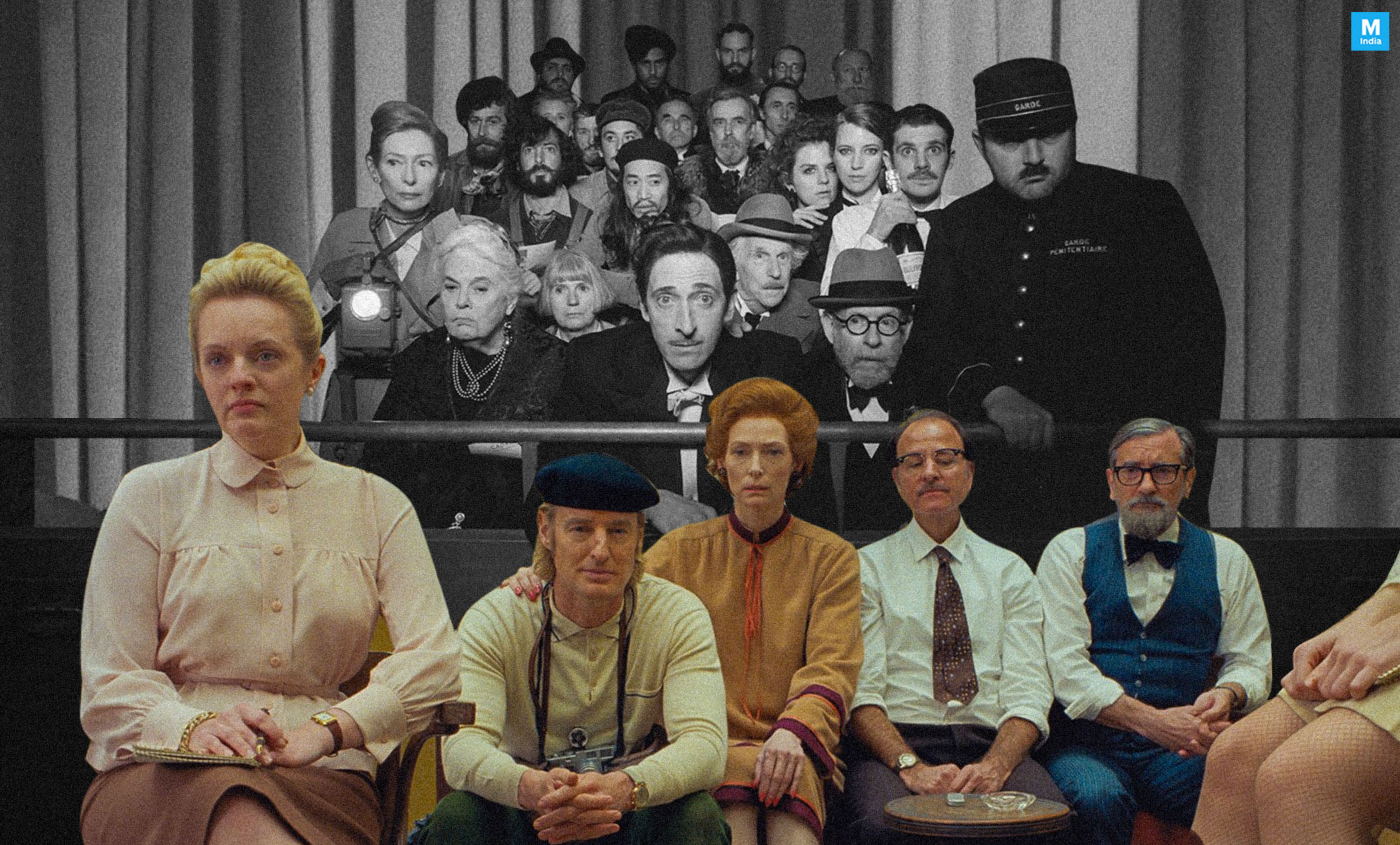
Boasting everything you’ve come to expect from a Wes Anderson film — meticulous set design, vibrant color, symmetrical composition, elegance and artifice in equal measure, and a massive cast brimming with his own stock ensemble — the film is not one you might mistake for a Scorsese or a Spielberg.

Expect Anderson regulars Tilda Swinton, Mathieu Amalric, Lea Deydoux, Owen Wilson, Adrien Brody, Frances McDormand and newcomers Benicio Del Toro, Timothee Chalamet and Jeffrey Wright. And those are the big roles (although truth be told, no one is on screen all that long).

Blink and you might miss Saoirse Ronin, Willem Dafoe, Henry Winkler, Elisabeth Moss, Ed Norton, Christoph Waltz, Liev Schreiber and Jason Schwartzman.

In the segment filed under the “Taste and Smells” section, Dispatch writer Roebuck Wright (Wright) turns in a sprawling profile on master chef Nescaffier (Steve Park) that – to Howitzer’s chagrin – contains merely one quote from Nescaffier himself. As with the other pieces of the anthology, the many tangents of the piece are explained through Anjelica Huston’s narration, which can’t replace a truly emotional through line and holds the film back from resonating beyond its immaculate construction.

Anderson’s framing of symmetry and motion has never been more tightly controlled, and the film becomes a parade of wonderfully assembled visuals paired with intellectual wordplay and an appropriately spare score from Alexander Desplat.

As a tribute to a lost era of journalism and the indelible writers that drove it, Anderson delivers a fascinating and meticulous exercise boasting impeccable craftsmanship and scattershot moments of wry humor. But the layer of humanity that elevates the writer/director’s most complete films (Rushmore, Moonrise Kingdom, The Grand Budapest Hotel) never makes it from page to screen, and The French Dispatch ultimately earns more respect than feeling.

https://www.youtube.com/watch?v=z0_hwGWen-I

Oh, Hell

Hellarious

by Hope Madden

Short films rarely get their due, and getting an audience is rarer still. Any opportunity to sit down with a set of shorts that made a splash in the festival circuit is an opportunity worth taking. If arterial spray and laughter are your thing, Hellarious is a chance worth taking.

The compilation contains seven short films, each a horror comedy. There’s no framing device or theme, simply a collection of sometimes bawdy, once in a long while sweet, mostly viscous horror. There are a lot of fluids here.

Like an automatic door to hell, James Feeney’s Killer Kart opens things. His creeping camera sets a fun tone for an absurd “ordinary item” monster movie (a la Rubber). An inspired score by Daniel Hildreth, Christine Rodriguez and Ray Bouchard matches the mayhem nicely.

Robert Boocheck’s charming Horrific—a tale of mutant varmints, hula hoop porn and besotted tidy whities—lands laughs thanks to Mike Nelson’s semi-heroic central performance. Likewise the Deathgasm-esque Death Metal offers a highly enjoyable and sometimes morally questionable bloodbath with the most delightful practical effects.

A sweet authenticity drives Bitten, Sarah K. Reimers’s romantic, dog-loving upending of the werewolf tale. (Who’s a good boy? Iggy is! Iggy’s a good boy!) If you can take your eyes off that adorable dog, you’ll notice two tenderly funny performances by Francine Torres and Michael Curran.

Director Jason Tostevin, who also compiled the films, helms two of the shorts in the program, both co-written with Randall Greenland. ‘Til Death offers a post-mortem comeuppance tale boasting several strong performances. Born Again, though, is one of the compilation’s two highest points.

Six and a half minutes with the worst Satanists ever exposes you to a really beautifully filmed subversion of expectations. Slyly comical performances top to bottom entertain, but Greenland is a laugh riot in a starring role.

The collection’s second high peak comes thanks to Clarissa Jacobson and J.M. Logan’s sloppy concoction, Lunch Ladies. This is a delirious fantasy about underdogs rising to the challenge and making their dreams come true—becoming personal chefs to “the Depper,” Johnny Depp. Donna Pieroni and Mary Manofsky deliver consistent laughs in a film that almost makes a person want to love Johnny Depp again.

Variety, laughs, mayhem, blood spatter, romance, cheerleader pot pie—Hellarious is a tasty treat of bite sized horror.

Love & Friendship

Modern Persuasion

by Cat McAlpine

Wren Cosgrove is happy to go on her morning runs, talk to her cat Wentworth, and work too hard. But when her ex-boyfriend hires her marketing firm, she’s suddenly forced to face her past and contemplate whether or not she’s actually happy at all.

Based on Jane Austen’s novel Persuasion, Modern Persuasion trades social balls for launch parties and romantic poets for lyrics by The Smiths. Jonathan Lisecki co-wrote and co-directed the film, with fellow writer Babara Radecki and co-director Alex Appel. Even with three different visions at work, plus Austen’s original groundwork, the film largely fails to find any footing.

Wren (Alicia Witt) is more likable and more approachable than predecessors in the workaholic trope. Unfortunately, her counterpart/ex Owen Jasper (Shane McRae) says and does little to tease any anguish out of her. What makes Austen’s novels so compelling, even after all this time, is the absolute longing they are filled with. That tension is largely missing from this adaptation.

Wren has better chemistry with her two other love interests. And at 1 hour and 20 minutes, three love interests are a lot to juggle, making Owen little more than an awkward inconvenience for most of the film.

Modern Persuasion is filled with an interesting cast of characters, but they stay flat for the length of the film. It seems late in the game to be making millennial jokes, but two of Wren’s coworkers are reduced to trendy lingo and illicit “Speak English please,” responses from their much older boss.

The film is strongest in the moments where it finds genuine connection between characters, like when Wren gives new assistant Denise (a lovable Adrienne C. Moore) help on her first day. Another shining moment is when Wren and Sam (Dominic Rains, charming) connect over a moody playlist. Witty lines, mostly from the women in the cast, keep it comedic and grounded.

For Austen and romcom fans alike, the film might be worth a curious watch. But for the rest, Modern Persuasion has nothing new to offer.

https://www.youtube.com/watch?v=R0L54ZfhtSI

Who Are You, Again?

Yourself and Yours

by Hope Madden

It’s taken four years, but Hong Sang-soo’s Yourself and Yours is finally screening internationally. The delightfully confusing love story uses inebriation and one well-placed mannequin to illustrate the giddy, identity-demolishing euphoria of love.

Young-soo (Kim Ju-hyuk) decides to believe his friends when they tell him his girlfriend Minjung (Lee Yoo-Young) goes out drinking—and who knows what else?—with other men.

But does she? I mean, it sure looks like she does, but maybe it isn’t her? Or maybe it is her, but there’s some kind of explanation, like mental illness? Or maybe it doesn’t matter, because the filmmaker is less interested in who is (or isn’t) doing what to whom than he is in how others react.

The film is a charming change of pace in at least a dozen ways. Its intentional ambiguity works in its favor because it keeps you from falling into the frustrating trap of seeing Yourself and Yours in the same terms as some kind of American doppelganger erotic thriller noir, which is certainly what the same story could have become.

Instead, the film delivers an entirely off-kilter sensation (as, some would say, does love). Lee’s enigmatic performance is captivating—at times tender, defensive and silly but always engaging. It’s hard to imagine the film working with anyone else in this role because, thanks to her unshowy but convincing portrayal, you are never absolutely certain what the hell is going on.

Supporting performances couldn’t be richer, whether the flatly disgusted female friend, the “sorry I started this whole thing” buddy, the nonchalant bartender or Minjung’s (or is it?) other smitten beaus. With limited screen time and limitless commitment to the concept, the ensemble adds to the confusion and the joy to be found throughout the film.

It may be Kim’s turn and the transformation of his character that elevate Yourself and Yours above quirky love story to truly solid, insightful art. His performance is quite beautiful, as is the film.

As, some would say, is love.

Zombie Eat World

The Night Eats the World

by Hope Madden

People like to make lists. For some people, it’s a bucket list. Some like to keep track of the celebrities they are allowed to sleep with if the opportunity arises. Not me.

Years ago I put together my zombie survival team. And though I know plenty of people with varied and worthy skills, making my team mainly came down to two things. Are you smart? Are you quiet? Because it is the introverts of the world who will survive the zombie apocalypse.

Director Dominique Rocher’s unusually titled The Night Eats the World understands this.

Sam (Anders Danielsen Lie) reluctantly stops by his ex’s party to collect his things. It is a loud, raucous event and Sam is in no mood. He stands moping alone until finally he wanders into a quiet back office, locks the door to the partygoers and waits.

By morning, Sam may be the only living human left in Paris.

The majority of the film quietly follows Sam through the apartment building as he fortifies his position, spends his time, survives. It’s a pleasantly pragmatic approach to the zombie film, although it asks many of the same questions Romero asked in Dawn of the Dead.

In fact, TNETW sometimes bears an amazing resemblance to the underseen German zombie flick Rammbock: Berlin Undead. (It’s great. You should see it.)

There’s a lot going on here that’s fresh, though. Rarely is a zombie film this introspective or a horror hero this thoughtful. More than that, though, Rocher’s horror is a meditation on loneliness.

Not only is that an unusual topic for horror, it’s delivered with the kind of touching restraint that’s almost inconceivable in this genre.

Danielsen Lie, in what nearly amounts to a one-man-show, never lets you down and never feels showy. Sam is a man who is maybe too at home with the situation in a film that quietly asks, just what has to happen before a true introvert longs for human companionship?

That’s why they’ll outlast us. It’ll just be a few dozen socially uncomfortable loners skilled at closing themselves off from the chaos around them. Plus Keith Richards.

Call to Action

Incitement

by Rachel Willis

Opening with real-life footage of Iraeli Prime Minister Yitzhak Rabin’s speech on the South Lawn of the White House on September 13, 1993, director Yaron Zilberman creates a disturbing portrait of a country in crisis with Incitement.

Rather than focus on Rabin and the political decisions surrounding his peace accords with Palestinian leader, Yasser Arafat, the film instead focuses on Rabin’s assassin, Israeli law student Yigal Amir.

After the signing of the Middle East Peace Agreement, Amir drives directly to a rally protesting the peace accord. After a near arrest, he drives to the campus of Bar-Ilan University and takes part in further demonstrations. A rabbi in support of the protests speaks to the students, encouraging their involvement in activities to undermine the government’s efforts for peace.

The film does not spend inordinate time focusing on the violent Palenstinian-Israeli history. Instead, we’re thrown directly into Amir’s world. There are brutal acts by Jewish extremists that are fully supported by Amir. At the funeral of Baruch Goldstein (responsible for the massacre of 29 Muslim worshippers in a mosque), Amir listens to a rabbi praising Goldstein as a martyr and a hero for the Jewish people. When suicide bombings in Tel Aviv occur as a reaction to the massacre, Amir cannot see the cyclical nature of this type of extremist violence.

From the beginning, there is little sympathy for Amir. We’re merely witness to his descent into religious extremism and right-wing nationalism. The film is also an indictment of the rabbis and political leaders who spoke about Rabin in harsh tones. At rallies for Benjamin Netanyahu, from which Zilberman incorporates real footage, protesters call Rabin a traitor and chant “Death to Rabin!”

Throughout the film, Zilberman uses archival footage to great effect. It heightens the tension and shows the audience exactly how violent the rhetoric became surrounding the peace accords. While thousands came out in support of Rabin, seemingly just as many came out against him.

However, it takes a while for Zilberman to make his point, and not enough focus is given to the factors that drove Yigal Amir. The film spends a lot of time following Amir around as he tries various ways of undermining Rabin’s attempts to create a peaceful coexistence between Israel and Palestine.

As right-wing nationalism and extremism rises around the world, it’s worth examining how violent rhetoric from religious and political leaders can inflame an already angry populace. Would Amir have acted had he not felt he had the support of numerous rabbis and Jewish law?

Zilberman has his opinion, and Incitement is the means in which he expresses it.

Go Beavers!

Knives and Skin

by Hope Madden

Falling somewhere between David Lynch and Anna Biller in the under-charted area where the boldly surreal meets the colorfully feminist, writer/director Jennifer Reeder’s Knives and Skin offers a hypnotic look at Midwestern high school life.

When Carolyn Harper (Raven Whitley) goes missing, carefully erected false fronts start crumbling all over town. Cheerleaders take a harder look at football players. Football players cry in their Mustangs. Goth girls fondle pink dresses. Pregnant waitresses bleed at the kitchen sink.

And everyone sings impossibly appropriate Eighties alt hits acapella. Even the dead.

Knives and Skin’s pulpy noir package lets Reeder explore what it means to navigate the world as a female. As tempting as it is to pigeonhole the film as Lynchian, Reeder’s metaphors, while fluid and eccentric, are far more pointed than anything you’ll find in Twin Peaks.

She looks at relationships between mothers and daughters, as daughters toe the line between acceptable and unacceptable levels of conformity and mothers bear the toll exacted by years of fitting in.

Reeder blurs that line between popularity and ostracism, characters finding common ground as they address the question: Are you a whore or a tease?

The ire is not one-dimensional. Though toxic masculinity requires a price, the males in Middle River, even the worst among them, are as sympathetic and as damaged by expectations as anybody.

Reeder’s peculiar dialogue finds its ideal voice with Grace Smith as Joanna Kitzmiller, a jaded feminist and budding entrepreneur. Likewise, Marika Englehardt and Tim Hopper bring extraordinary nuance and sympathy to what could have been campy characters.

This cockeyed lens for the middle American pressure cooker that is high school suggests exhilarating possibilities, but does so with a melancholy absurdity that recognizes the impossibility of it all.

And in the end, all the Middle River Beavers stare longingly at the highway that leads out of town.

The Glitter and the Gold

Downton Abbey

by Christie Robb

Like a proper English tea, the Downton Abbey movie delivers a little bit of everything with a light, elegant—sometimes even whimsical—touch.

A royal visit to the titular estate in 1927 provides the inciting incident that reunites fans of the popular TV series with the Crawley family and their domestic staff. The film starts with a lengthy show recap (for those who haven’t anticipated the film by binge-watching all six seasons). It then squeezes at least half a season’s worth of drama into a two-hour runtime.

No spoilers here, but expect familiar Downton themes delivered in unexpected ways: violence, illness, romance, jealousy, snobbery, inheritance issues, reputation anxiety, surprise Crawley cousins, and buffoonery provided by a certain sad-sack ex-valet.   

Unlike the excellent series finale that neatly wrapped up every character’s storyline, the film does not focus equally on all the main characters. Director Michael Engler returns from the TV version, and the film reads more as a continuation of the story than an extended epilogue, much like an extra-long Christmas special without the holiday bit.

Still, the Downton movie’s production values are a tad higher, providing extended drone shots of the impressive house and grounds. There are more sets, showing us previously unseen rooms inside the Abbey, a bit more of the village, and a neighboring, even fancier abode that hosts a ball.

The ensemble cast slips effortlessly back into their former roles, highlighted by the Dowager Countess (Maggie Smith) and Isobel Merton (née Crawley, Penelope Wilton) and their delicious repartee full of sniping and droll bon mots. 

This is definitely a film made for fans of the show, as a newbie would probably be completely lost even with the recap. But for those who spent 2011-2016 devouring the show like a warm scone fresh out of the oven, the movie is a delightfully unnecessary, but very welcome, treat.