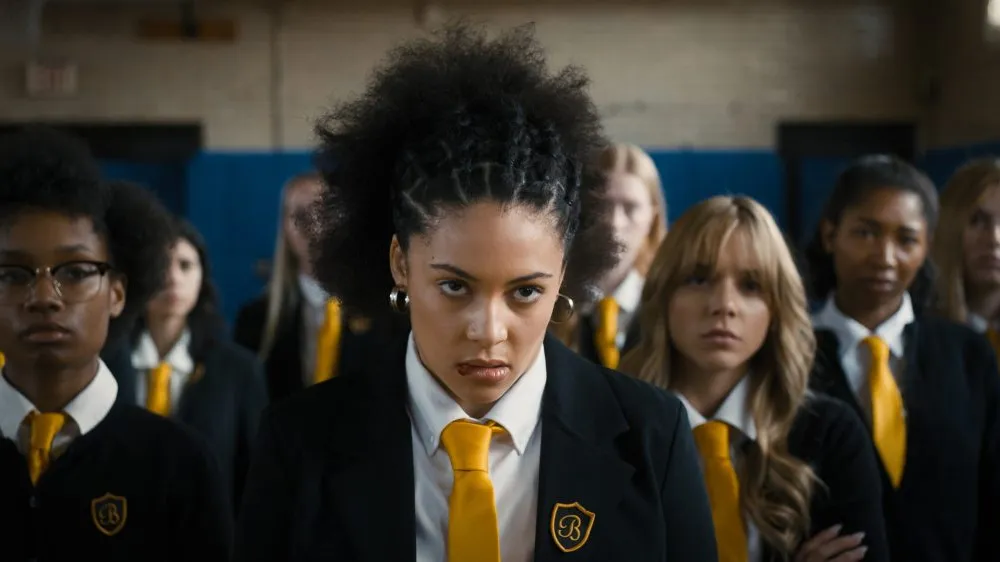
Jennifer Reeder is preoccupied with missing girls. Her 2019 gem Knives and Skin watched a town fall to pieces around one such absence. Where that film was full of melancholy absurdities, Reeder’s latest, Perpetrator, is a little bolder, a little angrier.
As Jonny (Kiah McKirnan) approaches her 18th birthday she goes a tad out of control. Her dad (also in some kind of crisis) doesn’t know what to do with her, but an out-of-town aunt (Alicia Silverstone, a sinister delight) offers to take her in. So, Jonny goes from a fairly anonymous, if reckless, urban life to something far more noticeable in her aunt’s small town.
And there is something deeply amiss in Jonny’s new hometown. Girls just go missing. All the time.
McKirnan’s fish out of water performance is so much fun here because Reeder forces the audience to identify with this feral creature. The rest of the town is so odd, almost willing victims after a lifetime of systemic herding. Jonny’s humor, cynicism and enjoyable streak of opportunism give the film a constant sense of forward momentum, though the just-this-side-of-surreal atmosphere has a dreamlike quality.
Silverstone’s prickly, unpredictable performance is nothing but twisted fun, and all the supporting turns contribute something simultaneously authentic and bizarre to the recipe. (That’s a cooking metaphor because of Aunt Hildie’s birthday cake, an ingenious and foul plot kink worth acknowledging.)
Reeder’s work routinely circles back to peculiar notions of coming of age, but John Hughes she ain’t. Goofiness and seriousness, the eerie and the grim, the surreal and familiar all swim the same bloody hallways, practice the same open shooter drills, and speak up at the same assemblies honoring the latest missing girl.
Reeder’s interested in the way women are raised to disregard one another, to compete with each other, to be adored and consumed, sexualized, victimized and vilified. Her reaction to this environment amounts to a reclamation of blood. Perpetrator swims in blood and gore and humor and terror and feminism galore.
Retribution marks the third remake of the Spanish thriller El desconocido, just in the 8 years since the original’s release.
What is it about this bandwagon that has made it so tempting to jump aboard?
If the latest version is any indication, it’s most likely the easily digestible stakes amid a standard thriller framework that offers plenty of room for tweaks without altering the chances for purely surface-level satisfaction.
So when you’ve got such a ready-made template for an English language thrill ride, the Neeson hotline is sure to be lighting up.
But this time, Liam plays Matt Turner, a banking executive living in Germany whose particular skills mainly involve ignoring his wife Heather (Embeth Davidtz), son Zach (The Way of Water‘s Jack Champion) and daughter Emily (Lilly Aspell, young Diana from the Wonder Woman films).
Matt picks a bad day to begrudgingly take the kids to school, because a disguised voice calls to tell Matt his car has been rigged with bombs. And the bombs have been rigged with pressure plates under the seats that will trigger those bombs if anyone gets out of the car.
So, what does the caller want? Is it just a ransom demand, or maybe revenge for some bad investment advice that wiped out a client’s life savings?
Shut up and drive!
Director Nimród Antal (Machete, Predators) tries his best to bring some style to the automobile setting, grabbing any opportunity he can for a new POV angle or mirror reflection. His instincts are understandable, but the approach often lands as just showy desperation.
Neeson’s on phone-yelling/time racing cruise control. But, the kids are good and both Matthew Modine and Noma Dumezweni (The Little Mermaid) provide strong support with limited screen time.
No one in the cast is given much chance of character development from Christopher Salmanpour’s script, but you can expect a surprise or two while he makes some promising edits to the original mystery. And though the final showdown does shake off a very Scooby-level unmasking to eventually better El desconocido, any hopes for mining something meaty from this derivative premise are erased when the film all too eagerly reverts to “Liam defends his daughter” factory settings.
We’ve all been stuck at a dinner or party with that one couple that seemingly hates one another. The snide remarks, uncomfortable body language, and icy stares create a tense environment that’s almost tangible. Now, imagine that this couple are the only two characters in a 90 minute horror movie. It would be easy to root for their eventual demise, but through clever plotting and character arcs, Brightwood manages to circumvent early assumptions.
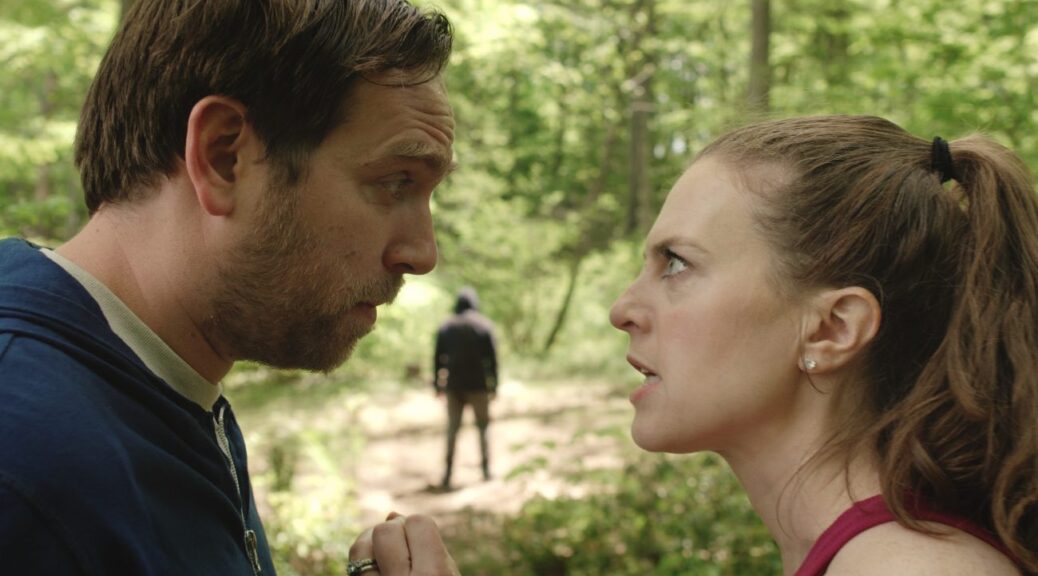
Things are not going well for Jen (Dana Berger) and Dan (Max Woertendyke). Dan’s embarrassed himself – and mostly Jen – at a party the night before, and the hostility between the couple is at a fever pitch. That he’s tagged along on her morning run has only made Jen all the more angry. As Dan tries to match Jen’s pace – and beg for forgiveness along the way – the two slowly realize that their surroundings keep repeating and that odd-looking – but familiar – strangers are appearing to the both of them.
Writer/Director Dane Elcar takes his time getting to the genre trappings in Brightwood. The deteriorating relationship between Jen and Dan takes up the bulk of the film’s first act. It’s a portion that may test a lot of viewers as the rage and desperation radiating from the couple showcases two people at their lowest. That Berger and Woertendyke are so good at selling these heightened characters only makes the latter half of the film all the better.
Elcar keeps things character-centric even as the events around the couple get weirder. Brightwood isn’t a plot heavy film. The strange events happening to Jen and Dan are never explained. The fascinating part of the film is witnessing their arc not only in “real time”, but also through various versions of themselves that come and go.
Things get devilishly funny and violent as the film races (ahem) to its climax. What could’ve at first been a talky relationship drama ends in blood-soaked mayhem by the time the end credits begin the role. Dead Alive this movie ain’t, but Elcar doesn’t shy away from the carnage.
The tonal shifts never feel jarring or unnatural, which is a testament not only to Brightwood’s script but also the actors bringing it to life.
Brightwood is a clever addition to the time travel subgenre. Instead of getting lost in the mechanics of paradoxes and and alternate timelines, the film wisely keeps its eye on the two characters experiencing this horrifying event.
The Agranat Commission, a 1974 panel investigating the intelligence mishap that left Israel unprepared for the 1973 Yom Kippur War, creates the framing device for Guy Nattiv’s latest, Golda.
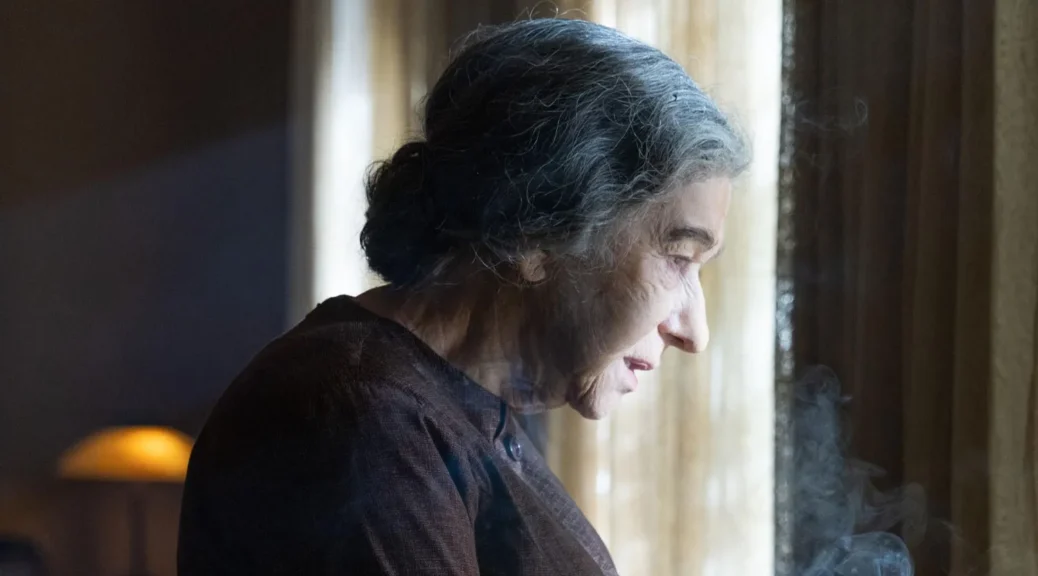
The venerable Helen Mirren dons sensible shoes, knits heavy brows and chain smokes her way through a terrific performance inside a superficial, if perfectly time stamped, historical drama. As Prime Minister Golda Meir, Mirren stands out, not only because the film delivers constant opportunities for the Oscar winner to showcase her skills. Mirren is a movie star and Nattiv films her as one – lengthy close ups, moments of vulnerability, moments of breathtaking savvy, crushing failure and overwhelming grief.
Her performance is never showy. But the direction is.
Much has been made of the fact that the English actor was perhaps an inappropriate choice to play Israel’s first woman Prime Minister. Mirren is capable, of course – she is an amazing talent. But she is hard to miss as Helen Mirren in the war room surrounded by Israeli actors including Lior Ashkenazi (as Chief of Staff David Elazar), Rami Heuberger (as Minister of Defense Moshe Dayan) and Dvir Benedek (as disgraced General Eli Zeira).
But Mirren’s appropriateness is not the problem with this film. Her performance certainly isn’t. The problem with Golda is how inexplicably bland it is. Writer Nicholas Martin penned the delightful Florence Foster Jenkins after a career in TV, but neither suggest a knack for nail-biting suspense, which is what this film both required and deserved.
Golda is no biopic. Indeed, the decision to include archival news footage of Meir only demonstrates how poorly this film captured the spirit of the Prime Minister.
It’s not a war movie by any stretch – there’s no action to speak of – and as a political thriller, it’s a bit too plodding to keep your attention. Frustrating is what it is.
When I used to coach youth baseball, I would sometimes encourage the use of video games to teach the young ones about rules, game situations and strategy.
And then one day the Major Leagues called up one of my best players!
Nah, that would be crazy. Almost as crazy as the true story at the heart of Gran Turismo, a trope-laden but surprisingly engaging mix of product placements and underdog sports heroics.
Orlando Bloom is Danny Moore, a UK marketing exec for Nissan who worries that young people are caring less about driving cars and more about driving simulators, specifically Gran Turismo on PlayStation. So, Danny proposes a contest that would fuel excitement for real driving.
Find the 10 best “sim” racers in the world and send them to GT Academy boot camp. The academy champion will join Team Nismo and compete in actual races against seasoned pros who will hate them.
The fact that this actually happened to Jann Mardenborough (Archie Madekwe) in 2011 is mind-blowing, and director Neill Blomkamp (District 9) presents the racing action with an engaging fantasy/reality mix of burning rubber and game graphics that seems fitting.
Madekwe (Midsommar, Heart of Stone) gives Jann a sense of wounded determination that is easy to root for, but it’s David Harbour’s turn as no-nonsense driving instructor Jack Salter that consistently comes up a winner. Harbour’s chemistry with Bloom is antagonistic and amusing, while Jack and Jann eventually develop a bond of respect and affection that carries some warmth.
But getting there is a long 135-minute road, with some hazards.
Screenwriters Jason Hall, Zach Baylin and Alex Tse hamper Blomkamp’s foot-on-the-gas highlights with cliches, manufactured rivalries and the overwrought dramatics of Jann’s struggle to connect with his father (Djimon Hounsou). And while the constant instructions to Jann and his fellow drivers are a nicely organic way to keep the rest of us updated on the stakes, mounting distractions kill the buzz too often.
The hook here is a gamer earning his racing stripes, and the attempts at some Rocky-esque search for dignity aren’t strong enough to support it. But – much like Jann himself – when Gran Turismo is free to fully embrace what it is, the film can shine with a thrill of unexpected victory.
The haunting visual poetry of a cityscape littered with abandoned buildings and new developments is home to Youssef Chebbi’s latest, Ashkal: The Tunisian Investigation. The apt title describes not only the film’s plot – a mystery concerning a string of suspicious suicides – but also the identity of a country itself.
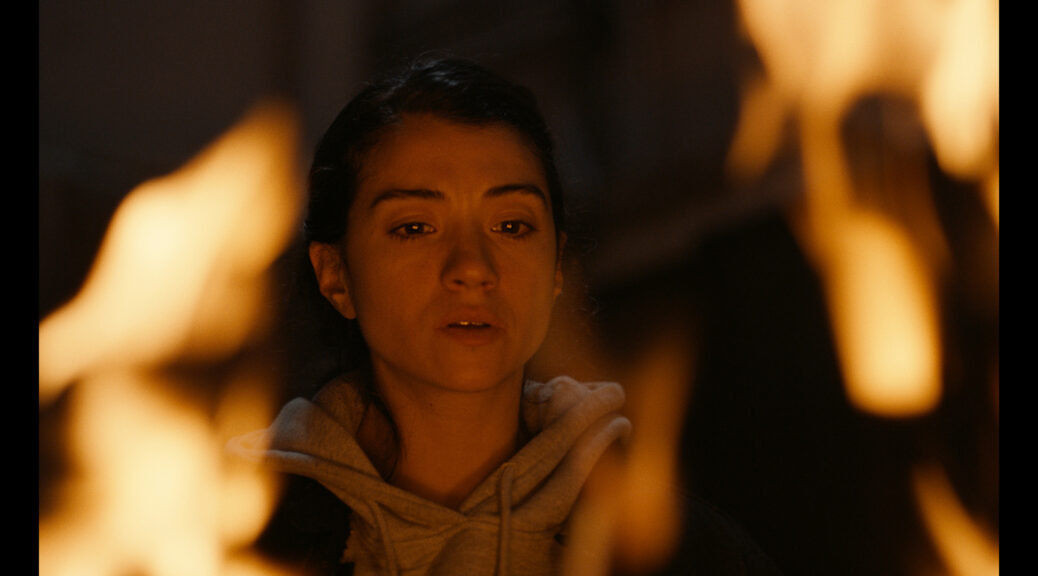
As Fatma (Fatma Oussaifi) and Batal (Mohamed Grayaâ) investigate the apparent self-immolation of a security guard at a high-rise construction site, they uncover evidence of an earlier, similar death that had been hidden by their police department colleagues. Why hide it? In a country where self-immolation – that astonishing act of defiance – triggered a revolution in 2010, these deaths feel particularly ominous. Especially for the corrupt.
As tyranny and its allies, police and corporate corruption, once again thwart justice, an epidemic of self-immolation spreads like a contagion through the city.
Oussaifi delivers a quietly fierce performance, one that Grayaâ counters with unexpected tenderness. Both actors are given plenty of room to breathe, Chebbi lingering with each in their private moments to allow for introspective, patient character development.
Those quiet moments look amazing, too. Ashkal is gorgeously filmed, Chebbi finding symmetry in the bones of the buildings and unexpected beauty in the fire. An evocative use of color, shadow and light create a hypnotic fusion of supernatural fantasy and police procedural.
The context is specific to Tunisia, but the themes are universal. As greed and corruption overwhelm a city, victimizing the poor and the powerless, political protest blends with cultural grief. Simultaneously pessimistic and hopeful, grim and beautiful, Ashkal is a meditation on modern times.
Sweden has been making freaky, introspective, gorgeous, nightmarish horror for fully 100 years. Why has it taken us so long to celebrate that? Here are our favorite Swedish horror movies.
5. Haxan (1922)
Part power point presentation, part reenactment, Benjamin Christensen’s semi-documentary about the hysteria of witchcraft from early times through 1922 is a remarkable piece of cinema.
His thoroughness and fascinating point of view – particularly logical and liberal for 1922 – help the film keep your attention. But what makes this 100+ year old effort remain a fixture for movie buffs is its gorgeous filming. Yes, the use of camera tricks are impressive for the time, but dramatic segments often take on the look of a Renaissance painting.
Christensen’s use of light and framing sometimes surpass even contemporaries Murnau and Dreyer, and his playful depictions of Satanic orgies – That butter churn! That tongue! – never lose their charm.
4. Koko-di Koko-da (2019)
What about Groundhog Day, but with unrelenting psychological dread? That’s the premise of Johannes Nyholm’s horror fable Koko-di, Koko-da, and it’s a testament to writer/director Nyholm that the film’s excruciating time loop manages to go from torturous to therapeutic.
One grieving couple’s unresolved trauma starts to literally stalk them in the shape of three carnivalesque figures, with each nightmare encounter ending the same way: some gruesome death, and then Tobias wakes up to repeat the loop all over again.
Koko-di Koko-da is not a pleasant film to watch, but it is often a beautiful one. And it lays bare the truth that there’s no escaping misery in life—that the only way to break the cycle is to confront it, pain and all.
3. Border (2018)
Sometimes knowing yourself means embracing the beast within. Sometimes it means making peace with the beast without. For Tina—well, let’s just say Tina’s got a lot going on right now.
Border director/co-writer Ali Abbasi has more in mind than your typical Ugly Duckling tale, though. He mines John Ajvide Lindqvist’s (Let the Right One In) short story of outsider love and Nordic folklore for ideas of radicalization, empowerment, gender fluidity and feminine rage.
The result is a film quite unlike anything else, one offering layer upon provocative, messy layer and Abbasi feels no compulsion to tidy up. Instead, he leaves you with a lot to think through thanks to one unyieldingly original film.
2. Let the Right One In (2008)
In 2008, Sweden’s Let the Right One In emerged as an original, stylish thriller – and the best vampire flick in years. A spooky coming of age tale populated by outcasts in the bleakest environment, the film breaks hearts and bleeds victims in equal measure. Kare Hedebrant‘s Oskar, with his blond Prince Valiant haircut, falls innocently for the odd new girl (an outstanding Lina Leandersson) in his shabby apartment complex. Reluctantly, she returns his admiration, and a sweet and bloody romance buds.
As sudden acts of violence mar the snowy landscape, Oskar and Ali grow closer, providing each other a comfort no one else can. The film offers an ominous sense of dread, bleak isolation and brazen androgyny – as well as the best swimming pool scene perhaps ever. Intriguingly, though both children tend toward violence – murder, even – you never feel anything but empathy for them. The film is moving, bloody, lovely and terrifying in equal measure.
1. Hour of the Wolf (1968)
An atmospheric masterpiece, Ingmar Bergman’s meditation on artistic conflict and regret is a haunting experience.
Bergman favorites Max von Sydow and Liv Ullman are a married couple spending time on an isolated, windswept island. Ullman’s Alma is pregnant, and her relationship with her husband becomes strained as his time and attention become more and more consumed by visions, or demons – or maybe they’re just party people.
Von Sydow’s character is tempted with the decadence missing from the wholesome life that may be dissatisfying to him. But it’s Ullman, whose performance spills over with longing, that amplifies the heartbreak and mourning that color the entire film.
Shot in incandescent black and white, with Bergman’s characteristic eye for light and shadow, Hour of the Wolf is a glorious, hypnotic nightmare.
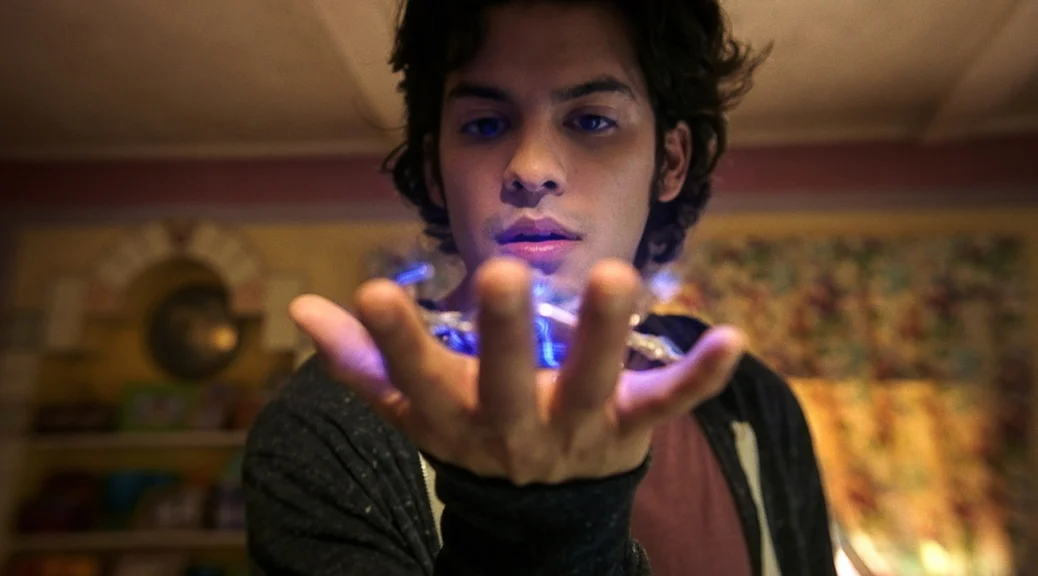
There’s something in the bones of the new DC movie Blue Beetle that’s very familiar. Very Spider-Man. Very Captain Marvel. Very Green Lantern, The Flash and Shazam.
Mainly Shazam.
And director Angel Manuel Soto capably builds a recognizable plot from those bones. An unlikely protagonist (Xolo Maridueña) takes on superpowers without really wanting to, goes through an awkward phase of figuring out how to use them, then stumbles into danger and crime, and must eventually accept his fate and save humanity.
Blue Beetle delivers solidly on each of those plot points. Where it really makes its presence known, though, is in the way it fleshes out those bones.
Blue Beetle is unapologetically, vibrantly Latinx. It is stunning how a change of perspective revives a story.
Writer Gareth Dunnet-Alcocer (Miss Bala) writes rich, funny, fully developed characters and a winning cast takes advantage. Maridueña charms in the lead role while Belissa Escobedo’s sarcastic sister keeps him in check. George Lopez steals scenes as the looney, tech savvy, conspiracy theorist uncle and Nana (the great Adriana Barraza) kills it.
Plus, Susan Sarandon hams it up as villainous billionaire (is there any other kind?) Victoria Kord. It’s fun. But it’s not the film’s differentiator. This Mexican American superhero isn’t separated from his family, his neighborhood, his backstory or culture. Indeed, those roots not only strengthen the hero himself, but the entire film.
The story of underdogs facing down corporate greed, of the terrors of the global military industrial complex, the blight of gentrification, the joy of a good telenovela and every joke springs naturally and lands better because of the cultural context the filmmakers use to ground their story.
The plot may not break new ground, but the film itself feels revolutionary. Like Nana.