Tag Archives: Gus Van Sant

Trigger Unhappy

Dead Man’s Wire

by George Wolf

Even without the cameo from Al Pacino, Dead Man’s Wire has the gritty, absurdist vibe of legendary 70s thriller Dog Day Afternoon. Also based on true crime events, the latest from director Gus Van Sant leans on a timely, anti-hero tone and some stellar performances for a look into the desperate edges of the American dream.

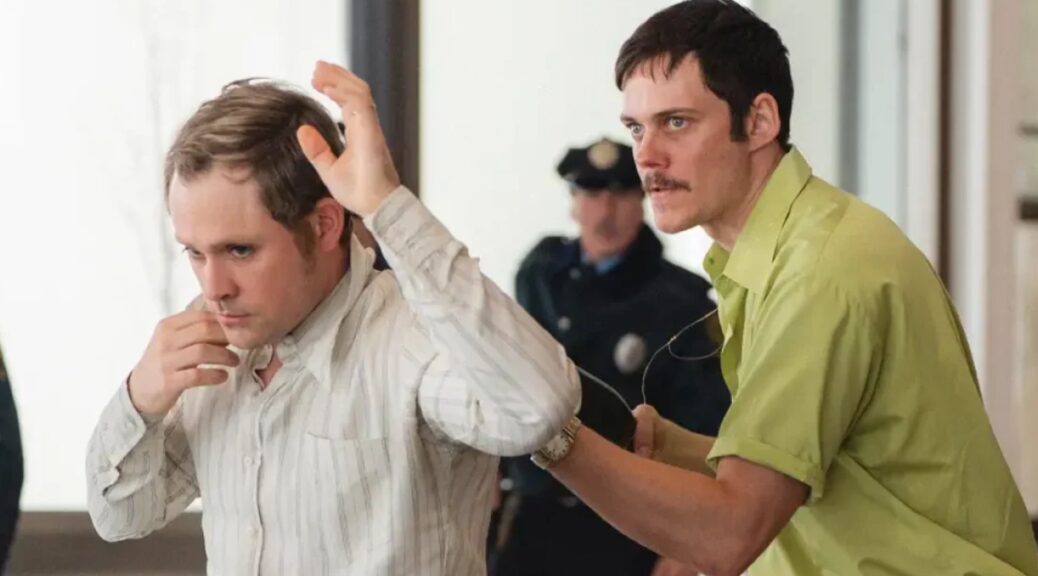
Bill Skarsgård is utterly manic and completely magnetic as Tony Kiritsis, who held an Indianapolis mortgage company executive hostage in February of 1977. Kiritsis, who hoped to build a shopping center on his 17 acres of land, became convinced that Meridian Mortgage president M.L. Hall (Pacino) was sabotaging the project. Finding M.L. out of town, Kiritis settled on son Richard Hall (Dacre Montgomery from Stranger Things) for his plan of revenge.

Armed with a sawed-off shotgun and a “dead man’s wire” running from the trigger to Richard’s neck, Tony demanded media access, immunity, compensation and a personal apology from M.L. himself.

Tony’s mood swings with wild abandon, but he’s downright starstruck when telling his story to WCYD deejay Fred Temple, the “voice of Indianapolis.” The great Colman Domingo plays Temple with a grounded mix of caution and curiosity, as the confused local celeb is reluctantly pulled into a life-or- death drama where a potential murderer is a gushing fanboy.

Writer Austin Kolodney comes from a comedy background, and Van Sant weaves some darkly comedic layers through terrific period details that only enhance the through line from 1977 to today’s breaking news.

Just two years ago, we saw how a communal feeling of hopelessness can turn a fugitive into a heroic man of the people. Dead Man’s Wire reminds us this feeling of simmering resentment is as old as the art of stacking decks. And while his narrative approach ultimately carries more polish than bite, Van Sant and a terrific ensemble never fail to make this history lesson an engaging high wire act of sadness, surprise and bittersweet delight.

Hot Wheels

Don’t Worry, He Won’t Get Far on Foot

by Hope Madden

In case you are missing it, Joaquin Phoenix is having one hell of a year. The inarguable talent is fresh off the relentlessly wonderful You Were Never Really Here (watch it right now!). Later this year we’ll get the chance to see him in Mary Magdalene as well as Jacques Audiard’s Western, The Sisters Brothers—both films boasting extraordinary casts.

Sandwiched in between his turns as gun-for-hire (YWNRH) and Jesus (MM), the clearly versatile actor portrays cartoonist John Callahan in Gus Van Sant’s biopic Don’t Worry, He Won’t Get Far on Foot.

Portland-based Callahan used creating cartoons as an outlet for his frustration, creativity and humor following a car accident that left him paralyzed. His simple visual style (both arms and hands were badly compromised by the paralysis) and his dark, taboo-driven humor found favor and protest in his hometown newspaper.

Phoenix charms and breaks hearts in equal measure as Callahan. What the actor conveys in breathtaking fashion is discovery. After Callahan’s accident and through his fleeting moments of clear-headedness, the character affords Phoenix many opportunities to recognize, accomplish or notice things for the first time. His interaction with an adorably saucy sex therapist, for instance, is pure joy.

His is not the only wonderful performance in the film. Jonah Hill effortlessly conveys a wearied tenderness that reminds you how truly talented an actor he is. Jack Black has a small but gloriously Jack Black role, and the AA group (Udo Kier, Beth Ditto, Mark Webber, Kim Gordon and Ronnie Adrian) offer rich and interesting characters regardless of their minimal screen time.

Rooney Mara, on the other hand, seems like she’s acting in an entirely different film. I fully expected her character to be a figment of Callahan’s imagination, pulled intact from another movie.

Van Sant bounces back from a creative lull (The Sea of Trees, anyone?), showing, among other things, his remarkable knack for period detail.

And while the 12-step structure feels both too stifling and too familiar for such an irreverent central figure, Van Sant bursts through that frame with a non-chronological series of vignettes and wild antics. As the film progresses, step by dutiful step, Van Sant fills gaps with quick jumps back and forth through drunken episodes and pivotal moments.

As interesting and entertaining as these flashes are, the chaotic lack of chronology fits so poorly with the rigid timeline of the film around it that the whole feels like an experiment gone wrong.

But so much of the film goes very, very right—thanks in large part to another award-worthy performance by Phoenix.


Drowning in Sap

The Sea of Trees

by Hope Madden

In 2002, filmmaker Gus Van Sant released one of his more polarizing and thoughtful films. In Gerry, two guys named Gerry (Casey Affleck and Matt Damon) hike ill-prepared into the desert to find themselves fighting for survival.

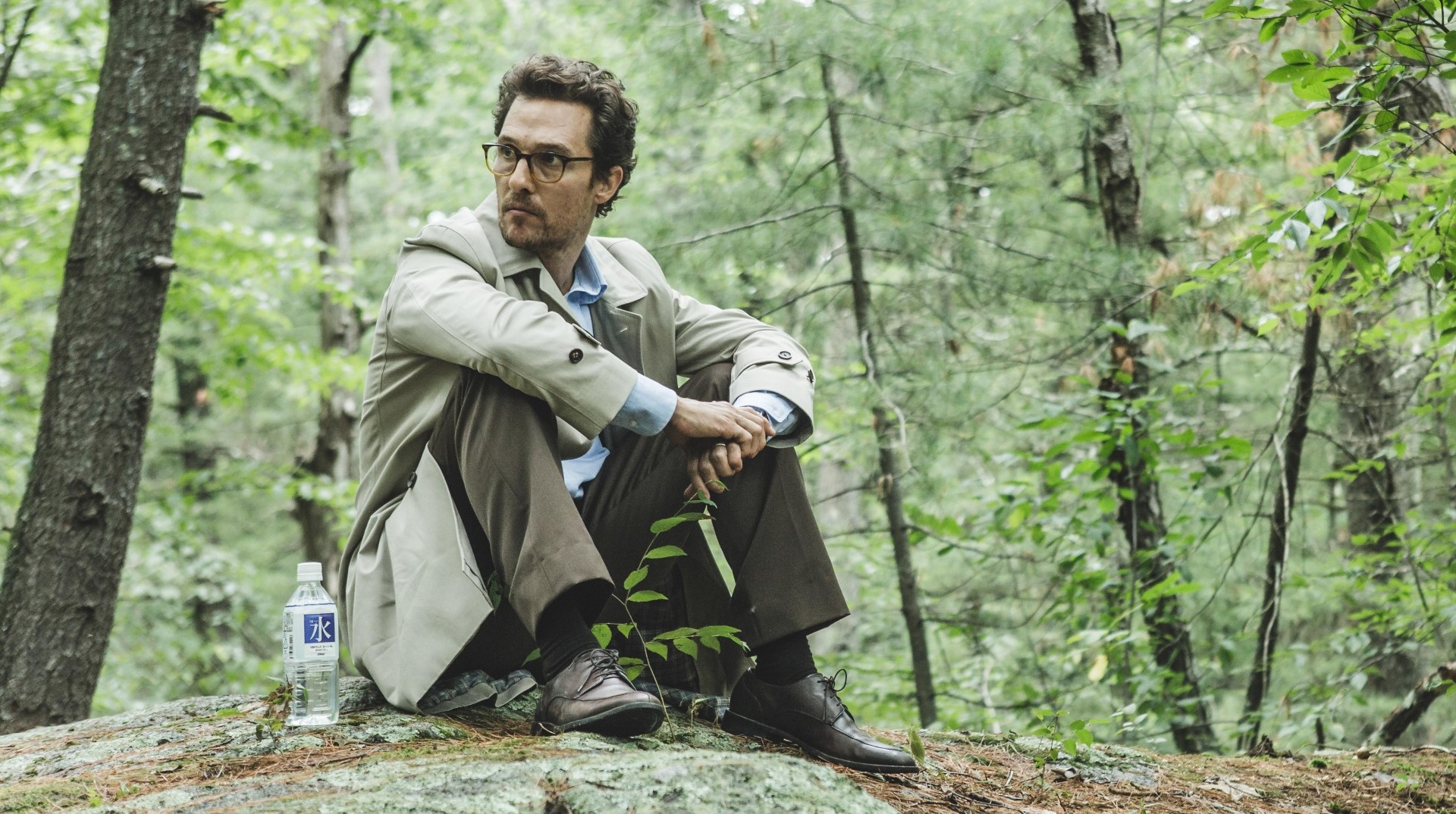
A quick glance at The Sea of Trees suggests that perhaps Van Sant returned to these themes. Matthew McConaughey loses himself in a Japanese forest, befriends another wayward traveler (Ken Watanbe), their treacherous journey offering life lessons aplenty.

Because horror writer Chris Sparling penned The Sea of Trees, I was kind of hoping the film would be a cross between Gerry and The Blair Witch Project.

It is not.

No, it’s an overtly sentimental, culturally patronizing waste of one Oscar winner and two Oscar nominees.

We wander Aokigahara, Japan’s “suicide forest,” with McConaughey’s Arthur Brennan. Brennan’s a scientist, and you know that that means. That’s right – atheist.

Van Sant falls back on the crutch of the flashback to help us understand what this handsome scientist is doing in the suicide forest. It’s in these segments that we meet Naomi Watts’s Joan Brennan and begin to unravel the mystery behind Arthur’s trip into the woods.

Watts suffers most from Sparling’s hackneyed dialog. Her few scenes need to be pivotal and weighty – we know this because of her utterly unrealistic speeches as well as Mason Bates’s condescending score.

Van Sant is no stranger to schmaltz. As great a filmmaker as he has been, sentimentality tripped him up in Promised Land, Finding Forrester and others. His career is peppered with other writers’ projects, many of them with a point to make, and those statement films tend to be Van Sant’s weakest.

Perhaps it’s because, rather than finding his own language for the story via camerawork or score, he relies on an existing style. The Sea of Trees certainly suffers from a heavy handed score. Van Sant also misses opportunities to create a sense of foreboding, claustrophobia, isolation or even redemption with the forest itself, Kasper Tuxen’s photography instead offering irrelevant yet lovely images of windblown treetops.

Trees can definitely be sappy.

Verdict-2-5-Stars