Tag Archives: George Wolf

Oscar Nominated Shorts: Animation

by George Wolf

When I was a kid watching the Oscars, I remember always being perplexed by short film categories. How do people manage to see these shorts?

Good news, kids, it’s gotten much easier. In the last several years, all the nominated shorts have been packaged by category for theatrical showings. This year, of course, virtual screenings are available as well, making it more convenient than ever to find great films in smaller packages.

In these 5 nominated (and three bonus) treats, you’ll find charm, humor, fascination, and devastation – all a tribute to the different ways animation can touch our souls.

Burrow 6 mins. Writer/director: Madeline Sharafian

An excited bunny has big plans for a new home underground (maybe a disco?). But the more the bunny burrows, the more times she accidentally invades a neighbor’s place!

What to do?

Originally intended as the short subject intro to theatrical showings of Soul, Burrow is a completely charming reminder of the need for friends you can count on. And the beautiful 2D, hand-drawn animation gives it a picture book feel that’s refreshingly retro.

https://www.youtube.com/watch?v=apx1aUP3MqA

Genius Loci 16 mins. Writer/director: Adrien Merigeau

From France, Genius Loci is a surrealistic trip through “urban chaos, ” as a young loner named Reine (voiced by Nadia Moussa) takes off on a dreamlike tour through the heartbeat of her city.

Unfolding like a watercolored stream of consciousness, Loci is wonderfully stylistic, bursting with contrasts and ambiguities about Reine’s headspace that keep it constantly intriguing.

If Anything Happens, I Love You 12 mins. Writers/directors: Michael Govier, Will McCormack

Oh my, this one is heartbreaking, tender and devastatingly lovely.

A middle-aged couple is living in a fog of despair, completely unable to comfort each other or find any joy in life. A charcoal-type animation style reveals shadows depicting a former life of happiness, then leading eventually to the tragic event that broke them.

Keep the tissues handy for a soft-spoken gut punch that reframes the stakes we know only too well.

Opera 9 mins. Director: Erick Oh

9 minutes? I could watch this for 9 hours.

Billed as a “massive 8K size animation installation project which portrays our society and history,” Opera is a single frame in constant, intoxicating motion.

The eye level creeps in, then out, up and down and around a pyramid filled with scores of small figures co-existing in a constantly evolving community. Even as you fixate on one fascinating section, you’re drawn to others that are equally rewarding.

Oh has created a true animated marvel, and one that should be hard to beat in this category.

Yes-People 8 mins. Director: Gisli Darri Halldorsson

Welcome to a tenement building in Iceland, where we follow some 3D Wallace and Grommet-looking Icelanders going about their daily trials and snowy tribulations.

Most of the dialog is a well-placed exclamation of “Yow!” which adds to the goofiness and overall fun factor. With glimpses into work, school and mundane chores around the house, Yes-People becomes a light and breezy take on the small moments that make our lives.

The 2021 animated shorts program will also feature three “highly commended” animated short films

Oscar Nominated Shorts: Documentary

by George Wolf

When I was a kid watching the Oscars, I remember always being perplexed by short film categories. How do people manage to see these shorts?

Good news, kids, it’s gotten much easier. In the last several years, all the nominated shorts have been packaged by category for theatrical showings. This year, of course, virtual screenings are available as well, making it more convenient than ever to find great films in smaller packages.

As usual, these nominated documentary shorts are often heart-wrenching, but able to speak necessary truths to power and our collective human experience.

A Concerto Is a Conversation 13 mins. Directors: Kris Bowers and Ben Proudfoot

Pianist and film composer Kris Bowers explains to his 91 year-old grandfather Horace (and to us) that a concerto is a conversation between a soloist and an ensemble.

But the conversation between the Bowers men is a moving work of art itself, as Horace recalls his life’s journey from a poor kid in the Jim Crow south to a successful business owner in Los Angeles.

And as Kris prepares for the premiere of his first concerto, the film becomes a beautiful expression of heritage, love, talent and courage.

Colette 25 mins. Writer/director: Anthony Giacchino

75 years after her stint as a member of the French Resistance, 90 year-old Colette Catherine is preparing to make her first journey to the concentration camp in Germany where her brother Jean-Pierre died.

She’s accompanied by the young Lucie, a history student and docent at France’s WWII museum, who regards Colette as a “national hero.”

As sobering and horrific as the subject matter suggests, Collette – the film and the hero – finds a redemptive power through defiantly shining a spotlight on an evil that still searches for dark places to take root.

Do Not Split 36 mins. Director: Andreas Hammer

Taking us to the front lines of Hong Kong’s pro-democracy protests of 2019, Do Not Split becomes a tense, indelible account of resistance against civil rights abuses that will look pretty familiar to U.S. audiences.

Hammer is blessed with a host of intimate footage, often featuring first person commentary from protesters while they are actively pushing back against tear gas and police escalation.

It’s gripping stuff. Without becoming overbearing, the film never lets you forget you are watching important and heroic history unfold.

https://www.youtube.com/watch?v=zuO71RwQp_k

Hunger Ward 40 mins. Director: Skye Fitzgerald

Part 3 of Fitzgerald’s Refugee Trilogy (along with 50 Feet From Syria and the Oscar-nominated Lifeboat), Hunger Ward‘s focus is the children – specifically those affected by the ongoing civil war in Yemen.

The images of wounded and starving children carry an understandably tragic weight, while real time footage inside a Yemeni memorial service being actively shelled is unforgettable.

And still, those committed to helping the children exhibit an unwavering and miraculous resolve.

The U.N. has labeled Yemen as home to the world’s “greatest humanitarian crisis,” and Fitzgerald’s unflinching call for action and empathy will leave your heart in your throat.

A Love Song For Latasha 19 mins. Director: Sophia Nahli Allison

A touching tribute to one victim of senseless gun violence, A Love Song…turns the focus away from the aftermath and toward the positive effect Latasha Harlins had on those around her.

In 1992, 15-year-old Latasha was killed by a store clerk in South Central Los Angeles. Framed by Allison (and Executive Producer Ava DuVernay) as a VHS tape memoir with sequences of animation, the film lets the narration from Latasha’s best friend Ty and cousin Shinise craft a warmly intimate profile.

A Love Song For Latasha wants us to know that these victims of racial injustice aren’t just statistics to be glossed over. In a short time, Latasha Harlins made a big impact. So it seems only fitting that a short film makes you glad to meet her.

Exit Stage Gauche

French Exit

by George Wolf

So, it seems your quick, stealthy exit migrates from Irish to French when excess alcohol is not involved.

Good to know, I had to look it up.

Francis Price (Michelle Pfeiffer) certainly enjoys a good martini, but her exit plan is a bit more serious than just ducking out of the local bar unnoticed.

After years of living high as a Manhattan socialite, Francis’s inheritance is nearly gone. So after selling off what they can, Francis and her son Malcolm (Lucas Hedges) head to Paris to stay in her best friend’s empty apartment. When the last dollar is finally spent, Francis plans to kill herself.

It sounds pretty dramatic, but writer Patrick DeWitt (who also penned the source novel) and director Azazel Jacobs start peppering in the absurdity and black comedy as soon as mother and son are aboard a ship to France.

Malcolm leaves his fiancee Susan (Imogen Poots) behind, and hooks up with Madeleine (Danielle Macdonald) en route. Madeleine is a medium, and she soon becomes Francis’s conduit for summoning the late Mr. Price (Tracy Letts) when his soul returns in a cat.

Pfeiffer is cold, condescending perfection. Francis’s words for nearly everyone she encounters practically drip with contempt, and Pfeiffer is always able to keep the film’s tricky tonal balance from toppling toward either maudlin or silly.

She enjoys a wonderful chemistry with Hedges, who impresses yet again as a young man who is still coming to grips with the lack of affection in his upbringing, his mother’s icy worldview, and how they’ve both affected his ability to relate to other people.

And soon, there are plenty of other people to relate to in the Paris flat. There’s the neighbor who desperately wants to make friends (a scene-stealing Valerie Mahaffey), Madeleine the medium, a detective hunting for the runaway cat (Isaach De Bankole), ex-fiancee Susan and her new man (Daniel di Tomasso), and Joan, who actually owns the apartment (Susan Coyne)!

You’d be quick to label the entire affair a Wes Anderson knockoff if Jacobs (The Lovers, Mozart in the Jungle, Doll & Em) didn’t fill the center with such unabashed heart. The affection between mother and son is never in doubt, and Pfeiffer’s delicious turn makes sure Francis never becomes a villain, just a fascinating and darkly funny mess.

With its self-conscious quirks and surface-level satisfactions, this is a French Exit more obvious than most. But thanks to Pfeiffer and a sharply drawn ensemble, it’s never less than wicked fun.

My Normal Size Jewish Funeral

Shiva Baby

by George Wolf

“You can’t just show up for the after party for a shiva, and like, reap the benefits of the buffet.”

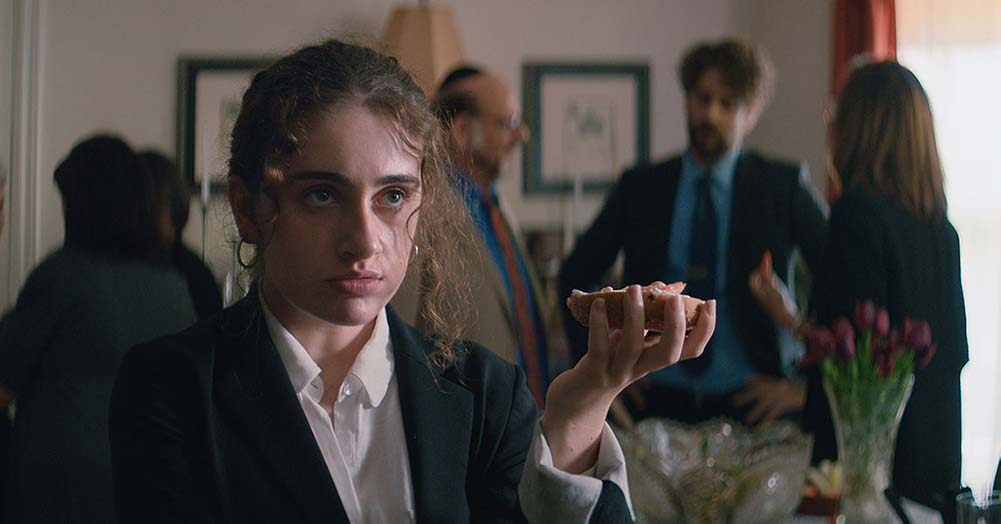
Twentysomething Danielle (Rachel Sennott – irresistible) is definitely guilty of skipping the actual funeral (she doesn’t even know who died!), but if there are benefits to the after party, she isn’t reaping them. It’s awkward enough that her former flame Maya (Molly Gordon) is there, but that’s hardly the worst of it.

To her horror, Danielle sees that Max (Danny Deferarri) is there, too. Max is Danielle’s sugar daddy, and look, he brought his beautiful wife (Dianna Agron) and their cute baby daughter!

With Shiva Baby, Emma Seligman expands her 2018 short film for a feature debut full of observational comedy, mounting anxiety and a strangely appealing sexiness. Imagine the Coen Brothers rebooting Uncut Gems as a coming-of-age sex comedy, and you get an idea of the tonal tightrope Seligman is able to command.

The film’s opening finds Danielle confident and alluring. By the end of the day, she’s an unkempt, sweaty mess of beverages, blood and embarrassment. Almost all of Danielle’s arc takes place inside the home of the bereaved, and Seligman makes sure that is a hilariously uncomfortable place to be.

Danielle’s parents (the ever-reliable Fred Melamed and a scene-stealing Polly Draper) pressure her to work the room for job contacts, family friends inquire about her post-college plans, Molly wonders why Danielle ghosted her, and Max’s wife is getting suspicious.

And through it all, Seligman’s camera draws in closer and closer, making Danielle’s darkly comic claustrophobia almost palpable.

Clearly, much of Seligman’s sharp dialog comes from personal experience, and if it’s one you share this is a film that will feel like part of the family. But you didn’t have to be Greek to get caught up in that Big Fat Wedding, and you don’t have to be Jewish to see the joy in Shiva Baby.

Seligman flashes an insight that disarms you with sex and humor, keeping its hand at a subtle distance. But by the time we’re leaving that buffet, a breakout filmmaker and star have delivered a fresh, funny and intimate take on the indignities of finding yourself.

Place Your Bets

Godzilla vs. Kong

by George Wolf & Hope Madden

Here’s a sampling of the things we yelled at the screen during Godzilla vs. Kong:

“Boom! In the face!”

“Kyle Chandler is a terrible father.”

“Skull f**k him!”

“It’s just a flesh wound, get up!”

So you could say we were engaged in this battle, the one that’s been brewing since the end credits stinger from the excellent Kong: Skull Island four years ago. GvK can’t quite match that film’s tonal bullseye, but it easily lands as second best in the “Titan” Monsterverse that was reborn with 2014’s Godzilla.

Picking up three years after the tedious Godzilla: King of the Monsters, the film finds Kong contained on Skull Island under the respectful eye of Ilene Andrews (Rebecca Hall).

Meanwhile, Godzilla attacks APEX’s Florida headquarters – seemingly unprovoked. Mansplaining Mark Russell (Kyle Chandler) says Godzilla’s changed his hero stripes, but his daughter Madison (Millie Bobby Brown) and “Titan Truth” podcaster Bernie Hayes (Brian Tyree Henry, committing grand theft scenery) think there’s got to be more to the story.

There’s plenty more, and Dr. Nathan Lind (Alexander Skarsgård) believes Kong could be the key to proving his Hollow Earth theory about the Titans. Ilene agrees to allow the heavily sedated Kong to be transported by sea, but far from Godzilla’s favorite swimming holes, of course.

Riiiight.

Director Adam Wingard (You’re Next, Blair Witch) clearly realizes that monster mashes aren’t compelling if you can’t tell who’s fighting, and the technical aspects of GvK bring the Titan battles to vibrant life. Pristine cinematography, detailed CGI effects and a wonderfully layered sound design elevate the thrills early and often.

And that is what we’re here for, isn’t it?

That’s a familiar refrain when the human arcs in these films are so woeful, but screenwriters Eric Pearson and Max Borenstein toss the overwrought melodrama of King of the Monsters and add a frisky sense of welcome fun.

Yes, there’s another cute kid (Kaylee Hottle) with negligent guardians, and more than enough characters, locations and theories to keep up with. But even if you fall behind, you’ll catch up when these two Titans throw hands and tails, because they mean business.

They’re timing ain’t bad, either, as this is the kind of cinematic spectacle that could mean very good business for newly reopened theaters that badly need it. It’s a PG-13 return to form for a legendary franchise, with plenty to reward your popcorn munching and ringside commentary (keep it clean at the multiplex, please).

Just pick your screen size, and get ready to rumble.

Surrender the Booty

The Vault

by George Wolf

If we were going to add a third certainty to join death and taxes, how about the fact that heist movies are fun?

A good one makes you want to go assemble your crack team to trade quips, try on parkas and steal a Picasso. A bad one just makes you want to watch the good ones again.

The Vault (formerly titled Way Down) borrows from a host of similar films, keeping the formula familiar, the pulse quick and the scenery exciting for a ridiculous caper that never takes itself too seriously.

Freddie Highmore is Thom, a 22 year-old engineering genius fresh from the University of Cambridge. Bored by all the job offers from Big Oil, his interest is piqued by a mysterious opportunity to “change his life.”

Adventurer Walter Moreland (Liam Cunningham) offers Thom a spot on his “salvage” team, and the chance at untold riches. The plan? Break into the Bank of Spain and steal a centuries-old treasure first buried by Sir Francis Drake. The vault holding the booty is a puzzle of engineering yet to be solved, and Moreland is counting on Thom to be the big brain that outsmarts it.

The upper-crust thieves will have a timely distraction on their side. Spain’s World Cup final will be shown on a Jumbotron set up right outside the bank, meaning that during the match, all security cameras will be pointed at the huge crowd of soccer fans flooding the street, and not at the bank itself.

The script-by-committee mentions “Danny Ocean” early on, which is just stating the obvious. The Italian Job and Now You See Me, Now You Don’t will also come to mind, but director Juame Balagueró ([REC] and [REC2]) isn’t pretending he’s breaking new ground, just trying out a new playground.

Balagueró keeps his pace impatient from the opening minutes. Expect a succession of fake outs, multiple “We’re screwed!” exclamations and a shameless amount of “all is lost” moments. Realizations come only at the most fortuitous junctures and the tests to Thom’s genius never seem quite that strenuous.

And the effect of all of that on the film isn’t nearly as deadly, or taxing, as it should be.

The two hour run time feels about half that. Balagueró gives his camera a stylish flow and keeps us supplied with plenty of opportunities to feel like we’re in on the con, and have a stake in the success of the heist.

And you know what that is?

Fun.

Don’t Text and Shoot

Doors

by George Wolf

How much better would 2001 have been if there were helpful onscreen text explaining the motives of the monolith?

Use that bone as a weapon and you won’t starve.

None. The answer is none better.

A habit of over-explanation is just one of the weights pulling down Doors, a science fiction drama presented in three separate acts by three different writer/directors.

Jeff Desom fares best with the opening segment entitled “Lockdown.” As high schoolers in a classroom hear their locked-up cellphones buzzing, planes overhead and vaguely ominous announcements, some nice tension is built via mystery and subtlety.

And then both are gone.

A late night podcaster quickly sets the stage. Imposing, sentient “doors” have appeared around the world, and in the rush for answers, volunteers called (what else?) knockers are answering the invitation. The “Knockers” segment, from Saman Kesh, features Josh Peck and Lina Esco as a couple who find a greatly distorted reality awaits them on the other side.

Dugen O’Neal’s final segment, “Jamal,” carries a fine performance from Kyp Malone as a reclusive man successfully communicating with a door in secret. When an unexpected betrayal brings outsiders, the onscreen text brings mood – spoiling clarity to what the door requests.

Extended exposition via a podcaster is at least an organic device, but text? Since none of the characters can see these messages, they are only for our benefit as viewers, and land as the most inexplicable aspect of this entire cosmic trip.

This film starts with an intriguing setup to a decent sci-fi premise, but can never find resonant avenues for development. Some confidence in its audience, better performances, a more compelling score and crisper sound mix would be steps forward, but the most gaping hole is the absence of one clear storytelling vision.

Without it, Doors is an awkward anthology in search of an anchor, as well as a satisfying reward for opening it.

One Vision

Zack Snyder’s Justice League

by George Wolf

No matter what you thought of Justice League 1.0, the mere arrival of this “Snyder Cut” is fascinating on multiple levels.

It’s more than the Everest of fan service. There just isn’t any way Snyder’s DCEU epic – this version of it anyway – would exist without the Snyder/Whedon mashup mess of 2017.

It’s four freaking hours, people! You think Snyder’s gonna get that (and the extra millions for reshoots) without the whole hashtag campaign? But while the extended time and money giveth, they also taketh away, meaning that first JL debacle can take some ironic credit for all that’s better – and worse – about round two.

But it is indeed better.

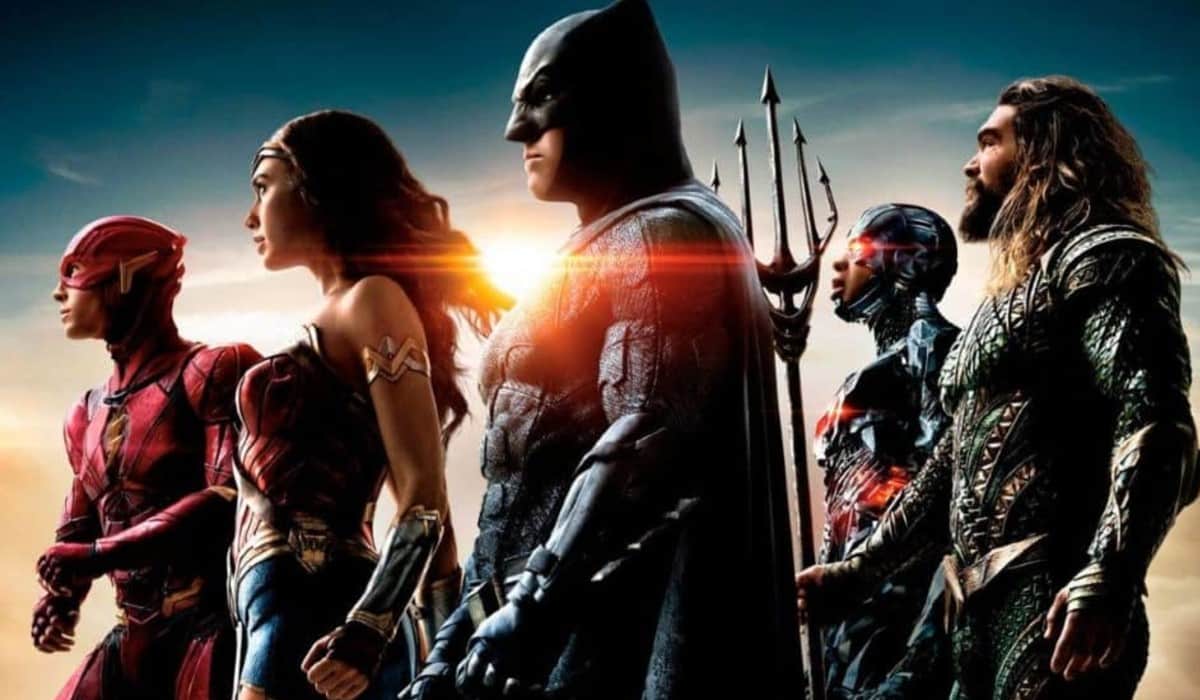
More than anything, it’s a singular vision. The first was nothing if not a super-sized compromise, but this is Snyder unbound, no compromises. The 4:3 format is enriched with greatly improved CGI, specifically the “armor of scales” appearance of Steppenwolf (voiced by Ciaran Hinds), the underwater depths of Atlantis and the complete absence of Superman’s (Henry Cavill, again a perfect Clark Kent) distractingly altered upper lip.

The character development – as you would hope with this run time – is much more satisfying, especially with the two justice leaguers we know the least: Flash (Ezra Miller) and Cyborg (Ray Fisher).

And while truly important moments (Superman’s death and rebirth, for example) get the extra time they need to resonate, Snyder can still linger too long (those mini music videos, ugh) when he could be moving on.

Ben Affleck reminds you he’s a fine grizzled Batman, Gal Gadot’s Wonder Woman gets more badass moments and fewer leering camera angels, and at its core, the basic plot remains the same. Steppenwolf is seeking to unite the three “mother boxes” that will conquer another world for his master Darkseid (voiced by Ray Porter). But with the nurturing of return characters and the welcome appearance of new ones (like Darkseid), the chaptered storytelling feels more natural and complete.

Yes it is dark and brooding, and this League may hold the mother lode of daddy issues, but it never becomes tedious. And while you can’t quite call it fun, it is super, and heroic, and sometimes thrilling.

The stinger (actually an epilogue)? It’s a humdinger (nothing rhymes with epilogue), one that will more than satisfy the die hards while setting a major hook for more justice, darkly served.

https://www.youtube.com/watch?v=vM-Bja2Gy04