Tag Archives: film

Sheep’s Clothing

Wolf

by George Wolf

More metaphorical than Cuckoo’s Nest, more elusive than Girl, Interrupted, and with less satirical bite than The Lobster, Wolf brings a few other films to mind. But like many of her characters, writer/director Nathalie Biancheri is committed to her own different animal.

George MacKay is hypnotic as Jacob, a young man suffering from species dysphoria. He believes he is a wolf trapped in a human’s body, and when we first meet Jacob, his distraught parents are dropping him off for an extended stay at a treatment center promising a cure.

Once inside, Jacob meets others in similar circumstances: Parrot (Lola Petticrew), German Shepard (Fionn O’Shea), Duck (Senan Jennings), Horse (Elsa Fionuir) and Wildcat (Lily-Rose Depp) – all patients under the domineering thumb of The Zookeeper (Paddy Considine).

Though enemies in the wild, Wolf and Wildcat become drawn to each other within the confines of the treatment center. She’s mysterious, with privileges the other patients don’t enjoy, which comes in mighty handy when Wolf starts resisting The Zookeeper’s increasingly harsh methods.

Biancheri’s metaphor for conversion therapy certainly isn’t hard to pick out, but on a wider scale, her film speaks not only to ignorance toward the LBGTQ+ community, but to a universal push for conformity across all lanes of society. To The Zookeeper, a happy and productive life comes only when you accept what is expected of you, and while Biancheri often juggles different tones within this theme, she is able to craft several moments of powerful humanity, including a structured lesson on laughing that will just about break your heart.

MacKay (1917, The True History of the Kelly Gang) is such a wonderful actor, and it’s no surprise that he’s able to uncover Jacob’s inner conflict with a touching, understated depth. But even beyond that, his command of the role’s animal physicality is powerful and striking.

As Wolf and Wildcat grow closer, MacKay and Depp (also impressive in a comparatively underwritten role) often seemed locked in to an acting school exercise on primal instincts that left the rest of the class in the dust.

There’s more than enough here – from the narrative core to the stellar ensemble to the clinical production design and beyond – for a compelling and thought provoking parable. But while Biancheri’s ambitions are bold and worthy, her second feature (after 2019’s Nocturnal) can’t quite settle on a species.

Such commitment to a unique identity is certainly thematically consistent, but a more streamlined focus may have made the finale feel less abrupt, and brought more clarity to Wolf‘s high concept vision.


The Impossible Dream

14 Peaks: Nothing is Impossible

by George Wolf

Nirmal “Nims” Purja likes to keep a positive outlook.

“I’m not going to die today. Maybe tomorrow, but not today.”

And while tomorrow isn’t promised to any of us, Nims tends to tempt fate more than most. A mountaineer, adventurer and former member of the Special Forces in Nepal, Nims feels most alive when he’s dreaming big and living life on the edge.

Netflix’s 14 Peaks documents his biggest dream: summiting all 14 of the world’s 8,000 meter + peaks (26, 247 feet and above) in just 7 months. To put that in proper context, the previous record for achieving the feat was 7 years. And Reinhold Messner – one of the greatest legends in all of climbing – took 16 years to ascend all 14.

So the plan that Nims dubbed “Project Possible” was ambitious, to say the least, and Messner himself sets the stakes for us. To Messner, climbing these wonders of the world “is not fun.” It is a practice filled with pain, danger and death.

That said, Nims sure seems to be enjoying himself, and part of that is helping to document his own journey.

If you come to 14 Peaks only for the breathtaking visuals, you will not be disappointed, especially if you can view it on a wide screen. Director/co-writer Torquil Jones takes us above the clouds over and over again, utilizing sparkling, absolutely thrilling footage often taken by Nims himself (including his incredible shot of a 300-person Mt. Everest traffic jam that quickly went viral).

But Jones also mines tension through the attempts at fundraising for the project (where Nims admits “I sound like a lunatic’) and getting the clearance from the Chinese government to climb in Tibet. Intimacy comes from getting to know Nims himself, who turns out to be a fascinating and endearing subject. We see his preparations and the tests that reveal him to be genetically gifted for enduring high altitude/low oxygen environments, as well as Nim’s commitment to to helping fallen comrades on the mountain, and to getting recognition for the oft-nameless Sherpas who are invaluable to visiting climbers.

And, Jones lets us meet Nims’s family, establishing a touching contrast between his apparent lack of fear and the feeling of failure that comes from being away from his ailing mother as he climbs.

14 Peaks will help you discover both a man and a mission. Separately, they’re pretty compelling. Together, they’re a force of nature.

Nuthin’ But a G Thang

House of Gucci

by George Wolf

Just four years ago, director Ridley Scott deconstructed the Getty family’s wealth of dysfunction in the masterful All the Money in the World. House of Gucci shows he’s still got money on his mind, and his mind on the rot that can take root in such mind-altering luxury.

Based on the true events detailed in Sara Gay Forden’s bestseller, the film dissects the complete unraveling of the Gucci family dynasty, a fuse seemingly lit by the unlikely relationship between Muarizio Gucci (Adam Driver) and commoner Patrizia Reggiani (Lady Gaga).

Though the Gucci name gets Patrizia’s attention at their first introduction, Muarizio didn’t seen to have much interest in the empire shared equally by his father Rodolfo (Jeremy Irons) and uncle Aldo (Al Pacino). But once he puts a ring on it, the mix of Patrizia’s ambition and Aldo’s invitations finally bring Maurizio into the family business.

Aldo’s own son Paulo (Jared Leto in some nifty makeup) is the Fredo in this clan, and it isn’t long before Paulo is trying to form his own back door alliance with Rodolfo, and Patrizia is Lady Macbeth-ing it everywhere from Italy to New York (complete with bewitching help from Salma Hayek as psychic Pina Auriemma).

You may have noticed that this is a pretty impressive cast. True, and even with their wheel-of-accents there’s little doubt that watching them all try to out-Italian each other in this trashy mash of The Godfather, I, Tonya, Shakespeare and The Real Housewives of Milan is the film’s biggest pleasure. But Scott and screenwriters Becky Johnston and Roberto Bentivegna can never establish a consistently compelling tone (overly random soundtrack choices don’t help, either), and the two and a half hour run time takes on curious contrasts. Even as the overall narrative has moments that drag, Maurizio’s transformation to the dark side still feels too rushed and convenient.

But Gaga proves worthy of another Oscar nom, and though the film never reaches the level of crackling relevance Scott mined in his look at the Gettys, she proves a fascinating window for the legendary director’s latest foray into an iconic family’s arc of greed, suspicion, betrayal and worse.

And if your Thanksgiving ends up going completely off the rails, House of Gucci is a star-powered and entertaining way to feel a whole lot better about your own family.

Leader of the Pack

The Power of the Dog

by George Wolf

Deliver my soul from the sword; my darling from the power of the dog.

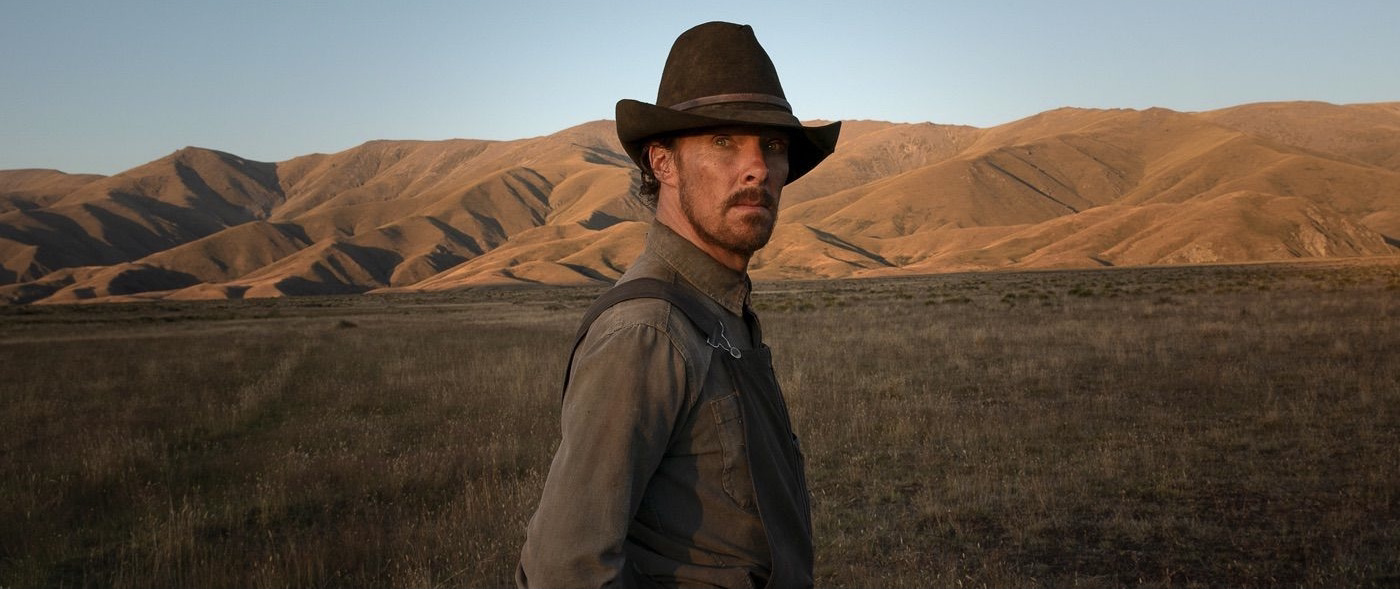
Psalm 22:20 pleads for protection from pack animals that attack the vulnerable. And in the first film in 12 years from writer/director Jane Campion, the leader of the pack is Phil Burbank (Benedict Cumberbatch).

Phil and his brother George (Jesse Plemons) are wealthy ranchers in 1925 Montana. George is soft spoken, well-dressed, polite and empathetic. Phil is none of those things.

So Phil is nothing but resentful when their family dynamic is upended by George bringing home Rose (Kirsten Dunst) and introducing her as his new wife. Though Phil doesn’t hide his suspicions of the new Mrs. Burbank, it is Rose’s son Peter (Kodi Smit-McPhee), that becomes his new favorite target.

Peter is quiet, gentle, and artsy, the perfect foil for Phil to belittle in front of his ranch hands. A master at exposing vulnerabilities, Phil doesn’t hesitate to loudly question Peter’s masculinity and his worth at the ranch – if not in the world.

So it surprises everyone – most notably the resilient, cautious Rose – when Phil seems to reverse course and take the young man under his wing. Peter needs new skills to be accepted into the ranch life, and Phil begins taking extra time to personally mentor him, passing on lessons that Phil himself learned at the feet of local legend Bronco Henry.

Even if you haven’t read the celebrated source novel by Thomas Savage, Campion’s adaptation unfolds with enough subtle poetry to convince you that it must be a wonderful read. Onscreen, the Oscar-winning Campion (The Piano) contrasts the vast majesty of the American West (kudos to cinematographer Ari Wegner) with delicate details that shift the nature of love, trust and strength within a family.

Campion gives Plemons, Dunst and Smit-McPhee the room to craft indelible characters, and they each respond with tenderly restrained excellence. But Cumberbatch is also the leader of this pack, delivering a magnificent, completely immersive performance sure to get awards season attention. Phil is unclean, both physically and spiritually, and Cumberbatch makes him a darkly compelling character, a feeling that directly feeds the unease that comes when Phil reasses his relationship with Peter.

What made Phil such an unforgiving brute? Are his new intentions truly kind, or is Peter in danger? And maybe Peter is seeing Phil more clearly than we realize.

The Power of the Dog finds its own power in what it shows but never truly tells. It’s a film that is hauntingly lyrical and masterfully assembled, with a beauty that lingers like an echo in the Montana wilderness.

Remember 1984? Be a Lot Zuuler If You Did

Ghostbusters: Afterlife

by George Wolf

Have you tried to branch out, only to end up with a revolt on your hands? Perhaps fan service is right for you! In other words, if 2016’s Ghostbusters was The Last Jedi, Afterlife is The Rise of Skywalker. With a side of Goonies.

That doesn’t mean it’s not a fun trip down memory lane.

Director/co-writer Jason Reitman picks up the 1984 baton from dad Ivan, crafting a new adventure that casually ignores the 1989 sequel.

Egon Spengler’s long-estranged daughter Callie (Carrie Coon) is being evicted from her Chicago apartment, so she takes daughter Phoebe (Mckenna Grace – just terrific in a completely heroic arc) and son Trevor (Finn Wolfhard) to the only thing Dad left her when he died: a dilapidated farmhouse in small-town Oklahoma.

Ah, but this farm holds secrets, and it isn’t long before science whiz Phoebe is getting familiar with proton packs and Trevor is checking to see if the ECTO-1’s engine might actually turn over.

Good timing, too, because Phoebe’s teacher Mr. Grooberson (Paul Rudd) has been noticing some serious seismic activity in town that he cannot explain. Turns out the Sexiest Teacher Alive is also a big fan of the original Ghostbusters, and he clues in Phoebe and her conspiracy-happy friend “Podcast” (a charming Logan Kim) about Grandpa’s heroics back in the day.

Once Trevor’s crush Lucky (Celeste O’Connor from Freaky) makes it a quartet, it’s up to the kids to figure out the real reason Egon abandoned the GB’s all those years ago, what’s brewing under the farmhouse, and just how to wrangle a stage 5 apparition.

This is a film so steeped in the nostalgia for its source material that you cannot imagine it existing on its own. Is that a direct result of the savagery that greeted the female (and for what it’s worth, underrated) reboot or a natural reaction by a son following in his father’s footsteps?

Either way, the benchmark callbacks come early and often, with Reitman frequently holding the shot an extra beat just to make sure you pick up what he left for you. And while the Bill Murray zany-ness is replaced by Paul Rudd sarcasm and wisecracking from a cast of wonderful young actors, there is humor here, enough to justify the “comedy” label (which honestly, the original trailer had me questioning).

But is it fun? Oh yeah, with some slick CGI and high points that are zuuler than the other side of the pillow.

You’ll want to stay through the credits for two extra scenes, but there’s a good chance you’ll still be thinking about all that Reitman has in store during that finale. It’s plenty – maybe even enough for your eyes to stay as pufty as a certain marshmallow man.

I’m So Eggcited

Red Notice

by George Wolf

Heist Movie? Gal Gadot? I’m in.

Plus Dwayne Johnson and Ryan Reynolds.

I said I’m in! Sounds like a bunch of fun.

But somehow, it’s just not.

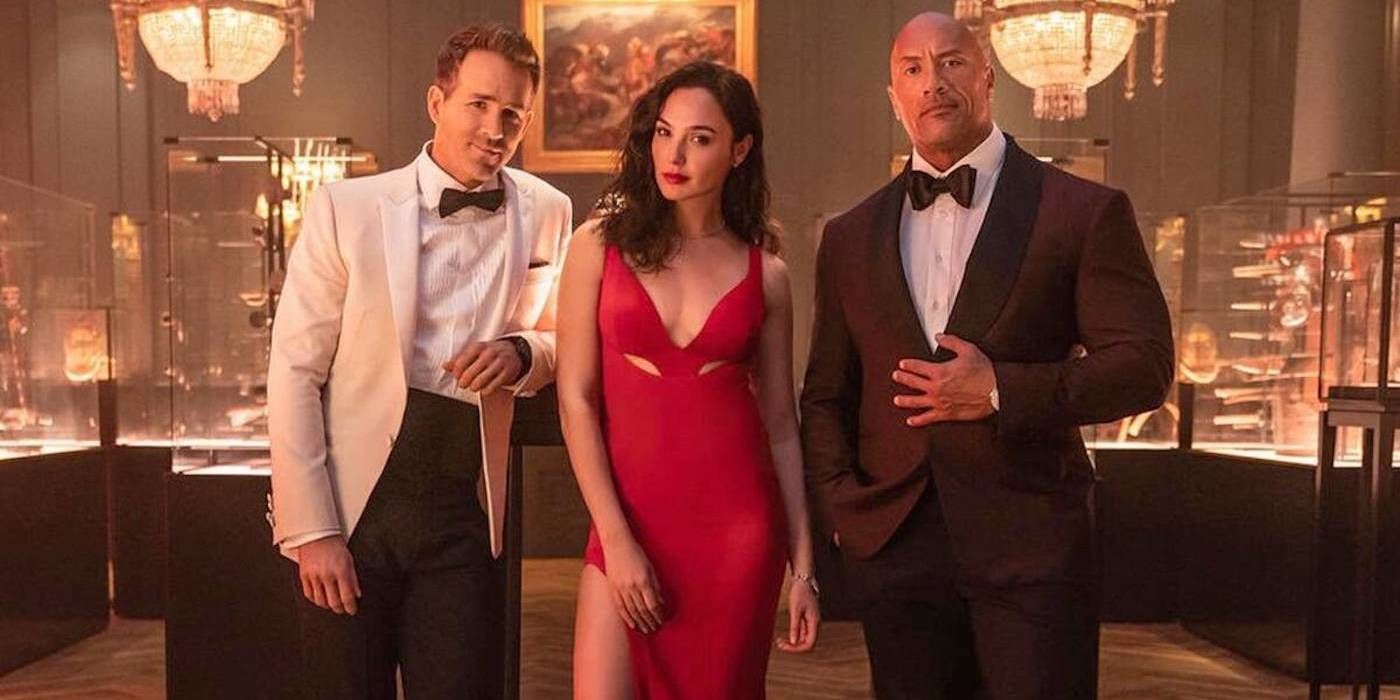
Johnson is FBI agent John Hartley, and he’s on the trail of Nolan Booth (Reynolds), the 2nd most wanted art thief in the world.

Who’s number 1? That would be The Bishop (Gadot), a mysterious criminal who always seems one step ahead of Booth in the quest to reunite three priceless jeweled eggs that Marc Antony once gave to Cleopatra. Yes, Cleopatra.

After a snappy, parkour-heavy chase to open the film, Hartley offers Booth the chance to move up to the top spot on Interpol’s Red Notice (highest level arrest warrant) list. All he has to do is help Hartley and the Feds nab The Bishop.

And the game is on!

Writer/director Rawson Marshall Thurber (Dodgeball, We’re the Millers, Central Intelligence, Skyscraper) has assembled three charismatic A-listers for a globe-trotting adventure with glamourous locales, double crosses and a script full of quippy banter. And it takes barely thirty minutes to begin wondering how it all went wrong.

You would think that watching Gadot, Reynolds and Johnson do anything together would be at least a marginal hoot, but nobody seems comfortable. What chemistry there is feels forced, at best, and none of the three stars bring much beyond the personas they’ve earned in better films. Reynolds carries most of the comedic weight, but with schtick that’s nearly interchangeable from his two Hitman’s Bodyguard films, a stale odor appears early and often.

There are a few LOL moments, most notably Hartley and Booth arguing about Jurassic Park and the real Ed Sheeran showing up to fight some federal agents. But with direct references that include Indiana Jones and Vin Diesel, plus multiple outlandish wardrobe changes (Johnson can’t exactly buy off the rack, so who had the tailor made safari outfit?), Thurber ends up navigating an awkward space that teeters on spoof.

Is Red Notice really trying to launch a new action/comedy franchise? Or is it just riffing on the genre? Either way, it ends up on the naughty list. Even those two Hitmans Bodyguard films embrace their own ridiculousness to deliver some dumb, forgettable fun. Red Notice manages two out of those three, and that ain’t good.

Bloody Well Write

The French Dispatch

by Hope Madden and George Wolf

Who’s ready for Wes Anderson’s most Wes Anderson-y movie to date?

It feels like we say that every time he releases a new film, but The French Dispatch is absolutely the inimitable auteur at his most Andersonesque.

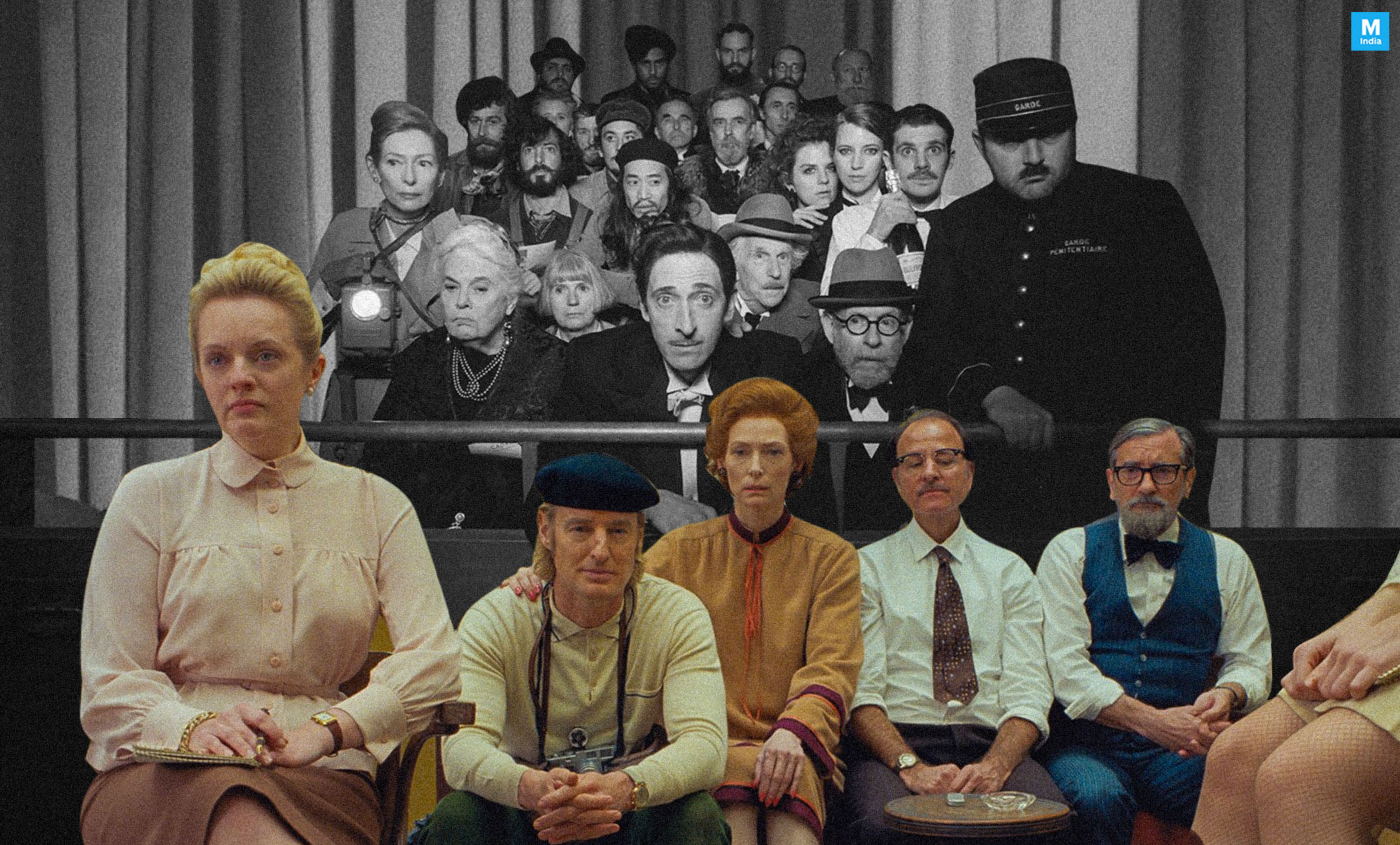
The French Dispatch is a magazine — a weekly addition to a Kansas newspaper covering the ins and outs of Ennui, France, the town where the periodical is based. The film itself is an anthology, four shorts (four of the stories published in the final edition) held together not by the one character each has in common, editor Arthur Howitzer, Jr. (Bill Murray), but by Anderson’s giddy admiration for France and The New Yorker.

Boasting everything you’ve come to expect from a Wes Anderson film — meticulous set design, vibrant color, symmetrical composition, elegance and artifice in equal measure, and a massive cast brimming with his own stock ensemble — the film is not one you might mistake for a Scorsese or a Spielberg.

Expect Anderson regulars Tilda Swinton, Mathieu Amalric, Lea Deydoux, Owen Wilson, Adrien Brody, Frances McDormand and newcomers Benicio Del Toro, Timothee Chalamet and Jeffrey Wright. And those are the big roles (although truth be told, no one is on screen all that long).

Blink and you might miss Saoirse Ronin, Willem Dafoe, Henry Winkler, Elisabeth Moss, Ed Norton, Christoph Waltz, Liev Schreiber and Jason Schwartzman.

In the segment filed under the “Taste and Smells” section, Dispatch writer Roebuck Wright (Wright) turns in a sprawling profile on master chef Nescaffier (Steve Park) that – to Howitzer’s chagrin – contains merely one quote from Nescaffier himself. As with the other pieces of the anthology, the many tangents of the piece are explained through Anjelica Huston’s narration, which can’t replace a truly emotional through line and holds the film back from resonating beyond its immaculate construction.

Anderson’s framing of symmetry and motion has never been more tightly controlled, and the film becomes a parade of wonderfully assembled visuals paired with intellectual wordplay and an appropriately spare score from Alexander Desplat.

As a tribute to a lost era of journalism and the indelible writers that drove it, Anderson delivers a fascinating and meticulous exercise boasting impeccable craftsmanship and scattershot moments of wry humor. But the layer of humanity that elevates the writer/director’s most complete films (Rushmore, Moonrise Kingdom, The Grand Budapest Hotel) never makes it from page to screen, and The French Dispatch ultimately earns more respect than feeling.

https://www.youtube.com/watch?v=z0_hwGWen-I

Who Are You, Again?

Yourself and Yours

by Hope Madden

It’s taken four years, but Hong Sang-soo’s Yourself and Yours is finally screening internationally. The delightfully confusing love story uses inebriation and one well-placed mannequin to illustrate the giddy, identity-demolishing euphoria of love.

Young-soo (Kim Ju-hyuk) decides to believe his friends when they tell him his girlfriend Minjung (Lee Yoo-Young) goes out drinking—and who knows what else?—with other men.

But does she? I mean, it sure looks like she does, but maybe it isn’t her? Or maybe it is her, but there’s some kind of explanation, like mental illness? Or maybe it doesn’t matter, because the filmmaker is less interested in who is (or isn’t) doing what to whom than he is in how others react.

The film is a charming change of pace in at least a dozen ways. Its intentional ambiguity works in its favor because it keeps you from falling into the frustrating trap of seeing Yourself and Yours in the same terms as some kind of American doppelganger erotic thriller noir, which is certainly what the same story could have become.

Instead, the film delivers an entirely off-kilter sensation (as, some would say, does love). Lee’s enigmatic performance is captivating—at times tender, defensive and silly but always engaging. It’s hard to imagine the film working with anyone else in this role because, thanks to her unshowy but convincing portrayal, you are never absolutely certain what the hell is going on.

Supporting performances couldn’t be richer, whether the flatly disgusted female friend, the “sorry I started this whole thing” buddy, the nonchalant bartender or Minjung’s (or is it?) other smitten beaus. With limited screen time and limitless commitment to the concept, the ensemble adds to the confusion and the joy to be found throughout the film.

It may be Kim’s turn and the transformation of his character that elevate Yourself and Yours above quirky love story to truly solid, insightful art. His performance is quite beautiful, as is the film.

As, some would say, is love.

Saturday Screamer: The Mist

The Mist (2007)

Frank Darabont really loves him some Stephen King, having adapted and directed the writer’s work almost exclusively for the duration of his career. While The Shawshank Redemption may be Darabont’s most fondly remembered effort, The Mist, an under-appreciated creature feature, is our vote for his best.

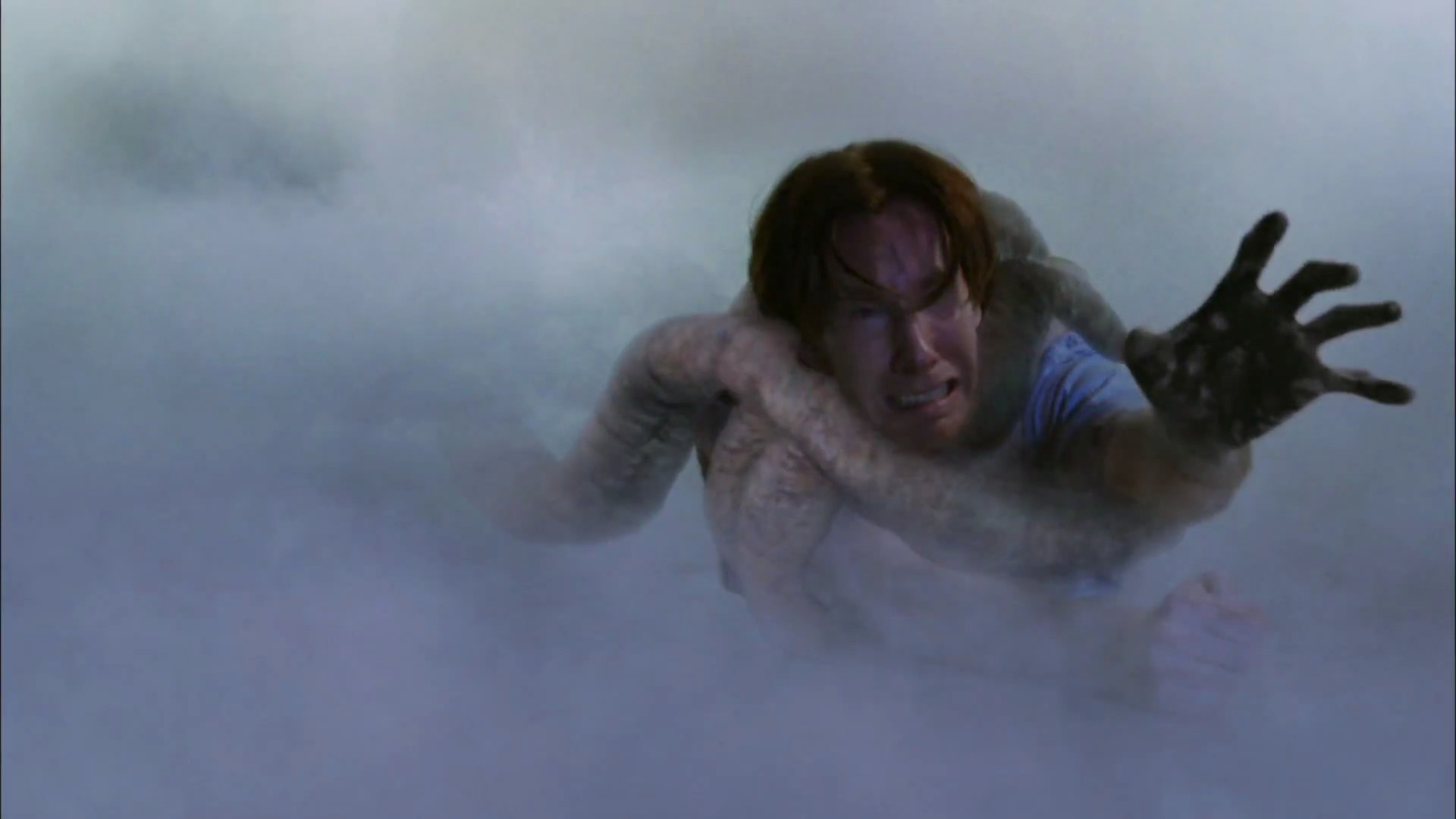
David Drayton (Thomas Jane) and his young son head to town for some groceries. Meanwhile, a tear in the space/time continuum (who’s to blame?!) opens a doorway to alien monsters. So Drayton, his boy, and a dozen or so other shoppers all find themselves trapped inside this glass-fronted store just waiting for rescue or death.

Marcia Gay Harden is characteristically brilliant. As the religious zealot who turns survival inside the store into something less likely than survival out with the monsters, she brings a little George Romero to this Stephen King.

In a Romero film, no matter how great the threat from the supernatural, the real monsters tend to be the rest of the humans. King does not generally go there, but he does so with The Mist and it’s what makes this one of his most effective films.

While Harden excels in a way that eclipses all other performances, the whole cast offers surprisingly restrained and emotional turns – Toby Jones is especially effective.

The FX look good, too, and let’s be honest, a full-on monster movie with weak FX is the lamest. The way Darabont frames the giants, in particular, gives the film a throw-back quality to the old matinee creature features. But he never gives into cheekiness or camp. The Mist is a genuinely scary film – best seen in the black and white version if you can find it.

Regardless, it’s the provocative ending that guarantees this one will sear itself into your memory. Though this is likely what kept The Mist from gaining an audience in theaters, it is a brilliant and utterly devastating scene that elevates the film from great creature feature to great film.


Zombie Eat World

The Night Eats the World

by Hope Madden

People like to make lists. For some people, it’s a bucket list. Some like to keep track of the celebrities they are allowed to sleep with if the opportunity arises. Not me.

Years ago I put together my zombie survival team. And though I know plenty of people with varied and worthy skills, making my team mainly came down to two things. Are you smart? Are you quiet? Because it is the introverts of the world who will survive the zombie apocalypse.

Director Dominique Rocher’s unusually titled The Night Eats the World understands this.

Sam (Anders Danielsen Lie) reluctantly stops by his ex’s party to collect his things. It is a loud, raucous event and Sam is in no mood. He stands moping alone until finally he wanders into a quiet back office, locks the door to the partygoers and waits.

By morning, Sam may be the only living human left in Paris.

The majority of the film quietly follows Sam through the apartment building as he fortifies his position, spends his time, survives. It’s a pleasantly pragmatic approach to the zombie film, although it asks many of the same questions Romero asked in Dawn of the Dead.

In fact, TNETW sometimes bears an amazing resemblance to the underseen German zombie flick Rammbock: Berlin Undead. (It’s great. You should see it.)

There’s a lot going on here that’s fresh, though. Rarely is a zombie film this introspective or a horror hero this thoughtful. More than that, though, Rocher’s horror is a meditation on loneliness.

Not only is that an unusual topic for horror, it’s delivered with the kind of touching restraint that’s almost inconceivable in this genre.

Danielsen Lie, in what nearly amounts to a one-man-show, never lets you down and never feels showy. Sam is a man who is maybe too at home with the situation in a film that quietly asks, just what has to happen before a true introvert longs for human companionship?

That’s why they’ll outlast us. It’ll just be a few dozen socially uncomfortable loners skilled at closing themselves off from the chaos around them. Plus Keith Richards.