Tag Archives: family films

No Shoes, No Pants, No Problem

Peter Rabbit

by Christie Robb

Once upon a time there were four little rabbits, some gatecrashing, a tense dude named McGregor, and a pervasive lack of pants. But Will Gluck’s Peter Rabbit is a bit of a departure from Beatrix Potter’s twee kids’ books.

And you might think, ugh, not another attempt to lengthen and embellish a piece of classic literature beyond all reason (looking at you, Peter Jackson). But hold on. This (cotton) tale takes place somewhat after the events in Ms. Potter’s books. Both Peter’s (James Corden) parents are dead and there’s a new McGregor in town, Domhnall Gleeson (perhaps most familiarly known now as the strident General Hux from the Star Wars saga).

Gleeson’s McGregor is an acutely type A city slicker who longs to immediately sell his recently inherited country estate in order to reinvest the profits in a business venture back in London. Until he meets the animal lover/bunny portraitist Bea (Rose Byrne) who lives in the Pinterest-worthy cottage next door.

This gets Peter’s invisible knickers in a twist for two reasons: 1) restricted access to the tantalizing McGregor garden, and 2) a rival for the affections of Bea who, in the absence of his own rodent parents, has become personage he invests with a significant amount of maternal affection.

The conflicts escalate in cartoon violence that’s kinda Home Alone by way of the Odd Couple. And, as you might expect, it is an absolute delight to see Gleeson rant in nearly Shakespearean cadences about the antics of an anthropomorphized rabbit.

(To be honest, I’d probably pay the price of a movie ticket to see Gleeson take exception to piece of burnt toast.)

Like Gleeson, the supporting cast is also a delight. Margot Robbie, Elizabeth Debicki, and Daisy Ridley stand out as Peter’s siblings Flopsy, Mopsy, and the devil-may-care Cotton-tail.

If you want to get all highbrow about it, the entire movie can be read as a metaphor for a kid’s struggle to accept a new romance in the life of a primary caregiver. And if you want to be honest, it bears as much resemblance to its source material as my 4-year-old’s picture of me does to the Mona Lisa.

But there’s enough beautiful animation, fun 90s and early 00s songs, and Easter-egg jokes for parents in case the kids decide they really like this movie and you have to watch it 400 times.

The Studio’s Apprentice

Mary and the Witch’s Flower

by Matt Weiner

There’s something about the helpless awkwardness of growing up that guarantees the enduring appeal of magic. Mary and the Witch’s Flower taps into that spirit with appealing grace. And it’s a promising first feature from Studio Ponoc, home to a Studio Ghibli diaspora that formed after the venerable Japanese animation studio announced a production break back in 2014.

When a walk in the woods leads to a chance encounter with special flowers, Mary (voiced by Ruby Barnhill in the English language version) gains temporary magical powers. Her broomstick whisks her away to the magical college Endor, which looks about like if Hogwarts put down stakes in Spirited Away.

Mistaken for a witch and propped up by the magical flowers (apparently the PEDs of the wizarding world), Mary is deemed a prodigy by the excited school faculty. She soon learns she’s not the only one interested in those flowers, and outsider or not it will be up to her to save magic for everyone.

Director Hiromasa Yonebayashi, Ghibli veteran and Oscar nominee for When Marnie Was There, keeps the visual charm turned up throughout the film—a good thing, given that his script (co-written by Riko Sakaguchi and based on a children’s novel by Mary Stewart) lacks the heft of a typical Ghibli film.

For adult viewers, Yonebayashi’s light touch can be a bit too light. Mary, with her wild hair and strong will, is a charming stand-in for kids, but her hero’s journey will be instantly familiar. Endor professors Madam Mumblechook and Doctor Dee (Kate Winslet and Jim Broadbent) exude sinister charm, but the rest of the sparse supporting roles don’t have much to add beyond perfunctory plot points.

These are minor complaints though. And the animation, especially the magical set pieces that test Mary’s mettle, makes up the difference. The film offers up a fully-formed magical world with smart visual economy over exposition (cough Fantastic Beasts cough). Mary’s determination is contagious, and even if her saving the day is inevitable it’s impossible not to feel moved by the choices she makes to get there.

For all the magic that infuses Endor, Doctor Dee was on the right track when he told Mary that electricity is just another form of magic. If Mary and the Witch’s Flower doesn’t always have the preternatural spirit that animates the best of Studio Ghibli, it’s a delightful visual successor even when it’s working a little harder to keep the spark alive.

A Very Rare Sort of Bear

Paddington 2

by Cat McAlpine

Paddington 2 paints a beautiful, pop-up love letter to London. It breaks down something like this:

Wes Anderson aesthetic + Lemony Snicket whimsy + marmalade = Paddington Bear’s latest adventure.

Sure, this is a kid’s movie. The main character is a talking bear. His greatest aspiration is to buy a rare pop-up book of London for his Aunt’s birthday. In most ways, the film is predictable. Almost rote. But there’s some sparkle there, too.

Firstly, the movie is incredibly well lit. Lighting this good has no business in a children’s film’s sequel. And yet there it is. Warm yellow homes, moody shafts of light through window panes, snowy alleyways. That light isn’t wasted either. It illuminates bright, punchy sets and colorful costumes hung on a parade of quirky characters.

The Wes Anderson inspiration shows up in bright green rooms and pastel pink prison uniforms. Director Paul King finds sweetness in even life’s most ordinary moments. Where he cannot find sweetness, in a grimy pipe or a shattered telephone box, he finds curiosity instead, playing with light and camera angles.

Following a pop-up book of London, King makes sure to hit all of London’s beloved landmarks. London is a part of Paddington’s mythology. It’s a magical kingdom full of fun and mystery. King paints the city beautifully.

Secondly, what a cast. Sally Hawkins, fresh off her incredible performance in The Shape of Water, oozes gumption. English favorites parade across the screen: Peter Capaldi, Richard Ayoade, Brendan Gleeson.

None quite as fun, though, as Hugh Grant in his role as an unhinged stage actor. As the baddie, Grant never slips into evil. Nefarious, yes, but never evil. King keeps his film silly, always, but never allows it to be hollow.

For every predictable gag there’s a genuinely funny moment, too. Good children’s films cater to their whole audience, kids and parents. Its important to screen films like these in theatres. I was reminded of this when a character passed out, face down, into a cake. The children in the audience shrieked with delight.

That’s Paddington 2’s final merit. It’s good natured. It has jokes, visual gags, and constant reminders to be kind. Paddington believes in himself, his family, and his friends. Sure, a children’s film about a talking bear isn’t destined to be profound. But it manages to be sweet all the way through, just like marmalade.

Seeing Red

Ferdinand

by Hope Madden

I’m thrilled to announce that Ferdinand, the new animated feature from Carlos Saldanha (Ice Age, Rio), did not ruin my childhood.

Whew!

The story of a peaceful if enormous bull who’d far rather sniff flowers than fight matadors was my favorite book as a little kid, but to stretch these 32 or so sentences into a 90-minute feature-length film, there would have to be padding.

I worried about the padding.

Credit a team of six screenwriters for finding—for the most part—organic ways to develop the story. We meet Ferdinand as a young bull being raised with a handful of other bulls specifically to fight in the ring. Then we follow him on his adventure to freedom from the ring and back into the sights of the matador.

That doesn’t mean the film never feels padded. It definitely does. But a slew of vocal talents including John Cena, Bobby Cannavale and Kate McKinnon helps to keep the film afloat.

Rarely laugh-out-loud funny, a bit bloated and a tad dark at times, Ferdinand still manages to entertain. It looks good, bears a social conscience and remains more or less true to the simple “be who you are” core that made Munro Leaf and Robert Lawson’s picture book so lovely.

https://www.youtube.com/watch?v=n7RkOfN8KvE

I See Dead People

Coco

by Hope Madden

Pixar is probably still the best bet in animation, though they followed up their 2015 high point Inside Out with the somewhat mediocre The Good Dinosaur and Finding Dory, and finally the underwhelming third installment in their least impressive series, Cars 3.

Can Coco, a story of finding your place between family and dreams, between this world and the next, set things right?

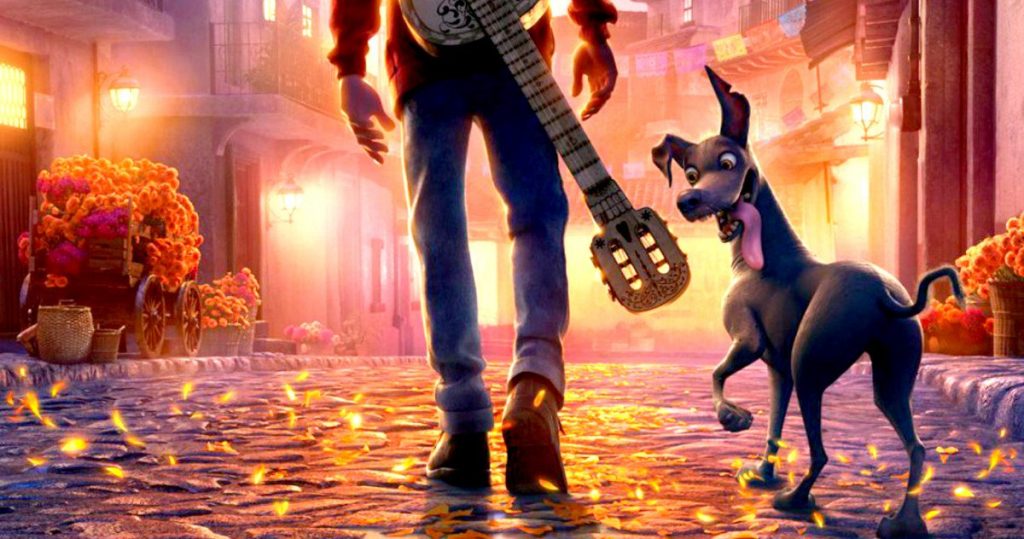
The film follows Miguel (well voiced by young Anthony Gonzalez), a musician, like his great-great-grandfather. The one no one is allowed to mention. The one whose face has been torn from the family photo. The one the whole family is supposed to forget.

Instead of being a musician, Miguel is supposed to make shoes, like the great-great-grandmother who taught herself to make shoes when her husband left her to pursue his dreams of being a musician.

But Miguel prefers music—who wouldn’t?—and “borrows” the guitar of the great, long-dead hometown hero Ernesto de la Cruz (Benjamin Bratt) so he can play in the talent show during the Dia de los Muertos celebration.

One thing leads to another and Miguel finds himself in the Land of the Dead.

There are a number of things Coco does quite right. Though its themes are reminiscent of other Pixar films—Ratatouille, in particular—the cultural execution is a welcome change in a long and Euro-centric list of movies.

The film is also characteristically gorgeous, many frames spilling over with vivid color and imagery.

Coco also tells a satisfying story that packs an emotional wallop. Like the animation giant’s 2009 masterpiece Up, Coco invests in elderly characters and celebrates death as a tragic but inevitable consequence of life.

The structure by now has become common, with too many notions borrowed from other Pixar films. Worse, the laughs are rarely hearty and the genuine emotion is saved for the climax leaving too much time spent with little serious audience connection.

That’s the tough thing about being Pixar, though, isn’t it? We’ve become so accustomed to treasures that we disregard a lovely, heartfelt piece of family entertainment. Coco is no Toy Story, but it’s a lovely film.

Choose Kind

Wonder

by Hope Madden

On its surface, Wonder is about feeling like an outsider.

Auggie Pullman (Jacob Tremblay, proving that his remarkable turn in Room was no fluke) is about to start middle school. There’s anxiety enough in that, but this will be Auggie’s first “real school,” having spent his formative education being homeschooled by his more than capable mother (Julia Roberts).

But there’s more. Auggie suffers from a congenital malady which, after dozens of surgeries, leaves him with an unusually misshapen and scarred face. This is why he prefers to wear a space helmet whenever he’s in public.

To its enormous credit, Wonder makes Auggie’s plight universal. Doesn’t everyone entering middle school desperately fear some kind of ostracism? Doesn’t every parent fear the same for their tender youngster?

How much worse will it be for Auggie? Few parents will not recognize the sincerity in his mom’s plea as she sends her son off to his first day of real school: “Please, God, let them be nice to him.”

Roberts, whose work in recent years has radically outshone everything from the first couple decades of her career, offers a strong and believable center of gravity for both the Pullman family and the film.

Director Stephen Chbosky also co-wrote this adaptation of R.J. Palacio’s popular juvenile fiction book. Chbosky waded into similarly angst-ridden waters when he directed the screen version of his own novel Perks of Being a Wallflower, but with Wonder he manages to find an emotional truthfulness missing from his previous film.

Wonder is surprisingly—almost amazingly—understated, given the content. The film avoids many a tear-jerking cliché and sidesteps sentimentality more often than you might expect.

It’s also dishonest— well-meaning, but wildly dishonest. Conflicts are easily resolved, lessons quietly learned, comeuppance generally had and loose ends carefully tied.

Wonder is about as wholesome a movie as you will see, lacking even an ounce of cynicism, which certainly makes Auggie’s ordeal easier to bear. But it’s still a cinematic cop out.

Girl with All the Gifts

Gifted

by Hope Madden

A pensive charmer tries to raise a child prodigy on his own. Gifted offers a premise as rife with possibilities as it is weighed down by likely cliché and melodrama, and it strangely meanders somewhere between the two.

Chris Evans attempts the gruff everyman with some success, playing Uncle Frank, guardian to math genius Mary (Mckenna Grace – very solid). Against the advice of his landlord and Mary’s bestie Roberta (Octavia Spencer), Frank enrolls Mary as a first grader in a local public school.

There Mary wows her good natured teacher (Jenny Slate), and draws the attention of her grandmother (Lindsay Duncan), who’s been MIA since Mary’s mother – another family genius – died when the girl was just a babe.

What’s the best way to care for a gifted child? This is the conundrum at the heart of the film. In rooting out the answer, writer Tom Flynn wisely keeps Mary at the center of the story. She’s an actual character, not a prop for evangelizing one course of action over another.

Luckily, Grace is up to the task, and her chemistry with Evans feels genuine enough to make you invest in their story.

Perhaps more important is Duncan, a formidable talent who elevates a tough role. She, too, shares a warm chemistry with Evans, and it’s that kind of unexpected character layering that helps Gifted transcend its overcooked family dramedy leanings.

On occasion, Gifted is Little Man Tate without the pathos. At other times, it’s Good Will Hunting for first graders.

Strong performances help the film navigate sentimental trappings, but Flynn’s script veers off in too many underdeveloped and downright needless directions, and director Marc Webb ((500) Days of Summer) can’t find a tone.

Gifted is warm without being too sweet. Though it knows the answer to the question it’s asking, the film resists oversimplification and never stoops to pitting one-dimensional characters against each other in service of a sermon.

Though the final decision about what’s best for Mary is really never in doubt, in getting to that revelation, the film acknowledges nuance in the choice.

That’s not to say Gifted avoids cliché altogether, or that it embraces understatement. It does not – on either count. But it does present an intriguing dilemma, populates its story with thoughtful, almost realistic characters, and refuses to condescend to its audience or its characters.

Verdict-3-0-Stars

Glen Baby Glen Ross

The Boss Baby

by Hope Madden

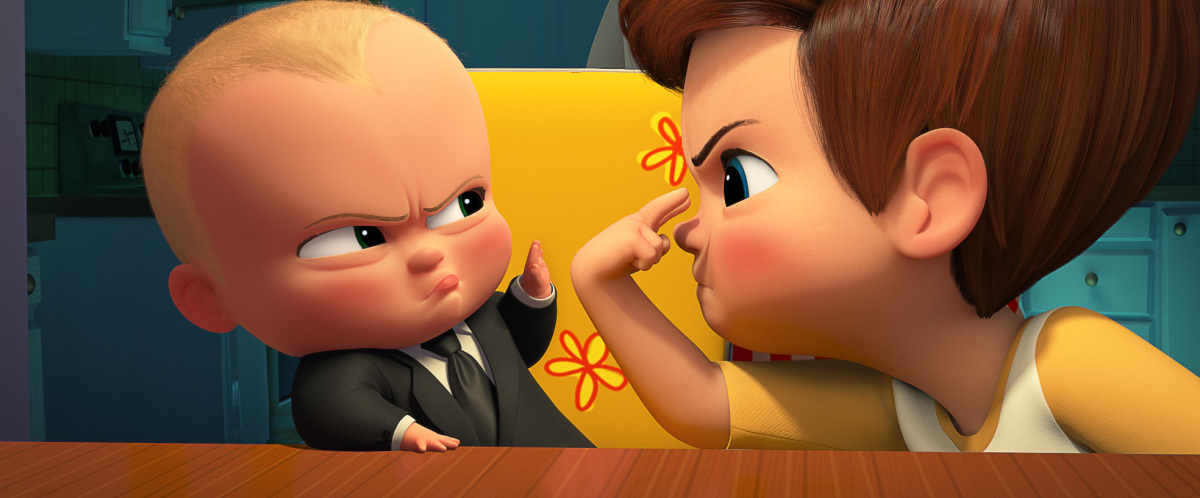
Imaginative only child Tim (Miles Christopher Bakshi) loves his life. He loves to play with his mom (Lisa Kudrow) and dad (Jimmy Kimmel), loves to have adventures, and loves to go to sleep after his three favorite stories, five hugs and one special song.

All that changes when his little brother (Alec Baldwin) arrives. Why can’t his parents see that this stranger in their home is all manner of wrong?

Tim’s right – there is something up with the wee one. Baldwin’s Baby has been sent to Tim’s house to infiltrate a pet company. Why? Because puppies are so darn cute, people might want to stop having babies and just get puppies.

Things get considerably more convoluted from there.

Marla Frazee’s children’s book The Boss Baby is a clever metaphor brought to life. There’s a new boss in the house, and he is a total baby. Cute.

It was Michael McCullers’s unfortunate task to turn Frazee’s couple dozen lines into a screenplay that would take up approximately 90 minutes. That leaves an awful, awful lot of space to fill with McCullers’s imagination, and that brain takes us in some weird directions.

The film’s foundation combines ideas from the recent animated mediocrity The Secret Life of Pets and Storks. Plus there’s a surprisingly good dose of The Office tossed in there, and, of course, some Glengarry Glen Ross.

But still, there is more time to kill.

How shall we fill it?

How about with Elvis impersonators? Lots of poop jokes? An evil Mrs. Doubtfire? Pacifier acid trip? Maybe a pot shot or two at designer puppies?

Why not?

As it turns out, The Baby Boss is a very strange and strangely subversive little cartoon.

Many of the jokes are aimed high above the average 3-foot-tall and under crowd, but honestly there’s not a great deal for the tykes to cling to. The story is far too complicated, and the dazzling array of bizarre ornamentation only further confounds viewers.

Maybe you have to settle for the little things. Does Tim learn that there is enough love to share with his baby brother? Does Alec Baldwin say, “cookies are for closers”?

Yes and yes.

Verdict-2-5-Stars

Abs-olutely Fabulous

The LEGO Batman Movie

by Christie Robb

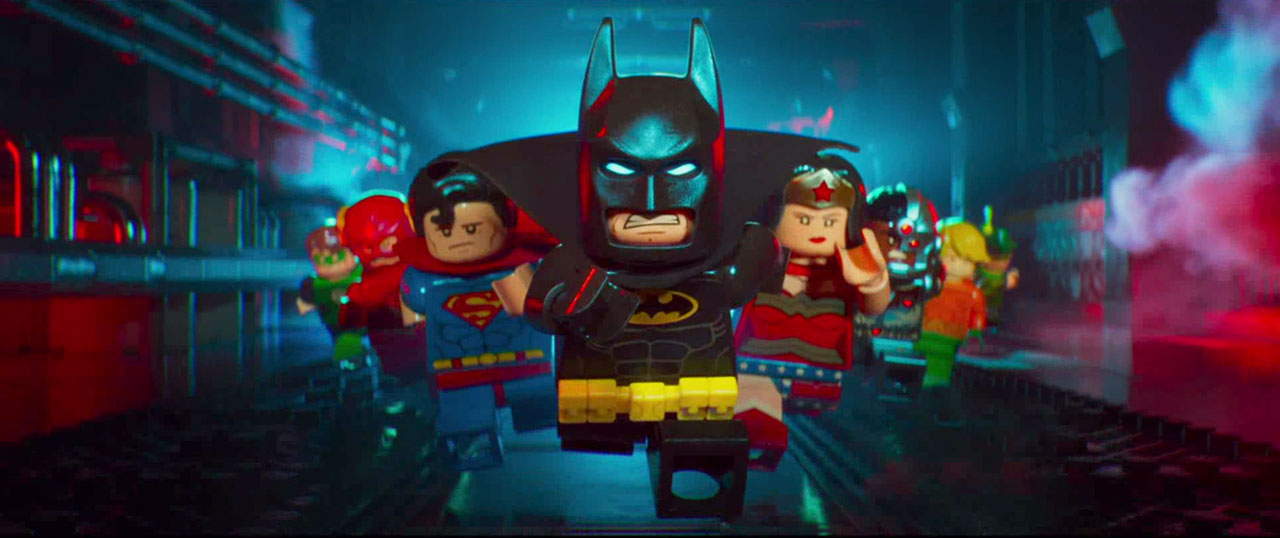
This year’s spin-off of 2014’s The LEGO Movie centers on Batman—the brooding solitary vigilante with the wonderful toys and the nine-pack abs. We catch up with him doing the usual thing—saving Gotham City from a supervillain. But when he gets home after a long day, who does he have to share his life with? Just a judgey Alfred, Siri, and a microwaved plate full of lobster. Apparently Batman’s greatest fear is intimacy.

The Bat can’t even identify his “bad guy”—breaking Joker’s heart when he decides to “fight around.”

So when Barbara Gordon takes over as police commissioner amid plans to work more collaboratively with Batman, he gets the heebie jeebies. Discovering that he’s accidentally adopted an orphan doesn’t help. Nor does the Joker’s rounding up of all of Gotham’s villains and submitting a group resignation letter.

Faced with demands on his emotional intelligence and without purpose, Batman begins to crack. Sure that Joker is up to something, Batman refuses to work with Gordon and inadvertently places Joker in a position where he can destroy all of Gotham for good.

Only one thing can stop this nefarious plan…teamwork.

LEGO Batman is a PG-rated movie that is probably even more fun for adults than for kiddos. Those responsible for paying the tab will get to enjoy spotting the references to other Batman movies, identifying terrible Batman TV show villains (like the Condiment King), and wondering how the administrative folks at the studio acquired permission for all the outside intellectual property required for the climax.

The movie also has a remarkable depth of voice talent. Will Arnett handles the gravel-voiced protagonist, but Michael Cera steals scenes as the endearingly twee Robin. Not only do we get Rosario Dawson as Gordon, we get Ralph Fiennes as Alfred and Zach Galifianakis as the Joker. But even characters that have minute amounts of screen time get good coverage. Billy Dee Williams, for example, briefly reprises his 1989 role as Harvey Dent.

And, in the end, we learn everything is cool when you’re part of a team.

Verdict-4-0-Stars


Pixar Just Keeps Swimming

Finding Dory

by Christie Robb

Thirteen years later and Finding Nemo has a sequel. Finding Dory takes place a year after father and son triumphantly reunite with the aid of memory-challenged Dory. Now Dory is feeling restless, gnawed at by flashes of the family she lost. She’s ready to take an apprehensive Marlin and an enthusiastic Nemo on a quest to find her parents that sends them across the Pacific Ocean to the Marine Life Institute—an aquarium specializing in the rehabilitation and release of a wide variety of adorable sea creatures.

Like Nemo, Dory is voiced by an incredible cast of actors: Ellen DeGeneres (Dory), Albert Brooks (Marlin), Ed O’Neill (Hank the curmudgeonly octopus), Kaitlin Olson (Destiny the nearsighted whale shark), Ty Burrell (Bailey, the beluga with confidence issues), Diane Keaton, and Eugene Levy (Dory’s parents). Other celebs provide cameos, including an amazing effort by Sigourney Weaver.

The movie is predictably beautiful, frenetic in pace, and often hilarious, but is also emotionally devastating. It hooks you right in the heartstrings from the moment child Dory asks her parents, “What if I forget you? What if you forget me?” This is followed by a montage of a lost, lonely baby asking strangers if they’ve seen her parents.

(As a mom of a 2-year-old too young to attend the screening, I had to claw my seat to avoid speeding home to envelop her in a bear hug.)

Having a few more ominous scenes than Finding Nemo, and a PG rating, take your little ones’ sensitivity to heart before heading into the theatre for this one.  But if you can handle the assault on the feels, rest assured that Pixar has, once again, delivered a whale of a tale. (And the preceding short, “Piper”, ain’t no slouch either.)

Verdict-4-0-Stars