Tag Archives: David Freyne

Get a (After) Life

Eternity

by George Wolf

Early on, Eternity may feel like a Hallmark Channel movie that made it to the big leagues. But thanks to a great cast and some easygoing humor, the whiffs of schmaltzy contrivance at its core are gone before that first commercial would have kicked in.

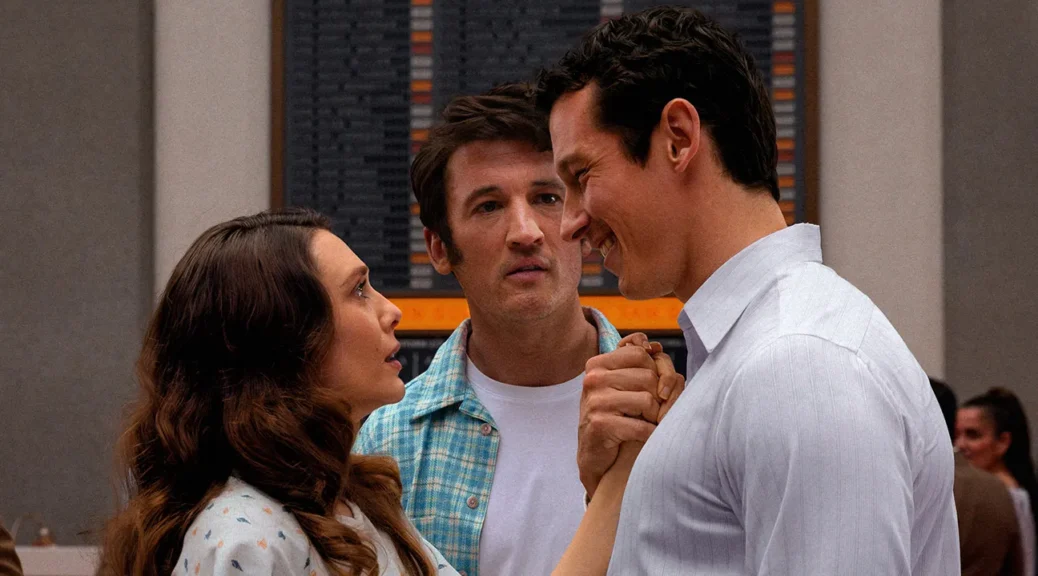
Elizabeth Olsen and Miles Teller play Joan and Larry. Married for 65 years, they drag their bickering selves to a family gender reveal party where Larry promptly chokes to death.

Once Larry accepts his fate, his helpful Afterlife Coordinator, Anna (Da’Vine Joy Randolph) gives him the scoop. Larry has one week to browse a very theme park-like showroom for all the eternity options available, and then make his choice.

But while he’s mulling, Larry meets Luke (Callum Tuner), who took a job as the showroom bartender rather than make an eternity choice at all.

Why would he do that? Because Luke is Joan’s first husband, who died in the Korean War and has been waiting 67 years for Joan to arrive.

And right on cue, the cancer that Joan and Larry had been hiding from their family sends Joan to her own Afterlife Coordinator, Ryan (John Early), who explains the obvious.

Joan’s Heavenly table only seats two, and she has one week to decide.

Director/co-writer David Freyne starts winning us over early with the Disneyfied weigh station. Various booths offer some well-played sight gags (“Choose Wine World!” “Man Free World Sold Out!”) while Anna and Ryan begin increasingly competitive campaigns for their clients’ futures.

It’s all good, high concept fun, but the three leads make the film a charmer that’s pretty hard to resist. Turner leans into Luke’s reputation as a perfect war hero too handsome even for Joan (I’m sorry, what? That’s Elizabeth Olsen!), while Teller is a perfect goofball trying to compete with Luke’s pristine memory.

And Olsen is the sweet, harried soul at the center, flush with the return of the young love fighting to drown out decades of memories.

In lesser hands, all three of these characters would become ridiculous posers, but the terrific ensemble and a deceptively smart script end up working wonders. Yes, you can probably guess how some of this plays out, but even that can’t spoil the film’s winning flight of fantasy.

Character-based with bits of nifty visual flair, Eternity delivers some warm fuzzies perfect for the season, even without any time spent in an afterlife Holiday World.

Maybe they don’t want to give Hallmark any ideas.

Smells Like Teen Spirit

Dating Amber

by Hope Madden

Awkward teens pretend to date each other to sidestep the school bullies, only to find a deep and genuine bond. That sounds pat enough, but writer/director David Freyne (The Cured) and a stunning cast have something far messier and human in mind.

Welcome to County Kildare in the mid Nineties. Divorce is still illegal, homosexuality a curse, the Irish army or the hair salon are the likeliest post-graduation vocations. As Amber (Lola Petticrew) says frequently, “This place will kill you.”

Amber should know. She found her father hanging in the forest near the trailer court where she rents out spots to horny teens, which she does to accrue enough dough to head to London the minute she graduates.

But to survive between now and then, she proposes the “let’s pretend we’re dating” con to Eddie (a remarkable Fionn O’Shea). Because Amber is gay. Gay gay gay. And so is Eddie.

No. No, he definitely is not gay. Not at all. But still…it isn’t a terrible idea.

So begins Freyne’s semi-satirical look at the perils of high school generally and sexual conformity specifically. There are delightful, early, broad-stroke comic moments that simply feel like a cheeky Irish upending of John Hughes tropes.

But that’s not Dating Amber. Not at all. The brightly familiar comedy trappings serve to lull you into a comfortable space so the film can unveil something beautifully untidy and really heartbreaking, something simultaneously devastating and resilient.

Freyne mixes darkness and forgiveness in equal measure. Everyone has their own shit to deal with, and an depressed small town full of frightened people lacking in any real opportunity or choice is bound to take its toll—on the gay kids, on the parents who probably don’t want to be married anymore, on the younger brother who just wants to feel like his family is normal, and on everyone facing graduation and whatever likely dismal future lies ahead.

But mainly, Freyne is interested in how Amber and Eddie contend with things. Luckily, Petticrew and O’Shea share a truly lovely chemistry, creating the kind of bond you long to see for every desperate and lonely teenager.

Their honesty gives every scene an extra punch—of laughter or heartbreak. Coming of age still looks like it seriously sucks, but Dating Amber is a keeper.

Metaphorically Yours

The Cured

by Hope Madden

Zombies have proven to be metaphorically versatile over the decades. For Romero, they were sometimes the mindless consumer, sometimes the oppressed, sometimes the political outcasts.

David Freyne’s new Irish horror, The Cured, pushes the epidemic/ostracism angle to create xenophobic and racist parallels, as well as flashes of the kind of contagion-phobic hatred the AIDS epidemic met with. And Freyne does so without losing sight of a compelling, sometimes punishing story.

The Dublin of the not-so-distant future is home to the world’s most cataclysmic outbreak of the MAZE virus—a 28 Days Later kind of thing.

Senan (Sam Keeley) is among the stricken. Along with thousands of his countrymen, Senan has spent the last several years a zombie of sorts—a mindless, cannibalistic killing machine.

And though a cure has been found—relieving 75% of the infected—returning to a society proves difficult because the cured can remember their beastly behavior. So can the uninfected.

Plus, there is still that tricky question of what to do with the other 25%, “the incurable.”

Ellen Page (who also executive produces) co-stars as Senan’s widowed sister-in-law, and becomes  our window into what humanity may be left in humanity.

For a world in chaos (ours, not that of the movie), zombies offer a simple way to contend with the unimaginable: racism being celebrated at the highest offices, child molestation being excused when it’s politically convenient, Nazis being labeled good guys. For Freyne, publicly sanctioned fear and hatred leads first to oppression and then to uprising.

His set decoration echoes WWII-era propaganda as his characters struggle with shame, disenfranchisement, and righteous indignation. Keely’s deeply human performance remains focused on overcoming, but it’s the unnerving turn by Tom Vaughan-Lawlor that makes this film a keeper.

A barrister with political aspirations before the outbreak, Vaughan-Lawlor’s Conor proves a natural to lead a revolution. But what feels at first like an imbalance between entitlement and outrage slowly blossoms into something impressively fiendish.

There are two concerns with The Cured. 1) By horror standards, it’s a sociopolitical drama. 2) By the time it decides to become a horror movie, any hint of novelty or originality vanishes.

But don’t discount it. The Cured is smart and relevant. It doesn’t leave you guessing and won’t satisfy your bloodlust, but there is something satisfying in knowing that the ugliness and chaos of the day has not gone unnoticed.