Screening Room: Kung Fu Panda 4, Imaginary, Ricky Stanicky, Damsel & More
by Daniel Baldwin
It’s a tale as old as time. Sweethearts get married to fix their very rocky relationship and – surprise, surprise – it makes things worse! Chloe and Jack are longtime lovers turned newlyweds taking a honeymoon trip to Miami, hoping that it might bring them closer together. When a chance encounter with a strange drug mule leaves them with a stash of designer drugs, they hope that tripping together might help them achieve that.
Spoiler alert: Things get even worse!
Sometimes couples want to tear each other apart. And other times, they want to – as the kids today say – “eat each other up, no crumbs left.” But in the case of Chloe and Jack, it’s both! You see, while the cocaine-by-way-of-peyote high that they’re on might initially make them more open to physical and emotional intimacy, their moments of sobriety between trips drive them further apart. The solution? Do more drugs. Problem there is that in addition to a trippy high, the substance has this bad habit of making one crave human flesh.
Cannibalism CAN be an interesting metaphorical delivery system for a romance. After all, when we’re in love, we want to be a part of one another as much as possible. What is more a part of you than what is inside you? Throw in cannibalism as an additional flavoring and you’ve taken the allegory to its most extreme conclusion. This is illustrated nowhere better than in Luca Guadagnino’s masterful road trip cannibal romcom, Bones and All.
While John Ainslie’s Do Not Disturb does not reach those same heights, there’s a lot to like here. Kimberly Laferriere and Rogan Christopher turn in good work as Chloe and Jack, although they’re more at home during the drug trips and horror elements than they are during the grounded dramatic beats. This is largely the fault of the writing not quite being up to snuff in those sequences, but the highs of the more genre-oriented fare go a long way toward balancing that out.
Do Not Disturb is slow to start, but once it gets going, it earns that build up and is at its best when it’s freaking out, man. If you’re a fan of the aforementioned Bones and All or even the psychedelic ferocity of Joe Begos’ Bliss, you’re bound to find something to like here. Just be sure not to snack on your loved ones while you watch it!

by Daniel Baldwin
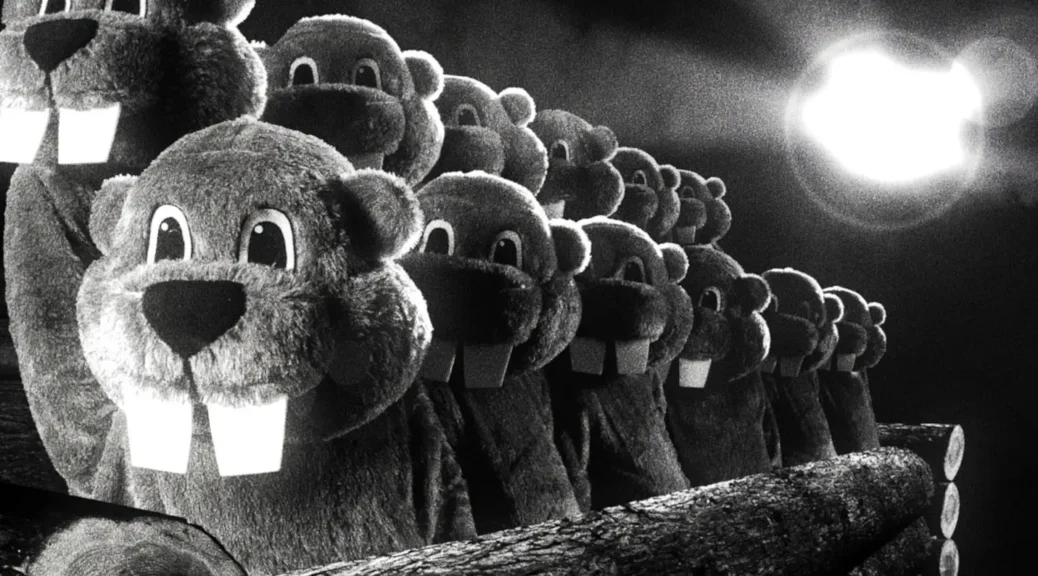
Earlier this year, quirky auteur Wes Anderson gifted us Asteroid City, which is probably best described as “What if Looney Tunes did its own take on Close Encounters of the Third Kind and then poured it through a theatre kid filter?” Some folks found that off-putting, as though Wes Anderson had gone a bit too Wes Anderson for them. Others, like me, found it to be an utter delight. Such a movie was one I never pictured myself needing, yet when it was finally presented to me, I could no longer picture myself living without it.
What does this have to do with Mike Cheslik’s Hundreds of Beavers? Nothing, and yet also everything. This is not Asteroid City, nor should it be. What it is, however, is the answer to the question “What if Looney Tunes did its own take on Jeremiah Johnson and then poured it through a silent movie filter?” I’m not sure who – outside of those who made it – asked for this movie. But I’m glad they did, because for the second time this year, I have been gifted an absolutely lunatic slice of cinema that I never knew I desperately needed.
Not everyone is built to appreciate a movie where a buffoon wanders around a cartoonish wilderness landscape full of animals that are portrayed either by people in mascot suits or puppets. Similarly, not everyone is built to appreciate such lunacy when it feels like it was made by mad scientists who Frankenstein’d together a plushy beast composed of parts from Chuck Jones, Tex Avery, Buster Keaton, Terry Gilliam, and the Keystone Cops. This is darkly violent, yet deeply comedic work that blends a love for classic cartoons and early cinema history together into an inspired near-masterpiece of a film. I say near only because it becomes a bit too indulgent during some of its lengthier set pieces, causing the pace to sag a bit at times. Well, that and maybe utilizing an anvil at some point would have also been nice!
Hundreds of Beavers is a gift. It’s one that some might want to return, but by God Bugs Bunny, it’s one that just as many are bound to cherish for the rest of their lives. This lunatic included.

by Daniel Baldwin
Rock music and horror have always gone together like peanut butter and jelly. Given that both are considered outsider artforms, it’s just a natural pairing. After all, rock (and metal or punk) music tends to be aggressive and there is no genre of film more aggressive than horror. Even action cinema tends to be less brutal.
Comedy is another genre that fits well with both horror and rock. Both artforms love to roll about in camp on occasion, cutting loose with over-the-top subject matter and black humor. Murder Ballads knows all of this and revels in it, while also mixing doses of British crime into the mix as well. What results is an offbeat concoction that feels like someone dumped elements of ‘90s slacker comedies, music biopics, and ‘90s crime comedies into a blender. The trappings are lo-fi due to its indie budget, but the throwback sentiments remain intact.
The story follows a struggling British rock band in desperate need of a new image – including a new member – and a new hit song. If they cannot swing either one, their label is going to give them the boot. Desperate times call for desperate measures and those desperate measures end up involving theft, deception, and murder, among other things. If that weren’t enough, most of the band members also happen to be morons. Given that morons are prone to making mistakes and mistakes are the last thing one should be making when committing crimes, well, you can see why things inevitably get out of control.
Writer/director Mitchell Tolliday has crafted a fun little film here about the darkly comedic and supremely chaotic rise and fall of a British rock ‘n’ roll band. The performances are pitched properly to the film’s playful tone, the faux documentary cutaways to actor Simon Callow are amusing, and the segues between sections are cute and inventive. Aside from some occasional pacing issues, this is a fun time.
by Daniel Baldwin
Genre-bending mysteries were big in the ‘80s and high concept thrillers were all the rage in the ‘90s. Attempting to combine both is a bit of a tall order, but it’s one that writer/director Evan Marlowe aims for with Abruptio. What we have here is an increasingly tense and weird tale of a mild-mannered sad sack named Les (James Marsters – more on that in a moment) who finds himself at the center of an increasingly weird and violent conspiracy. Forces beyond his comprehension are compelling him to commit heinous acts at the drop of a hat. If he refuses, he dies. But will he be able to live with himself if he continues to accept these diabolical missions?
You’d think that would be enough of a tightrope act for Marlowe to walk, but you’d be wrong. Not satisfied with crafting just any mere genre-melting pot thriller, Evan decided he should also do the entire thing with puppets and other handcrafted effects. The potential failure rate for such an additional complication is high, but Abruptio nonetheless manages to pull it off. Because of this, every last bit of tension, violence, and weirdness gains an extra layer of uncanniness, absurdity, and existential dread.
Quite a few of our puppet leads are voiced by familiar genre performers. There’s the aforementioned James Marsters, who voices a troubled middle aged lead who 30 years ago could have easily been played in the flesh by J.T. Walsh. We also get the late Sid Haig as a sketchy stand-up comedian, the great Robert Englund as a haunted neat freak, and Christopher McDonald as a gruff intimidating police chief. All of this is an added bonus atop a film that bears multiple influences from genre filmmaking luminaries like David Cronenberg, John Carpenter, Don Coscarelli, David Lynch, and Joel Schumacher.
An experimental, genre-bending, high concept thriller performed entirely with advanced puppetry should be a recipe for disaster. In the hands of Evan Marlowe, his crew, and his voicecast, it sings. Abruptio should not work, but it very much does. The world has been gifted a wild little midnight movie here that isn’t for everyone, but the people who it is for are going to love every last bit of it.