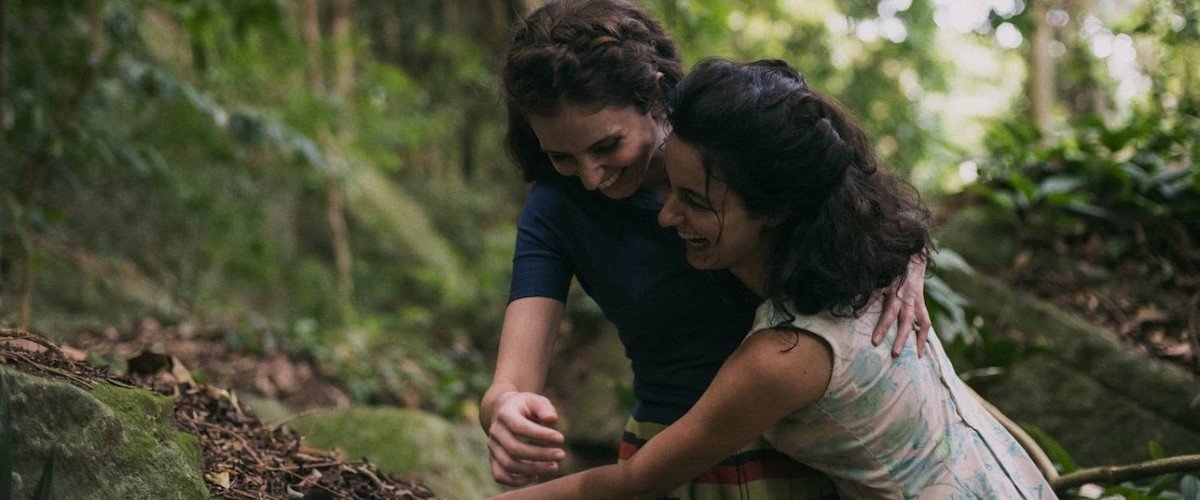
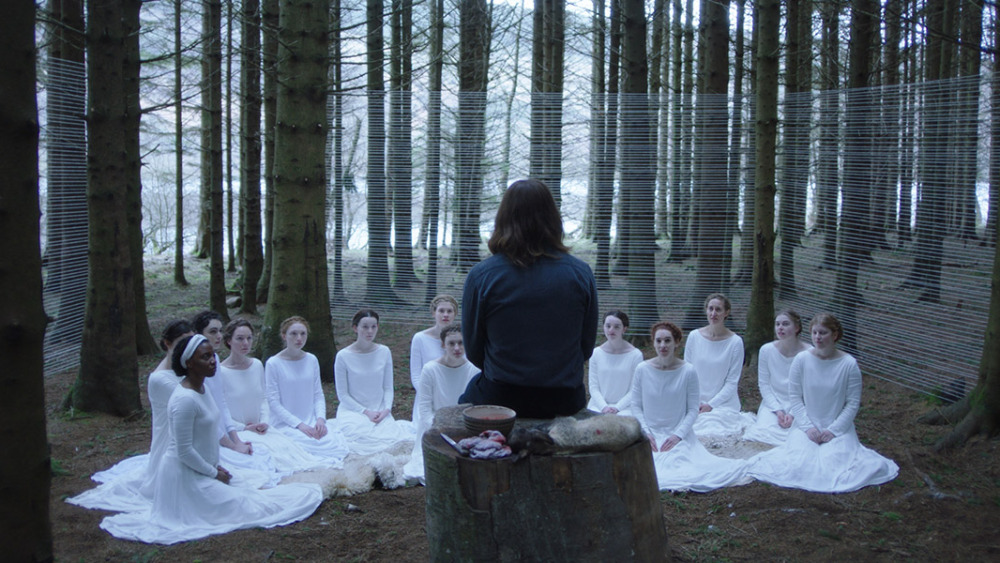
Invisible Life(A Vida Invisvel) is one of the few films that earns its melodrama status in only positive ways. Director/co-writer Karim Ainouz attacks our sentimentality in such a loving, dreamlike manner you easily fall under his spell of family strife in 1950s Brazil.
Sisters Euridice and Guida (Carol Duarte and Julia Stockler, both exceptional) grew up inseparable but have begun to follow different paths. While Guida dreams of finding love, Euridice has aspirations as a classical pianist.
A dramatic turn leads to one of the women being disowned by their father, and the two sisters begin living disconnected lives, each believing the other’s circumstances are very different than reality.
The “invisibility” of the sisters to each other, and of the lives of all women in a patriarchal society, is a thread Ainouz weaves skillfully and repeatedly throughout. The result is a lush and emotional period piece that dives into its genre with no apologies, tugging at your heart with broken dreams and familial bonds until you’re nothing but thankful for it.
The year was 1988, and as far as you know, metal bands shouted
“hail Satan” and evangelicals took to the airwaves warning their flocks about cults
driven to spill virtuous blood.
Marc Meyers (My Friend Dahmer) jumps in the way back
machine to road trip with three besties headed to a rock show. Alexis
(Alexandra Daddario), Val (Maddie Hasson) and Bev (Amy Forsyth) are rockin’
like Dokken with those bare midriff black tees and upside down cross dangles,
but something’s amiss.
For one thing, their hair is not nearly obnoxious enough. No
way they’re en route to a rock concert in ’88. No one’s hair even grazes the
car ceiling.
Also, that trio of dudes they’re flirting with (at least one of them is mulleted, so there is a whiff of authenticity) is clearly beneath them. Plus, with this nationwide ritualistic Satanic killing spree going on…
Here’s the thing, though. I was actually alive in rural Ohio
in the late Eighties, and there honestly were people—like, people in
authority—who believed our corn fields were lousy with covens. They believed metal
music transmitted the words of the dark lord to the eager ears of teens.
It wasn’t true. It’s just that all rock bands in 1988 sucked.
Nonetheless, Meyers creates a nearly believable atmosphere
for his spare, occasionally comical dive into Ozzy-inspires Satanism.
Hasson charms as the hot friend with a weak bladder. While
the banter never feels quite fresh enough to be improvisational, the dialog
among the three girls is random, comfortable fun.
Daddario and Hasson share a silly chemistry that keeps scenes bright and engaging, even when the slight plot begins to wear through.
In its best moments, We Summon the Darkness conjures Kevin Smith’s Red State (an underseen and under-appreciated horror gem). Johnny Knoxville plays intriguingly against type as the Midwestern pastor warning youngsters about the lures of the devil, and Daddario has enough screen presence to anchor the movie.
There’s just not a lot to see here. Pretty girls. Terrible music. Worse clothes. Religious zealots. Backwards thinking. Friends who drive you crazy on a road trip because they have to stop every ten minutes to pee.
Yes, that does sound like 1988 to me, actually. It’s just too bad Meyers couldn’t deliver the kind of inspired, memorable scares born of high school relationships, weirdos and misfits he shared in My Friend Dahmer. Instead the camaraderie and atmosphere become entertaining distractions from a forgettable story.
Another day, another desperate attempt to find entertainment. Well, unless you’re willing to brave Target in search of a DVD, the new studio releases for streaming won’t help, except ironically.
It’s time to get real. And by that, we mean real nasty.
There’s something not quite right about Chris Cleese (an unsettlingly cherubic Sean Bridgers), and his family’s uber-wholesomeness is clearly suspect. This becomes evident once Chris hunts down a feral woman (an awesome Pollyanna McIntosh), chains her, and invites the family to help him “civilize” her.
The film rethinks family – well, patriarchy, anyway. Notorious horror novelist and co-scripter Jack Ketchum may say things you don’t want to hear, but he says them well. And director Lucky McKee – in his most surefooted film to date – has no qualms about showing you things you don’t want to see. Like most of Ketchum’s work, The Woman is lurid and more than a bit disturbing. (Indeed, the advanced screener I watched back when the film was first released came in a vomit bag.)
Aside from an epically awful performance by Carlee Baker as the nosey teacher, the performances are not just good for the genre, but disturbingly solid. McIntosh never veers from being intimidating, terrifying even when she’s chained. Bridgers has a weird way of taking a Will Ferrell character and imbibing him with the darkest hidden nature. Even young Zach Rand, as the sadist-in-training teen Brian, nails the role perfectly.
Nothing happens in this film by accident – not even the innocent-seeming baking of cookies – nor does it ever happen solely to titillate. The Woman offers a dark and disturbing adventure that finds something unsavory in our primal nature and even worse in our quest to civilize.
Don’t even ask about what it finds in the dog pen.
You know the drill: 5 college kids head into the woods for a wild weekend of doobage, cocktails and hookups but find, instead, dismemberment, terror and pain. You can probably already picture the kids, too: a couple of hottie Alphas, the nice girl, the guy she may or may not be into, and the comic relief tag along. In fact, if you tried, you could almost predict who gets picked off when.
But that’s just the point, of course. Making his directorial debut, Drew Goddard, along with his co-scribe Joss Whedon, is going to use that preexisting knowledge to entertain holy hell out of you.
Though Goddard was an unproven entity behind the camera, the duo have written and produced some of the most intriguing projects in film and on TV in recent memory, including Cloverfield, Lost, and Buffy the Vampire Slayer. Whedon wrote Toy Story. There is nothing that garners higher praise from me than that particular credit.
Their quirky, dark humor is on full display in this effort.
Aside from the setup, the best thing to know about this film is nothing at all. The less you know, the more you’ll enjoy the savage, wickedly funny lunacy.
I will tell you this, though: Best onscreen elevator ride ever!
Goddard and Whedon’s nimble screenplay offers a spot-on deconstruction of horror tropes as well as a joyous celebration of the genre. Aided by exquisite casting – particularly the gloriously deadpan Richard Jenkins and Bradley Whitford – the filmmakers create something truly special.
Cabin is not a spoof. It’s not a satire. It’s sort of a celebratory homage, but not entirely. What you get with this film is a very different kind of horror comedy.
Fans of the genre will be elated. Those who generally avoid horror cannot help but be entertained. I left the theater absolutely giddy. As smart as Scream, as much fun as Evil Dead, this film is as thoroughly enjoyable a horror flick as anything you’ll find.
Vitalina
Varela travels to Portugal to sift through the ashes of the life her husband
led there.
“There
is nothing for you here.” Someone on the tarmac whispers upon her arrival, gripping
her by the shoulders with a robotic intensity.
But
Vitalina marches forward.
Varela plays herself, in a re-enactment of her journey to Libson in the days following her husband’s death. After more than two decades apart, Vitalina no longer recognizes the man she once knew. She navigates an impoverished neighborhood shrouded in darkness, searching for clues as to the man Joaquim had become.
Director
Pedro Costa (Horse Money) co-wrote the script with Varela. Together they
weave a tale that asks both “How do we forgive others?” and “How do we forgive
ourselves?”
Varela delivers a stoic but moving performance as she seeks a kind of redemption for the years spent waiting for her husband. Costa knows where to place Varela, leaving her constantly teetering on the edge of something, in perfectly lit doorways and windows.
This
film is largely about the emotion of light and shadow, both on screen and in
our own lives. With minimal dialogue and a cast of non-professional actors,
Costa must work harder to visually manipulate his tale. To his aid comes a
realistic and heavily layered sound design that pairs the low rumble of a
crowded neighborhood with the high-pitched notes of spoons in bowls and the
yips of dogs.
Almost
every scene seems to be lit with a single spotlight, which brings to your
attention how dark the spaces really are.
While this technique illuminates every frame like a luxurious renaissance painting, highlighting the sharp turns of hollowed cheeks and shrouding the crumbling backdrop, after two hours your eyes tire from the strain. Vitalina Varela’s strength is also its weakness.
The film is so slow and so hyper-focused on the silence between emotional revelations, it seems largely detached from anything other than its own dark places.
There is a triumphant return to the daylight, beautifully shot like the rest, but it comes long after the movie should have ended. 120 minutes is simply too indulgent for the pacing and sparse narrative offered.
Before hitting play on Slay the Dragon, make sure you’re a good social distance away from Grandma’s fine china.
Because you’re going to want to break something.
Directors Chris Durrance and Barak Goodman open their deep dive into political gerrymandering with a quote from Founding Father John Adams about democracies and suicide. They then spend almost two hours making the case that time is running short for America to prove Adams wrong.
The film’s historical context of gerrymandering – or drawing Congressional districts in a hyper-partisan manner – is informative and even entertaining in spots. Who knew the practice got its name from pairing an old Massachusetts governor with a salamander?
But once it digs into the deep pockets and advanced metrics behind “packing,” “stacking” and “bleaching,” the film’s view that this a fight between voters picking winners and winners picking voters does not seem hyperbolic.
The direct, measured approach pushes hardest when reminding us that new district maps are drawn every ten years, so elections in a year that ends in zero – LIKE THIS YEAR – are especially important.
But to make their film a rallying cry for passionate turnout, Durrance and Goodman know that beneath the dirty tricks, blatant hypocrisy, systemic oppression, corporate greed and Supreme Court setbacks, there has to be hope.
We get it via Katie Fahey and Voters Not Politicians, a grassroots movement fighting gerrymandering in Michigan that began with a Facebook post. Fahey, a total neophyte diving into vicious waters, is instantly relatable and easy to root for, creating a narrative contrast that’s a bit simplistic but naturally effective.
It does get a bit long-winded in spots, but Slay the Dragon makes its case with enough info, passion and persistence to make it necessary, especially in a year that ends in zero.
With her 2013 debut It Felt Like Love, Eliza Hittman brought a refreshing honesty to the teen drama. Zeroing in on the summer days when two girls began their sexual lives, the film was an exciting introduction to a writer/director with a quietly defiant voice.
At its core, Never Rarely Sometimes Always could be seen as Hittman’s kindred sequel to her first feature, as two friends navigate a cold, sometimes cruel world that lies just beyond the hopeful romanticism of first love.
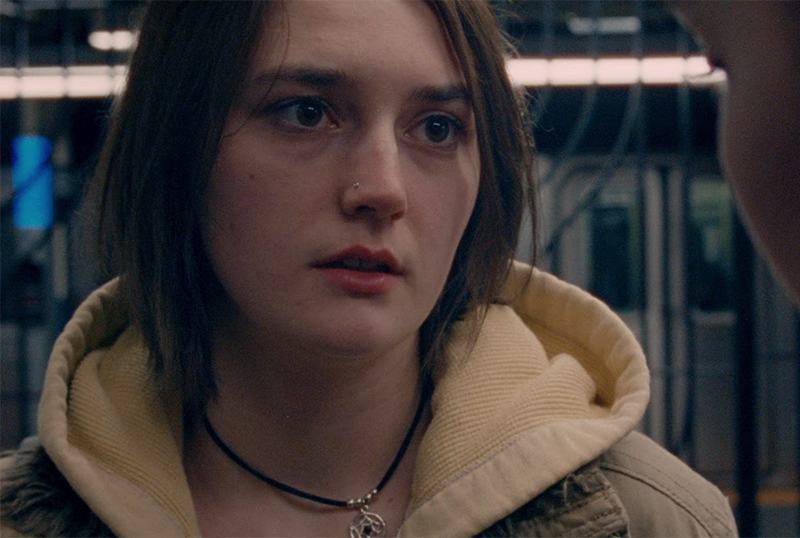
Autumn (Sidney Flanagan) is a talented 17 year-old in Pennsylvania whose crude father berates her for an ever-present foul mood. She’s worried, and when a visit to her local health clinic confirms her fears, Autumn confides only in her cousin Skylar (Talia Ryder) as she weighs her options.
In Autumn’s home state, those options are severely limited, so the girls scrape together as much money as they can and hop a bus to New York, encountering more hard realities along the way.
The over-reliance on metaphor that sometimes hampered It Felt Like Love now feels like that awkward school picture from just a few grades back. NRSA shows Hittman in full command of her blunt truth-telling, demanding we accept this reality of women fighting to control their own bodies amid constant waves of marginalization.
Flanagan, a New York musician making her acting debut, is simply a revelation. There isn’t a hint of angsty teen caricature in Autumn’s dour moodiness, just a beaten down worldview born from all that is revealed in her beautifully brutal interview at the New York clinic.
As an off-camera social worker asks Autumn to give the titular response to a series of questions, Hittman holds tight on Flanagan and she never shrinks from the moment. It’s a devastatingly long take full of hushed experience that may easily shake you.
Just three films in, Hittman has established herself as a filmmaker of few words, intimate details and searing perspective. NRSW is a sensitive portrayal of female friendship and courage, equal parts understated and confrontational as it speaks truths that remain commonly ignored.
Given the subject matter, the film’s PG-13 rating is surprising, but hopeful. This film deserves an audience, much like the conversations it will undoubtedly spark.
Phoenix, Oregon tells the outrageous story of Oregon
hipsters polluting the glorious, white trash game of bowling. $18 pizzas?
Organic pilsners?
What does a sister gotta do to get a large pep and a Bud?
That is, actually, the story it tells, but its focus is more
on the small town coming-of-middle-age saga of the hipsters.
Journeyman James Le Gros is Bobby, a fiftyish bartender at what passes for a fine dining establishment in Phoenix, Oregon. His best friend Carlos (Jesse Borrego) is the chef who can no longer tolerate the cheapskate ways of whining, entitled restauranteur Kyle (Diedrich Bader).
He proposes that Bobby take the fifty grand his mom left him
(along with the Airstream where he’s been living since he downsized after his
divorce) and invest that cash in a dream: said hipster bowling alley/pie shop.
Bobby needs to think—wallow, really—the same way he always
does, by drawing impressive panels in a graphic novel/memoire concerning the
aliens who pre-determine his life.
But really, he mostly draws pictures of his ex-wife.
Gary Lundgren’s direction and production values betray a
minimal budget and comfortably limited imagination. Like Bobby, Phoenix,
Oregon doesn’t set out to impress anybody, so the fully grown slacker kind
of vibe actually suits it.
Le Gros’s slyly low key performance certainly fits. Quiet
and socially uncomfortable, he brings a
realism to the life transition, intentionally but not obnoxiously calling to mind
the same awkwardness of adolescence.
Lisa Edelstein, also bracingly realistic, enlivens all her
scenes with the sexy vitality and charm of world worn freedom.
Characteristically, Kevin Corrigan is a wrong-headed hoot as a repairman with a chip on his shoulder, but even his generally raucous humor feels subdued. Phoenix, Oregon contents itself with a smirk and a shrug. The entire effort’s lack of showiness allows a hometown authenticity to drive the narrative.
Phoenix, Oregon, while pleasant throughout, offers low stakes, low energy, low drama. Rivalries are easily if not tidily overcome and life goes on. It’s sweet and charming in a low key, comfortable way, but it is hardly a thrill ride.