Screening Room: Godzilla Minus One, Dream Scenario, Candy Cane Lane, Silent Night, Where the Devil Roams
by Daniel Baldwin
Earlier this year, quirky auteur Wes Anderson gifted us Asteroid City, which is probably best described as “What if Looney Tunes did its own take on Close Encounters of the Third Kind and then poured it through a theatre kid filter?” Some folks found that off-putting, as though Wes Anderson had gone a bit too Wes Anderson for them. Others, like me, found it to be an utter delight. Such a movie was one I never pictured myself needing, yet when it was finally presented to me, I could no longer picture myself living without it.
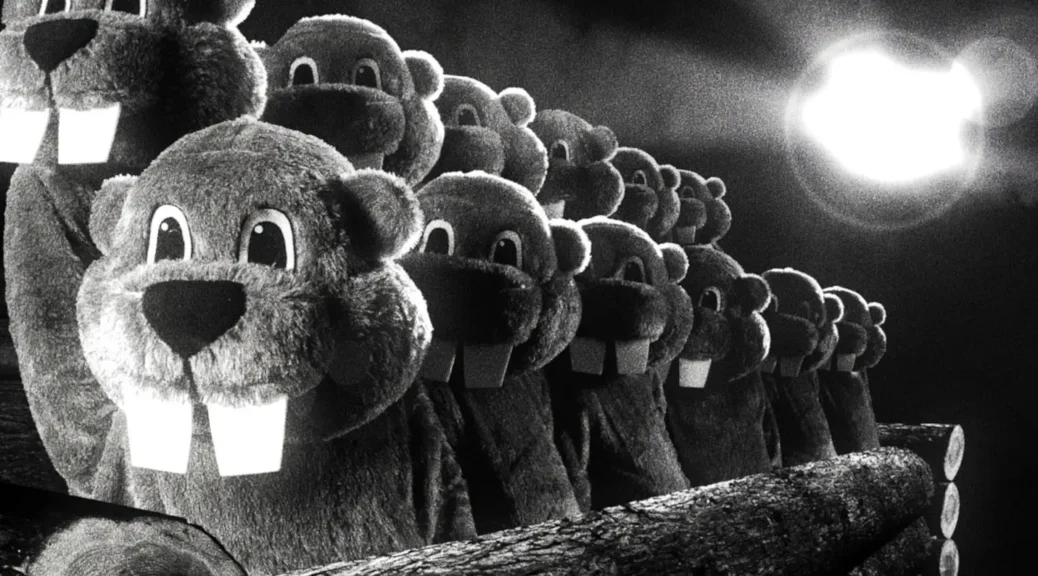
What does this have to do with Mike Cheslik’s Hundreds of Beavers? Nothing, and yet also everything. This is not Asteroid City, nor should it be. What it is, however, is the answer to the question “What if Looney Tunes did its own take on Jeremiah Johnson and then poured it through a silent movie filter?” I’m not sure who – outside of those who made it – asked for this movie. But I’m glad they did, because for the second time this year, I have been gifted an absolutely lunatic slice of cinema that I never knew I desperately needed.
Not everyone is built to appreciate a movie where a buffoon wanders around a cartoonish wilderness landscape full of animals that are portrayed either by people in mascot suits or puppets. Similarly, not everyone is built to appreciate such lunacy when it feels like it was made by mad scientists who Frankenstein’d together a plushy beast composed of parts from Chuck Jones, Tex Avery, Buster Keaton, Terry Gilliam, and the Keystone Cops. This is darkly violent, yet deeply comedic work that blends a love for classic cartoons and early cinema history together into an inspired near-masterpiece of a film. I say near only because it becomes a bit too indulgent during some of its lengthier set pieces, causing the pace to sag a bit at times. Well, that and maybe utilizing an anvil at some point would have also been nice!
Hundreds of Beavers is a gift. It’s one that some might want to return, but by God Bugs Bunny, it’s one that just as many are bound to cherish for the rest of their lives. This lunatic included.

by Daniel Baldwin
Genre-bending mysteries were big in the ‘80s and high concept thrillers were all the rage in the ‘90s. Attempting to combine both is a bit of a tall order, but it’s one that writer/director Evan Marlowe aims for with Abruptio. What we have here is an increasingly tense and weird tale of a mild-mannered sad sack named Les (James Marsters – more on that in a moment) who finds himself at the center of an increasingly weird and violent conspiracy. Forces beyond his comprehension are compelling him to commit heinous acts at the drop of a hat. If he refuses, he dies. But will he be able to live with himself if he continues to accept these diabolical missions?
You’d think that would be enough of a tightrope act for Marlowe to walk, but you’d be wrong. Not satisfied with crafting just any mere genre-melting pot thriller, Evan decided he should also do the entire thing with puppets and other handcrafted effects. The potential failure rate for such an additional complication is high, but Abruptio nonetheless manages to pull it off. Because of this, every last bit of tension, violence, and weirdness gains an extra layer of uncanniness, absurdity, and existential dread.
Quite a few of our puppet leads are voiced by familiar genre performers. There’s the aforementioned James Marsters, who voices a troubled middle aged lead who 30 years ago could have easily been played in the flesh by J.T. Walsh. We also get the late Sid Haig as a sketchy stand-up comedian, the great Robert Englund as a haunted neat freak, and Christopher McDonald as a gruff intimidating police chief. All of this is an added bonus atop a film that bears multiple influences from genre filmmaking luminaries like David Cronenberg, John Carpenter, Don Coscarelli, David Lynch, and Joel Schumacher.
An experimental, genre-bending, high concept thriller performed entirely with advanced puppetry should be a recipe for disaster. In the hands of Evan Marlowe, his crew, and his voicecast, it sings. Abruptio should not work, but it very much does. The world has been gifted a wild little midnight movie here that isn’t for everyone, but the people who it is for are going to love every last bit of it.

by Daniel Baldwin
Hannah Swayze and Daniel Contaldo’s Caverna is a surrealist work about an experimental theater workshop in Florence, Italy. We follow two particular students, Giorgia (Giorgia Tomasi) and Lorenzo (Lorenzo Passaniti), who are pushed by a daring teacher named Alba to unleash their inner thoughts and fears through acting exercises in front of the group. If that sounds like a movie about a bunch of theater kids wandering about a stage as they talk about their feelings, don’t worry. It’s not that kind of movie.
Instead, Caverna hovers between reality and fantasy as dreams, desires, and nightmares are portrayed in a rather trippy fashion as the film flips back and forth between the actors and their “scenes”. What is real and what is acting blurs as both feed into one another. Is there really a rad-looking cyclops stomping about the wooded areas of Florence, chasing a princess? Probably not, but if it looks, sounds, and feels real, who’s to say that it isn’t? The same holds true for the rest of the mythology-infused moments of fantasy that are weaved throughout.
Caverna is about how the deepest parts of one’s psyche often fuel the art that they unleash upon the world. It is not the first film to do this. Nor will it be the last. It then becomes a question of whether or not its somewhat-psychedelic arthouse notions are enticing enough to draw you into its web. This is very much a niche piece of filmmaking, with a heavily disjointed nature that can and will push many a viewer away. If you’re inclined to welcome such filmmaking, however, then there’s a lot to enjoy here.
Complementing its wilder storytelling tactics is a lot of striking imagery. The cinematography – both in the fantasy and “real world” sequences – is sumptuous throughout, often giving the film a lush and vibrant look. In terms of pacing, it never overstays its welcome, which has ultimately resulted in a runtime that barely exceeds an hour. That might be a turn-off to those looking for something grander, but it also means that it avoids the bloat that plagues a lot of modern arthouse fare. Swayze & Contaldo clearly know that not everything needs to be 2 ½ hours long. Caverna might not knock your socks off, but if you’re open to its imagination, you’ll be in for an interesting ride.

by Daniel Baldwin
A modern celebration of classic Japanese V-cinema (their version of DTV genre fare), director Kensuke Sonomura’s Bad City unleashes a furious, fist-flying tale of crime, corruption, and righteous retribution. The story is a tale as old as time: a diabolical businessman (Lily Franky) is in league with the Korean mafia and local politicians. His goal? To bring “prosperity” to Kaiko City by bringing in casinos that no one but the rich wants. His methods? Bribery, blackmail, and murder. All that stand in his way are a handful of good cops and some honorable Yakuza with aligned interests.
At the center of it is 60-year-old genre stalwart Hitoshi Ozawa (Dead or Alive, Gozu), who also wrote the screenplay. His knowledge of and experience in Yakuza cinema comes in mighty handy here, as does his charisma and still-formidable physical prowess. He’s an absolute powerhouse as the unflappable Captain Torada and he’s surrounded by equally great supporting castmates including Tak Sakaguchi, Masanori Mimoto, Katsuya, Mitsu Dan, Akane Sakanoue, Masaya Kato, and the aforementioned Franky.
There’s nothing wholly original on display in terms of narrative, but that matters not, as Sonomura and Ozawa are aiming for grandiosity over complexity, even amidst their low budget. The plot is still filled with twists, turns, and double-crosses, but the pace moves with breakneck speed. It plows through subplots and arcs like it’s tearing through an entire season of television, ultimately offering up a narrative that is as dense as it is straightforward.
Any danger of monotony in terms of pulp crime storytelling and exposition is wiped away by the action itself. While there is the occasional moment of gun violence, the bulk of the fighting is brutal hand-to-hand combat. Fists, knives, baseball bats, pipes, and even a loudspeaker are utilized as criminals and cops wail on each other to the point of exhaustion. The fights constantly swing back and forth between martial arts, vicious groundwork, and barroom-style brawls. Said action is further punctuated by some absolutely stellar foley work, making each punch, kick, and stab sound even more painful than it looks. Throw in the fact that many of the characters are wearing sneakers – one has to be comfortable on the brawling move after all – and the bouts often sound like a massacre playing out on a basketball court.
Simply put, this is a killer slice of low budget action cinema.