Tag Archives: Netflix

Save a Prayer

The Devil All the Time

by Hope Madden and George Wolf

“Lord knows where a person who ain’t saved might end up.”

Indeed. The constant fight to overcome the worst in ourselves lies at the heart of The Devil All the Time, director Antonio Campos’s darkly riveting realization of Donald Ray Pollock’s best-selling novel.

Bookended by the close of World War II and the escalation in Vietnam, the film connects the fates of various characters living in the small rural towns of Southern Ohio and West Virginia.

Arvin (Tom Holland), the son of a disturbed WWII vet (Bill Skarsgård), fights to protect his sister (Eliza Scanlen) while he ponders his future. Husband and wife serial killers (Jason Clarke and Riley Keough) look for hitchhikers to degrade, photograph and murder. A new small town preacher (Robert Pattinson) displays a special interest in the young girls of his congregation.

It’s a star studded affair—Mia Wasikowska, Haley Bennett and Sebastian Stan joining as well—but every actor blends into the woodsy atmosphere with a sense of unease that permeates the air. No stars here, all character actors in service of the film’s unsettling calling.

Pollock’s prose created a dizzyingly bleak landscape where Flannery O’Connor and Cormac McCarthy might meet to quietly ponder man’s inhumanity to man. Campos unlocks that world courtesy of Pollock himself, who narrates the film’s depravity with a backwoods folksiness that makes it all the more chilling.

As rays of light are constantly snuffed out by darkness, Campos (who also co-wrote the screenplay) uses Pollock’s voice and contrasting soundtrack song choices to create a perverse air of comfort.

Redemption is a slippery aim in and around Knockemstiff, Ohio, and grace is even harder to come by. With a heavier hand, this film would have been a savage beating or a backwoods horror of the most grotesque kind. Campos and his formidable ensemble deliver Pollock’s tale with enough understatement and integrity to cut deeply, unnerving your soul and leaving a well-earned scar.

The Snack that Smiles Back

Okja

by Hope Madden

That lovely period of youth, close enough to childhood to be magical, near enough to adulthood to be tinged with longing – it’s that moment where people like Spielberg made their greatest mark.

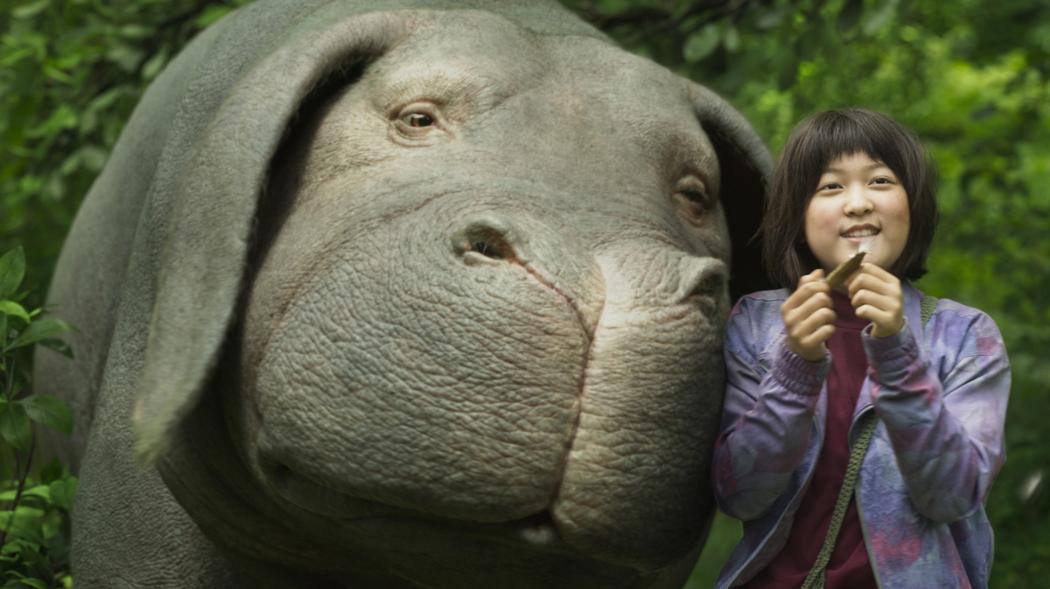
Filmmaker Joon-ho Bong takes us there with the story of a super pig – a genetically engineered and yet utterly adorable hippo-like beastie bred to feed a lot of people cheaply – and her best friend.

If you haven’t seen the films of Joon-ho Bong, you should. All of them. Repeatedly.

This versatile Korean filmmaker is as comfortable with dystopian fantasy as he is creature features, with dark family dramas as police procedurals. Whatever he makes, he edges it curiously with humor and shadows with a bit of horror. It’s a heady mix, but in Bong’s hands, it never ceases to satisfy.

In this case, we tag along as Korean farm girl Mija (Seo-hyun Ahn) wiles away days in the rural mountains with Okja. Ten years earlier, the Mirando corporation left the tiny piglet with Mija’s farmer grandfather. It’s now time for the company to take her back.

What opens as a beautiful story of magical childhood friendship a la E.T. or some kind of live-action Miyazaki film turns, in Act 2, into something far darker. Once Tilda Swinton (glorious – and playing twins!) and Mirando Corp come calling, Okja becomes satire of the most broad and brutal sort.

Though Bong peppers the prolog with a couple F-bombs, there’s still no way to be ready for the pivot his film makes. Not every actor is prepared for the shift, either.

Swinton – so breathtakingly brilliant in Bong’s 2013 flick Snowpiercer (Be a shoe!) – is characteristically fascinating as Mirando’s mogul, and Paul Dano offers a startlingly unpredictable eco-terrorist.

The generally reliable Jake Gyllenhaal can’t seem to nail his part, kind of a Jack Hannah patterned after a crackhead version of Richard Simmons. It’s less interesting than it sounds.

Otherwise, though, the collision of styles and gut punch of a third act guarantee that the film will stick with you.

Okja is the first film in which Bong clearly states a prescribed purpose, rather than simply writing and directing a fine, if politically astute, film. That doesn’t take away from his movie’s power, and only cements his position as a filmmaker at the top of his game.

Verdict-3-5-Stars
