Tag Archives: movies

The Cost of Doing Business

The Man in My Basement

by George Wolf

You see Willem Dafoe is starring in a film called The Man in My Basement, and you suspect things could get freaky – in ways both hilarious and perverse. But if you’re at all familiar with Walter Mosley’s source novel, you know this basement business will deal in the bonds of history, the questions of philosophy and the responsibility of heritage.

The basement belongs to Charles Blakey (Corey Hawkins), an African American man in Sag Harbor whose life is slowly unraveling. With his parents deceased, Charles lives alone in his ancestral home, surrounded by artifacts he only values for possible sale.

Unemployed, Charles spends his days drinking, gambling and aimlessly drifting through life. With no motivation or prospects, Charles has little hope of saving the house from foreclosure, until Anniston Bennet (Dafoe) shows up on his door with an unusual offer.

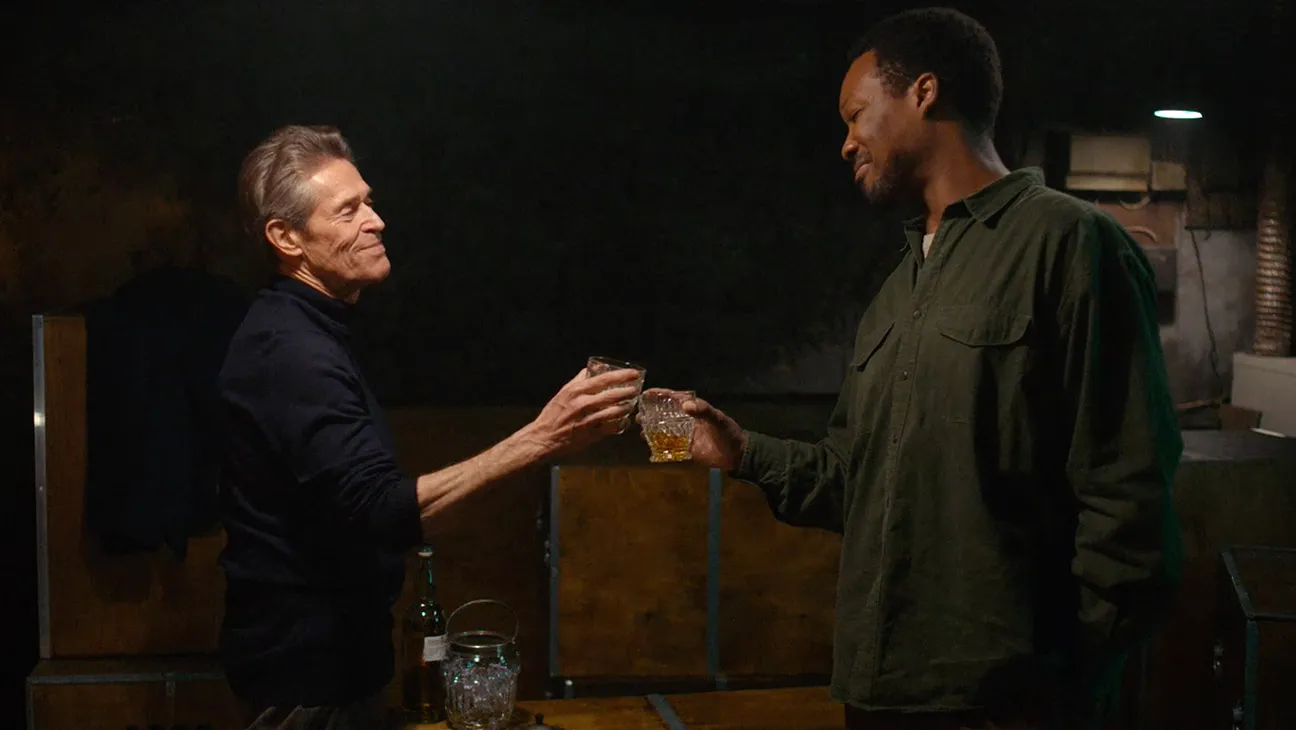
If Bennet can rent the basement of the house, he’ll pay Charles one thousand dollars a day for 65 days. And he’ll pay in cash. What luck.

But of course, once Bennet moves in, Charles begins to discover the strings attached to the offer, and director Nadia Latif – adapting the screenplay with Mosley – zeroes in on the psychological battle downstairs.

Hawkins is impressive, with an understated approach that lends valuable authenticity to Charles’s gradual awakening. Through conversations with Bennet, and his growing friendship with a local curator (Anna Diop), Charles begins to the see the world – and his place in it – in an important new light.

Bennet’s unusual charm seems effortless for Dafoe. Is he angel or devil? Teacher or student? Prisoner or warden? From the minute Bennet’s offer is accepted, you know there will be consequences, and Dafoe has little problem upping the ante with a persuasive intensity.

Latif’s defiant final shot lands more securely than the attempts to paint the film as more of a danger-filled thriller than it really is. Charles’s nightmares seem more tailored to beefing up the trailer than the narrative, ultimately adding to a frustrating superficiality that dulls the edges of otherwise compelling themes.

The meaningful weight is found in the back and forth between Charles and Bennet. Hawkins and Dafoe flesh out both similarities and differences, and how each man is changed from the encounter. It is in these moments that the film finds its voice, and you end up wanting to push aside the overt symbolism, hoping to find a little more boundary pushing.

Say Yes to This

Hamilton

by George Wolf

Five years after Hamilton hit streaming, who ever could have predicted its lesson of resisting a dictator would feel even more urgent?

I know, plenty of people. Still, after all the sold out performances, the Tony awards, the historical debates and a Pulitzer, the worldwide phenomenon that is Lin-Manuel Miranda’s Hamilton finally comes to theaters.

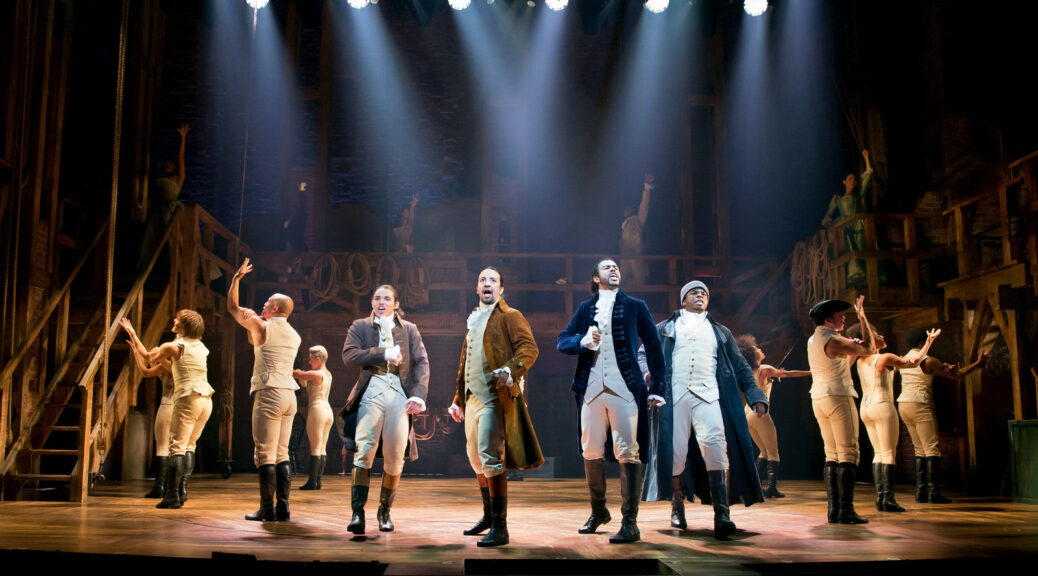
Number one, if you’re somehow new to Hamilton, you’re going to discover what a fantastic show it is. But then the exhilarating nature of this movie is how well it translates the live theater experience to the big screen. And they are two totally different entertainment experiences, so what director Thomas Kail pulls off here is not easy.

The difference between seeing something live and feeling the energy exchange between cast and audience, as opposed to watching it on a screen where you’re removed from the human element of it, is often hard to overcome. (Remember Cats?) But Kail – who also directed the 2016 Broadway shows that were recorded for this film – has crafted a near perfect mix of spatial movement and character intimacy.

This original Broadway cast, including Miranda, Leslie Odom Jr., Phillipa Soo, Renée Elise Goldsberry, Anthony Ramos, Daveed Diggs, Jonathan Groff, Chris Jackson and even a pre-Oscar Ariana DuBose in the ensemble, is spectacular. Miranda’s sing-through soundtrack is littered with highlights from “My Shot”, “The Schuyler Sisters”, “Say No to This”, and “Helpless”, to “Satisfied”, “The Room Where It Happens”, “Burn” and King George’s delightfully mad trilogy.

The technical craftsmanship here never suffers a misstep. Kail makes sure we get close enough to see the sweat (and sometimes the spittle) on the actors’ faces, before pulling back to showcase choreography, set construction and the artful, hypnotic movement of the entire production. Jonah Moran’s editing is downright masterful, displaying a wonderful instinct for layering intimate moments and energetic flow.

And even more so today than when it first hit Disney+, the film reminds us how hard it was to birth this country. Of course Miranda took creative liberties, but time has only increased the weight of this lesson in the price of democracy, and the importance of fighting for it.

Half a decade later, Hamilton still stands as a high water mark for bringing a stage musical to the screen. It’s hard to imagine it being done any better.

War Rooms

The Roses

by George Wolf

If you’re anything like me, you’d pay to see Olivia Colman and Benedict Cumberbatch do anything from cranking up polka music to telling a story about a rucksack full of coke and a sword. Well, good news for both of us. They do all that and plenty more in The Roses, a fun and funny update of The War of the Roses from 36 years ago.

Director Jay Roach starts with a flashback (and some nifty de-aging) to give us the impulsive and passionate start to Theo (Cumberbatch) and Ivy’s (Colman) relationship. Ten years later and the married Brits have moved to California where he’s an architect, she’s a part-time culinary artist and they have two pre-teens.

Life is good, until the worst night of Theo’s professional life also gives Ivy a springboard to becoming a celebrity chef. Three more years go by, and she’s the jet-setting breadwinner while he’s staying home and raising the kids via a regimented, competitive style that Ivy always resented.

Colman and Cumberbatch are perfection, with an instant chemistry that lets the cracks in the marriage seem organic and relatable. Trouble is brewing, and it’s sensed by their group of friends Including Zoe Chao, Andy Samberg and a priceless Kate McKinnon as a woman not shy about awkwardly exploring social boundaries.

It’s all very clever and witty in an acerbic and oh-so-British sort of way, until screenwriter Tony McNamara adds some good ol’ American meanness to the mix. From then on, The Roses gets laugh-out-loud funny. McNamara (The Favourite, Poor Things) serves up a riotous contrast between the American and British ways of arguing, and this cast brilliantly turns his phrases into moments of joyful vitriol.

Then, for the push over the cliff, Alison Janney strolls in with a fire-breathing cameo as a brutal divorce lawyer, and the down-and-dirty battle we’ve been waiting for finally begins.

Anyone who remembers the original will appreciate the subtle twist of this war’s end. But The Roses has no trouble standing on its own. Sharply written, nicely paced and impeccably performed, it’s a winning adult comedy that finds big laughs inside some all too familiar modern foibles.

Suspicious Minds

Eden

by George Wolf

Eden tells a fascinating story. And it tells that story in a star-studded, well-crafted way that’s rarely dull, even when the weight of its melodrama gets heavy enough to be nearly undone by the film’s parting shot.

Director Ron Howard joins co-writer Noah Pink to recount a historical tale “inspired by the accounts of those who survived” as a parable of greed, power, suspicion and annoying neighbors.

“Democracy, Fascism, war. Repeat.” So yeah, still plenty timely.

In the years just after WW1, Dr. Friedrich Ritter (Jude Law) and his partner, Dore Strauch (Vanessa Kirby), left civilization for a hardscrabble existence on the Galapagos Island of Floreana. Convinced that mankind was finished, Ritter became determined to write a new philosophy that would save humanity from itself, and in pain…find salvation.

His writings were picked up by the occasional passing ship, eventually attracting quite a following among others looking for a new life. And that, of course, led to the very thing Ritter didn’t want on his island: more people.

Heinz Wittmer (Daniel Brühl), and his wife Margaret (Sydney Sweeney) arrive first, inspired by Ritter’s vision and hoping for a better climate for their son Harry’s (Jonathan Wittel) tuberculosis.

The Wittmers – especially Margaret – prove tougher than Ritter imagines, but the Baroness Eloise Bosquet de Wagner Wehrhorn (Ana de Armas, scene-stealing and never better) is a larger-than-life problem no one expected.

The Baroness arrives on Floreana with servants/lovers and a grand plan to build an ulta-exclusive hotel for the wealthiest of tourists. De Armas digs in, crafting her as a shameless narcissist, so ruthless and sociopathic that she’d be cartoonishly absurd if not for the gaslighting cult of personality we wake up to every day.

The entire cast shines. And like her or don’t, Sweeney continues to impress with another film that challenges her range and physicality (Margaret must fight off wild dogs and give birth alone…damn!) while eschewing any shades of empty pinup girl glamour.

The running time pushes well past 90 minutes, but Howard keeps things humming right along. The dangerous motives, shifting alliances and double crosses create an over the top, sometimes darkly funny concoction that pulls us in, fascinated by who will emerge the victor in this battle for the unhappy high ground.

And when the inevitable historical update arrives with the credits, we see footage of the actual people who fought this fight…and they’re laughing, smiling, waving! Like the surprising Maria Callas footage in last year’s Maria, you wonder where these happy people have been hiding the last two hours.

Bet they could have shed more light on what life was really like on the island of lost smiles.

But would they have been as much primal, pulpy fun?

Feels Like Injustice

The Knife

by George Wolf

Suspicion, fear, perception and manipulation all converge in The Knife, a briskly-paced thriller that examines action and consequence as it picks at the scabs of modern anxieties.

This is the feature debut as a director and co-writer (with Mark Duplass) for Nnamdi Asomugha, a former NFL star who began a second career in film shortly before his playing career ended in 2013. Asomugha also stars as Chris, a construction worker whose night – and maybe life – is quickly unraveling.

After some very late night flirting that gives us a warm and effective introduction to the characters, Chris and his wife Alex (Aja Naomi King) decide they’re just too damn tired for any sexy time. They’ve got three young kids in the house, and that morning alarm is coming way too soon.

But sleep has to wait thanks to some bumps in the night. Chris gets up to investigate, and finds a strange, haggard woman in his kitchen. By the time Alex arrives for backup, the old woman is unconscious on the floor with a knife nearby, and Chris doesn’t remember what happened.

Alex is plenty wary of inviting cops into the situation, but things could get worse if they don’t. So their “bad” neighborhood gets lit up with cruisers, and Detective Carlsen (Oscar winner Melissa Leo) arrives to ask some increasingly difficult questions.

There are issues raised about memory, medications in the house and whether or not that knife may have been tampered with. Asomugha and Duplass make sure these can seem justified, just as much as the interrogations feel escalated by assumption and profiling.

With a run time of barely 80 minutes, the most glaring weakness in The Knife is its lack of investment in a more satisfying payoff. The tension is relatable and relevant, with complexities of truth-gathering added organically until a nice little pot of motivational stew is boiling. It’s enough to make you eager for a memorable, world weary punch that never gets thrown.

Though it feels unfinished, Asomugha’s step up the film ladder is taut, self-contained and promising. The Knife may ultimately offer more questions than answers, but the conversations it could start are well worth having.

You Gotta Live It Every Day

East of Wall

by George Wolf

With a narrative structure that recalls The Florida Project and Nomandland among a few others, East of Wall immerses you in a way of life among the actual people who are living it. Buoyed by two veteran acting talents, a fiercely strong woman and her extended family become a testament to will and commitment.

In the Badlands of South Dakota, Tabitha Zimiga (as herself) runs a broken down ranch where she trains and sells horses, earning a reputation as a nearly unmatched horse whisperer. With tattoos, piercings, a half-shaven head and a take-no-shit attitude, Zimiga cuts an imposing figure. And after the death of her husband John a year ago, Tabitha’s intimidating nature helps her deal with a rowdy mother (Jennifer Ehle) and a houseful of seven teenagers – only some of which are her own.

One of those, Porshia Zimiga (as herself) is a barrel racing champ who helps her mother out come auction time, but the horses just aren’t bringing the prices they should be.

Big time rancher Roy Waters (the always welcome Scott McNairy) offers a way out: he’ll buy all of Tabitha’s 3,000 acres, with a promise that the family can stay. Maybe so, but their birthrite will be gone, and Tabitha has little problem sizing Roy up while she weighs his offer.

This is the feature debut for writer/director Kate Beecroft, and it’s crafted with loving tenacity that echoes the hardscrabble nature of these family bonds. The camerawork is intimate and assured, while Austin Shelton’s cinematography delivers beauty of horses and majesty of land in equal measure.

East of Wall is the type of film that should be sought out by those complaining about sequels and superheroes. It’s a sobering, no-frills story of strong women carving out a life of meaning and a place to call their own, told with an honesty that makes it hard to look away.

Super Freaky

Freakier Friday

by George Wolf

The story goes that it was the way-too-early early Oscar talk for Jamie Lee Curtis in 2003’s Freaky Friday that inspired her hubby, Christopher Guest, to make For Your Consideration. No surprise, then, that Curtis is the best thing about the sequel.

Freakier Friday catches us up with Dr. Tess Coleman (Curtis) and her daughter, Anna (Lindsay Lohan). Tess is a therapist working on a podcast and a book, while Anna has moved on from teen pop stardom to become a record exec crafting the career of a new young diva (Maitreyi Ramakrishnan from Never Have I Ever).

Anna is also a single mom to Harper (Julia Butters), who isn’t too fond of Lily (Sophia Hammons), the new girl in school who has recently arrived from London. But Anna is pretty fond of Lily’s dad, Eric (Manny Jacinto), and six months later, the high schoolers are faced with a coming wedding and life as stepsisters.

But a multi-tasking psychic (Vanessa Bayer stealing some scenes) at the bachelorette party spurs a double body swap, and when the two teens wake up in the bodies of Tess and Anna, breaking up the wedding gets a freaky bit easier.

Confusion and hijinx mount, as director Nisha Ganatra (Late Night) and writer Jordan Weiss (TV’s Dollface) can’t equal the clever plotting that drove the original. A sight gag set in the record store owned by Anna’s ex, Jake (Chad Michael Murray), does pay dividends, easily rising above the forced antics of food fights, pickleball games, and dance lessons.

But the charming chemistry between Curtis and Lohan hasn’t waned, and anyone who grew up with the first film will appreciate the fun the stars have with the effects of aging. Curtis, especially, seems to be having a ball.

Yes, the “walk a mile in my shoes” lessons are obvious and the finale is contrived, but the film isn’t really trying to do anything more than feed its target audience some warm and relatable nostalgia. And it certainly does that.

Freakier may not be better, but it still can lead to moments of silly fun.

Still No Free Drinks

Ebony and Ivory

by George Wolf

How many “very”s would it take until you were convinced that the journey a movie character had just survived was quite long?

Two? Twenty Hundred?

If you’ve seen The Greasy Strangler or An Evening with Beverly Luff Linn, you know that writer/director Jim Hosking leans toward the latter. And you’re probably wondering about the possibility of free drinks.

Sorry, still no. What you will get is an even greater heap of Hosking’s absurdist world-building, one that’s hampered by limiting the madness to a collab meeting between two unnamed musical legends Unnamed? Yeah, but it’s 1981 on the Mull of Kintyre in Scotland, and the white one (Sky Elobar) is English and into “vegetarian ready meals” while the American (Gil Gex) is Black and blind.

Plus, the movie is titled Ebony and Ivory, so…

The idea does seem like fertile ground for the type of quotable, often brilliantly inspired silliness Hosking has become known for, but nothing really sticks. And it’s not for lack of trying many, many times to sear “shit and fuck,” “Scottish cottage” and “Doobie Woobie” into your pop culture brain. Too much of this just lands like filler set on repeat while it searches for some piece of story to grasp.

The boys do venture outside the cottage where they naturally get naked and fly their merkins in perfect harmony, but by then you’re way past longing for more members of Hosking’s lunatic fringe to join the chorus and push things forward. It’s not exactly Waiting for Godot, more like waiting for Michael St. Michaels to drop in on lead guitar. Two characters and one setting is just too constraining, as if Jim Steinman was hired to write for the Spice Girls.

Look, I’d still take it over Bohemian Rhapsody, but you won’t find much of Ebony and Ivory on any Jim Hosking’s greatest hits playlist.

Daddy’s Girl

She Rides Shotgun

by George Wolf

She Rides Shotgun sports a passionate performance from Taron Egerton as a desperate man on the run. It also features John Carroll Lynch – one of the most reliable character actors around – digging into the role of a crooked sheriff carrying a very nasty streak.

But it’s the nine year-old girl you’ll be talking about long after the movie ends.

Ana Sophia Heger delivers one of the most impressive child performances in years as Polly, a young girl who hesitantly gets in the car with her dangerous father Nate (Egerton) when her mother doesn’t show after school.

You can probably guess why Mom is late, and Polly could be next unless Daddy and daughter make a blood-soaked road trip through the Southwest toward a chance at settling old scores.

Director and co-writer Nick Rowland adapts Jordan Harper’s source novel, a story that shares the roots of generational violence that propelled Rowland’s brooding and excellent 2019 feature, Calm With Horses. And while that film was deeply and unmistakably Irish, this time Rowland crafts some sharp edges from the tragically familiar American meth epidemic.

Egerton is intense, taut and terrific as a father with one last shot at redemption, while Lynch, as the sadistic “God of Slabtown,” mines tension and terror through a measured commitment to brutality. This is just the latest version of a tale that’s been told in countless crime thrillers, but Rowland works levels of camerawork, pace and performance that give familiar themes relevant life.

Heger (Things Seen and Heard, TV’s Life in Pieces) simply amazes, displaying a wonderfully authentic chemistry with Egerton that shines from their very first moments together. And though it’s hard to know in what order the scenes were shot, you start to wonder if Rowland began pushing Heger once he realized just what he had in the little powerhouse.

The violence, tension and dramatic intensity get heavier, and this girl does not shrink from it at all. Far from it. Rowland trusts her enough to deliver his parting shot via a gradual, extended close up that will leave you astonished at Heger’s level of emotion and control.

It’s a gripping reminder that one young actor has a seemingly boundless future, and that She Rides Shotgun conjures an effective remedy for some old wounds.

Suspect Your Elders

The Home

by George Wolf

About an hour into The Home, things escalate. And quickly. There’s a big enough jolt of blood and violence to make you hopeful the foolishness that’s been rolled out so far can be rescued.

Sorry, too little, too late.

Pete Davidson gives the film a solid, sympathetic anchor as Max, a troubled man who gets sentenced to community service doing custodial work at a New Jersey old folks home. He makes friends with some of the residents, angers some of his co-workers, and quickly comes to realize something pretty f’ed up is going on.

Director and co-writer James DeMonaco, who created The Purge franchise and helmed three of the chapters, can’t mine the same levels of socially-conscious horror or reality-based tension. What’s up with these seniors is ridiculous sci-fi horror built on ideas from much better films, with a message that’s hammered home through repetition, explanation and – for the first 60 minutes at least – boredom.

Through it all, Davidson exhibits a fine screen presence, and the supporting cast is littered with veteran faces you’ll recognize even if the names (John Glover, Ethan Phillips, Bruce Altman) aren’t familiar. They help you to keep rooting for the movie when the bloodshed hits, but DeMonaco doesn’t see it through, pulling up too soon and settling for a curious finale that’s far too weak to satisfy.

A horror film out to chop bloody holes in that “Greatest Generation” mantra is plenty intriguing. The Home, though, feels stuck between more desirable neighborhoods. It’s not self-aware or over-the-top enough to be satirical fun, but far too obvious for metaphorical nuance.

So we’re left wanting, reminded of how important it is to craft a good plan for the golden years.