Tag Archives: movie reviews

Talk to Me

The Ants & the Grasshopper

by Rachel Willis

For Anita Chitaya, climate change is devastating. Along with her community, she does what she can to minimize its impacts in Bwabwa, Malawi. However, she knows that for real change to happen, she needs to go to America – and convince those who don’t believe.

Directors Raj Patel and Zak Piper give her that opportunity and film the journey for their documentary, The Ants & the Grasshopper.

The first 20-minutes of the film shows us Anita’s world. Not only does she farm her one acre of land with her husband, Winston, she erases old notions of gender roles. She encourages men to cook and help their wives with necessary chores. Her program is successful, though there is one notable hold out who refuses to do “woman’s work.”

Upon the success of her endeavors in her hometown, she believes she can convince people in America about the reality of climate change if only she could talk to them.

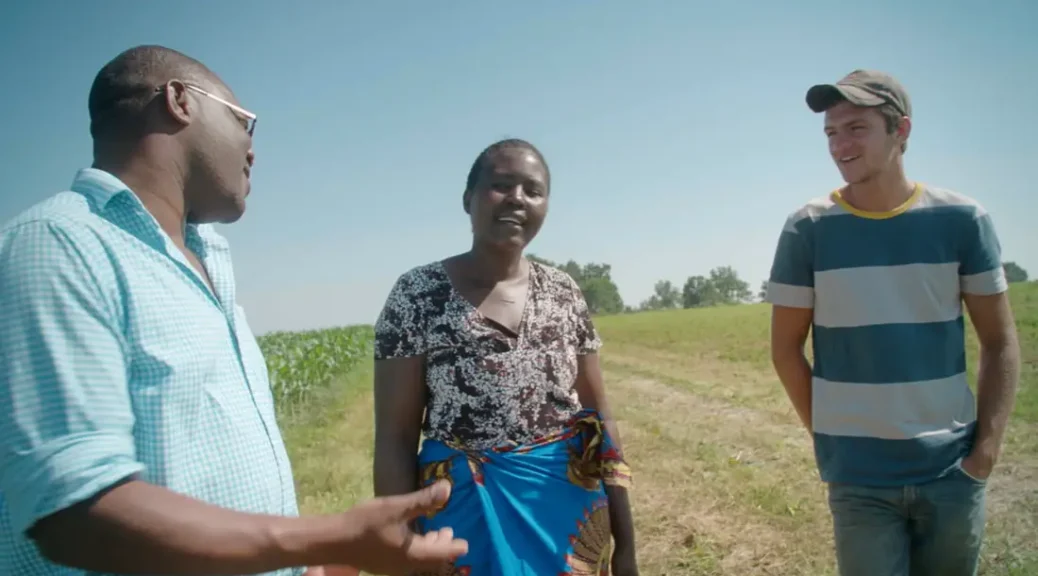
The film picks up steam when Anita, along with her friend Esther, arrives in the United States. Her journey begins in the Midwest, speaking with farmers about the impacts of their practices on Bwabwa.

Though everyone who meets Anita is civil, it’s clear some don’t believe her plight at home is due to climate change. Jordan works on his family’s farm; though he says he will do what he can to help, he blatantly states he doesn’t think it’s an issue. This shocks his parents. That members of the same family have conflicting beliefs speaks to the heart of the problem in America.

It’s humbling and a little shaming to watch Anita travel across America. As she takes in the excess, she points out that we take what we have for granted. Her companion, Esther, points out that it’s not about making anyone feel guilty – “too much time is wasted on guilt.” But when Anita and her community struggle to find water for cooking and cleaning, what we take for granted is damning.

However, there is hope to be found. After Anita returns home, we find the same man who refused to do woman’s work now teaching other men how to cook. Skeptic Jordan wishes he could apologize to his Malawi friends for laughing when “maybe I should have cried.” People can change. Though the sentiment is that it’s never too late to change, the faster we wake up, the better for everyone.


Both Refined and Uncouth

Personality Crisis: One Night Only

by Hope Madden

David Johansen may not be the first name you associate with New York City, but why not? The Staten Island native has been a fixture of a teeming NYC Avant Garde since his teens, even before he launched perhaps the city’s first punk rock band, the New York Dolls.

Martin Scorsese, directing with longtime collaborator David Tedeschi, captures both New York and live music as only he can with the Johansen documentary, Personality Crisis: One Night Only.

Filmed in January, 2020 – Johansen’s 70th birthday – at Café Carlisle, the show sees the finely-coiffured troubadour fronting a jazzy combo, still the hippest guy in the room. Interviews, concert clips and other archival footage flank selections from a classic cabaret act.

As has been the case with all of Scorsese’s music docs, Personality Crisis is heavy on music. We’re treated to complete songs, Scorsese’s camera lingering on the Johansen’s snapping fingers, a great over the shoulder shot continually glimpsing an intimate club space filled with well-behaved, well-dressed patrons.

Because Johansen “was in no mood for learning new songs,” he performs old, mostly Dolls tunes in the style of Buster Poindexter. Of the many brilliant ideas to pour from this two-hour testament to punk spirit, the decision to perform Dolls songs as cabaret standards is perhaps the brightest and best.

Plenty of punk bands have taken on pop classics, giving them a dangerous spin. But very few punk songs stand up to more popular, lyric-focused stylings. But as Dolls superfan Morrissey points out early and often in this doc, Johansen wrote incredible pop songs.

As much as I hate to agree with Morrissey, he’s right. There’s no denying the introspection, pain and poetry in Johansen’s lyrics.

Plenty of Music, Funky but Chic, Temptation to Exist, Subway Train, Better than You (even though he forgot the lyrics), and, of course, Personality Crisis take on the rich, boozy texture of the cabaret style and tell you more than they did the first go-round.

Maimed Happiness transcends time entirely, feeling more at home in the mouth of a septuagenarian than it ever did a teenaged punk.

Tedeschi also edits this film, having worked with Scorsese on Shine a Light, and George Harrison: Living in the Material World . He mines for gold, not only onstage, but in the archives. From old interviews to intimate family footage shot by Johansen’s daughter, Leah Hennessey, to clips from his Sirius satellite radio show, we’re treated to a glimpse of a life richly, and sometimes dangerously lived.

Johansen’s an onstage charmer, but more than that, he’s a vibrant ghost of New York past.

Head’s in Mississippi

Far East Deep South

by Hope Madden

In 2015, Larissa Lam convinced her husband Baldwin Chiu that they should start filming. Chiu had begun to dig into his family’s history and Lam believed that what he was finding would make a great movie. The result was the award-winning short film Finding Cleveland.

The filmmaker believed that the surprising evidence of a substantial community of Chinese immigrants living in Cleveland, Mississippi dating back to the 1800s would compel viewer interest.

It did – so much interest, in fact, that Lam and Chiu dug deeper. The result is the feature length documentary Far East Deep South. Told in chapters, Lam’s doc begins intimately with the family and broadens to tap universal themes.

We travel with Baldwin and his family, uncovering an America few people knew existed. In watching the effect of this discovery on Baldwin’s father Charles, who last saw his own father when he was barely a toddler living in China, it’s tough not to be moved. Learning who his father was, why he lived so far away, and that he missed his children reshaped the way Charles saw himself.

Because of the Chinese Exclusion Act, Chinese women couldn’t immigrate to the US for decades. Because of anti-miscegenation laws, the Chinese men who’d come to the States couldn’t easily marry here. Many of these men therefore traveled back and forth to China to marry and have families, essentially creating generations of fatherless families in China.

Dr. Jane Hong and other experts punctuate Lam’s tale with some of those missing historical details we all should have learned in middle school. Like many products of the American educational system, the Chius were unfamiliar with the Chinese Exclusion Act. They had no idea there was a vibrant Chinese American population outside of the West Coast, or that their own history was so entrenched in America’s. This documentary points to the painful impact of massive omissions in the teaching of history.

Wisely, Lam limits the expert talking head footage, using it to illustrate the backdrop and letting the touching family drama drive the film. Far East Deep South is not only a statement about absence but a testament to the effect a person can on a community.

What’s maybe most touching is how this journey softened Charles Chiu’s memory of his grandmother, who’d lost both a son and a husband and still devoted herself to Charles. Seeing his love for her deepen before our eyes delivers as much emotional punch as his evolving feelings toward his father.

Come to Far East Deep South for the beautiful and surprising human drama. Stay for a chance to see America with sharper vision.

Solo Act

Chrissy Judy

by Christie Robb

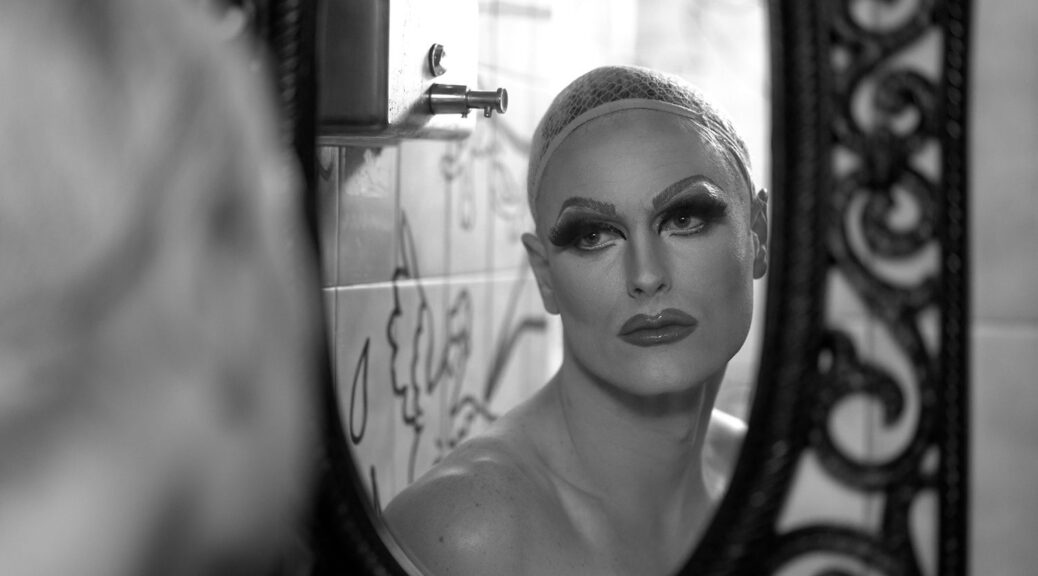
Judy (Todd Flaherty) and his partner Chrissy (Wyatt Fenner) are co-stars of an underwhelming New York drag act. Then, Chrissy up and quits and moves to the hinterlands of Philadelphia to make a go of it with his on-again-off-again long-distance boyfriend Shawn, leaving behind the remains of a humdrum double act.

Judy, still ambitious, but now 30 and feeling out of step with the young, struggles to choreograph the next act in their life.

Judy is obsessed with nostalgia and the vintage glamor of old Hollywood, so it’s fitting that the film itself is beautifully shot in black and white and scored in a mix of old standards and jazz. The dialogue often harkens back to the fast-talking banter of old screwball comedies, updated with modern slang, a lot more cursing, and the occasional references to douching.

Written, directed, edited, produced by AND starting Flaherty, there’s a real emotional depth to this one. Flaherty and Fenner manage to convey the complex layers of a long-term and somewhat complicated friendship.

Avoiding the heteronormative tropes of typical romantic movies, this one feels like part rom-com, part coming-of age while offering a novel take on a love story.

iCaramba

iMordecai

by Tori Hanes

Ah, the great dismay of reviewers everywhere: putting to word the film that is, in all respects, just fine. 

Good intention, beating heart, a splattering of fine performances… a contrived story, weird relationships, and dramatically confusing decisions. Comme ci, comme ça. 

Holocaust survivor turned Miami Beach grandfather Mordecai Samel is played by Judd Hirsch – and let’s be honest here. The man’s 88 years old. This in and of itself is worthy of praise.

Mordecai is forever changed by the purchase of an iPhone. This singular point sprouts approximately 12 plots that messily attempt a parallel run, including: 

  • A flailing cigar business run by Mordecai’s perpetually disgruntled son, Marvin (Sean Astin)
  • A wholeheartedly strange relationship with a member of a Nazi bloodline
  • A bizarrely convenient dementia diagnosis 
  • A budding, introduced-and-forgotten art career

Any of these could’ve, and probably should’ve, been the primary plot. Instead, they bob and weave to and fro, knocking each other off course for the chance at a fleeting moment in the sun. 

The contexts surrounding this film are, unfortunately, more interesting than the movie itself. Filmmaker Marvin Samel created iMordecai as a joyous tribute to his father, and that palpable love is present throughout the 102 minute run time. Mordecai Samel did survive the Holocaust in a Siberian orphanage, and he did create a happy life in sunny Miami. His son claims to have learned the craft of filmmaking through online classes, accumulating his knowledge to create the cinematic experience of his father’s golden years.

Hilariously, iMordecai is touted as a “true story – the bold, true story of an older man learning how to use an iPhone.” Of course this is a hyperbolic simplification, but the nature of the claim feels about as asinine as that. It’s a glaring example of the lack of perception toward what makes this movie interesting. Mordecai Samel, the man at the center, is the heart, pumping blood to every far reaching vein. When the film turns a tourniquet on itself, it loses.

Overall, the plot’s messy but comprehensible. The direction is jarring but understandable. The cast is stacked, the performances are solid, but the characters are left-footed. iMordecai is digestible in every way but forgettable just the same.

Screening Room: Air, Super Mario Bros., Paint, The Five Devils & More

Oklahoma Not Okay

One Day as a Lion

by George Wolf

A few films in now, director John Swab’s favorite playbook seems to be upending familiar narratives with unexpected left turns. But unlike previous projects such as Candy Land, Little Dixie and Ida Red, his latest is built on a script Swab didn’t pen himself.

One Day as a Lion comes from screenwriter Scott Caan, who also stars as Jackie Powers, consistently recalling his father James as an Oklahoma man driven to desperate measures by the arrest of his son, Billy (Dash Melrose).

With Billy’s hearing just days away, Jackie needs money to hire TV lawyer Kenny Walsh (Billy Blair), who refers to himself in the third person and promises results. To get the money that talks to Kenny Walsh, Jackie agrees to whack powerful local rancher Walter Boggs (J.K. Simmons), who hasn’t paid his gambling debts to crime boss Pauly Russo (Frank Grillo).

But the diner hit goes south, leaving Jackie to kidnap waitress Lola Brisky (Marianne Rendón) and head out on the run, while Walter and Pauly threaten Jackie and each other.

Sound like your standard thriller, right?

Caan has something a little more zany in mind. As Jackie and Lola hit up her mother (Virginia Madsen )- a rich woman known as “Black Widow” after her trail of dead husbands – for the needed funds, a whiff of romantic comedy is in the air. And with Okie hillbillies arguing about gymnastics and Pauly yelling about belt buckles, the whole adventure starts to feel like the remote intersection of Taylor Sheridan and a Jimmy Johns commercial.

But Swab frames the dusty landscapes and empty streets with an appropriately desperate grit, the ensemble digs into the character eccentricities, and One Day as a Lion pulls you along a light but oddly compelling tale of kooky crime and possible punishment.

I’m still trying to figure out just what is up with the post-credits stinger, but even it lands with a “what just happened?” vibe that seems right at home here.

Big Top of Broken Dreams

Balloon Animal

by Brandon Thomas

Movies set in or around circuses often have a darkness to them. If the animal cruelty doesn’t get to you then the limitless tales of alcoholism and depression will. Oh, and one of them has Pee-wee Herman running around. Thankfully Balloon Animal leaves the cruelty and boozing behind in favor of a thoughtful character piece about isolation and expectations. 

Poppy Valentine (Katherine Waddell) makes the balloon animals at Valentine’s Traveling Circus, owned by her overbearing father Dark Valentine (Ilia Volok). The once bustling circus now plays to sparse, apathetic crowds. Dark’s intense dependence on his daughter is fueled by his wife’s abandonment of him years before. After her father offers her a more significant role in the business, Poppy begins to question her place in the circus, her father’s life, and the world at large. 

At first glance, the premise of Balloon Animal reads like half of dozen indie dramas released since the mid-90s. That assessment isn’t completely untrue, to be fair. However, the difference is in the execution. Writer-director Em Johnson delivers an honest – but never quite brutal – drama that always feels real to its characters. Poppy’s trajectory through the film is natural and doesn’t end up where you think it will.

Setting this story inside a traveling circus is a fascinating choice. Johnson shows little interest in digging into the mechanics of the circus or its day-to-day. The focus is on the people who live and work inside this nomadic community. For them, it’s just a job (for now). For Poppy, though, there’s a cost of isolation and monotony that she’s unable to ignore and eventually begins to reject. 

The performances are just as notable as the film’s tight storytelling. Waddell’s naturalistic charm makes her a great focal point. She delicately straddles Poppy’s creeping loneliness while allowing the character’s meek pragmatism to shine through. It’s not a showy role, but Waddell does so much with it. Likewise, Volok turns what could be a wholly unlikable character into someone with pathos. His ferocity is equaled only by his ability to elicit empathy from the audience. 

Balloon Animal doesn’t end with any definitive answers for its characters. What it does, though, is give them a stopping point for this particular story in their lives and a starting point for an entirely new one.

Kindness Has No Borders

A Handful of Water

by Daniel Baldwin

Jakob Zapf’s quiet drama A Handful of Water revolves around grieving widower Konrad Hausnick (Jurgen Prochnow) living out his days going through his usual routine in a very cold and robotic manner, with the only light in his life coming not from his adult daughter and her new family, but instead from his fish-filled basement aquarium. He is a man who has found himself unable to move beyond his sorrow, nor to find room in his heart for the joy of others. Enter Thurba Al-Sherbini (Milena Pribak).

Thurba is a 12-year-old Yemeni refugee who is on the run . She set off into the world on her own when German police come knocking at her home, forcing her to leave her mother and two siblings behind. Per German law, the family cannot be deported back to Bulgaria unless all members are accounted for. If you’re guessing that Thurba manages to take up residence in Konrad’s home, you’re right on the Deutsche Mark!

A young person managing to bring a bereaved aging man out of his shell is a tale as old as time. Sometimes it comes in the form of fantastical animation like Up!, a violent comic book blockbuster like Logan, or a soaring sports drama like Creed. And sometimes it arrives in a much smaller package, as it does here. This is a tried and true formula because it’s one that often sings and that holds true for this film as well.

Those of you who are primarily used to seeing Prochnow vamp it up in a villainous manner across decades of genre cinema are in for a treat here, as this is a very different side of the man. Jurgen has rarely been better than he is as Konrad, and his performance is matched pound for pound by newcomer Pribak. They are the heart and soul of the film. It doesn’t matter if you can guess where things will go at almost every turn, as the flavors they add to the journey make it worthwhile.

A Handful of Water might not contain very many surprises, but it also avoids the pitfalls of many dramas of this type. It’s never too on the nose with its message and it’s never too saccharine for its own good either. Zapf, Prochnow, and Pribak get the recipe right from moment one and the end result is a fine little drama.

How to Train Your Latin Dragon

The Fist of the Condor

by Daniel Baldwin

Since 2006, the Chilean powerhouse team of writer/director Ernesto Diaz Espinoza and martial arts superstar Marko Zaror has been delivering some of the best independent action cinema in the world. From raucous martial arts mayhem (Kiltro) to street-level superhero satire (Mirageman) to Eurospy parody (Mandrill), their wild body of work together has been a diabolical fondue of influences ranging from kung fu movies to spaghetti westerns to blaxploitation cinema and beyond. What makes them all the more impressive is that of the four previous films they’ve made together, no two are alike in terms of style and tone. Other than a good time, you never know what you’re going to get from an Espinoza and Zaror pairing.

The Fist of the Condor sees this duo reuniting for the first time in almost a decade. Their last outing, the rogue assassin tale Redeemer, had been their weakest effort to date, but I’m happy to report that they’ve bounced back here and then some. A deep-flowing love of classic kung fu cinema has always run throughout their collaborations, but it’s never flowed as deeply or as lovingly as it does here.

This is a martial arts adventure just as concerned with evoking the philosophy of both the genre and the real-life practices behind it as it is in showcasing expertly-choreographed fights. There is a poeticism behind the fisticuffs on display here that calls to mind the Hong Kong classics of yore, leaving us with a masterful modern piece of meditative martial arts cinema that would make the Shaw Brothers smile.

Espinoza has always had a way with striking imagery that is a delicious mix of exquisite location photography and beautiful artifice that holds decades of movie knowledge behind it. Condor is no different, as it births some of the best sequences his wonderful mind has conjured to date. All backed by another excellent ‘70s-infused score by longtime collaborator Rocco, of course!

Those whose only experience with Marko “The Latin Dragon” Zaror are his villainous turns in Hollywood films such as John Wick: Chapter 4 and Machete Kills might be surprised to see the monk-like heroism of his primary role here. Fear not, however, as he also plays his own evil twin! His heroic (but not innocent) protagonist Guerrero is his best role since Kiltro and one we’ll be lucky to see continue, since this is meant to be the first in a trilogy. The next two cannot get here soon enough.