Tag Archives: Laurence Leboeuf

Rocket Ride

The Stunt Driver

by George Wolf

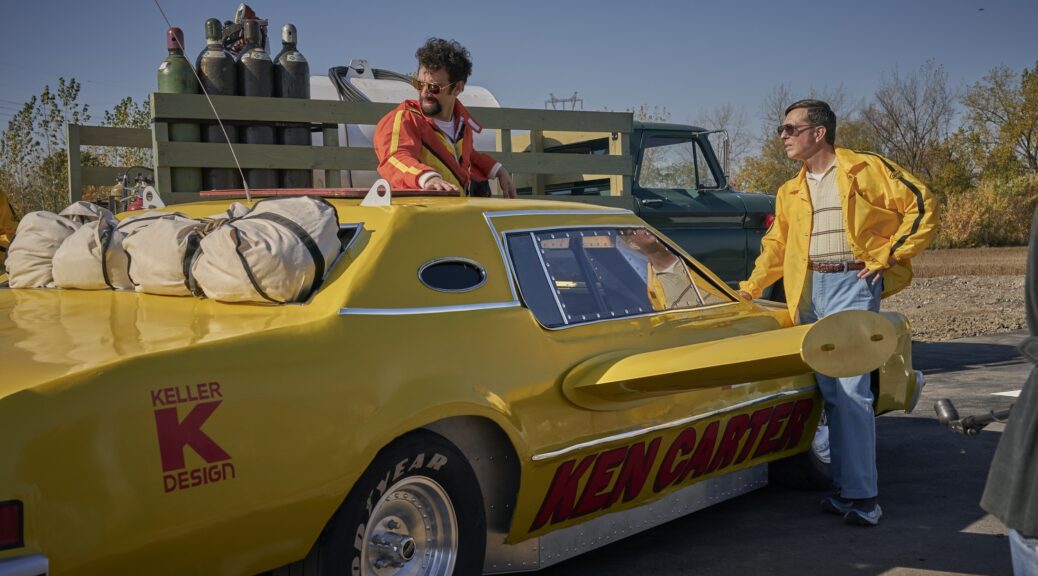
If you’ve seen the underrated 2011 hockey comedy Goon, you’ll understand why I was stoked for The Stunt Driver. It reunites writer/director Michael Dowse with star Jay Baruchel for another based -on-true-events look at a rough and tumble lug fighting to stand out in the crowd.

Back in the 1970s Ken Carter was known as “The Mad Canadian,” a cross-eyed, bushy-haired high school dropout who made his name through high-flying car stunts. So, when Evel Knievel’s Snake River Canyon jump fizzled out in ’74, Carter hatched a plan to show him up.

He would jump over the St. Lawrence river in a “rocket car,” taking off in Canada and landing a mile away in Ogden Island, New York. In Carter’s view, Evel was “a nerd and a coward,” and the St. Lawrence jump would put the stunt driver glory – don’t call him a “daredevil!” – where it belonged.

As Carter, Baruchel delivers a career-best performance. Stunt driving is all Carter knows and the passion to “leave his mark” is felt throughout the years-long journey toward the jump. When doubt and even fear creeps in, Baruchel makes sure both are just shades of a completely human character we want to succeed.

Much like Goon, the commitment to character drives the film. Dowse surrounds his Mad Canadian with interesting people on all sides. From Carter’s long-suffering wife (Laurence Leboeuf) to his engine designer (Ed Helms), his protege (Marc Beaupré) and his promoter (Dan Bakkedahl), we get a series of fleshed-out personalities to bring a perfectly 70s aesthetic to life.

And when producers on ABC’s Wide Wide of Sports insist on bringing Evel himself (Ben Foster) on as a tech consultant, the relationship between Knievel and Carter instantly becomes a deadpan delight.

Dowse takes inspiration from the 1981 doc The Devil at Your Heels. He juggles different film stocks and aspect ratios throughout the film’s 99 minutes, which makes the use of real jump footage feel seamless, and bolsters the hardscrabble appeal of Carter’s entire persona.

Even when the tonal path starts to wobble in the second act, The Stunt Driver again shows Dowse and Baruchel can find heart, soul and authenticity in the life of a true sports underdog. Maybe Ken never got as famous as Knievel, but it’s a good bit of absurd fun getting to know him.


Women Out of Love

Two Women

by Matt Weiner

“Plus ça change, plus c’est la même chose.” It’s a fitting aphorism for the new Two Women, Chloé Robichaud’s remake of the original 1970 film that probes how much has really changed for women since the sexual revolution of the 1960s and 70s.

Florence (Karine Gonthier-Hyndman) and Violette (Laurence Leboeuf) have a lot in common. The two women live next to each other in a large Montreal apartment complex, share feelings of sexual frustration and a lack of desire with their current partners, and have to deal with mental health issues around new motherhood (for Violette) and depression (for Florence).

The two women bond with one another over their shared frustrations, a bond that deepens quickly when they both seek out casual affairs from relative strangers in the apartment complex. This breezy update, written by Catherine Léger, puts a modern spin on the original, with app-based encounters helping to supercharge the litany of cable guys, repairmen and delivery people who make up the anonymous casual sex for the women.

And these men (plus the occasional woman) are truly anonymous—they are credited by occupation only. This leads to some comic relief as the neighbors start to sense something going on with the revolving door of service workers going in and out of the women’s apartments. But it also adds a serious note to their sexual adventuring.

Florence and Violette reclaim these pornified archetypes for their own journeys of self-discovery, complete with intentionally awkward and turgid come-ons as the women make their desires known to the bemused workers. It helps that Gonthier-Hyndman and Leboeuf excel at giving the risqué romps emotional heft. We see both of their characters go from halting, even fumbling encounters to a fully realized confidence by the end of the film.

While the leading women are fantastic, the film is on shakier ground when it pulls back to ascribe some broader societal points about their sexual politics. Monogamy and mental health both factor into where the story winds up going, but Robichaud’s otherwise light comic touch winds up making these threads feel underbaked while also not given enough weight.

There’s a frank sweetness to the film that, along with the grounded performances, keeps the philosophical detours from ever derailing the movie’s charm, however. This is in no small part thanks to fully inhabited performances from the women’s partners, the tragicomic David (an excellent Mani Soleymanlou) and churlish Benoit (Félix Moati). We may have gone through enough waves of social change in the last 50 years to know that “having it all” is its own unrealistic myth for anyone in today’s world. But Two Women shows that, six decades on, that shouldn’t stop you from asking what you actually desire in your life, whether that’s fixing the cable or “fixing the cable.”
