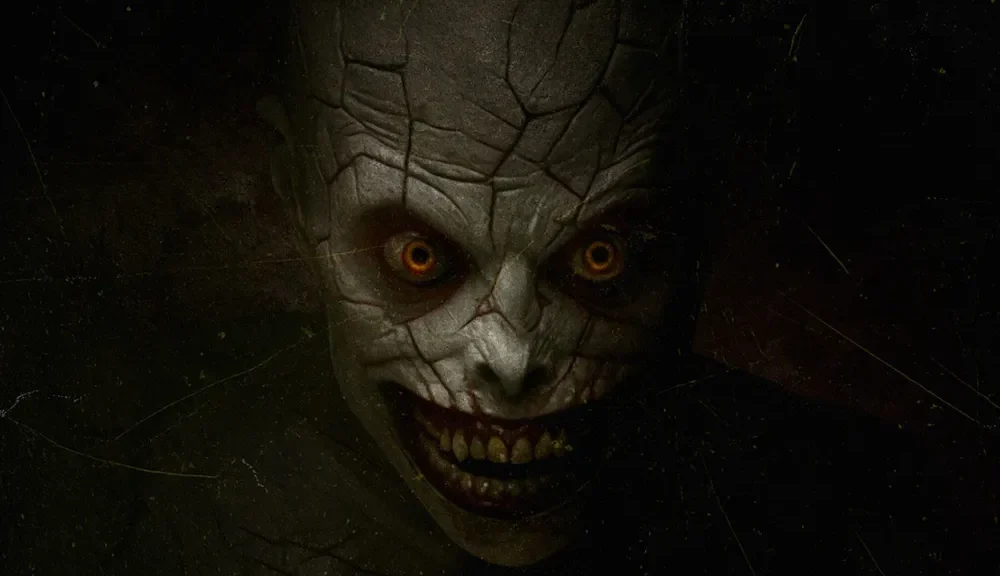
Director Jeremiah Kipp hits the exact right tone as he opens his latest feature, The Mortuary Assistant. Based on the popular video game, the film follows Rebecca Owens (Willa Holland) through her first night on her own at the mortuary.
Before she can fly unaccompanied, she completes her first solo autopsy, as the mortician (Paul Sparks) watches. The scenes are clinical, filmed in close-up, Kipp manufacturing the best combination of mundane and macabre.
Soon enough, Rebecca will begin her first overnight shift, and the clients are not your run of the mill cadavers.
Kipp, working from a script by Tracee Beebe, finds organic ways to give Rebecca a backstory. Flashbacks are not intrusive until they need to be, as the film warps that history into another way to really ruin Rebecca’s first night on the job.
John Adams figures into Rebecca’s past. He’s a perfect choice for a loving dad and for what that pesky demon haunting the mortuary has planned for her.
Holland’s great in a tough role. Rebecca carries probably 90% of the film, much of that screentime spent alone or with a lifeless (?) corpse. It’s an internal character, not an extrovert or the type who talks to herself, and the actor impresses, commanding attention and driving action.
Bebee’s script adds some depth to the game storyline as well, using Rebecca’s backstory to develop a theme of addiction that suits the horror and helps to explain Rebecca’s connection to events.
Sparks delivers an enjoyable performance, stiff and weird as you might expect from a mortician, certainly from this particular mortician. Supporting turns from the small ensemble (Keena Ferguson Frasier and Emily Bennett, in particular) elevate emotion, whether that emotion is heartbreak, fear, or revulsion.
Plus that demon is freaky.
Frequent gamers may be able to make more sense of the actual mythology—possession, demonic bindings, the minutia of morgue work. Still, The Mortuary Assistant transcends the issues that usually plague big screen game adaptations and delivers fun, creepy demonic horror.
Big thanks to filmmaker Jeremiah Kipp, whose exceptional horror Slapface inspired our topic. We look into the best brothers (or sometimes worst brothers!) in horror. Be sure to listen in because Jeremiah has some thoughts and recs you won’t want to miss.
5) The Lost Boys (1987)
Joel Schumacher spins a yarn of Santa Carla, a town with a perpetual coastal carnival and the nation’s highest murder rate. A roving band of cycle-riding vampires haunts the carnival and accounts for the carnage, until Diane Weist moves her family to town. While hottie Michael (Jason Patric) is being seduced into the demon brethren, younger brother Sam (Corey Haim) teams up with local goofballs the Frog brothers (Corey Feldman and Jamison Newlander) to stake all bloodsuckers.
There are two obvious sets of brothers, one that’s falling apart and one that acts exclusively as a team, the band of vampires also represents a brother hood. This becomes clearest when Max (Edward Herrmann) makes it clear that his intention is to have Weist’s character play mother to all the boys.
4) Basket Case (1982)
This film is fed by a particularly twin-linked anxiety. Can anyone really be the love of one twin’s life, and if so, where does that leave the other twin? More than that, though, the idea of separating conjoined twins is just irresistible to dark fantasy. Rock bottom production values and ridiculous FX combine with the absurdist concept and poor acting to result in an entertaining splatter comedy a bit like Peter Jackson’s early work.
When super-wholesome teenage Duane moves into a cheap and dangerous New York flophouse, it’s easy to become anxious for him. But that’s not laundry in his basket, Belial is in the basket -Duane’s deformed, angry, bloodthirsty, jealous twin brother – but not just a twin, a formerly conjoined twin. What he really is, of course, is Duane’s id – his Hyde, his Hulk, his Danny DeVito. And together the brothers tear a bloody, vengeful rip in the fabric of family life.
3) Goodnight Mommy (2014)
There is something eerily beautiful about Severin Fiala and Veronika Franz’s rural Austrian horror Goodnight Mommy (Ich seh, Ich seh).
During one languid summer, twin brothers Lukas and Elias await their mother’s return from the hospital. But when their mom comes home, bandaged from the cosmetic surgery she underwent, the brothers fear more has changed than just her face.
Inside this elegantly filmed environment, where sun dappled fields lead to leafy forests, the filmmakers mine a kind of primal childhood fear. There’s a subtle lack of compassion that works the nerves beautifully, because it’s hard to feel too badly for the boys or for their mother. You don’t wish harm on any of them, but at the same time, their flaws make all three a bit terrifying.
Performances by young brothers Lukas and Elias Schwarz compel interest, while Susanne Wuest’s cagey turn as the boys’ mother propels the mystery. It’s a hypnotic, bucolic adventure as visually arresting as it is utterly creepy.
2) Frailty (2001)
“He can make me dig this stupid hole, but he can’t make me pray.”
Aah, adolescence. We all bristle against our dads’ sense of morality and discipline, right? Well, some have a tougher time of it than others. Paxton stars as a widowed, bucolic country dad awakened one night by an angel – or a bright light shining off the angel on top of a trophy on his ramshackle bedroom bookcase. Whichever – he understands now that he and his sons have been called by God to kill demons.
Paxton, who directs, leans on excellent performances from young Jeremy Sumpter as the obedient younger son and Matt O’Leary as our point of view character, the brother whose adolescent rebellion will pit him against the father he loves and the brother he’d like to protect.
1) Dead Ringers (1988)
The film is about separation anxiety, with the effortlessly melancholy Jeremy Irons playing a set of gynecologist twins on a downward spiral. Cronenberg doesn’t consider this a horror film at all. Truth is, because the twin brothers facing emotional and mental collapse are gynecologists, Cronenberg is wrong.
Irons is brilliant as Elliot and Beverly Mantle, bringing such flair and, eventually, childlike charm to the performance you feel almost grateful. Like some of the greats, he manages to create two very distinct yet appropriately linked personalities, and Cronenberg’s interest is the deeply painful power shift as they try and fail to find independence from the other. The film’s pace is slow and its horror subtle, but the uncomfortable moments are peculiarly, artfully Cronenberg.
Abuse is easy to confuse with a complicated form of love, especially if you’re a child. For the feature length expansion of his 2018 short Slapface, writer/director Jeremiah Kipp complicates his tale of grief and rage with these confusing notions of abuse.
He relies mainly on the unexpected bond between Lucas (August Maturo, exceptional) and a monster sometimes called the Virago Witch (Lukas Hassel, reprising his role from the short). Lucas lost his parents in a car accident and grieves deeply for his mother. He lives just off the woods with his older brother Tom (Mike Manning, who also produces).
Tom’s new girlfriend Anna (Libe Barer) is concerned about the way the siblings live. The only other companionship Lucas has is a trio of bullies. One of those bullies, Moriah (Mirabelle Lee) is willing to be Lucas’s girlfriend as long as he keeps it secret.
In this way, Kipp layers his original tale of grief with conflicting emotional baggage. It’s to his credit, and the endless benefit of his film, that the filmmaker never tidies up these emotional storylines. In fact, it is Lucas’s confusion over the characters who seem to both love and harm him that creates his greatest turmoil.
The monster becomes a remedy of sorts to this internal conflict. The larger-than-life, terrifying presence works much the way that the monster in J.A. Bayona’s 2016 treasure A Monster Calls works. The beast allows Lucas to process the complicated reasons for his pain.
Kipp’s film trades in Bayona’s melancholy magic for something more brutal. But Hassel and Maturo find sincere tenderness in their time together onscreen, which makes the horror even more heartbreaking.
Not every performance is as strong, but Kipp’s ensemble finds nuance in characters that help the film compel more than just terror.