Is the flattery still sincerest if you’re imitating yourself?
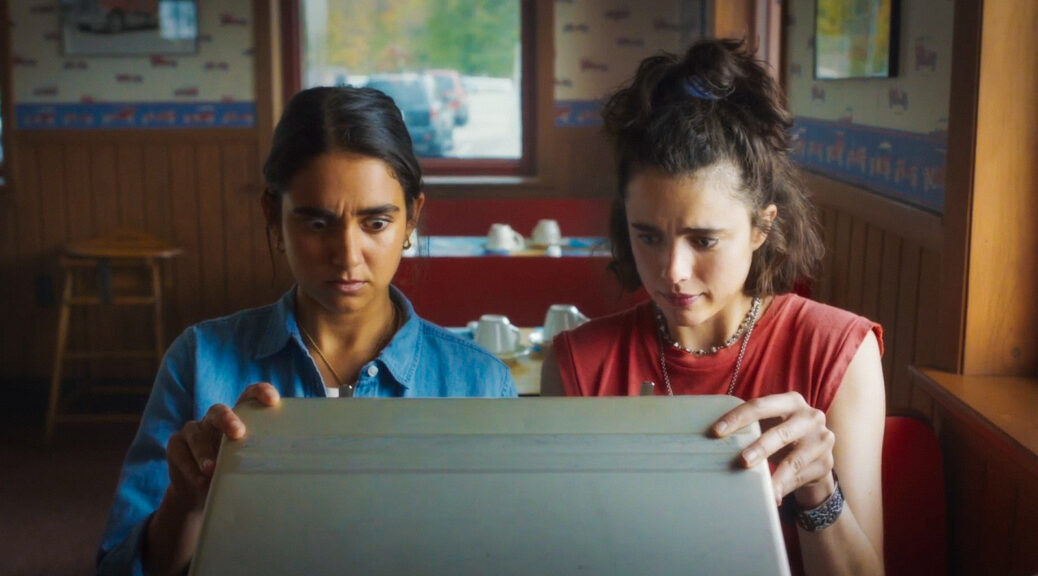
Because about 15 minutes into Drive-Away Dolls, the first installment of a lesbian B-movie trilogy from director/co-writer Ethan Coen and co-writer Tricia Cooke (Coen’s longtime producer/editor/wife), you can’t ignore how much this film reminds you of Coen Brothers movies.
And yes, better Coen Brothers movies.
Like The Big Lebowski, Burn After Reading, Barton Fink and A Serious Man, all of which get subtle and not-so-subtle nods in a twisting story of two young women and a mysterious, valuable briefcase.
Jamie (Margaret Qualley) and Marian (Geraldine Viswanathan) are queer best friends in 1999 Philadelphia. Marian is sexually conservative, and the free-spirited Jamie hopes to get her friend some action while they accept a drive-away job down to Tallahassee and hit every lesbian bar they can find.
What the girls don’t know is that the car they’ve been given has two very important items in the trunk, and it isn’t long before “The Chief” (Colman Domingo) and his two hapless henchman (Joey Slotnick, C.J. Wilson) are on their tail heading South.
The cast is indeed impressive (with appearances from Pedro Pascal, Bill Camp, Beanie Feldstein and Matt Damon), but while the film serves up a handful of LOL moments, the vast majority of the nuttiness lands with more desperation than inspiration.
It all feels so forced, except for Viswanathan, whose earnest delivery points out the artifice in Qualley’s. The Foghorn Leghorn-y of pre-millennium lesbians, Jamie’s every line draws attention to its own zaniness. It calls to mind The Ladykillers—and that’s never the Coen movie you want to make people remember.
Much of the ensemble works magic, though. Camp is particularly, dryly memorable. But this script, and the unsteady direction, suffers from high expectations. Drive-Away Dolls is fine. It’s fun enough. It’s nutty. But if Coen and Cooke weren’t awkwardly chasing their own family history, it would have been more satisfying.
It’s understandable if Ordinary Angels seems familiar. Hilary Swank playing a tireless do-gooder in a based-on-true-events drama with a vaguely inspirational title is probably going to feel that way.
And while the film does rely on plenty of broad-brushing, it ultimately mines enough nuance to find some genuine feels, as well.
Swank plays Sharon Stevens, a hard-partying beauty salon owner in Kentucky who’s hoping one day to mend the relationship with her estranged son, Derek (Dempsey Byrk). While waiting at the grocery store checkout, a local newspaper story gives Sharon’s life new meaning.
Five year-old Michelle Schmitt (Emily Mitchell) has a rare disease and needs a liver transplant to survive. Her father Ed (Jack Reacher‘s Alan Ritchson), still hurting from his wife’s fatal battle with Wegener’s disease, is facing a mountain of medical debt while struggling to raise Michelle and her older sister Ashley (Skywalker Hughes) as a single parent.
After so much heartache, Ed admits to his mother Barbara (Nancy Travis) that he’s losing his faith. Could this hardscrabble hairdresser at their door be a Godsend? The few thousand dollars she raises from a salon fundraiser is a darn good start.
Two-time Oscar winner Swank is perfect for the role, even if the script from Kelly Fremon Craig (Are You There God? It’s Me, Margaret) and Meg Tilly (the veteran actress with her first feature writing credit) doesn’t provide many edges, at least early on. Sharon is all “hush my mouth” spunk, smiling through her accent as she imposes her will on multiple situations and begins to feel interchangeable with similar characters from The Blind Side to Swank’s own Conviction.
Ritchson is fine and shares sweet chemistry with the two adorable young girls, though Ed also lacks the depth to move the character beyond any number of faith-based dramas following a basic heart string-tugging playbook.
Ordinary Angels does find a unique voice in the third act, when Ed’s patience wears thin, and Sharon is finally forced to confront the life she’s really trying to save. Plus, director Jon Gunn (The Case for Christ, The Week) moves away from the formulaic to develop some respectable tension when the call for Michelle’s life-saving transplant comes during a monster snowstorm.
That really happened, and the true story here does provide an inspiring example of the good that humans are capable of. No doubt we need that right now, and Ordinary Angels manages just enough extraordinary moments to please more than the choir.
When Rob Schenck was a young pastor, he was told never to prepare a sermon without consulting the Theological Dictionary of the New Testament, edited by Gerhard Kittel.
Years later, Schenck learned that Kittel was also the man who gave Hitler a Christian blessing for his Final Solution.
“That was an eye opener,” Schenck admits. The point—that there is no limit to what radical Christianity can be used to justify—is what drives God & Country. And much of the film’s success comes from how it combats that fanaticism with a measured, confident deconstruction.
Director Dan Partland doesn’t insert himself into the conversation, but has no problem crafting a spirited one. Yes, he has a clear agenda, but includes enough footage from news reports, political speeches and televangelist messaging that the film’s worldview becomes the “other side” getting a chance to be heard.
Partland relies on historians, authors, and theologians to trace the rise of Christian Nationalism, it’s deviation from actual Christian teachings, the quest for power over values that earns a rebranding as “White Religious Nationalism,” and how the true believers have been convinced that America has a God-ordained role in human history.
And if democracy gets in the way? See January 6th, 2021.
The attack on the Capitol is what bookends the film, and in between, Partland actually elicits sympathy for the attackers, who have been fed a calculated diet of lies, fear and outrage. The resulting echo chamber creates an alternative reality bubble, one that was always designed to burst.
If you noticed the proudly theocratic ruling from the Alabama Supreme Court last week, you know that the threat to democracy is only becoming more dangerous. Partland makes it clear that the biggest hope is awareness, so that those led astray by the fervor (like Schenck) can experience a new awakening.
Christian Nationalism has nothing to do with Christianity. And God & Country finds a useful tone between sermonizing and condescension that can help us see that light.
Past memories and present regrets mix in director Olivier Peyon’s film, Lie with Me.
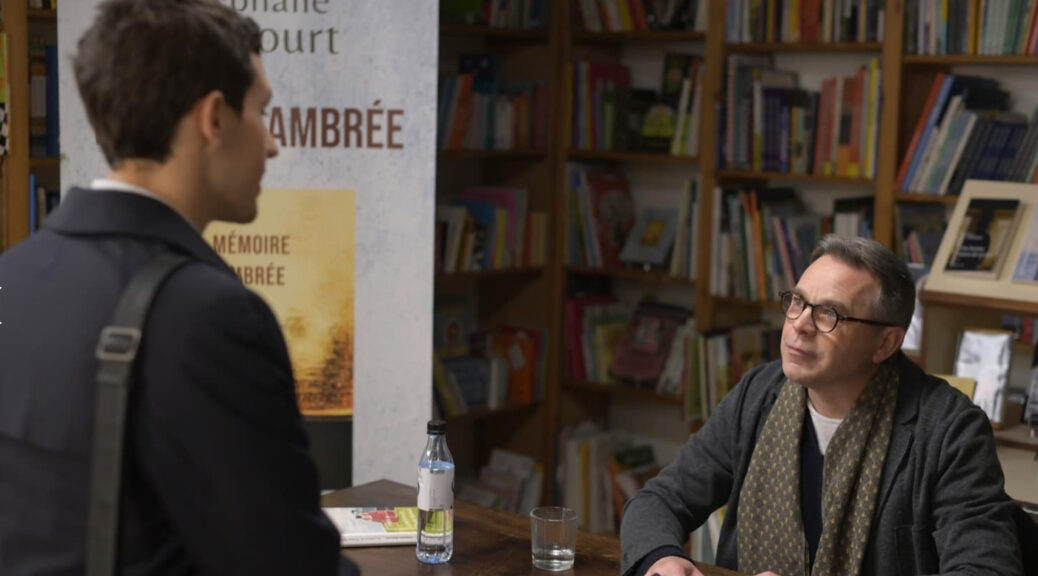
Returning to his hometown after decades away, celebrated author Stéphane Belcourt (Guillaume de Tonquédec) looks to dig up the ghosts of his past in hopes of inspiring something lost. Or in this case, one ghost.
In 1984, a young Stéphane (Jérémy Gillet) begins a relationship with popular student, Thomas (Julien De Saint Jean). The only condition of their relationship is that no one can know. What starts as something tawdry deepens as the two boys spend more time together. Scenes from the past intermingle with scenes from the present, as memories of his first love overwhelm an older Stéphane.
It’s not clear if Stephane expects to encounter his past love when he returns, but he is floored when instead he meets Thomas’s son, Lucas (Victor Belmondo).
There are two very touching relationships in the film as we watch the budding romance between Stéphane and Thomas unfold, along with Stéphane’s friendship with Lucas. The two actors portraying Stéphane are equally skilled at bringing the character to life in a seamless blend of one person at two different times in life. It’s as effectives as the contrasting natures of Thomas and his son, Lucas. Where Thomas is reserved, never revealing who he is, Lucas is at ease with himself.
The slow steps the film takes in trying to reveal Thomas are elusive; can we ever really know a person who doesn’t know himself? In hiding a part of himself from everyone but Stéphane, he essentially lives a stunted life.
There are some scenes that don’t always work. A few are too heavy-handed and sentimental in a film that works better when it embraces restraint. As the older Stéphane, de Tonquédec can convey a range of emotion with his expressions. When his controlled façade slips, we see sadness and radiance as he recalls moments of love and loss.
The movie isn’t perfect, but it’s touching. There is a quiet sadness that haunts Stéphane as we follow him through his memories. While some scenes carrying a heavy weight, the film is not without hope. While it’s true there are some people we can never really know, often they leave hints, revealing as much of themselves as they can. It’s depressing, but it’s hopeful, too.
Perhaps one day, the world will learn the accept others for who they are and there will no longer be a need to hide.
When I was a kid watching the Oscars, I remember always being perplexed by short film categories. How do people manage to see these shorts?
Good news, kids, it’s gotten much easier. Not only to we now have ShortsTV, but in the last several years, all the nominated shorts have been packaged by category for theatrical showings. And in the cases where the combined run times don’t reach feature length, some bonus shorts are added to the programs.
In this year’s Documentary group, you’ll find informative shorts that inspire, surprise and delight.
Island In Between 20 Mins. Director: S. Leo Chiang Taiwan
Taiwanese-American filmmaker S. Leo Chiang calls this his ”op-doc,” as he reflects on a ”three way custody battle” that continues to define him.
The triangle of influence is made up of the U.S., China and the small island of Kinmen, where Chiang’s parents still live. Kinmen is a Taiwanese island only 10km from mainland China, a small piece of land sitting literally and figuratively between vastly different worlds.
It’s often wise to funnel complex ideas through smaller, more intimate perspectives, and Chaing does that effectively here. In documenting his own journey to self-identification, Island In Between becomes an enlightening window into a slice of world history that continues to breed tension.
No trailer available
Nai Nai & Wài Pó 17 mins. Director: Sean Wang United States
In a bad mood? Give this one 17 minutes and it will be gone like a fart in the wind.
Probably one of Wai Po’s farts.
Nai Nai & Wai Po are the paternal and maternal grandmothers of filmmaker Sean Wang. They live together in China, and are happy that their grandson is visiting to make them ”movie stars!”
Wang fills each frame with love and appreciation, allowing each woman to look back, to talk about how they see life and death, and to get gloriously silly.
It’s a wonderful love letter to family that will bring a warm smile to your heart, and make you want to call your Mom or Grandma.
The ABCs of Book Banning 27 Mins. Directors: Trish Adlesic, Nazenet Habtezghi, Sheila Nevins United States
The film quickly gets you up to date on some sobering facts: approximately 2,000 books have been removed from U.S. school districts after being restricted, challenged or banned.
Then, the directors let a group of 8, 9 and 10 year-olds sound ff on these decisions. These kids are smart and thirst for knowledge, and their wonderfully simplistic assessments expose the ridiculous objections to many of these books.
“You’re stealing knowledge.”
“I like to learn.”
“Something’s not clicking in your brain.”
And, after being told that a book having same sex parents is objectionable: ”Why? It’s not like they turned into a werewolf!”
The clear objective here to give voice to those who don’t often get to weigh in on an issue that directly concerns them. But to rest its case, the film spotlights a 100 year-old woman’s impassioned speech to a local school board debating banned books.
Neither age group has much use for BS. Well done.
The Barber of Little Rock 35 mins. Directors: John Hoffman Christine Turner United States
Get to know Arlo Washington.
A Little Rock barber and small business owner, Arlo’s commitment to confronting the racial wealth gap led to his forming the People’s Trust bank in 2008, a Community Development Financial Institution specially designed to combat the economic segregation of his community.
I.e. ”banking while Black.”
You feel inspired just spending time with Arlo, and smarter for the way he and the film break down the ways CDFI’s can make truly impactful differences in both lives and communities.
Arlo’s work provides freedom, which is precisely why a friend advises him to watch his back. The film lets you understand why the friend’s words are well taken, even as you’re hoping Arlo’s work is just getting started.
The Last Repair Shop 39 mins. Directors: Kris Bowers, Ben Proudfoot United States
The team behind the 2020 Oscar nominee A Concerto Is a Conversation returns to spotlight the people inside a musical instrument repair shop, and the students whose lives they are touching.
Since 1959, the L.A. school district has been providing free instrument repair for its music students. It is one of the last U.S. districts to still offer this service, and the film shows us the joy the practice can bring to the kids, while it profiles the unique circumstances that brought four expert craftspeople to the same repair shop.
It’s a captivating and warm approach to illustrating this one degree of separation between generations, and reminding us of the enrichment possible through music education.
When I was a kid watching the Oscars, I remember always being perplexed by short film categories. How do people manage to see these shorts?
Good news, kids, it’s gotten much easier. Not only do we now have ShortsTV, but in the last several years, all the nominated shorts have been packaged by category for theatrical showings. And in the cases where the combined run times don’t reach feature length, some bonus shorts are added to the programs.
In this year’s Live Action group, we get four tear-jerkers, two big plot twists and one Wes Anderson cavalcade of whimsy. Enjoy.
Invincible 30 Mins. Writer/director: Vincent René-Lortie Canada
Based on the last 48 hours in the life of Marc-Antoine Bernier, a 14 year-old boy struggling with incarceration in a youth centre, Invincible finds humanity amid heartbreak.
Young Léokim Beaumier-Lépine gives a terrific performance as Marc, whose continued outbursts have put his weekend visits home at risk. Marc has shown himself to be both smart and talented, but has not responded well to his confinement. The situation is also beginning to take a toll on his younger sister, Justine (Élia St-Pierre).
René-Lortie brings an artful touch of grace to this tragic story, allowing a troubled spirit to soar toward freedom.
Knight of Fortune 25 mins. Writer/director: Lasse Lyskjær Noer Denmark
Karl (Leif Andrée) has come to the morgue for a last look at his beloved wife. He’s told to be prepared for the changes in her appearance, but he can’t quite bring himself to open the coffin and accept that she is gone.
In the restroom, Karl meets Torben (Jens Jørn Spottag), another grieving widower who would like Karl to accompany him to the room with his own late wife’s coffin, and help him say goodbye.
The men’s quick bond is bittersweet and warmly funny. And when Karl learns some surprising facts about Torben, the film becomes a wonderfully touching message about love, loss, and what it takes to keep moving forward.
No trailer available
Red, White and Blue 23 mins. Writer/director: Nazrin Choudhury United State
Brittany Show stars as Rachel, a struggling single parent in Arkansas who is suddenly faced with an unwanted pregnancy. She’s forced to cross state lines for the care she seeks, and Rachel’s choices seem fairly clear cut.
Until they’re not.
Choudhury, a veteran TV writer directing her first film, drops a major twist that changes everything we thought we knew about Rachel. Yes, what follows comes on pretty strong, but Choudbury isn’t interested in whispering, and there’s an urgency in Red, White and Blue that can’t be denied.
The After 19 mins. Writers: Misan Harriman and John Julius Schwabach Director: Misan Harriman United Kingdom
The first of two Netflix films in this group, The After finds Dayo (David Oyelowo in fine form as always) struggling to accept unspeakable tragedy.
Sleepwalking though what’s left of his life, Dayo takes a job as a ride share driver. The lack of personal interaction seems perfect for Dayo’s desire to withdraw, until a certain passenger forces him to confront the past.
The film is not subtle, but Oyelowo’s turn is deeply affecting, allowing The After to speak clearly through the tears.
The Wonderful Life of Henry Sugar 37mins. Writer/director: Wes Anderson. U.K./U.S.A.
One of three short films Wes Anderson produced for Netflix last year, Henry Sugar unfolds like a delightful pop-up book being presented to us by a breathlessly enthusiastic troupe.
Benedict Cumberbatch, Dev Patel, Ralph Fiennes and Sir Ben Kingsley lead a stellar ensemble that thrives inside Anderson’s trademark world of unmistakable color, framing and pace.
You could say the film is about a man who learns to see through objects with help from a stolen book, but that would be doing a disservice to the engaging ways the entire tale evolves. Wonderful indeed.
Greta is a young girl in Germany who loves her some Wille Nelson. Her unstable mother does not agree.
“Turn it off or I’ll punch you in the face!” Not a lot of gray area there.
But her devotion to the Red Headed Stranger endures into adulthood, when Greta (Eva Haßmann, who also writes and directs her first feature) feels compelled to travel to America and attend Willie’s “farewell” concert in Las Vegas.
So after selling the Porsche behind her husband’s back and setting their kitchen on fire (accidentally?), Greta just can’t wait to get on the road (again).
Flying first into L.A, Greta finds the city pretty welcoming, starting with the helpful hotel desk clerk who sails often on whiskey river (Peter Bogdanovich, in his final screen appearance). A local Elvis impersonator named Nick (Blaine Gray) also takes an interest in Greta’s welfare, stirring echoes of how an entire city instantly rolled over for Elizabeth Berkeley’s character in Showgirls.
But rather than serving up pretentious camp, Haßmann embraces the utter silliness of Greta’s quest. There are snake bites, blow up dolls, stolen cars, pre-teen con artists and more trying to derail Greta’s journey, but she just keeps plowing ahead with the certainty of the Blues Brothers’ “mission from God.”
It’s not really that funny, and the production values can be shaky, but there’s a quirky charm here, thanks mainly to a commitment from Haßmann that mirrors her character. She even writes and performs a song with Willie himself, who handles double duty with a cameo as a mysterious man in black.
It adds up to a madcap slice of Napoleon Dynamite-esque Americana that’s just as likely to leave you scratching your head as laughing out loud. There’s little chance Willie and Me will be always on your mind, but at just 87 minutes, it’s a whimsical tribute to an icon that won’t feel like a waste of time.
“What happens in the teacher’s lounge, stays in the teacher’s lounge.”
Mrs. (Carla) Nowak uses that line as a condescending quip to avoid some pointed questions from her students’ even as she’s starting to desperately wish it were true.
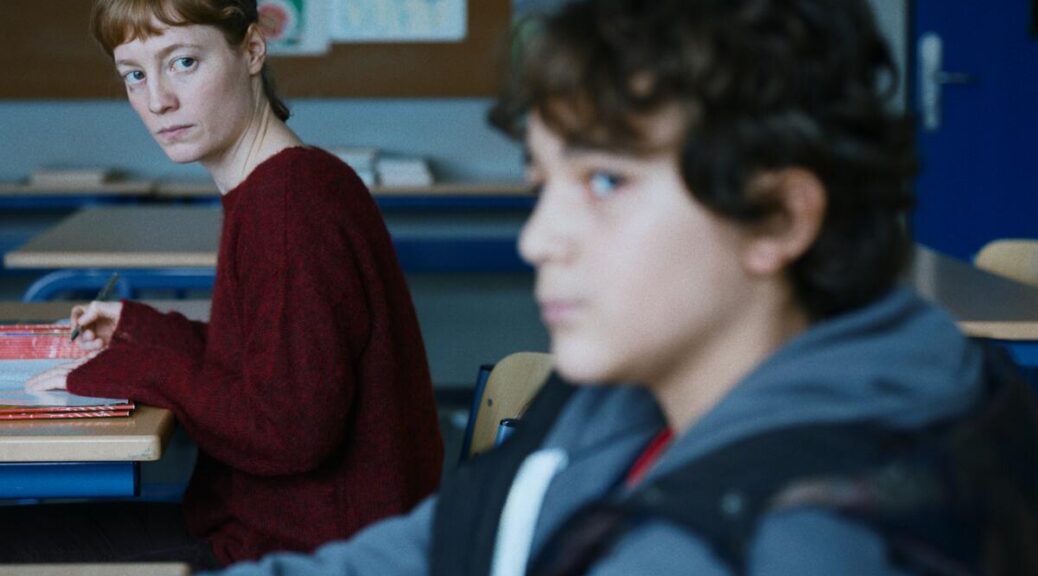
Carla (Leonie Benesch, fantastic) teaches 12-year-olds at a German grade school. Carla exchanges small talk with her fellow teachers, and doesn’t look away when she notices one who helps herself to what’s in the office coffee fund jar just minutes after Carla donated some change.
It’s a small but meaningful moment that writer/director Ilker Çatak uses to effectively illustrate Carla’s idealism, and to foreshadow her coming clash with reality.
The conflict begins to simmer when Carla witnesses two other teachers try to coerce some “good” students into naming who they think might be behind the recent rash of thefts at the school. Carla objects to the line of questioning, and reacts by using her wallet and laptop camera to set a trap and expose the guilty party.
What follows is a tense and utterly fascinating parable of accusation, distrust, paranoia and anger that has garnered an Oscar nomination for Best International Feature. Çatak crafts the school community as a Petri dish of contrasting agendas, one where teachers, students and parents fight for claims on the moral high ground.
Benesch is simply wonderful. Carla’s care for her students is never in doubt, but as the gravity of her situation begins to dawn on her, Benesch often only needs her wide eyes and tightened jawline to deliver Carla’s increasingly desperate mix of emotions.
As perspectives change, you may be reminded of Ruben Östlund’s insightful Force Majeure. But with The Teacher’s Lounge, Çatak moves the conversation to how the tribal nature of modern society can lead to separate realities, and how quickly those dug-in heels can be weaponized.
Just going by its trailer, you might not expect The Promised Land to have much in common with Saltburn, but the similar themes are there. So while there’s no shocking bathwater here – or much bathing at all – there is a sweeping historical epic of one man’s quest for social climbing.
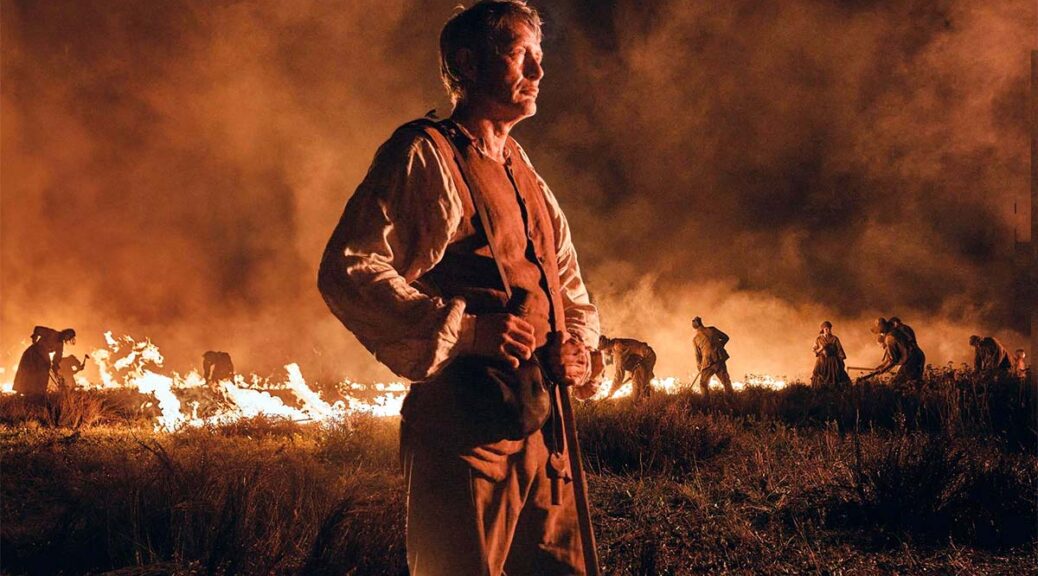
The man is Ludvig von Kahlen (Mads Mikkelsen), a longtime captain in the German army who returns home to Denmark in 1755. Desiring both wealth and honor, he visits the court of King Frederik V with a promise to bring the King what no one else has managed to deliver: settlements on the Danish heath.
Ludvig promises to tame the barren land in exchange for a noble title, a manor and some servants. And to seal the deal, Ludvig will finance the farming project with his own military pension.
Battling the elements and the roaming outlaws will be tough enough, but Ludvig also must face the wrath of sadistic county judge De Schinkel (Simon Beenebjerg), who wants to claim the land as his own and make good on his promise to Ludvig that “life is chaos.”
Director and co-writer Nikolaj Arcel adapts Ida Jessen’s historical novel as a harrowing tale that consistently reveals new layers throughout its two compelling hours.
Mikkelsen – teaming again with Arcel after 2020’s terrificRiders of Justice – is perfection as the battle-tested soldier with steely-eyed dreams of nobility. Ludvig’s arc plays out patiently, but as the Captain takes in two runaway peasant farmers (Amanda Collin, Morten Hee Anderson), a well-meaning pastor (Gustav Lindh) and an unwanted child (Melina Hagberg), Mikkelsen ensures the awakened humanity feels well-earned and real.
And Arcel keeps the stakes rising to thrilling effect. Cinematographer Rasmus Videbæk’s majestic frames serve and volley with the twists of the screenplay to mine drama that can be as subtle as a framed patch of dirt or as overt as the triangle that springs from Schinkel’s intended fiancée Edel (Kristine Kujath Thorp) eyeing Ludvig as the man who can save her.
What price ambition? It remains an intriguing question, whether you’re surrounding it with delicious ultra-modern pulp or re-imagining true events from hundreds of years past. The Promised Land takes the road less adorned, forging a rousing tale of savagery, revenge and fulfillment that will not be denied.
There’s an old adage about comedians making up jokes to hide real pain. It’s clear that for writer/director/star Leah McKendrick, there’s a very real struggle at the heart of Scrambled, and her film is better for not letting us forget that.
McKendrick plays Nellie, a 34 year-old perennial bridesmaid who clings to the “single bitches 4 life!” mantra, even as more members of her crew (including SNL’s Ego Nwodim and the always welcome June Diane Raphael) start settling down and getting pregnant.
Nellie has to face up to some harsh biological facts. Her mind and body can remain ready to mingle – but her fertility has a shelf life and the clock is ticking. So while she auditions a string of suitors from “The Nice Guy” to “The Prom King” to simply “Nope,” Nellie consults a amusingly deadpan doctor (Feodor Chin) about freezing her eggs.
Or, as Nellie’s Dad (a priceless Clancy Brown) calls it, “millennial feminist voodoo.”
McKendrick scores some big laughs with the family’s reaction to Nellie’s family planning, but this is an an issue that is very real for the first time feature director, and plenty of women like her. And beneath the jokes about Nellie’s dating habits and her parents’ longing for the return of her ex, McKendrick makes sure we see Nellie in fully formed terms.
She’s a grown ass woman choosing when and how she may want to have children. And in doing so, Nellie’s forced to navigate the social, physical, and financial barriers that can leave her feeling punished for embracing her own journey.
But Nellie moves forward – with both smiles and middle fingers. McKendrick’s recipe for Scrambled finds a nice balance of flavors, and we get a full-flavored dish of empowering humor.