Category Archives: Slider

For the homepage slider

Tough Time for a Brother’s Keeper

Out of the Furnace

by Hope Madden

Just in time for the holidays, a bleak look at desperation, blood ties, masculinity and loyalty. Welcome to Braddock, PA and Out of the Furnace.

Part Deer Hunter, part Winter’s Bone, Scott Cooper’s new film casts a haunted image of ugliness scarring natural beauty, whether it’s the steel town petering out and leaving a rusted carcass in a Pennsylvania valley, or the human nastiness up in the hills on the Jersey border.

The tale follows a pair of beleaguered brothers in America’s disappearing rust belt. It’s a deceptively simple story of being your brother’s keeper, but Cooper’s meandering storyline keeps you guessing, often entranced. Nothing is as simple as it seems, although there is an inevitability to everything that makes it feel strangely familiar.

Cooper’s camera evokes a palpable sense of place, and his script positions the film firmly and believably – but without a heavy hand – in a clear time period. The setting itself is so true and absorbing that many of the film’s flaws can almost be forgiven.

At the core of Furnace’s many successes are some powerful performances. Both Christian Bale and the endlessly under-appreciated Casey Affleck, as Russell and Rodney Baze, respectively, dig deep to uncover the anguish and resilience at the heart of the siblings’ relationship and struggles. Bale, in particular, smolders with a tenderness and deep love that is heartbreaking.

On the other hand, Woody Harrelson is just plain scary. As the villain (and excellently named) Harlan DeGroat, Harrelson goes all out, leaves nothing behind. Harlan is a Bad MoFo, no doubt, and Harrelson leaves no scenery unchewed.

Cooper stumbles here and there with his storytelling, though. There is some heavy-handed symbolism, and a letter written from one brother to another that’s almost too clichéd and trite to accept in the otherwise articulate piece of filmmaking.

Just four years ago, in his feature film debut Crazy Heart, Cooper led Jeff Bridges to his first Oscar, and Maggie Gyllenhaal to her first nomination. His sophomore effort is less assured, as if he’s trying too hard. His ability to conjure such a vivid place and time impresses, and both Bale and Affleck are characteristically wonderful, but the director can’t seem to reign in the entire cast, and he borrows too freely from other (excellent) movies.

While the stumbles aren’t crippling, they keep Out of the Furnace from the greatness it otherwise might have reached.

 

Verdict-3-5-Stars


Calling Mr. Plow!


by George Wolf


Though the animated landscape has become more crowded since the days of Beauty and the Beast and The Lion King, musicals remain solid Disney turf. Their newest is Frozen, and while not quite on par with the classics, it still offers plenty to delight the entire family.

Based on story elements from Hans Christian Andersen’s The Snow Queen, Frozen tells the tale of young Queen Elsa (Idina Menzel) and her sister, Princess Anna (Kristen Bell). The Queen has mysterious powers she struggles to control, and they have caused her kingdom to suffer under the ice and snow of a permanent winter. In sad desperation, Elsa has isolated herself in a faraway ice castle, which leads Anna, along with her friend Kristoff (Jonathan Groff) and a goofy snowman named Olaf (Josh Gad) on a quest to find the Queen and save the kingdom.

With its big-eyed princesses in peril, dashing gentlemen, wise-cracking sidekicks, and soaring odes to empowerment, Frozen feels instantly familiar. Beyond those Disney benchmarks, though, there is some irony in the casting of Menzel, who won a Tony award for originating the role of Elphaba in the stage musical Wicked.

The similarity of the character names (Elsa, Elphaba), the unfair labeling of Elsa as “evil,” and the preeminence of a sisterly relationship over the search for Prince Charming all contribute toward a winning narrative assembled from some shrewdly familiar parts.

Of course, none of these elements are above rehashing, especially in the land of fairy tales. Disney veterans Jennifer Lee and Chris Buck, sharing story and directing duties, weave them all into a fast-paced, funny adventure that will, if the audience at a recent preview screening was any indication, totally captivate the young ones.

The 3D animation is often gorgeous, as the chilly setting gives the animators ample opportunity to impressively explore drifting show or glistening ice. Inside, Anna dances past framed paintings, a clever reminder of the added dimension these artists are deftly employing.

Musically, the husband and wife team of Robert Lopez and Kristen Anderson-Lopez fill Frozen with original songs that are pleasing, if a bit unremarkable. While there’s no “Be Our Guest” or “Circle of Life” here, Menzel’s voice remains a wonder to behold no matter the material, and Bell, an accomplished singer in her own right, shows impressive versatility.

Though he’s no match melodically, Gad steals the film as the daffy Olaf. Putting his unique voice to good use with some inspired delivery, he makes a funny character even more fun, and Frozen steps more lively whenever he’s near.

Now, the big question:  how are they going to recreate this frozen tundra for the theme park tie-in in Orlando?

I’m sure those wicked minds will think of something…


Verdict-3-5-Stars


http://www.youtube.com/watch?v=x1ieZ4f-DqM

State of the Art Gaming


by George Wolf


When a movie runs two and a half hours, yet the ending arrives as an unwelcome surprise, you know that film has done something right.

The Hunger Games:  Catching Fire is that film, one that manages to do just about everything right.

From the start, it raises the stakes from last year’s franchise debut. While The Hunger Games was certainly a competent adventure, it was content (perhaps understandably) to work within the “young adult” parameters of Suzanne Collins’s source novel.

Catching Fire deals in more mature themes and sophisticated ideas, weaving an intelligent script, impressive direction and superlative performances into a massively entertaining blockbuster that leaves you anxious for the next chapter.

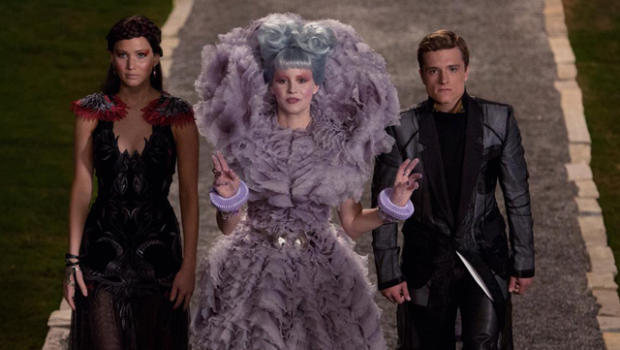
The story picks up with Katniss (Jennifer Lawrence) and Peeta (Josh Hutcherson) on their victory tour, accompanied by their ever-present handlers Haymitch (Woody Harrelson) and Effie (Elizabeth Banks). While the group is away, President Snow (Donald Sutherland) and new chief game maker Plutarch (these names!) Heavensbee (Phillip Seymour Hoffman) worry that Katniss has become a symbol of hope for the common people, a symbol which could spur another uprising.

Planning to eliminating that threat, Snow declares the next Hunger Games will be played only by former victors,  which means Katniss and Peeta will again be fighting for their lives.

While this sounds like just another empty rehashing of a successful formula, Catching Fire‘s scriptwriters, following Collins’s lead, have more on their minds.

Simon Beaufoy (Slumdog Millionaire/127 Hours) and Michael Arndt (Little Miss Sunshine/Toy Story 3), both Oscar winners, fill their script with the emotional heft needed to create a sequel which immediately creates potential for a truly memorable trilogy.

We connect with the characters on a deeper level, the sociopolitical undertones carry greater nuance, and there are even some sly parallels offered between the superstar status of Katniss and the actress playing her.

Speaking of Lawrence, well, if you’re sick of hearing she’s great, call a doctor. She grounds Katniss in vulnerability while never relinquishing the character’s heroic status. Perhaps more impressively, she sells the love triangle, making Katniss’s conflicted feelings for both Peeta and Gale (Liam Hemsworth) totally believable. And not a shirtless wolf-boy in sight..who knew it was possible?

The strong supporting cast is peppered with new faces, such as Hoffman, Jeffrey Wright, and Jena Malone , who plays against her former child star type as the edgy Johanna. Keep an eye out for her elevator scene, one of the film’s lighter moments. It’s a scream.

All the separate elements are wrapped in a nice holiday bow by director Francis Lawrence (no relation). He smoothly guides the film from spectacle to solitude and back again, providing some arresting visuals in the process (see the IMAX version if you can). Despite director Lawrence’s heretofore lackluster resume (Constantine/ Water for Elephants), the choice to keep him at the helm for the Mockingjay finale (to be split into two films) now seems totally justified.

Okay, Catching Fire does stumble here and there. The scenes of Haymitch introducing Katniss and Peeta to their new opponents seems more fitting for an American Gladiators reunion and…well, that’s about it.

Fans of the book should expect a fantastic realization of the world they imagined, while those who haven’t read the novels (like myself) get to fully enjoy the delicious twist at film’s end, one that may invoke memories of a certain empire striking back.

Either way, The Hunger Games:  Catching Fire is rousing, epic entertainment.


Verdict-4-0-Stars


http://www.youtube.com/watch?v=keT5CRhhy84

McConaughey: More than Naked Bongo Drumming

by Hope Madden

It took the man almost 20 years in the business to find his real calling, but god damn, Matthew McConaughey knows how to create a character. And Ron Woodruff was nothing if not a character.

McConaughey plays the role of the real life AIDS victim and Texan in the compelling and surprisingly entertaining Dallas Buyers Club.

Woodruff was a part-time bull rider, an occupation that almost defines him as fearless, determined, thrill-seeking, and probably not long for this world. He was man who “preferred to die with his boots on,” and he makes for an unlikely hero. After a lifetime of dangerous behavior on every level, Woodruff lands in the hospital with the news that he has HIV and a predicted 30 days to get his affairs in order.

Well, he saw that news as bullshit, and thanks to those defining characteristics, his subsequent journey makes for a singularly fascinating film.

A character-driven historical piece on the grinding reality of the dawning AIDS crisis, Dallas Buyers Club offers a glimpse at desperation, isolation, bigotry and resilience. Regardless of the facts, this is not the tragic story of a charismatic straight man struggling with AIDS. It’s the story of AIDS in Texas in 1985.

There is something formulaic, even predictable, about the film’s structure, and the screenplay speechifies here and there, but Jean-Marc Vallee’s understated direction and the performances of the entire ensemble buoy the effort above its “socially relevant biopic” label.

McConaughey’s charmingly assholish depiction is never less than compelling. He doesn’t make a saint of this man because there’s no saint to be made. What he makes him is human, an effort aided immeasurably by the supporting work of Jared Leto.

Leto plays Rayon, Woodruff’s reluctantly-accepted partner in a health care whirlwind. Their work together recalls the barbaric money grab at the heart of any attempt to cure those dying every day of AIDS. Quietly and with genuine tenderness, Leto’s performance reminds you that no one was defined by this disease alone.

Both actors are likely to be remembered come awards time, and some will point to Oscar’s preference for true stories and physical transformation. (Because of the weight lost for the roles, both McConaughey and Leto are almost unrecognizable.) Celebrating their superficial metamorphoses, though, limits their work. With the aid of a director’s steady hand and an ensemble’s quietly powerful work, they provide the heart and soul of an exceptional and surprisingly fresh true tale.


Verdict-4-0-Stars


http://www.youtube.com/watch?v=cC6mv0KhOBY

Unforgettably Explicit


by George Wolf


Make no mistake, though the sex depicted in Blue Is the Warmest Color (La vie d’Adele) is explicit enough to earn an NC-17 rating, it is the way the film is emotionally explicit that makes it one of the very best of the year.

The focus is Adele (Adele Exarchopoulos), a French teenager nearing the end of high school who loves literature and has designs on a future teaching career. Her blasé interest in a new boyfriend is forgotten when she passes the blue-haired, twenty-something Emma (Lea Seydoux) on a city street. Instantly captivated, Adele is left confused by her new feelings, and by the newfound pleasure that her fantasies of Emma can bring.

In adapting the source comic book by Julie Maroh, director/co-writer Abdellatif Kechiche has created a completely engrossing drama, one that totally immerses you in the romantic arc between Adele and Emma. Kechiche doesn’t follow a by-the-numbers narrative, choosing instead to present sketches of the the two women’s lives – both together and apart.

Kechiche’s camera lingers on nearly every moment, and though this results in a full three hour running time, the film, almost miraculously, never feels self-indulgent. Rather, the pace seems a necessity, as Exarchopoulos and Seydoux slowly allow us to develop a bond with their characters that is deep enough to share in their joys and heartaches.

The film won the Palme d’Or at Cannes, and though this has historically been a prize for directors exclusively, the jury made an exception this year, choosing to also honor the two lead actors. Indeed, their performances go beyond fearless, reaching a point of emotion so raw you begin to feel self-conscious for intruding.

Exarchopoulos, in particular, is mesmerizing. She invites you into Adele’s journey for fulfillment, never once allowing a crack in her authenticity. If there has been a better performance on screen this year, I haven’t seen it.

A film this sexually frank will inevitably attract attention, especially when a male director is presenting girl-on-girl sex scenes with this much intensity and duration (one nearly ten minutes long). It is a fact that is not lost on Kechiche.

Throughout the film, lessons from Adele’s literature studies are deftly woven into the story, with one character remarking how seldom art ponders female sexual pleasure. While this is clearly not the case here, Kechiche gives the sex scenes (including one between Adele and her early boyfriend) a messy, natural quality, devoid of swelling music or rampant romanticism.

Lust is a major part of Adele and Emma’s relationship, and though Kechiche certainly presents it in a powerful way, he doesn’t employ empty titillation in the process.

Look beyond the distractions, and Blue Is the Warmest Color becomes a love story that nearly explodes with a timely urgency, one told with such depth, humor and humanity it simply cannot be ignored.


Verdict-4-5-Stars


Hammer Time!


by George Wolf


The very superhero nature of Thor presents a catch-22 for his standalone film installments. The medieval themes which anchor the character don’t really lend themselves to the fun we expect from Avengers films, yet leaving these themes behind would render any Thor adventure rather pointless.

The first film found a way to balance things quite nicely, establishing the blueprint that Thor:  The Dark World revises in even more impressive fashion.

The filmmakers made two smart moves right off the bat:  1) making Jane Foster (Natalie Portman) more than a bystander, and 2) bringing Loki (Tom Hiddleston) back for another round.

Well-rounded villains can make or break these films, and, in Hiddleston’s capable hands, Loki is the most interesting character on the screen. Sentenced to life in an Asgard prison by King Odin (Anthony Hopkins, finding just the right regal tone), Loki suddenly finds himself in high demand.

On Earth, Jane has stumbled into one the portals between worlds, and she becomes the keeper of something an ancient Dark Lord wants very badly. To save Jane and, a bit more importantly, the universe, Thor and Loki have to put aside old grudges and work together.

Director Alan Taylor comes with some serious medieval bonafides, directing several episodes of …pause for a moment of suitably reverential fanboy silence…Game of Thrones. His instincts for the pacing and framework needed to keep the Asgard scenes vital is spot on. While this may not be surprising, Taylor also shows himself to be more than capable of keeping the fun meter jumping as well.

The lively script, while a bit complicated in the early stages, settles into a very enjoyable rhythm that Taylor exploits well. Expect some nice surprises, of both the dark and light variety, as the film builds to an impressive final battle. Screenwriters Christopher Yost,  Christopher Markus and Stephen McFeely even manage to land a few subtle jabs about the folly of war and how easily one army’s hero can resemble another’s zealot. Well played.

As Thor himself, Chris Hemsworth again displays a mix of charisma, physique and temperament that makes the role his own.  His scenes with Hiddleston are a mischievous hoot, both actors seemingly locked in to both their characters and the expectations of one another.

Aside from one curiously low-tech moment of Thor taking flight, much of the film’s 3D presentation looks fantastic, with a broader, more heroic gloss. In particular, an Asgard ceremony set amid candle lights and waterfalls is downright stunning.

The only thing keeping Thor:  The Dark World from superhero elite status is a first act that drags a bit. Once that is vanquished, acts two and three bring richer storytelling than we have seen from Thor. Yes, this film is darker, but it’s also more fun.

And, keep in your seat for two extra scenes.


Verdict-3-5-Stars


Transcendent Filmmaking

12 Years a Slave

by Hope Madden

Remarkable, isn’t it, that it took a foreign-born filmmaker, with the help of a mostly foreign-born cast, to properly tell the shamefully American tale 12 Years a Slave.

Steve McQueen is the British director who artfully and impeccably translates Solomon Northup’s memoir of illegal captivity to the screen. Northup, played with breathtaking beauty by Chiwetel Ejiofor, was a free family man in New York State, a violinist by trade, duped, drugged, shackled and sold into slavery in Louisiana. We are privy to the next 12 years of this man’s life, and while it is often brutally difficult to watch, it’s also a tale so magnificently told it must not be missed.

Chiwetel Ejiofor is an intense talent, though you have likely never heard of him and have possibly never seen him. But if you happened to have come across Britain’s 2002 thriller Dirty Pretty Things and spied his tender, heart-wrenching turn as Okwe, a Nigerian immigrant fallen into sketchy company in London,  you knew he was destined for great things.

He’s found that destiny in 12 Years a Slave.

The clear Oscar frontrunner, Ejiofor is not alone as a favorite this award season. McQueen populates his understated, graceful picture with one of the most perfectly chosen casts in memory. Even the smallest role leaves a scalding impression. Whether it’s Paul Giamatti’s casual evil, Benedict Cumberbatch’s cowardly mercy, Paul Dano’s spineless rage or Adepero Oduye’s unbridled grief, there’s an emotional authenticity to the film that makes every character, no matter how brief their appearance in Northup’s odyssey, memorable – sometimes painfully so.

But there are three performances you will likely never forget. Principally, there is Ejiofor, a performer who expresses more conflict, anguish and thought with his eyes than most actors can hope to share in an entire performance. His work roils with emotions few would care to consider, and never does he bend to melodrama or overstatement.

In her film debut, Lupita Nyong’o’s almost otherworldly performance marks a profound talent.

Meanwhile, as the sadistic Master Epps, Michael Fassbender’s performance guarantees to be the most brilliantly unsettling piece of acting found onscreen this year. There is no stronger contender in this year’s Oscar race for best supporting actor, and likely none will show himself. He’s terrifying, and his performance feeds off the talent around him. The raw energy among the three – Fassbender, Ejiofor and Nyong’o – is sometimes too much to bear, and the three share a few scenes that are nearly too powerful to take in.

McQueen does not let the cast run away with his picture, though, and he mines a deep human beauty from Northup’s journey. He never forgets that while justice requires that Northup be delivered from slavery, it remains blind to all those people left on Epps’s plantation, many of whom faced a far more dire existence than Northup.

No romanticizing, no comic relief, just the abject truth of what will happen to a man, a woman, a young boy, and a little girl who is owned outright by the kind of human who believes owning another human is justified. It’s almost beyond comprehension, due not only to the fact it happened for 250 years in our own history, but  because across the globe, it still happens every day in the world’s booming sex trade industry.

12 Years a Slave transcends filmmaking, ultimately become an event, one that is destined to leave a profound, lasting impression.

Verdict-5-0-Stars


Grandpa’s Off His Meds Again!


by Hope Madden


If you can look past the entire scenes that Bad Grandpa lifts from Borat, Pee-wee’s Big Adventure, and Little Miss Sunshine, you might see two things:   1) A lot of Columbus, Ohio  2) A decent little comedy.

A Jackass production, the film operates Borat-style, as “grandpa” has to drive cross-country to deliver his grandson to a sketchy father. The two stop periodically along the way to convince polite Midwesterners, such as the kindly folks at my neighborhood diner Paul’s 5th Avenue (don’t you dare call it Paul’s Pantry!) that both man and boy are behaving very badly.

There are some really inspired moments, as well as a lot of asinine entertainment. Part of what makes the film work as well as it does is the obvious delight Johnny Knoxville, playing Grandpa Irving, takes in his young co-star Jackson Nicoll. And why not? Nicoll is genuinely delightful.

The kid’s hilarious – a deadpan genius – and Knoxville makes excellent use of his wee accomplice as well as some pretty effective old man make up to prank the unsuspecting grocery clerk, stripper, biker, mover, mourner, wedding guest, and Grandview Heights restaurant patron.

The film’s antics are mild when compared to the rest of the esteemed Jackass canon, and connecting them with a narrative sometimes works but often doesn’t. The same can be said for the string of hanging-testicle sight gags.

Bad Grandpa often feels forced and a bit derivative, but when it hits, it’s hilarious and there’s no denying the joyous chemistry of the two leads. Their giddy charisma is infectious, and it makes for a shamefully enjoyable waste of 90 minutes. (But be sure to waste the full 90 as the outtakes and behind-the-scenes shots are characteristically amusing.)


Verdict-3-0-Stars


What’s in a Name?

Carrie

by Hope Madden

Back in ’76, Brian De Palma brought Stephen King’s first novel, Carrie, to the screen and a terrifying vision of persecution and comeuppance emerged. But that was almost twenty five years before Columbine, and the image of the bullied and confused wreaking bloody revenge at a high school has taken on a different tenor.

That’s no doubt why King’s tale made its way to television in 2002 with a fresh take on the horror. But things in high school have changed again, and the story of Carrie White takes on particular tragedy in a wired time where another innocent high school girl takes her life almost weekly due to bullying. Perhaps that’s what drew filmmaker Kimberly Pierce, whose Boys Don’t Cry also outlines the tragedy that befalls a young woman violently unaccepted for who she is.

In Pierce’s hands, Carrie offers more stripped down drama – none of the scenery chewing of the De Palma original. There’s no humor to be found in the reboot, but realistic performances and updated context give the film enough bite to keep you watching.

Chloe Grace Moretz takes on lead duties as the youngster whose first monthly flow triggers all manner of havoc, from the most unconscionable bullying to telekentic powers. Oh, and her mom tries to kill her. So, not the blessing those Health Ed books try to tell us it is.

Moretz has a big prom dress to fill, and though she has always been a reliable talent, her turn here is unconvincing. Sissy Spacek truly was that innocent, a girl so repressed by her religious mother that she had no conscious knowledge of appropriate social behavior. Moretz is a cute, shy girl the mean kids dislike. It’s not the same.

The always exquisite Julianne Moore actually has an even larger task cut out for her. The role of Margaret White is a juicy one. Even the TV version drew the great Patricia Clarkson to the project. And Moore is characteristically strong, clearly defining the role in a terrifying yet almost sympathetic way. But she’s no Piper Laurie.

Laurie brought such vitality and insanity to the role that the prom became almost secondary, and her chemistry with Spacek was eerily perfect.

The updated context casts a truly saddening shadow over the film, making a major thematic adjustment without even trying. Stephen King wrote a story about hysteria over the dawning of womanhood. But today, the story carries an even darker message. Carrie is a cautionary tale about sending your kids to high school.


Verdict-3-0-Stars

Tonight There’s Gonna be a Jailbreak!


by George Wolf


As nonsensical, potentially offensive and completely ridiculous as it is, Escape Plan does enough things right to render it more entertaining that you might expect.

Think of it as residing in the Face/Off neighborhood, where a film embraces its outlandishness so convincingly you eventually surrender under the weight of the escapist fun to be had.

Of course, that film had two of the all-time greatest hambones, John Travolta and Nicolas Cage, operating at maximus overacti. Escape Plan has Stallone and Schwarzenegger, two aging action stars trying to prove they still have box office juice.

To its credit, the film doesn’t even address the age factor, even though it is very easy to imagine stars such as Dwayne Johnson and Mark Wahlberg in the lead roles.

Sly is introduced as Ray Breslin, the leading expert in structural security. He routinely puts his skills to the test by assuming the identities of inmates in various prisons and then going full MacGuyver to expose security weaknesses by busting out with little more than toilet paper and a used carton of chocolate milk.

Breslin’s firm gets an outlandishly lucrative offer to test the limits of a…cough, cough…”off the grid,” black-ops type prison in an undisclosed location. Despite concerns from his co-workers, Breslin goes in, realizing almost immediately he’s been set up, and must enlist the help of a mysterious new friend on the inside (Arnold) to break out for reals.

Director Mikael Hafstrom (The Rite/Derailed) wisely chooses to keep matters focused on action and away from any cheesy attempts at tongue in cheek humor. Less successful are his depictions of Muslim inmates and scenes of enhanced interrogation.

Giving the film a “Blackwater” setting may have been an attempt by screenwriters Miles Chapman and Jason Keller to address a timely topic. Instead, they toss the dark realities of torture around so flippantly the film comes dangerously close to making light of the entire issue. Muslim stereotypes don’t help either.

Still, there’s action aplenty amid some clever twists, an effective supporting cast (Amy Ryan, Sam Neill, Vincent D’Onofrio and a surprisingly emotive Jim Caviezel), and Arnold, at least, seems to be having a blast getting back in the saddle.

Maybe they’re not too old for this shit.


Verdict-2-5-Stars