Category Archives: New In Theaters

Reviews of what’s out now

Sea of Love

On Chesil Beach

by Hope Madden

Saoirse Ronan is a treasure. The fact that she follows up one raucous, very American coming of age film (Lady Bird) with a delicate, very British coming of age film (On Chesil Beach) without hitting a false note is hardly a surprise. She is maybe the most versatile talent of her generation.

On Chesil Beach reunites the performer with novelist Ian McEwan, whose Atonement garnered Ronan her first Oscar nomination back at the tender age of 13.

Adapting his own novella this time around, McEwan deliberates on the romantic struggle of two young lovers, Florence Ponting (Ronan) and Edward Mayhew (Billy Howle, who also co-stars with Ronan in an upcoming adaptation of Chekhov’s The Seagull).

Florence is a highly-strung classical musician from money. Edward comes from less, hopes to write history books and sometimes behaves rashly. Regardless of their differences, they are endearingly in love.

They are also identifiably at an age where a person may see this very moment in time as the only moment, the only way it will ever be, the only way they will ever feel. This terrifying, ignorant, innocent moment is something Howle, Ronan, McEwan and director Dominic Cooke capture effectively.

Elsewhere, they falter.

The film and its story revolve around one night on Chesil Beach where the two newlyweds contemplate their present and future while we’re given a glimpse of their past. For a number of different reasons (some explained, some just suggested) Florence has an abiding revulsion of sex.

Edward does not.

Expectations, yearnings and dread come to a boil on their wedding night, when a lack of wisdom and an abundance of insecurity convince the two (one of them quite rashly) to make a questionable decision.

Though Ronan’s performance perfectly captures both Florence’s love and her reticence, Howle struggles to convince as an impetuous, even volatile young lover. He seems nervous and sweet, and every sudden outburst feels out of place.

Director Dominic Cooke, known primarily for stage work, has trouble creating a welcoming atmosphere. Cooke keeps you at arm’s length from the lovers, less likely to empathize with them than to judge.

The gravity of one rash decision weighs heavily on both, and though McEwan’s beloved pages may make that felt, Dominic’s film does not, so when we revisit Edward years after that pivotal moment at the beach, it’s tough to buy his situation or feel much for him.

On Chesil Beach is a pretty film and a nice story, but never finds the depth to break your heart.

Family Jewels

Ocean’s 8

by Hope Madden and George Wolf

More than 15 years ago, Steven Soderbergh recast the Rat Pack, pointing out a set of Hollywood A-listers led by George Clooney who were as stylish and cool as Sinatra and the fellas.

Three films later (four, if you count Soderbergh’s hillbilly version Logan Lucky, and you should) and the Ocean family is drawn once again to the big payoff.

This time it’s Danny Ocean’s sister Deb (Sandra Bullock). A life of crime runs in the family, it seems. Fresh from incarceration, Deb is looking to execute the con she’s been fine tuning over the last 5 years in lockdown.

What Debbie needs is a team, and she knows what kind.

“A ‘him’ gets noticed. A ‘her’ gets ignored.”

That’s a line well-placed and well-played, and though the film seems awfully familiar from the jump, that’s not necessarily a bad thing. The music bumpers, throwback scene segues, strategy meetings and comfortable pacing set the cool vibe, and Ocean’s 8 is cheeky enough in its outright impersonation of the previous installments to shrug off feeling derivative. Instead, it comes off as second class, which may be more disappointing.

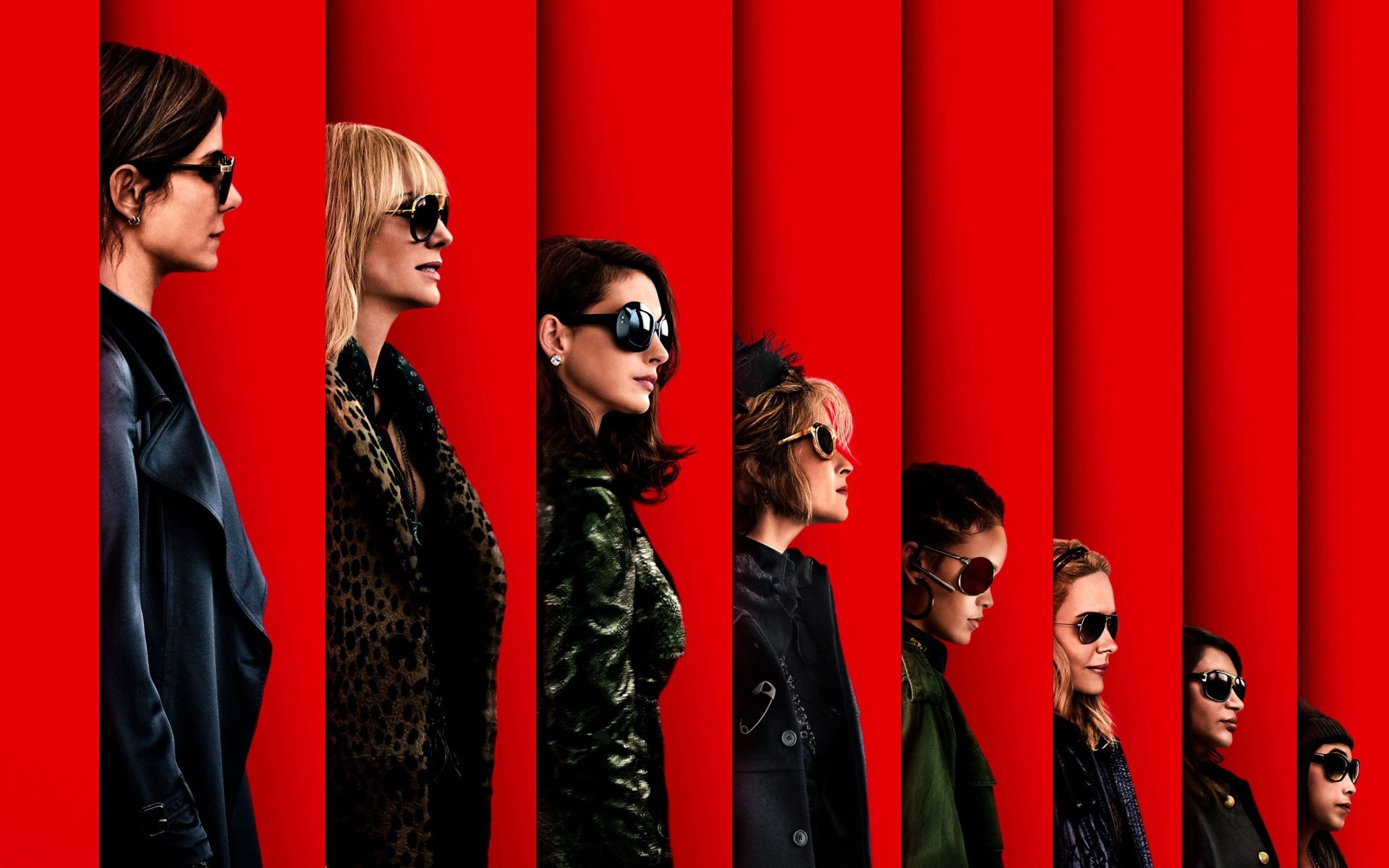
Though director Gary Ross (The Hunger Games) can crib the style—his cast (including Cate Blanchett, Sarah Paulson, Helena Bonham Carter, Mindy Kaling, Rihanna and a spunky Awkwafina) can’t generate the same chemistry. No one does a bad job, far from it, but Ocean’s 8 lacks the overlapping dialogue and easy rapport of earlier efforts. They have the talent, they just don’t have the material.

Anne Hathaway is the real thief in this caper, stealing every scene with a fun and funny send-up of the Hollywood diva persona (including her own). James Corden, popping in as a fraud expert investigating the theft of a multi-million dollar Cartier necklace during the Met Gala, brightens up the third act as well with his fresh perspective and savvy delivery.

Otherwise, the side characters are neither as meaty or as interesting as in previous franchise efforts. Surprisingly it’s Blanchett who disappoints most. Too dialed down, her Lou lacks the color and definition to be effective as Debbie’s second banana, and Blanchett’s casual greatness feels wasted.

The best of the Ocean’s films rely on sharp characterizations and sharper sleight of hand. You believe you’re watching the con unfold only to find that …whaat?….the real heist was somewhere you weren’t looking. It is you who’s been conned.

While 8 follows that formula it succeeds only to a degree, its script simply not crisp enough to charm you into buying all in. The con itself is not believably intricate and Ross, who co-wrote the screenplay with Olivia Milch, cops out in act three with heavy exposition.

But hey, heist movies are fun, and movies with this much star power are fun. Ergo, Ocean’s 8 is a fun time at the movies.

Glitzy, forgettable fun.

Men and Monsters

Mary Shelley

by Hope Madden

Mary Shelley was a fascinating person. She was the offspring of a radical feminist, sure. Still, what fire it must have taken to abandon societal pressures at the time in favor of a scandalous relationship with the married Percy Bysshe Shelley.

Of course, she was 16 and 16-year-olds make poor decisions.

Mary famously went on to outdo both her poet/philosopher husband and his poet/lover Lord Byron when, during a rainy spell in their summer together, they took part in a challenge to write a ghost story.

What then, did Byron or Percy Shelley write? Who can recall? But we do remember Mary’s.

Mary Wollstonecraft Godwin penned Frankenstein: or, The Modern Prometheus when she was 18 years old.

Such a life story would seem like fertile ground for a stirring biopic.

We’ll have to settle for Haiffa Al-Monsour’s stiff and middling effort, Mary Shelley.

Elle Fanning portrays Mary, a melancholy rebel who has yet to find her literary inspiration or her voice. She does become muse to Shelley (Douglas Booth), a handsome scoundrel more opportunistic than idealistic.

The film hopes to encapsulate the abandonment, longing and loneliness that fueled the creation of Mary Shelley’s novel, and more directly, her creature. But there is no life in these scenes—none of the gumption that must have fueled Mary’s early decisions.

Fanning’s listless performance casts an awfully prim shadow. She’s surrounded by perfectly reasonable if somewhat anemic turns by her supporting cast. All this subdued hush only makes Tom Sturridge’s bluster that much more, easily stealing scenes as the lothario, Byron.

Al-Monsour seems unsure of her intent. She struggles to illustrate the power struggle between male and female inside this free-loving environment. But more than anything, she fails to find any kind of spark or passion to propel her central character or her film.

Captive

Beast

by Hope Madden

An outsider love story, a chilly whodunit, a psychological thriller—Beast is all and none of these.

This remarkably assured first feature from writer/director Mark Pearce keeps its focus on Moll (Jessie Buckley), the highly-scrutinized woman living with her parents in a small island community.

We open serenely enough on an angelic church choir rehearsing, a peace that’s harshly broken by the choir leader’s remark: I need more from you, Moll.

Geraldine James is haughty Hilary Huntington, the choirmaster; Moll is her grown daughter.

Soon a rugged stranger draws Moll out of her unhappy life, makes her feel awake and seen. She is destined to love this boy regardless of the string of missing girls in her village, regardless of his shady past, and in spite of the warnings of the smothering community.

Pearce’s skills keep you entranced, no matter the tropes he so easily picks up, throws off or reinvents. Sunlight, shadow, earth, sea—all these serve the visual storyteller’s purpose, while angles and frames keep you off kilter as you puzzle through the tale at hand.

You’re as invested, cautious and curious as Moll, but it’s actually Buckley’s performance—her depiction of Moll’s internal conflict—that is the most compelling and mysterious. As Moll changes demeanor, exploring her own identity becomes more important than determining her lover’s.

Johnny Flynn impresses as well as the local no-account presumed guilty, sharing a misfit chemistry with Moll that is both primal and tender. Tenderness is not what she’s used to from her severe mother, an epic James.

Together with the washed out colors of the characters’ bleak world, the film offers a harsh backdrop for Moll’s dizzying grasp on her own reality. The conflict, duality and self-discovery in Beast cannot help but draw you in, asking you about your own inner beast.

Without hitting a single false note, no matter the choir leader’s opinion, Buckley ushers us through a moral quagmire with a fire and authenticity that is gorgeous to behold.

Checking Out

Always at the Carlyle

by Rachel Willis

There are a few directions a film can take when focusing on a hotel with the kind of history as the Carlyle Hotel in Manhattan. A historical retrospective of its place in New York would have cemented the hotel as one of the city’s vibrant hearts. A simple history of the hotel itself and its early struggles after opening during the Great Depression and its rise to prominence could have proved an interesting subject if explored.

However, director Matthew Miele focuses his documentary, Always at the Carlyle, on the shallowest of subjects—the hotel’s many famous guests.

A good chunk of the film feels like a promotional advertisement. Interviews with hotel staff highlight the hotel’s charms without diving too deeply into those charms. One of the staff was given the opportunity to stay in the room that Princess Diana frequented on her visits to New York. When asked by Miele if the room’s $10,000 per night fee is worth it, she says yes. It’s hard to imagine her saying anything else.

The rest of the film is interviews with its rich and famous guests. From George Clooney to Angelica Huston to Lenny Kravitz to Sofia Coppola, we’re told repeatedly why they find the Carlyle so inviting. They hint at scandals and extravagant parties, but no one ever divulges anything truly interesting.

There’s a lack of cohesion to the story Miele is trying to tell, so it’s not entirely clear what he hopes to accomplish. Part of the documentary focuses on the upcoming arrival of William and Kate, the Duke and Duchess of Cambridge. From the initial call booking the room to the couple’s arrival, it could have been a lynchpin for the movie, but their story is abandoned half-way through the film. Instead, it’s simply another entry into the Carlyle’s roster of celebrity guests.

Miele’s film is, in some ways, representative of the worst of our celebrity-obsessed culture. It equates wealth with class, fame with sophistication, and the past as a time when things were “better.” It’s the same kind of culture that led to the death of the hotel’s frequent visitor, Princess Diana.

While The Carlyle may have an interesting story to tell, this documentary doesn’t do it.

KITT, Meet Stem

Upgrade

by Hope Madden

It’s a setup you’ll recognize. A man, doing man’s work, brightens when his wife arrives. Oh, they are really in love. Let’s just do this one thing before the romance, OK honey?

Minutes from now, she will be dead, he will be damaged, and eventually his suicidal melancholy will fuel revenge.

From Death Wish to John Wick to Death Wish (again), it’s a premise that never goes out of style and never, ever surprises.

Credit writer/director Leigh Whannell and star Logan Marshall-Green (The Invitation) for keeping you entertained for 90 minutes.

Marshall-Green plays Grey. While all the rest of the world relies on technology to drive them around, buy their eggs and dim their lights, Grey’s in the garage listening to blues on vinyl and rebuilding a Trans-Am.

After the aforementioned tragedy, Grey reluctantly turns to a Cyber Victor Frankenstein type (Harrison Gilbertson, a little over-the-top), who implants a chip to help repair the physical damage.

What happens from there is like Knight Rider meets David Cronenberg.

Right?!

Whannell freshens up the technophobe dystopian narrative with a few fresh ideas, a silly streak and serious violence.

This is the guy who wrote Saw, after all. Those who are surprised by the inspired bloodshed probably haven’t seen his canon.

Marshall-Green shines when he’s not morose and lovelorn, but rather tentatively administering “justice.” His physical performance and the action sequences are enough to keep you interested; the strangely comical tone rewards you for your time.

Aside from Betty Gabriel (always a joy to see her), the performances around Marshall-Green are serviceable: the devoted mom, the icy mercenaries, the boundlessly loving wife. Luckily, this is Marshall-Green’s show. Though he struggles (as does Whannell) with the emotional bits, he’s more than at home with the goofy and the violent.

Long live the flesh!

Current Events

Adrift

by George Wolf

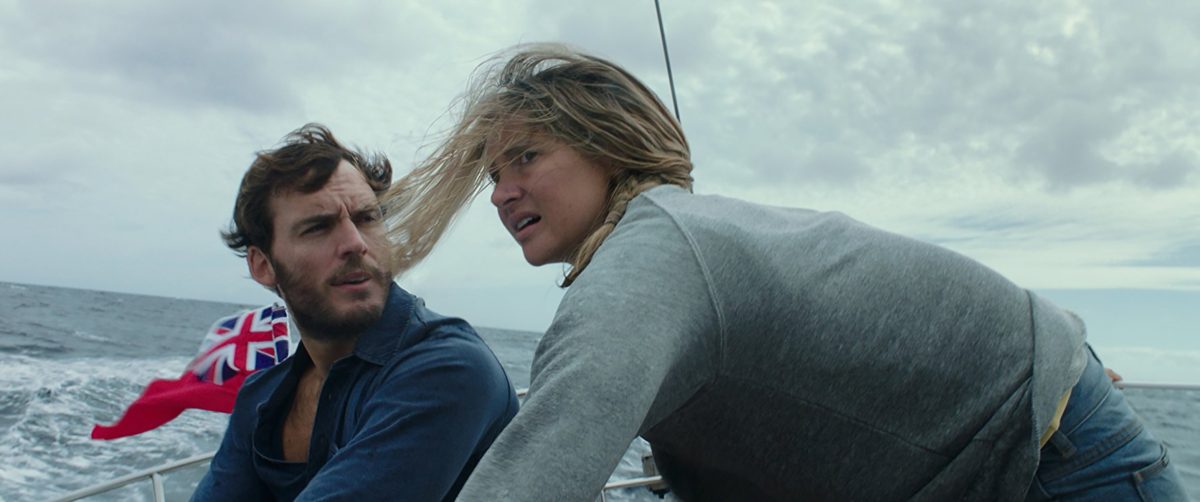
Opening with an extended take that efficiently moves us from confusion to desperation, director Baltasar Kormakur sets the gripping stakes of Adrift with scant dialog. His closing is equally effective, showcasing a touching humanity with nuance, and hardly a spoken word.

The journey in between is literally harrowing but cinematically uneven, a sometimes gritty testament to survival that is too often satisfied with the path more traveled.

Adapted from a memoir by Tami Oldham (Ashcraft), the film recounts her incredible ordeal surviving over month at sea in the aftermath of 1983’s Hurricane Raymond.

Oldham was traveling the world through odd jobs in exotic locales when she met fiancee Richard Sharp during a stay in Tahiti. Englishman Sharp, an experienced sailor, docked his own vessel and accepted a lucrative offer to sail a friend’s 44-foot yacht back to San Diego.

Oldham, a San Diego native with limited sailing knowledge, came aboard.

Shailene Woodley, also earning a producer credit on the film, stars as Oldham, instantly establishing an important and authentic chemistry with Sam Clafin as Sharp. The nautical metaphors (with Oldham drifting though life until Sharp becomes her anchor) may be hard to miss, but they go down easy through the talents of the lead actors.

A true life adventure such as this brings some inherent challenges to the big screen, and Kormakur meets them with understandably familiar narrative choices.

The time alone at sea is layered with flashbacks to how Tami and Richard’s bond was formed, both deepening our connection to them and breaking up the lonely stretches at sea through crowd-pleasing fun and romance.

As the situation grows more desperate, pleasing flirts with pandering, and Kormakur weakens the emotional impact with some unnecessary spoon-feeding.

When the couple sails into the teeth of the hurricane, it bites hard, giving Kormakur (Everest, 2 Guns, Contraband) the chance to flash his action flair via a breathtaking storm sequence.

The film’s tale is truly compelling, and it does deliver satisfying stretches while staying cautious of any narrative risks that might seem disrespectful.

Even at its most dangerous, Adrift feels ironically safe.

Good Day Sunshine

Let the Sunshine In

by Hope Madden

Claire Denis + Juliet Binoche = yes, please.

For her latest, Let the Sunshine In, the unerringly insightful French filmmaker takes on middle aged dating, following behind an exasperated Isabelle (Binoche) as she rotates through a series of relationships in Paris.

Isabelle is an artist, though her work—and her 10-year-old daughter, for that matter—are trivialities here. The point is the journey toward that last, real companion for the rest of the journey.

Could it be the boorish, married banker (Xavier Beauvois, flawlessly intolerable)? The boozy but oh-so-dreamy stage actor (Nicolas Duvauchelle)? Sensitive artist (Denis regular Alex Descas)? Brooding guy with the smooth dance moves (Paul Blain)? Ex-husband (Laurent Grevill)?

Whew! Who needs a rest?

Don’t look for any additional plot here. Denis’s focus, through a circuitous story of relationships crumbling, rekindling and sparking for the first time, simply illuminates the passionate daily trivialities of mid-life dating. She strips away nearly everything besides the ups and downs of Isabelle’s romantic life, sometimes skipping weeks at a time to pinpoint not the relationship itself, but each beginning and end.

And, of course, that intoxicating moment of promise —of love? Sex? Rejection? Few filmmakers capture that one moment, breathless and nervous, as authentically as Denis does.

It’s dizzying. No wonder Isabelle’s always so tired.

Binoche’s generous performance as the self-sabotaging Isabelle embraces the insecurities, optimism and neediness that color the character’s quest. Though never laugh-out-loud funny, the film is a comedy of sorts. There is something absurd about the assault of highs and lows, the desperate lurches toward love and the inevitably disappointing consequences.

And then a big cry and she’s off again.

Though Isabelle is a frustrating, often unlikeable character, the film never judges her. It’s too late to settle, which is a dangerous, selfish, vulnerable decision to make.

Good for her.

Pretty Vacant

How to Talk to Girls at Parties

by Hope Madden

Oh, the fish out of water tale. What if X found itself in Y: a mermaid in New York City, an American werewolf in London, an alien in Croyden? What hijinks could arise!

Elle Fanning is that alien, Zan, and Croyden is a suburb of London that was, in 1977, thrashing about to the strains of the burgeoning and decaying punk rock scene.

When Enn (Alex Sharp) and his fanzine-writing mates stumble into an alien house party, believing it to be a punk show after party, Zan abandons the strict duties of her visit to experience life on Earth.

Who better to bring Neil Gaiman’s short story to the big screen than Hedwig himself, John Cameron Mitchell (Hedwig and the Angry Inch, Shortbus, Rabbit Hole)? Directing, as well as co-writing the adaptation with Philippa Goslett, Mitchell strives to complete Gaiman’s 18 pages with punk attitude, coming of age angst, romance, political asides and style.

He’s only marginally successful on any of those counts.

Punk rock seems a perfect vehicle for the central themes of conformity versus individuality. What the film needs is a little punk rock. Instead, it offers knowing lip service (and next to no music) in service of an all-too-earnest love story.

The brightest light glimmers from Nicole Kidman as grand master on the scene, Queen Boadicea. Patroness of the dingiest club, bondage artist and the dying spirit of an era not meant to age well, she relishes every ridiculous line and delivers perhaps the film’s only truly honest dialogue.

Fanning captivates, as is her way. All the joy, curiosity and misunderstanding she can muster create a character who becomes far more than simply the first hot girl to pay attention to Enn.

Sharp performs solidly as the wallflower everyman, although that is part of the problem. Scribblings, safety pins and zines aside, Enn is just a middle-of-the-road sweetheart. The film is not about the outsider at all, though it pretends to be.

It pretends a lot of things, sometimes very colorfully and often entertainingly, but without a raucous atonal tune to push it forward and with a fairly lukewarm crisis to overcome, it fails entirely at embodying the punk rock themes it proposes.

Oh my God, this movie is a poseur.

What would Hedwig think?

Cowboy Up

The Rider

by Hope Madden

The classic western, the cowboy story, sings a song of bruised manliness. Chasing destiny, sacrificing family and love for a solitary life, building a relationship with land and beast—there may be no cinematic genre more full of romance.

This is the hardscrabble poetry that fills writer/director Chloe Zhao’s latest, The Rider.

Set on the Pine Ridge Reservation in South Dakota, the film shadows talented rodeo rider and horse trainer Brady (Brady Jandreau), who’s suffered a near-fatal head injury with lingering seizures and must now grapple with his future and his identity.

It’s a classic cowboy tale, really: will he give up cowboying because it will surely kill him, or will he get back up on that horse?

But what Zhao’s film avoids is sentimentality and sheen. With a hyper-realistic style showcasing performances by non-actors who lived a very similar story, she simultaneously celebrates and inverts the romance that traditionally fuels this kind of film.

Elegant and cinematic, but at the same time a spontaneous work of verite, The Rider breaks its own cinematic ground.

Images of real poverty butt up against lonesome vistas, a sole horse breaking up the line of the sunset. There’s no glossing over the realities Brady is facing when picking through what kind of future is left for him if he’s not a cowboy. The story is even clearer about what’s ahead of him if he is.

The Rider’s subject matter authenticity gives it the feel of a documentary. But because of the way Zhao plays with light, uses music, and fills the screen with the desolate beauty of the American plains, the film qualifies as a sleepy epic.

Zhao’s work is unmistakably indie, not a born crowd-pleaser, but beautifully lifelike. She has given new life to a genre, creating a film about the loss of purpose and, in that manly world of the cowboy, masculinity.