Tag Archives: Matt Weiner

Remembrance of Things Past

Our Father, the Devil

by Matt Weiner

Much of contemporary horror and thrillers have found chilling but abstract ways to exorcise trauma. Ellie Foumbi’s feature debut Our Father, the Devil is a haunting and welcome twist on the formula, with its all-too-human demons and a direct confrontation of the horrors of the past.

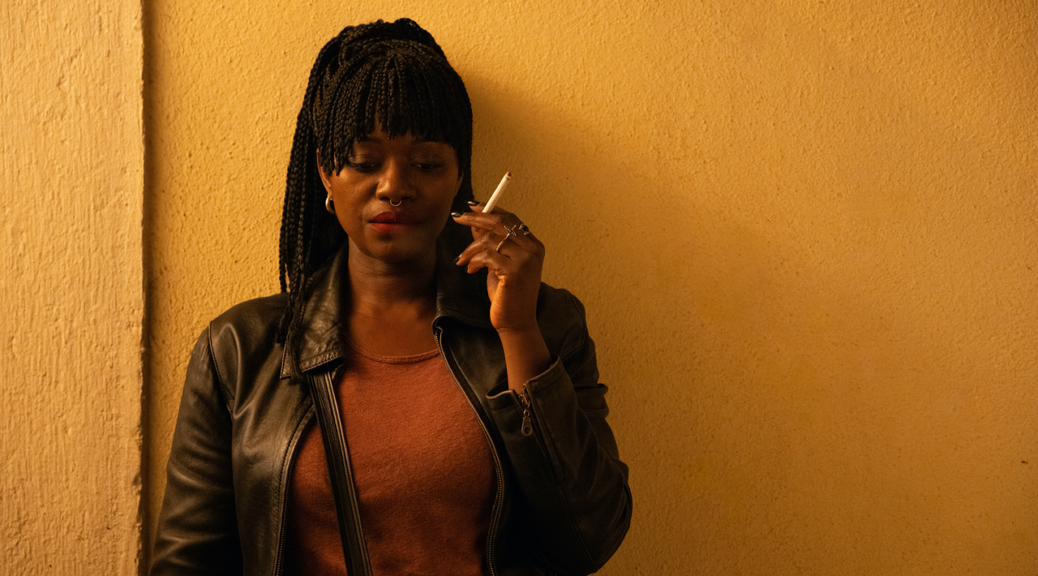
Marie (Babetida Sadjo) enjoys her work as a chef for a retirement home in southern France. She treats the elderly residents humanely, to the extent that she is gifted a family cottage from the kindly Jeanne (Marine Amisse), a former chef who also happened to get Marie the job as her star pupil.

It’s a slow burn in the bucolic countryside until the arrival of Father Patrick (Souléymane Sy Savané). The mere sound of the priest’s voice causes Marie to panic, a feeling that is later confirmed during a taut exchange alone between the two that triggers a distinct memory for Marie.

This tension is broken with a fateful outburst from Marie, who knocks the priest out and ties him up at her new cabin. She suspects that Father Patrick is actually Sogo, a supposedly dead warlord who murdered Marie’s family in Guinea and abducted her into his army of child soldiers.

The rest of the film is a tense, unblinking interrogation of what this reality means for Marie and the life she has left behind. The escaped war criminal hiding in plain sight has been fodder for plenty of films and procedurals, but Foumbi’s humane script and deft direction quickly elevate the uncertainty from material to spiritual doubt.

The horror of what Marie—and perhaps Father Patrick—have witnessed and done to others points to a deep, existential rot. Foumbi does not shy away from the moral complexity of Marie’s pursuit of vengeance.

And while the “Is he / isn’t he” part of the suspense is cleared up surprisingly early, electric performances from Sadjo and Savané and their interplay together keep the tension at almost unbearable levels for most of the film. Foumbi’s script eschews condemnation and easy answers in equal measure, and it wouldn’t work without the nuanced turns from the leads. Our Father, the Devil throws up a lot of weighty questions around forgiveness and salvation. The film is less concerned with answering those questions, but then that’s also the point. Escaping a cycle of trauma and abuse is hard. But not as hard as forgiveness.

Screening Room: Meg 2, TMNT: Mutant Mayhem, Shortcomings, Final Cut, Night of the 12th & More

Land of Old Tropes

Mob Land

by Matt Weiner

Stop if you’ve heard this one before… good-hearted, small-time criminals get caught up in a web of violence and forces far beyond their control, with a dash of social commentary and vague nods toward the senselessness of the universe and fate.

Mob Land, the feature film debut from Nicholas Maggio, could at a distance be mistaken for any number of neo-noirs it borrows heavily from. Strong, silent Shelby Conners (Shiloh Fernandez) relies on what work he can get—legal and otherwise—to support his family in rural Alabama. When his brother-in-law Trey (Kevin Dillon) comes up with a plan to rob a local pill mill, Shelby tags along as wheelman.

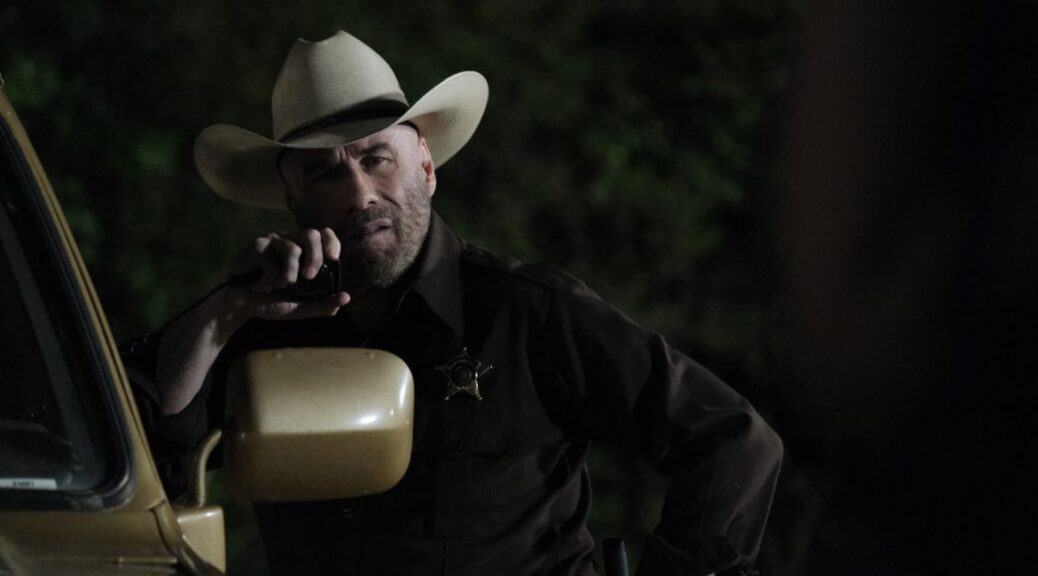
Both men of course end up over their heads and soon have to tangle with the ruthless New Orleans mob outfit that runs the clinic, as well as local law enforcement, headed up by a sheriff who exudes “too old for this” with each gruff word.

When it comes to showing its influences on screen, Mob Land is as unlucky as Shelby and Trey. The movie has the guts to take from more incisive forebears, and it’s hard not to make running comparisons. It’s also hampered by a script from Maggio that always feels right on the cusp of making a point about its characters and the hands they are dealt. But here again, it lacks the follow-through to turn its stars into more than the slightly off-discount versions of the brand name version.

The dialogue and character choices are likely too great for any ensemble to overcome, but Mob Land has brief flashes of a world where a less restrained pastiche might have worked. John Travolta’s performance as the tired sheriff is reserved to the point of redundancy. It serves mainly as a reminder that he deserves to find the right vehicle for this stage of his career.

But it falls to Stephen Dorff’s mob hitman Clayton as the prime example of how Mob Land stretches out the seams of the influences it wants to inhabit. Clayton is the AI output of an Anton Chigurh text generator. An unstoppable force with questionable morals who speaks almost entirely in empty aphorisms for the whole movie, Dorff tries valiantly to add dimensionality to the part. That it almost works is a testament to the actor, whose eclectic filmography belies how good he is in the right part.

Story aside, credit to Maggio as a director. Along with cinematographer Nick Matthews, Maggio elevates the film’s limited settings to deliver a believably lived-in southern noir. As by-the-numbers as much else seems, Mob Land takes an effective approach to the creeping dread and violence that tear apart Shelby’s world.

These touches aren’t enough to salvage the film, but they do keep it from being outright bad. Worse, Mob Land is mostly forgettable, perhaps the greater sin for a noir. There are echoes of the poverty porn of Hell or High Water, and more than a few heaping doses of the Coen brothers.

It’s all thrown together too haphazardly, and with little room left for Mob Land to have something to say of its own that we haven’t already heard before.

Recalled to Life

The Cow Who Sang a Song Into the Future

by Matt Weiner

A family haunted by the unexplained resurrection of their dead mother from a nearby river sounds like a good setup to a horror movie. But it works even better as a sparse, lushly filmed parable about environmental destruction and humanity’s relationship to the world that sustains us.

Chilean director Francisca Alegria’s feature film The Cow Who Sang a Song Into the Future sounds a clarion call to repair the destruction humans are doing to the world before it’s too late. It’s a message delivered urgently and unsubtly, but with moments of great beauty that make the warnings that much more stark.

When Magdalena (Mía Maestro) returns to life and walks from the polluted Cruces River to her family dairy farm, she shocks her now-aged husband Pablo (Benjamin Soto) so much that he ends up in the hospital. Magdalena’s extended family returns to the farm, and soon everyone has to confront the long-dead specter of Magdalena as they reckon with the holes her absence left on their lives.

And while the eco parable stays repetitively on message, the heart of the film is a more intimate examination of the inseparable connection between the environment and ourselves. The sense of loss that Magdalena left behind across generations of her family—and the trauma that continues to reverberate for her daughter Cecilia (Leonor Varela) as she carries this forward to her own children—mirrors the broader fight for environmental justice that we owe to people who come after us.

Grounding the film’s flights into magical realism is a riveting silent performance from Maestro as Magdalena. Maestro channels grief, wonder and even moments of sublime joy into the resurrected Magdalena.

The family’s initial response to seeing their reanimated matriarch ranges from love and excitement to the (perfectly understandable) horror, a note that Alegria brings out to great effect. In a different movie, Magdalena’s eerie wet footsteps through the house and across town would dog Cecilia and her father relentlessly.

It’s a confrontation that seems equally likely to end in catharsis or carnage. Alegria ratchets up the tension, as well as the environmental devastation, until the metaphorical dam breaks for Cecilia.

For a film whose songs into the future traffic in death and “the end” being here, the movie also holds out hope for an ending that has yet to be written. The film is agnostic on whether civilization writ large has earned our reprieve. But if a more connected world starts with just one family—then that’s a start.

Screening Room: The Flash, Elemental, The Blackening, Extraction 2, Maggie Moore(s) & More

Tomorrow Is Another Day

Dry Ground Burning

by Matt Weiner

Billing itself as a blend of “documentary and narrative fiction,” Dry Ground Burning succeeds wildly on all fronts, turning the Sol Nascente favela in Brazil into a feminist battleground that mixes light science fiction with immediate real-world consequences.

Léa (Léa Alves da Silva) is just out of prison, and reunites with her half-sister Chitara (Joana Darc Furtado). Chitara has become a local hero as the hardened leader of an all-female gang that makes money refining stolen oil and selling gasoline.

Under Chitara’s leadership, the gang defies local authority, a presence that pervades the characters’ lives even if the direct police response to Chitara is only briefly shown. (The directors make the most of this screentime by giving them and their “state-of-the-art” armored vehicle the full Verhoeven treatment.)

The gang’s ambitions run deeper than just survival, although the film argues that even that is worth celebrating in the face of authoritarian resistance. The women have mounted a political challenge with their People’s Prison Party, advocating a platform that speaks to the needs of the city’s working class and disenfranchised.

Directors and writers Joana Pimenta and Adirley Queirós chose to cast two local women (not actors) to play versions of themselves. The docu side of the docu-drama comes into its sharpest focus when the women are out campaigning. Their voices are sometimes literally drowned out by Bolsonaro supporters. And a political rally for the now former president of Brazil takes on the look of a green and gold descent into the Inferno.

In that scene, and in so many others in Sol Nascente, Pimenta and Queirós allow the narrative part of the story to fade away. Long, uninterrupted shots bring us both the grotesque horrors of a fascist rally and the unbowed joy of a DIY dance party.

There’s also a heartbreaking moment in the story when the narrative suddenly breaks the fourth wall and it is revealed just how many real-life elements from these women have been brought into the film. Despite these setbacks, or in the face of them, Chitara and her gang continue to demand an alternative future for the country that sees them in it.

Speculative documentary, narrative fiction… why not add hopeful dystopia to the genre list?

Death in the Afternoon

Everything Went Fine

by Matt Weiner

It feels indecent to call this euthanasia-based film from Francois Ozon “laid back.” But Everything Went Fine pulls off an exceptional character study with cool restraint, grounded performances and an unexpected well of humanity.

With a screenplay by Ozon based on a memoir by frequent collaborator Emmanuèle Bernheim, this dramatized version centers around the loving but complicated relationship between Emmanuèle (Sophie Marceau) and her father, André (André Dussollier, playing a difficult role with grace—and without sentimentality).

As the favored daughter, Emmanuèle bears the full emotional weight of her father’s request to end his life after a debilitating stroke at age 85. Assisted suicide is not an option for them in France, but the family has the means to maneuver through the quasi-legal (and not inexpensive) hoops for André to travel to a foundation in Switzerland that assists in the process.

The film counts down André’s final months with the matter-of-fact detailing of a documentary. The Bernheim sisters ride waves of false hope alongside “last milestones” together as André’s progress in physical therapy does not diminish his desire to leave the world on his terms.

Ozon presents the fullness of André’s life with a light touch—a mix of pregnant flashbacks, current regrets and the odd row with past lovers. André’s love for his daughters shines through it all, which is shadowed by a masterful cameo from Charlotte Rampling as André’s deeply depressed wife. Brief and reserved as her time is onscreen, Rampling’s detached presence breathes life into the couple’s challenging lifelong relationship.

The film mostly concerns itself with philosophical end-of-life questions. A sudden moment of legal suspense arises toward the end of André’s countdown, but Ozon clearly favors interpersonal drama over legal minutiae. Who are lawyers or the French courts to say what life means, anyway? That’s for the artists to decide. A noble sentiment from the filmmaker, if one that has the effect of blunting the controversial subject. There’s surprisingly little bite here for such a provocative topic from a filmmaker who doesn’t shy away from taboo.

But even that works in the movie’s favor. The family’s various responses to death at first feel soulless, even for a group of wealthy, ultra-cool Parisians. But Ozon allows longstanding tensions to simmer slowly alongside familial bonds. And even if the pot never boils over, this more detached approach ends up being all the more cathartic in the end.

Don’t Attract the Worm

Suzume

by Matt Weiner

With yet another worldwide success, director Makoto Shinkai’s newest film Suzume cements this stage of his career as one of the effective filmmakers dealing with ecological and psychological calamity.

Shinkai excels at balancing personal drama with major, world-altering stakes. Suzume feels in the same vein as his recent blockbuster successes, such as 2019’s Weathering with You and the smash hit Your Name. But Suzume also shows the difference between formula and formulaic.

There is plenty of coming-of-age and falling in love to be had during Suzume’s road trip. But there is also the inescapable backdrop of disaster, death and loss, as refracted through the 2011 earthquake that killed over 20,000 people and that Shinkai said has deeply affected his recent films.

That disaster is personal for Suzume Iwato (voiced by Nanoka Hara), the 17-year-old orphan who lost her mother at an early age. A chance encounter with the mysterious stranger Souta (Hokuto Matsumura) opens her eyes to an unseen world, where a dark worm-like force threatens to break into Japan, which, if successful would result in earthquakes and a catastrophic death toll.

The battle between hope and environmental doom stands out in Suzume, and here, too, Shinkai doesn’t lose his sense of optimism. This is helped along visually by his vibrant animation and palette. Whether it’s real-world Tokyo or the ethereal visions of the Ever-After, Shinkai’s exquisite art is both lived-in and otherworldly. To that Suzume adds a welcome bit of action and levity, helped along by Souta’s transformation into the cutest chair you’ll likely see all year.

The tonal shifts can be jarring for a film dealing with the end of the world, but it’s of a piece with Suzume’s story. Whether it’s the whole world ending or a more personal loss means your world is ending (or at least changing), you have to hold onto what matters. And there’s a quiet sweetness to the fact that even as the apocalyptic visions in his films sharpen, what matters to Shinkai above all appears to be love.

Love, Life Lessons & Basketball

Champions

by Matt Weiner

A team of ragtag misfits has to come together to win the big game, but not before they teach their washed up coach a thing or two about the power of teamwork in the process.

Yes, Champions is a remake of an older film, but it’s somehow not The Bad News Bears. In this case, it’s the 2018 Spanish hit Campeones. The kids are just as foul-mouthed, but this time the twist is that disgraced professional coach Marcus Markovich (Woody Harrelson, delivering a solid replacement-level version of classic Prickly Harrelson) has to work with a rec basketball team of intellectual disabled players as his court-ordered community service.

With a regional championship game looming in Canada for the Special Olympics, Marcus needs to juggle getting his own life and career back on track, dating new love interest Alex (Kaitlin Olson) and showing up for his team. The outcome of the game might be up in the air, but you can rest easy knowing that lessons are learned, love is found and use of the R-word is kept to a minimum and only to show personal growth. Neat.

While they might deserve a less stale vehicle to show off their skills, the performances from the actors with disabilities all rise above the cliched story (especially foul-mouthed Cosentino, played by Madison Tevlin, and Kevin Iannucci as Johnny, who gets caught in the middle of Marcus and Alex’s not-so-casual fling).

The team’s interactions with Marcus and one another make for the few genuinely earned emotions in a story that otherwise seems to exist to remind viewers in 2023 that people with intellectual disabilities also deserve to be treated with respect.

Olson is another acting standout. Her sharp comic timing wasn’t in doubt thanks to It’s Always Sunny in Philadelphia, but it’s surprising to see how much she shines in this kind of role. That is, surprising in the sense that she’s such a natural, refreshing fit that it seems impossible she hasn’t led more romantic comedies.

With Bobby Farrelly as director, it’s hard not to compare Champions to elements of past Farrelly Brothers work. We’re a long way from There’s Something About Mary – and let’s not speak of the inexorable Shallow Hal – but this film exists firmly and bizarrely in an era not so removed from that time. (A heartwarming sports comedy about Special Olympics athletes isn’t even new ground for the Farrellys – 2005’s The Ringer mixes up the beats but its basic dignity message about people with disabilities is the same.)

That Champions is appearing now feels less an indictment of Hollywood feet-dragging than a not-so-gentle suggestion that perhaps we’ve moved beyond needing generic sports movies with entry-level calls for respect to move the needle for any holdouts.

Champions does itself no favors by substituting coarseness for meanness. That’s preferable to what this movie might have looked like a few decades ago, but it manages to neuter the comic touch of Farrelly and writer Mark Rizzo while dulling any interesting edges at the same time. (For example, an ongoing plot about a manipulative employer taking advantage of discount labor gets reduced to deus ex machina to set up the final game.) It’s an odd twist that Peter Farrelly’s recent solo effort Green Book won the Academy Award for Best Picture. And yet Bobby’s Champions might be the film that traffics in fewer broad stereotypes. That’s a win worth celebrating on its own. Just don’t expect the taste of victory to linger longer than the closing credits.

You Say You Want a Revolution?

The Jesus Revolution

by Matt Weiner

In 1966, TIME Magazine captured the tumultuous era with a bleak cover question: “Is God Dead?”

One answer to that question was in the form of a countercultural movement that arose in the following years. The “Jesus Revolution” is less incongruous than it first sounds, placed among the backdrop of Vietnam, sex, drugs and rock & roll and a general spiritual ennui. The long-haired, sandal-wearing “love the stranger” Jesus spoke not just to some of the more soul-searching hippies but a wider generation trying to find its own voice.

At least that’s the message that Jesus Revolution wants to focus on. The film, written and directed by Christian film powerhouse Jon Erwin, falls more on the mainstream spectrum like Heaven Is for Real than the pricklier polemics like God’s Not Dead.

But for all its gloss, Jesus Revolution is a confounding movie. The production itself is a savvy, just saccharine enough dramatization of Pastor Chuck Smith (Kelsey Grammer) and the countercultural rise of the “Jesus freaks” in the late 60s and early 70s.

It’s a feel-good story, and the shiny treatment it gets here seems like a perfect match. But it’s also a story and a movement that deserves a more critical look than it gets here from the true believers.

Smith is a pivotal figure whose Calvary Chapel movement has influenced evangelical Christianity and the modern megachurch. Jesus Revolution wisely centers on an avuncular, befuddled version, with Grammer perfectly cast to deliver profundities like “It’s not something to be explained, it’s something to be experienced” in his soothing baritone.

It’s not until Smith meets the radical Lonnie Frisbee (Jonathan Roumie) that he comes to see that the Jesus of the Bible has a lot more in common with the growing hippie movement, and his unlikely partnership with Frisbee is part of a momentous time in evangelical history.

What the film omits from this “all are welcome” version of Smith, however, are any edges that might clash with a wider audience. Most notably, the pastor’s strident views against homosexuality. And while the script hints at Lonnie Frisbee’s split with Calvary and Smith, this is chalked up to doctrinal differences with no mention of Frisbee’s semi-open homosexuality.

At what point does the reality of a biography subject veer so far from the adaptation’s message that it becomes disingenuous? This friction-free adaptation goes well beyond that line. Which is curious, given that director Jon Erwin also wrote and directed the exceptional documentary The Jesus Music in 2021.

It’s a low bar to clear, but that sweeping look at contemporary Christian music from the era of Smith and Frisbee to artists today takes a more frank look at internecine debates and controversies, both within the movement and alongside secular culture at large. As someone whose personal history with religion starts and stops with the Old Testament, I feel confident recommending The Jesus Music as the better choice—both as film and agitprop—for those not already in the movement.

Where does that leave Jesus Revolution? To say it’s a Hallmark movie with better production values undersells how watchable the movie is. But if the film succeeds in standing on its own, with a goal of preaching beyond the choir, it also deserves to be judged that way. And that means bringing in the messy earthly politics that the script assiduously avoids. The likely reality is that church viewings will get an extremely competent adaptation of a historical era that continues to shape the country.

Secular audiences get a decent airplane movie that’s worth it for Kelsey Grammer completists. It’s win-win—unless you’re gay, in which case you might be incurring divine wrath, if you ask Pastor Smith. Better not to dwell on that part of Smith’s theology for a mainstream movie, though, and instead rely on the Old Testament and split the baby.