Tag Archives: Daniel Baldwin

Slay, Girl, Slay

KillHer

by Daniel Baldwin

Tell me if you’ve heard this one before: a bunch of hot young twentysomethings haul off into the woods for a weekend of fun, only to find themselves at the mercy of a psychopath. You have? Well, how about the one where a bunch of hot young twentysomething ladies get together for a pre-wedding party to cut loose? That one too? Well, how about if we mash them together? Alright, now that’s better.

Robyn August’s KillHer is one part rural terror, one part bachelorette slumber weekend, and all parts psycho-slasher flick. It’s a novel combo, especially when it actually involves tent camping, as opposed to riffing nonstop on “glamping” (although there is a bit of that too). We follow four young women opting to “rough it” for a weekend before their bestie gets married. Most of them aren’t the camping type, but the bride-to-be’s fiancée is, and she wants to impress him by trying it out.

What follows is a comedic terror tale that rolls straight down the usual checklist of tropes. Spotty cell signals? Check. Spooky forest noises? Check. Big sketchy dude also camping nearby? Check. Someone they were supposed to meet is M.I.A.? Check. From a writing standpoint, nothing too unexpected occurs and the dialogue isn’t the greatest. The special effects work is also a bit spotty at times, but that comes with the low budget territory.

What sets KillHer apart from the rest of the killer-in-the-woods subgenre? Actress M.C. Huff. She is an absolute firecracker from start to finish, nailing every last bit of emotion that the film calls upon her to perform. Whether she’s being bubbly & sweet, playful & funny, or whenever she’s tasked with dishing out the extreme levels of hysteria and mania that this particular genre specializes in, Huff is up to the challenge. The film around her might not knock your socks off, but her character Eddie is THE reason to check this one out. Huff is one to watch, folks.


Return to Sender

Condition of Return

by Daniel Baldwin

There aren’t too many movies out there that focus on mass shooters. You’ve got the occasional one that tackles it, such as Runaway Jury or the more recent Run Hide Fight, but they are few and far between. It’s not hard to see why, given both the frequency and severity of mass shootings in the United States. One might even call it a taboo cinematic subject. Taboos are, of course, the domain of genre and exploitation cinema. These are the corners of cinema where – when done right – we can find catharsis through art.

Tommy Stovall’s Condition of Return aims right at that taboo and pulls the proverbial trigger. Our protagonist is a churchgoing woman (AnnaLynne McCord) who, one day, shoots up said church, leaving over a dozen dead and even more injured. Why did she do it? That’s for the psychiatrist (Dean Cain) brought in to evaluate her ahead of sentencing to decide. Well, that and to professionally analyze whether or not she is sane enough to even stand trial. After all, she claims that the Devil (Natasha Henstridge) made her do it!

Normally what we would have here would be a battle of wits between a perpetrator and a medical professional as the latter sets about unravelling the mystery in front of them. Is she crazy? What’s the reason behind the reason for such a horrible act? Condition of Return is not interested in any of this. In fact, it makes it clear early on whether or not she is crazy. The answer is deeply troublesome. What we have here is a film that doesn’t put a whole lot of thought into the subtext behind the filmmakers’ storytelling decisions. And that’s not even getting into its problematic depictions of race.

There’s nothing wrong with making a film where the supernatural is real and inhuman beings are playing games with human lives for fun. Horror is filled with such fare. Angel Heart and The Devil’s Advocate come to mind. Religious horror is an important foundation of the genre. It only becomes a problem when evil acts by humans – especially topical epidemic ones – within such narratives are scapegoated upon such powers. Want my professional cinematic analysis? Stick with the Heaven & Hell thrillers that don’t blame mass shootings on anything other than the people pulling the trigger. As for McCord and Stovall, if you’re wanting horror fare featuring the talents either, seek out Excision and Aaron’s Blood instead. Mark this one as “return to sender.”

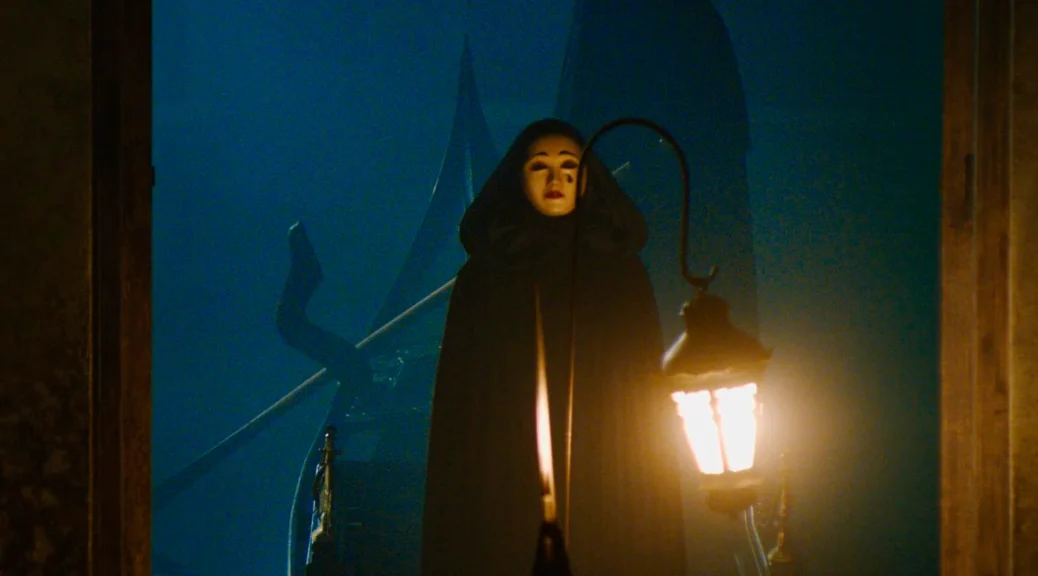
Screening Room: Haunting in Venice, Love at First Sight, Canary, Cassandro, Satanic Hispanics & More

Nightmares in a Damaged Subgenre

Megalomaniac

by Daniel Baldwin

Martha (Eline Schumacher) and Felix (Benjamin Ramon) are the children of the legendary uncaught serial killer The Butcher of Mons. Each of these siblings contends with their family legacy in different ways. Martha works as a janitor amongst coworkers who treat her with contempt. Meanwhile, Felix has taken up his deceased patriarch’s monstrous profession: kidnapping, torturing, killing, and dismembering women.

Their home life is not great. Neither talks to the other much, with Felix insisting on living in near total seclusion from his sister, despite residing in the same home. Both have frequent hallucinations tailored to their individual fractured psyches as they live out their own private hells. That is, until things go south at Martha’s job. A violent encounter forces Martha and Felix together, sending them down an even more vicious and crazed path.

If any of that sounds cliched, it’s because it very much is. What we have here in Megalomaniac is a film homaging both violent ‘70s exploitation and ‘00s New French Extremity cinema. The latter in particular. The fingerprints of modern classics such MartyrsFrontier(s), and High Tension are on full display here, as well as doses of older influences like Lustig’s Maniac and Scavolini’s Nightmares. Brutal, broken killers take out their rage on unsuspecting women. We’ve seen it countless times before and we have seen it done better.

From a filmmaking standpoint, the craft on display here is sound. There are some striking images to be found, particularly during the film’s more hallucinatory sequences. Unfortunately, the tone and color palette are both so grim and dour that any enticement within those images is immediately sapped away. What we are left with is yet another in a long line of torture & kill flicks. If there’s any solace to be had here, it is in Eline Schumacher’s performance in the first two acts. While the writing for her character ultimately becomes a lump of cliches in the final stretch, Schumacher gives a nuanced take on the degradation of a tortured psyche for the first two thirds of the film.

If this is a subgenre that you’re fond of, you might find some engagement within. All others would be better off seeking out one of the other films I mentioned above. This is a fans-only affair.

The Theatre of the Mind

Caverna

by Daniel Baldwin

Hannah Swayze and Daniel Contaldo’s Caverna is a surrealist work about an experimental theater workshop in Florence, Italy. We follow two particular students, Giorgia (Giorgia Tomasi) and Lorenzo (Lorenzo Passaniti), who are pushed by a daring teacher named Alba to unleash their inner thoughts and fears through acting exercises in front of the group. If that sounds like a movie about a bunch of theater kids wandering about a stage as they talk about their feelings, don’t worry. It’s not that kind of movie.

Instead, Caverna hovers between reality and fantasy as dreams, desires, and nightmares are portrayed in a rather trippy fashion as the film flips back and forth between the actors and their “scenes”. What is real and what is acting blurs as both feed into one another. Is there really a rad-looking cyclops stomping about the wooded areas of Florence, chasing a princess? Probably not, but if it looks, sounds, and feels real, who’s to say that it isn’t? The same holds true for the rest of the mythology-infused moments of fantasy that are weaved throughout.

Caverna is about how the deepest parts of one’s psyche often fuel the art that they unleash upon the world. It is not the first film to do this. Nor will it be the last. It then becomes a question of whether or not its somewhat-psychedelic arthouse notions are enticing enough to draw you into its web. This is very much a niche piece of filmmaking, with a heavily disjointed nature that can and will push many a viewer away. If you’re inclined to welcome such filmmaking, however, then there’s a lot to enjoy here.

Complementing its wilder storytelling tactics is a lot of striking imagery. The cinematography – both in the fantasy and “real world” sequences – is sumptuous throughout, often giving the film a lush and vibrant look. In terms of pacing, it never overstays its welcome, which has ultimately resulted in a runtime that barely exceeds an hour. That might be a turn-off to those looking for something grander, but it also means that it avoids the bloat that plagues a lot of modern arthouse fare. Swayze & Contaldo clearly know that not everything needs to be 2 ½ hours long. Caverna might not knock your socks off, but if you’re open to its imagination, you’ll be in for an interesting ride.

Screening Room: Meg 2, TMNT: Mutant Mayhem, Shortcomings, Final Cut, Night of the 12th & More

Brawl of the Kaiko Empire

Bad City

by Daniel Baldwin

A modern celebration of classic Japanese V-cinema (their version of DTV genre fare), director Kensuke Sonomura’s Bad City unleashes a furious, fist-flying tale of crime, corruption, and righteous retribution. The story is a tale as old as time: a diabolical businessman (Lily Franky) is in league with the Korean mafia and local politicians. His goal? To bring “prosperity” to Kaiko City by bringing in casinos that no one but the rich wants. His methods? Bribery, blackmail, and murder. All that stand in his way are a handful of good cops and some honorable Yakuza with aligned interests.

At the center of it is 60-year-old genre stalwart Hitoshi Ozawa (Dead or AliveGozu), who also wrote the screenplay. His knowledge of and experience in Yakuza cinema comes in mighty handy here, as does his charisma and still-formidable physical prowess. He’s an absolute powerhouse as the unflappable Captain Torada and he’s surrounded by equally great supporting castmates including Tak Sakaguchi, Masanori Mimoto, Katsuya, Mitsu Dan, Akane Sakanoue, Masaya Kato, and the aforementioned Franky.

There’s nothing wholly original on display in terms of narrative, but that matters not, as Sonomura and Ozawa are aiming for grandiosity over complexity, even amidst their low budget. The plot is still filled with twists, turns, and double-crosses, but the pace moves with breakneck speed. It plows through subplots and arcs like it’s tearing through an entire season of television, ultimately offering up a narrative that is as dense as it is straightforward.

Any danger of monotony in terms of pulp crime storytelling and exposition is wiped away by the action itself. While there is the occasional moment of gun violence, the bulk of the fighting is brutal hand-to-hand combat. Fists, knives, baseball bats, pipes, and even a loudspeaker are utilized as criminals and cops wail on each other to the point of exhaustion. The fights constantly swing back and forth between martial arts, vicious groundwork, and barroom-style brawls. Said action is further punctuated by some absolutely stellar foley work, making each punch, kick, and stab sound even more painful than it looks. Throw in the fact that many of the characters are wearing sneakers – one has to be comfortable on the brawling move after all – and the bouts often sound like a massacre playing out on a basketball court. 

Simply put, this is a killer slice of low budget action cinema.

Rolling Thunder, Raging Vengeance

Shrapnel

by Daniel Baldwin

DTV action maven William Kaufman (Sinners and Saints) returns for the third time this summer with a south-of-the-border extraction/revenger combo, Shrapnel. This time around, Kaufman is playing in another insanely tropey sandbox: “Dad has a special set of skills”.

Jason Patric plays military veteran Sean Beckwith, who lives on a Texas ranch with his wife and two daughters. The oldest of which, as per a frantic voicemail overheard at the start of the film, made the mistake of sneaking across the border into Mexico with a friend to party. Anyone who watches action flicks or TV shows already knows where this is going: she’s been kidnapped.

Beckwith attempts to go through proper legal channels to retrieve his firstborn, but there’s no help to be found. When pleas for mercy on TV just piss off the cartel responsible and result in them sending a hit squad to silence the family, Sean realizes that the only hope he has is to take the fight to them. Luckily, in true Rolling Thunder fashion, he has a former soldier buddy named Vohden (Cam Gigandet) who simply needs to be told to get his gear and tagalong for an assault on the cartel boss’s (Mauricio Mendoza) compound in Juarez.

What we have here is a pretty meat and potatoes modern Mexico-set action thriller. For better or worse, this is an inherently problematic subgenre that often centers around white vengeance (i.e. Rambo: Last BloodSicario, etc.). If you are willing to overlook that, Shrapnel does have some things to offer.

Patric is compelling as the ever-troubled Beckwith, who has doubts from the outset that his daughter is still alive and knows that even if she is, she’ll never be the same. Nor will his wife and other kid, after the ranch assault. Nor will he, for that matter. All of this plays on his face throughout.

Gigandet carries himself well as our Tommy Lee Jones but isn’t required to do much more than that. Other performance highlights include Kesia Elwin as Sean’s wife Susan, Guillermo Ivan as the main henchman, and the aforementioned Mendoza as the big bad.

It’s not the most original low budget actioner and it’s a step down from Kaufman’s own The Channel earlier this month, but if you’re in the mood for a solid little “Dad movie”, it’ll get the job done. While no Sicario, it’s certainly better than Rambo: Last Blood.