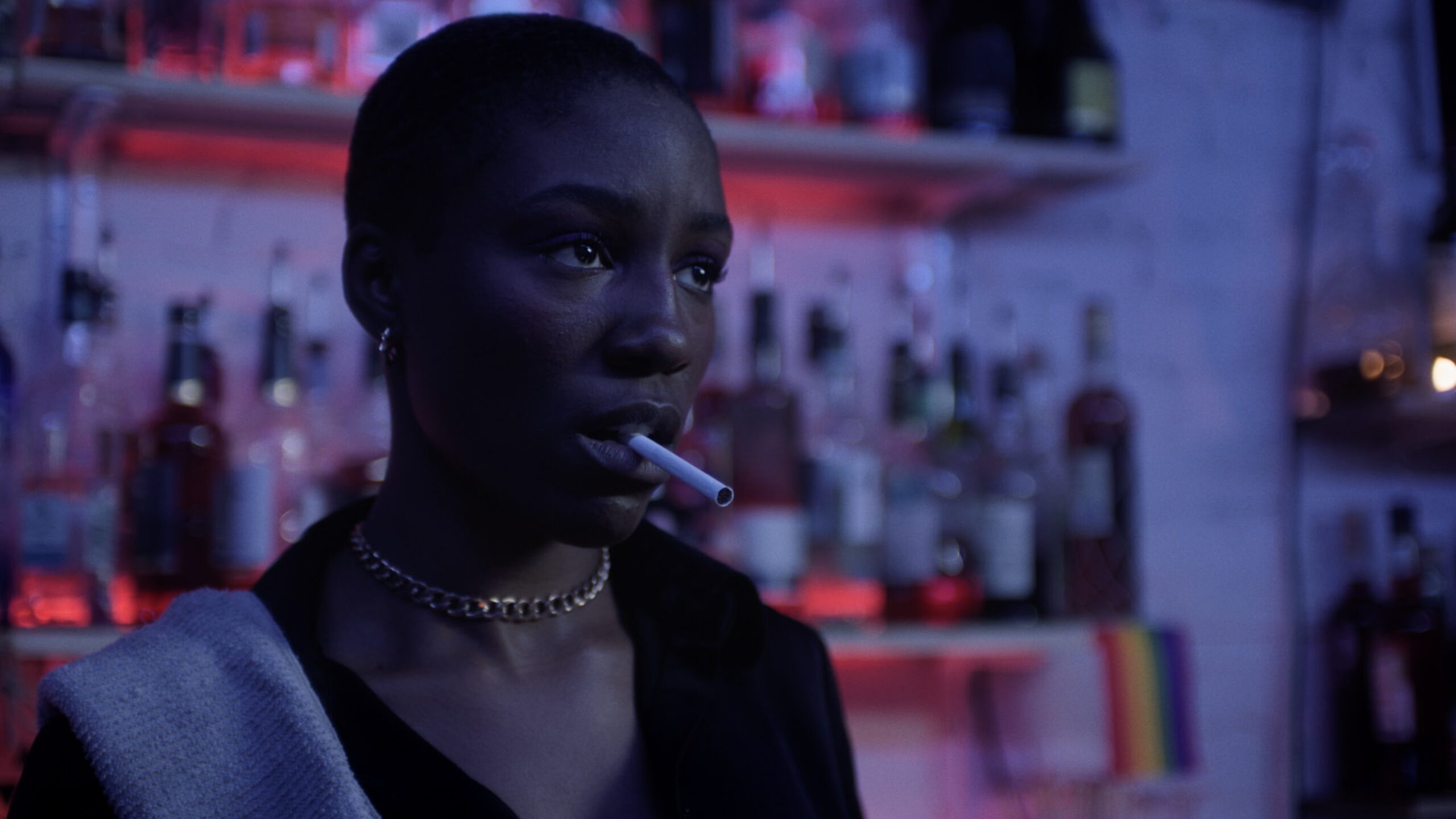
It’s hard to do something new with the “pregnant with Satan’s baby” formula. There are only so many ways it can go, and you can’t hope to unseat Rosemary’s Baby. But writer/director Houston Bone and a game cast breathe weird life in this oft-told tale.
Sara (Chloe Van Landschoot) is very pregnant. Overdue, huge, and constantly vomiting, she’s ready to be done. Her devoted girlfriend Carol (Tymika Tafari) takes good care of her. Still, Sara’s definitely not entirely OK.
She runs into Troy (Garrett Hnatiuk), the pre-Carol fling and baby daddy, and feels strangely compelled to take him up on his offer of dinner. Back at his house. Out in the middle of nowhere. With his mom (Jane Moffat).
While moments of Act 1 smack of cliché —certainly that package of bloody ground chuck in the refrigerator—Bone’s script and his actors’ talent, plus Sara’s convincing pregnant state, keep you invested.
Bone gives his cast breathing room, never rushing a scene, always lingering just long enough for someone to be intriguing. That could be Hnatiuk’s awkwardly seductive dancing, Tafari’s disdainful glare, Moffat’s contemptuous sneer, or Landschoot’s childlike gesturing. The chemistry between and among the actors is top notch, and the way they inhabit their characters ensures even formulaic scenes feel unusual and fresh.
Son of Sara is not a spendy affair, but it rarely feels trapped by its budget. Bone and crew make great use of what funds they do have, and the filmmaker’s instinct for relationship-driven humor and discomfort overcome nearly every cinematic setback.
Even if a few beats buckle under familiarity, the underlying change in theme quietly upends a status quo expectation in enormously enjoyable ways. Son of Sara has an F-you quality to it that doesn’t draw attention to itself and is all the more satisfying for it. It’s fun, tightly constructed, compellingly performed horror and you’re out in under 90 minutes. What do you have to lose?
We love Canada! As that nation’s proud neighbors to the south, we were thrilled to welcome Joey from horrorfacts.com to Fright Club to parse out the 5 best Canadian horror films. What makes it Canadian? It has to be directed by a Canadian, shot in Canada and, to the degree it’s possible to tell, set in Canada.
5. Red Rooms (2023)
True crime culture. Serial killer groupies. The Dark Web. Does all of it seem too grim, too of-the-moment, too cliché to make for a deeply affecting thriller these days? Au contraire, mon frère. Québécois Pascal Plante makes nimble use of these elements to craft a nailbiter of a serial killer thriller with his latest effort, Red Rooms.
Plante expertly braids vulnerability and psychopathy, flesh and glass, humanity and the cyber universe for a weirdly compelling peek at how easily one could slide from one world to the other.
His real magic trick—one that remarkably few filmmakers have pulled off—is generating edge-of-your-seat anxiety primarily with keyboard clicks, computer screens and wait times. But the tension Plante builds—thanks to Juliette Gariépy’s precise acting—is excruciating. They keep you disoriented, fascinated, a little repulsed and utterly breathless.
4. Pontypool (2008)
Canadian director Bruce McDonald’s shock jock horror film is best appreciated as a metaphor on journalistic responsibility and the damage that words can do. Radio air personality and general pot-stirrer Grant Mazzy (Stephen McHattie) finds himself kicked out of yet another large market and licking his wounds in the small time – Pontypool, Ontario, to be exact. But he’s about to find himself at the epicenter of a national emergency.
McDonald uses sound design and the cramped, claustrophobic space of the radio studio to wondrous effect as Mazzy and his producers broadcast through some kind of zombie epidemic, with Mazzy goosing on the mayhem in the name of good radio. As he listens to callers describe the action, and then be eaten up within it, the veteran McHattie compels attention while McDonald tweaks tensions.
Shut up or die is the tagline for the film. Fitting, as it turns out that what’s poisoning the throng, turning them into mindless, violent zombies, are the very words spewing at them. It’s a clever premise effectively executed, and while McDonald owes debts all around to previous efforts, his vision is unique enough to stand out and relevant enough to leave an impression.
3. Possessor (2020)
Brandon Cronenberg’s created a gorgeous techno world, its lulling disorientation punctuated by some of the most visceral horror to make it to the screen this year. There is something admirably confident about showing your influences this brazenly.
Credit Cronenberg, too, for the forethought to cast the two leads as females (Jennifer Jason Leigh playing the remarkable Andrea Riseborough’s boss). The theme of the film, if driven by males, would have been passe and obvious. With females, though, it’s not only more relevant and vital, but more of a gut punch when the time comes to cash the check.
Possessor is a meditation on identity, sometimes very obviously so, but the underlying message takes that concept and stabs you in your still-beating heart with it.
2. Ginger Snaps (2000)
Sisters Ginger and Bridget, outcasts in the wasteland of Canadian suburbia, cling to each other, and reject/loathe high school (a feeling that high school in general returns).
On the evening of Ginger’s first period, she’s bitten by a werewolf. Writer Karen Walton cares not for subtlety: the curse, get it? It turns out, lycanthropy makes for a pretty vivid metaphor for puberty. This turn of events proves especially provocative and appropriate for a film that upends many mainstay female cliches.
Walton’s wickedly humorous script stays in your face with the metaphors, successfully building an entire film on clever turns of phrase, puns and analogies, stirring up the kind of hysteria that surrounds puberty, sex, reputations, body hair and one’s own helplessness to these very elements. It’s as insightful a high school horror film as you’ll find, peppered equally with dark humor and gore.
1. Videodrome (1983)
Videodrome was the last truly Canadian film in David Conenberg’s arsenal, and it showed an evolution in his preoccupations with body horror, media, and technology as well as his progress as a filmmaker.
James Woods plays sleazy TV programmer Max Renn, who pirates a program he believes is being taped in Malaysia – a snuff show, where people are slowly tortured to death in front of viewers’ eyes. But it turns out to be more than he’d bargained for. Corporate greed, zealot conspiracy, medical manipulation all come together in this hallucinatory insanity that could only make sense with Cronenberg at the wheel.
Deborah Harry co-stars, and Woods shoulders his abundant screen time quite well. What? James Woods plays a sleaze ball? Get out! Still, he does a great job with it. But the real star is Cronenberg, who explores his own personal obsessions, dragging us willingly down the rabbit hole with him. Long live the new flesh!
No one looks forward to the consequences of their actions.
If you believe in God, they’re coming for you one way or the other.
Robert Cuffley’s latest economically made horror Bright
Hill Road shadows no-longer-functioning alcoholic Marcy (Siobhan Williams)
through a pretty bad stretch. It would be hard to imagine things getting any
worse, really. So, Marcy decides to drive across country to spend some time
with her sister Mia in California.
She doesn’t drive straight through, though. She wakes up in
her car in front of a pretty dodgy looking hotel in some forgotten little town
and finds herself checking in. The place is super weird, though, and Marcy’s
never sure if she’s hallucinating, drying out, or seeing and hearing ghosts.
Most of the time Bright Hill Road works—playing on
your guesswork without giving away all its secrets. Sometimes it does not work.
But the film lives and dies with Siobhan Williams’s performance.
Slight but scrappy, she takes on the image of Angela Bettis
or Elliot Page. You worry for her, believe in both her vulnerability and the
chip on her shoulder that might get her through it. She’s weary but spirited
and more than anything, she’s in denial.
Cuffley’s direction takes on a hallucinatory quality that
suits Susie Maloney’s trippy script. Both Act 1 and Act 3 feel rushed—the
opening bit of violence shocks you out of complaining, but the final moments
border on being unearned. Still, the meat of the film meanders at a creepy pace,
one that conjures the feeling of a bad dream.
Bright Hill Road has an intentional, low rent
Overlook quality to it—something both supernatural and seedy. It carries its own
internal logic, and while the toughest eruptions of violence hit us in the film’s
opening moments, it has some grim images to share as the hotel takes on
additional guests.
Cuffley doesn’t break a lot of new ground, but his is an appealing riff on a familiar tune. Most of our demons are within. Trauma takes on an even more sinister form when it’s mixed up with shame. Addiction is its own monster. No one likes a shared bathroom.