Tag Archives: Amanda Brugel

What Makes You Beautiful

Sweetness

by Hope Madden

Back in 1982, German filmmaker Eckhart Schmidt released The Fan, a horror thriller about a teenage girl obsessed with a pop music star. It’s a wild, weird, uncomfortable technopop ride, and I admit I expected (hoped?) Emma Higgins’s Sweetness would be a kind of American update.

Because The Fan is so very weird, yet somehow relatable.

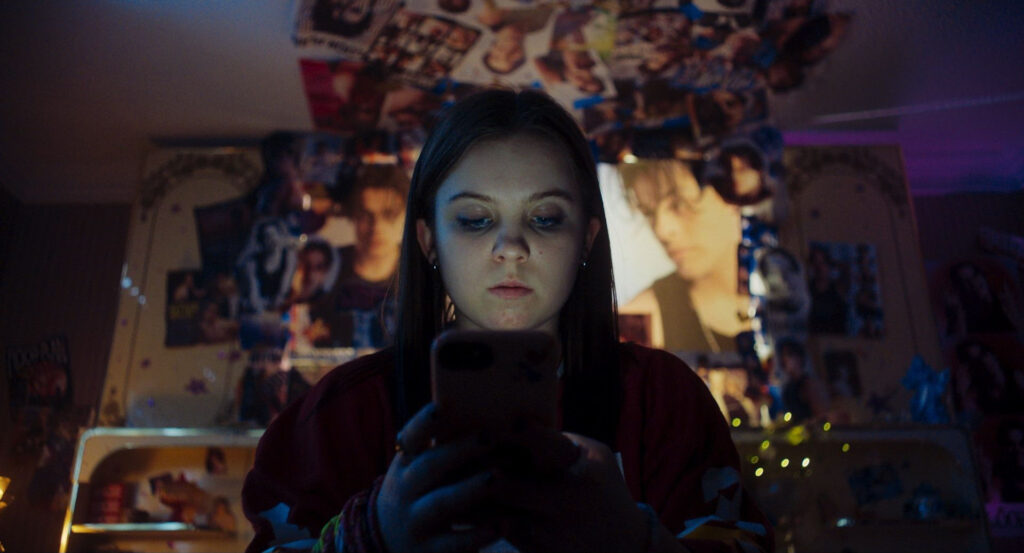
Higgins’s film is very different, and a touch more on the believable side. Kate Hallett (Women Talking) is Rylee, unpopular high school kid with an obsessive crush on Floorplan lead singer Payton Adler (Herman Tømmeraas). His pouty pretty face covers nearly every inch of her bedroom walls and ceiling. Her headphones are always in, his emotional vocals drowning out the mean girls in class, her father’s overly eager girlfriend (Amanda Brugel), and everything else Rylee doesn’t want to hear.

When bestie Sidney (Aya Furukawa, Fall of the House of Usher) leaves Rylee behind after a Floorplan concert, she meanders alone until being struck by a car driven by the very impaired object of her affection, Payton Adler!

Totally worth it!

What follows is a crooked path lined with the faulty logic of the young and the twisted imagination of a filmmaker who’s spent most of her career embedded with pop stars. Higgins has directed scads of music videos. That’s probably why the music for this film is so unnervingly authentic, exactly the kind of thing that would make a troubled teen swoon and believe her life had been saved.

Even if she’d, in fact, just been run down by a car.

Furukawa and Tømmeraas both shine, one as a semi-vacuous but still good friend, the other as a good-looking opportunist with a drug problem.

Hallett anchors the film with a sort of wide-eyed yet world wearied performance that’s as heartbreaking as it is frustrating.

Higgins never laughs at or Rylee and her youthful obsession. Though the movie doesn’t wallow in the maudlin, avoiding angst at all possible turns, the filmmaker demands that we empathize with this girl in a way that’s both moving and nightmarish.

Stylish cinematography and slick production design emphasize the pop music stylings, but the film is hardly all glossy exterior.

There are some telegraphed moments and a couple of convenient contrivances, and anybody seriously shocked by Rylee’s choices definitely needs to see The Fan. But there’s a twisted, broken little heart here and Higgins and Hallett want you to witness it.

A Sort Of Homecoming

Like a House on Fire

by Rachel Willis

Is there ever a good reason for leaving your family? And if you come home, can you expect them to welcome you with open arms?

Writer/director Jesse Noah Klein examines what happens to a family when a mother who left them behind wants to return in Like a House on Fire.

When the film opens, we’re not sure why Dara (Sarah Sutherland, Veep) has left her family. But we know from the beginning she wants to be let back in, and that she wants to see her daughter. Her husband, Danny (Jared Abrahamson), isn’t sure he wants that to happen, especially since their almost 4-year-old daughter, Isabel (an unspeakably adorable Margaux Vaillancourt), doesn’t remember mama.

Dara’s backstory, as it unfolds, helps the audience sympathize with her disenchantment upon finding her family hasn’t waited for her. But there’s also sympathy to be had for Danny, and particularly, Isabel. This is not a situation with a clear villain, but a nuanced look at the ways in which families can fall apart.

The film’s best moments come from Sutherland. She conveys the desperation of a woman who needs to reconnect with her daughter, as well as the hope that things will turn out the way she wants. Whenever her efforts are thwarted, we feel her devastation. Dara’s initial meetings with Isabel are touching. Dara’s joy and disappointment commingle whenever she’s with her daughter.

It’s the rest of the film that doesn’t always live up to its character.

There are some needless character conflicts that detract from the story’s focus. Dara’s stepmother (Amanda Brugel – a fabulous actress) is a thorn in her side – but the reasons why are unclear. There’s a stepsister (perhaps a half-sister?) who comes and goes without much to do except provide another reason for the stepmother’s animosity. It doesn’t seem as if much thought went into these two characters.

The college boy that Dara meets and befriends at the park is the film’s messiest issue. The time Dara spends with him would have been better devoted to digging into the larger family issues surrounding Dara – both with her husband and daughter, as well as her father and his family.

As it is, a lot of the issues and relationships in the film putter out. There’s an imbalance that sways the film one way and another, but never lands the audience on solid ground.

Which is perhaps how Dara feels all along.

Killer Tween

Becky

by Hope Madden

Finally, someone truly understands what it’s like to be an incredibly angry adolescent girl.

At the very least, Jonathan Milott and Cary Murnion’s film Becky understands enough to be afraid of her.

The titular 13-year-old, played with convincing charisma by Lulu Wilson, is a handful for her widowed father (Joel McHale). Still, dad has decided this is the weekend to take Becky for a getaway with his girlfriend (Amanda Brugel), and her 5-year-old (Isaiah Rockcliffe). They head to the old vacation cabin for a big talk.

He soon finds that his 13-year-old may not be the scariest thing on earth.

Or, you know what? Maybe she is.

Kevin James plays against type as a swastika-tatted up inmate, leader of a band of escapees. James may be hoping to catch the same mid-career fire Vince Vaughn has been fanning, mainly portraying the heavy in various indie thrillers. Early scenes play well, James cutting a solemnly menacing figure as he quietly organizes and orchestrates. But as the film wears on it becomes clear the actor can’t manage the sinister energy needed to really make an impression.

I’ll take this over Paul Blart, though.

Robert Maillet’s a lot of fun, though. At 6’10”, the one-time wrestler dwarfs even the gangly McHale. He’s no master thespian, but his arc creates a spectacular punctuation for Becky’s own transformation and his sheer immensity brings a little needed anxiety to the film.

The writing team, which includes Lane and Ruckus Skye of the brilliant and as-of-yet undistributed Devil to Pay (originally titled Reckoning), cheats a little with this script. Backstories, motivations and mysteries—particularly as they articulate the villainous characters—feel less undefined than lazily obscured. Between that and James’s inability to truly sell the viciousness in his character, the family’s jeopardy lacks the intensity it needs for this film to truly impress.

Wilson does not. In her hands, Becky is a fascinating character, and it is with this character that the writing team and directors score the most points. The film is bloody, angry and, even for its fairly formulaic premise, unpredictable.