Tag Archives: Travis Knight

Master and Servant

Masters of the Universe

by Hope Madden

Mattel, the company behind Greta Gerwig’s brilliant blockbuster Barbie, follows that unprecedented success by backing another woman centered feature driven by an Oscar worthy screenplay and helmed by a genius female filmmaker.

JK. They’re just making another toy movie.

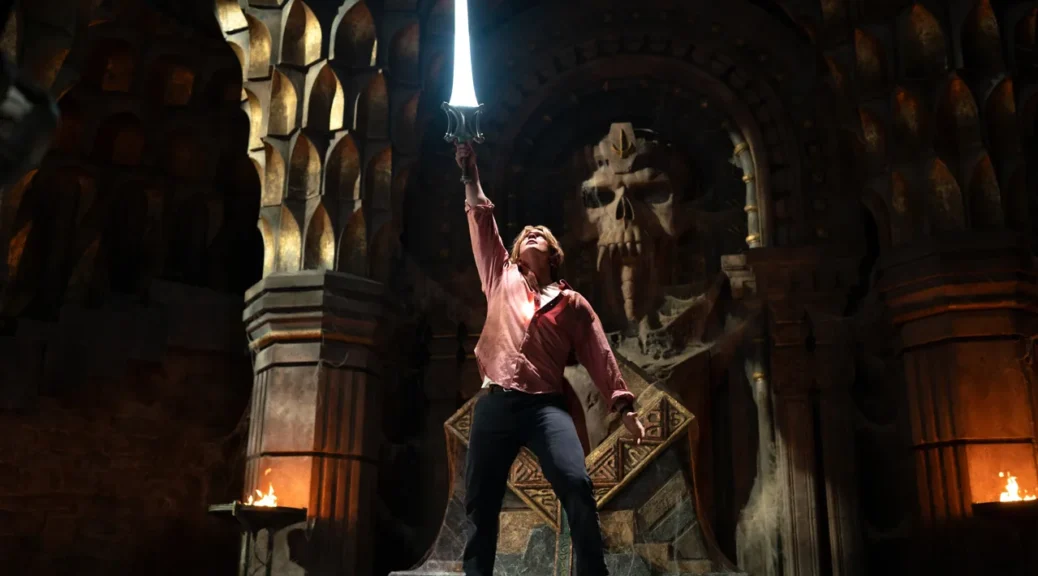
Mattel welcomes you to Pride month with the return of their second pinkest toy. Bulging hero He Man (Nicholas Galitzine), saucy villain Skeletor (Jared Leto), and scrappy helpers including Ram Man (Jon Xue Zhang) and Fisto (Jóhannes Haukur Jóhannesson), unite for a semi-campy Masters of the Universe origin story.

Director Travis Knight, who somehow carved one worthwhile film out of the Transformers franchise (Bumblebee), is tapped to try to Gerwig-up this afternoon 80s staple. The filmmaker’s been nominated three times for Oscars, all for producing truly exceptional animated films. He works here with a team of writers (Chris Butler, Aaron Nee, Adam Nee), collaborators all on other great animated features. It’s not Gerwig and Baumbach, but it’s an impressive pedigree for Masters of the Universe.

The cast off the top impresses. Galitzine, so spot-on in both Bottoms and 100 Nights of Hero, charms as the bumbling prince returned from Earth to save Eternia from the clutches of the cackling, weirdly muscular Skeletor.

Idris Elba elevates scene after scene as Duncan/Man at Arms, the tough talking softie who mentored young Adam and has become a bit of a lush in his absence.

Leto’s adequate. But Knight articulates his henchmen (Trap Jaw, Beast Man, Goat Man) well with a good practical/CGI mix.

The tone is the thing. Masters of the Universe is both playful and self-serious. This doesn’t always work cinematically, but there’s tenderness for the franchise baked into the film. And certain things require a bit of ribbing. Fisto? Seriously?

The good natured humor is not enough to entirely salvage the movie. Indeed, it makes you realize anew how remarkable Barbie was for its lack of cynicism and endless insight. But we may never again see a film quite like Barbie, especially if men keep deciding who makes movies. As Orko might have helped us see at the end of an episode, Masters of the Universe is no masterpiece, but sometimes it’s OK to have fun. And the movie is OK.

Stay tuned for three post-credits scenes. Number one will thrill fans, while two and three tease future installments. Bye for now!


Call Me Kubo

Kubo and the Two Strings

by Matt Weiner

Describing the story of Kubo and the Two Strings feels deeply wrong for a film that takes great pains to remind us of the raw power of storytelling—that our lives come and go, and all we can hold onto is the story of ourselves.

But here goes anyway: Kubo (voiced by Game of Thrones‘ Art Parkinson) is a one-eyed boy who spends his days entertaining his village in a magical, ancient Japan. His nights are a lot less fun, thanks to dire if not particularly lucid warnings from his mother about returning home before dark.

As young heroes in mythical tales are wont to do, Kubo eventually stays out past sundown, invoking the wrath of familial specters (twin sisters, voiced by Rooney Mara) who doggedly pursue him through the village, leaving a trail of destruction in their wake.

Kubo’s mother saves the day, but at great cost, and Kubo soon finds himself on the run with little besides his stringed instrument known as a samisen, a talking monkey (voiced by Charlize Theron) and magical powers that grow stronger by the day.

First-time director Travis Knight makes an impressive debut after years of animation experience. Knight, also the president and CEO of Laika Studios, has given his group another modern stop-motion classic. Laika has never been a studio to tread lightly around adult themes in their animated films—but while Coraline and ParaNorman aren’t short on death, Kubo cuts to the emotional core with a story so saturated with loss that it becomes its own texture, something as visceral as the sumptuously animated hair or backgrounds.

Kubo follows the typical hero’s journey: suffer adversity, embark on a quest, encounter friends and foes, suffer more adversity, conquer evil. (None of this should come as a spoiler for the adults watching who have seen or read… well, pretty much any story before.)

But beneath the surface, Kubo and the Two Strings quietly but persistently makes us confront what it means to be alive, and just how tenuous the bonds we share are with the ones we love in this world. And the script deftly handles this emotional gut punch without getting sentimental.

All the way up to the end, the film continues to ask questions without easy answers. What’s the difference between a story, a memory and a lie? Are we more than that?

Maybe not. But it’s all we have, and if Kubo doesn’t inspire you to seek out new stories of your own, you might as well be dead already.

Verdict-4-5-Stars


https://www.youtube.com/watch?v=p4-6qJzeb3A
