Tag Archives: Tae Kimura

When Darkness Comes

Never After Dark

by Hope Madden

Who doesn’t like a good ghost story? And a Japanese ghost story at that!

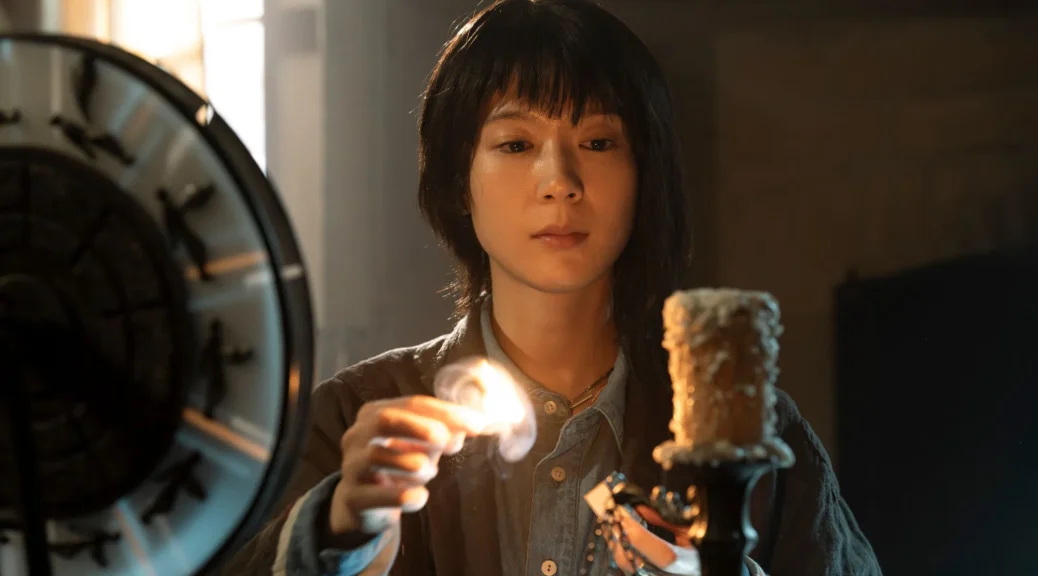
Writer/director Dave Boyle (Man from Reno) generates spooky tension with Never After Dark, his tale of a traveling psychic hired to help the dead leave this plane. Airi (Moeka Hoshi, TV’s Shōgun), the quietly no-nonsense medium, arrives at an isolated little inn recently purchased on auction by a widow (Tae Kimura) and her son (Kento Kaku). Odd things are happening at the property.

It’s hard to place the period for the film. Landlines, sweater vests and shoulder pads suggest early 90s (a sweet spot for J-horror). The analog vibe suits the film’s dreamy pace. This is a slow burn, sometimes perhaps slower than necessary, but it’s still effective.

Boyle immediately introduces a worn-out genre trope only to expose it, using the gimmick as a tool for the narrative at hand. It works surprisingly well. Images throughout the film feel familiar more than borrowed, and Boyle’s framing and use of light give scenes a lovely but spooky quality.

Hoshi delivers a fascinating central performance: a loner who’s not alone, a polite misanthrope more comfortable with the dead than the living. The balance of the small cast impresses with memorable characters, but the tension grows because of Hoshi. Airi’s petulant defiance of sound advice, her occasionally reckless behavior, and her utter isolation coalesce as the entity in the inn is more fully revealed.

When the violence does come, it’s unsettling. But Boyle has spent more than an hour slowly drawing your interest and almost reluctant affection for these characters, and that’s where the tension really comes from.

Never After Dark delivers on its earliest promise of a stylish supernatural thriller, but Boyle isn’t afraid to get nasty here and there. The combination gives the horror a little substance and the style a nice punch.

Grief’s Familiar Burden

Cottontail

by Christie Robb

A spare, competent take on the isolating toll of caregiving and grief from first-time feature writer/director Patrick Dickinson, Cottontail explores the beauty in human connection and the ability to find that connection though emotional vulnerability and honesty.

When Japanese widower Kenzaburo (Lily Franky, Shoplifters) receives a last request from his late wife, he embarks on a journey to Lake Windemere in England’s Lake District. He’s been drained by trying to care for Akiko (Tae Kimura, House of Ninjas) alone as she struggled with dementia, attempting to shield his adult son, Toshi, from the more unpleasant (and literally shitty) parts of this work. This only drove the two men apart.

But it’s clear that their estrangement started  years earlier. Akiko was the glue that held the family together. Kenzaburo was too focused on his own work to let Toshi into his life. And now, he wants to take this last journey alone, as if he is the only one who lost someone.

Weaving together the main narrative with key flashbacks, Kenzaburo wanders lost—metaphorically, in his own grief and shame, and literally, as he attempts to find Lake Windemere on foot, having gotten on the wrong train.

There’s a brief interlude where Kenzabro asks for help at an English cottage door and finds fellowship with another widower (an underutilized Ciarán Hinds), but otherwise the film keeps its focus on the main family and the drama that pulls them together even as they drift apart.

Simple and straightforward, like the beautifully prepared plate of sushi that appears in the first act of the film, Cottontail lets Franky carry the movie with the strength and confidence of an emotionally nuanced performer.

Is the film predictable? Yes. But so, sadly, is loss and grief and the struggle to stay emotionally available when adulthood means growing old and falling apart.
