Tag Archives: Japanese horror movies

Downbound Train

Exit 8

by Hope Madden

Horror video game movies are having a moment. And the simpler the video game, the more unsettling the film adaptation.

Though the unendurable Return to Silent Hill  might have sapped your will to live, both Iron Lung and The Mortuary Assistant honored their games’ uncomplicated storyline and reliance on viewer attention to generate dread and entertainment.

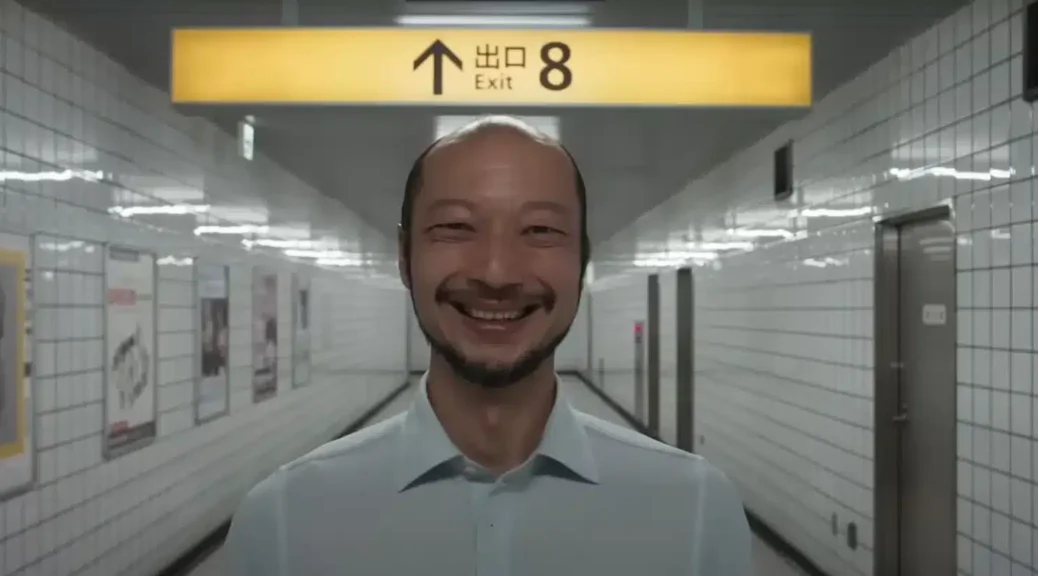
Perhaps the simplest and most unnerving is Genki Kawamura’s Exit 8, a captcha experiment in proving your humanity.

A minutes-long opening POV sequence announces the film as a video game, the first-person experience wearing thin just as Kawamura’s cinematic style alters. What has altered it?  Our hero, faced with a deeply human choice, enters the bowels of the metro and loses his phone signal.

Kazunari Ninomiya is “Lost Man.” Buds in his ears, his eyes on his phone, he’s almost entirely unconnected from humanity. Even with no reception, he’s so oblivious that it takes him quite a while in the underground passages to realize he’s walking in circles, forever finding himself back at the exact same spot in search of Exit 8.

Finally, he notices an information sign. If you see an anomaly, backtrack immediately. If there’s no anomaly, keep moving forward.

The monotony and claustrophobia build as white tiled, fluorescently lit hallway after hallway deliver oppressive tension. As the numbers ascend—Exit 1, Exit 2, Exit 3—you may find yourself yelling at the screen. Slow down! Don’t get sloppy now! Because if Lost Man misses one anomaly, one misplaced doorknob, one altered advertisement, it’s back to Exit 0 and the whole nightmare begins again.

And nightmare it is. Blackouts, crying babies, frozen smiles, giant hairless rats with human noses are some of the more obvious anomalies.

It would all become too monotonous to bear were it not for the chapter breaks, which allow us to shift perspective briefly. Yes, the other two characters—Walking Man (Yamato Kôchi) and The Boy (Naru Asanuma)—are likewise trapped in the labyrinthine underground. But their presence offers some clues beyond the surface level anomalies, some hint at the quest to find our humanity.

Kawamura doesn’t dig too deep for character development, but the spare setting and liminal hellscape bring it forth. Exit 8 seems not like a game you play again and again. Likewise, the film is unlikely to be one you revisit every spooky season. But it is a uniquely challenging effort and another surprising win for horror video game adaptations.

Good Night and Good Luck

Best Wishes to All

by Hope Madden

Filmmaker Yûta Shimotsu has seen a few Takashi Miike films. Everyone should. He’s one of the world’s greatest and most prolific genre filmmakers, so that’s not a drag on the Best Wishes to All (also known as Best Regards to All) writer/director.

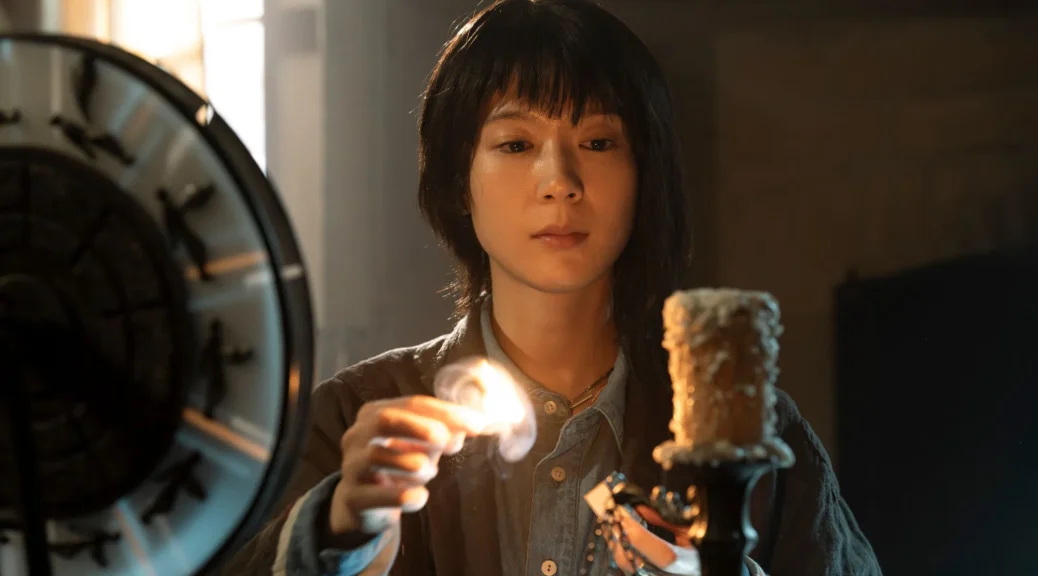
His first feature follows a nursing student (Kotone Furukawa) visiting her grandparents over break. They’ve gotten odd. Or have they always been odd and she’s just blocked it out more effectively until now?

Shimotsu’s film, co-written with Rumi Katuka and based on his own 2022 short, is a nimble little beast. What begins as a reckoning with the horrors of aging twists into something else altogether. And then, something else. Because what the unnamed granddaughter learns is that her family is keeping a secret from her. But what’s even more disturbing than the secret itself is the nonchalance with which it’s held, and that the secret does not belong to her family alone.

The filmmaker mines unease, even queasy dread, surrounding obligation to an older generation, the notion of one day turning into that same monstrous burden, or even worse, the realization that you never were anything other than a monster yourself.

Stylistically, Best Wishes to All recalls some of Miike’s more absurd horrors, Gozu in particular. But Shimotsu stitches the absurdity of Gozu or The Happiness of the Katakuris or even Ichi the Killer to pieces of grittier horror. Not quite Audition, but in that zip code. But he can’t strike a tone that can carry the two extremes.

The grotesquerie is always in service of a tale that’s more folk horror than body horror. This doesn’t always work, but it’s never less than interesting.

Kurukawa is delightfully absorbing as the obedient granddaughter utterly gobsmacked by her grandparents’ behavior. What appears to townsfolk as naiveté actually mirrors the audience’s horrified confusion, making the poor girl all the more empathetic.

But what is it, exactly, that’s expected of her? And why? Best Wishes to All is frustratingly unclear in terms of the narrative’s underlying mythology. This limits the satisfaction of the climax and robs the film’s final image of its necessary impact.

It’s a weird one, though, and certainly entertaining. Shimotsu can’t quite pull it all off, but it’s fun even as it falls apart.