Tag Archives: horror video game movies

Track Your Package?

Resident Evil

by Hope Madden

A lot of people seem curious to know what Zach Cregger is doing following up Weapons—one of the most revered horror films of the last decade—with the seventh installment in a horror video game movie franchise. By the looks of Resident Evil, having a blast is what he’s doing.

Rather than offer another badass on a mission story, Cregger’s episode, co-written with Shay Hatten (John Wick 3 & 4, Army of the Dead), enters the newly overrun Raccoon City with a hapless courier (Austin Abrams) tapped to run an important medical package to the Raccoon City General Hospital. Things go from bad to worse to much worse to oh my god no pretty quickly in an impressive series of set pieces showcasing body horror, carnage, mutants, goo, and more.

Cregger’s direction is fresh and fun, building dread and releasing it with bits of humor. He gives us some nifty first person shooter POV, but not enough of it to become tedious. The camera lingers when you don’t expect it to, and turns away when you really hope it will.

Cregger never takes the film too seriously, which is usually the downfall of any video game adaptation. But he absolutely embraces the video game-ness of the film, digging into the grossest and most disturbing elements of the game while rooting the mayhem in a character you can care about.

Resident Evil is frequently funny without falling into camp. Abrams, who was such a standout comic force in Weapons, delivers an ideal doofus to root for. John Walter Hauser has a fun expository sharing cameo, and Zach Cherry is also pretty funny.

It’s also pretty gross, fast paced, tremendously violent, and harrowing in a fun way.

The unhinged horror of it all won’t surprise those of us who saw Cregger’s 2022 feature Barbarian. He’s a horror guy. He knows horror and he has fun with it while still leaving some scars. Resident Evil isn’t going to win anybody an Oscar, but it’s a good time.   

Downbound Train

Exit 8

by Hope Madden

Horror video game movies are having a moment. And the simpler the video game, the more unsettling the film adaptation.

Though the unendurable Return to Silent Hill  might have sapped your will to live, both Iron Lung and The Mortuary Assistant honored their games’ uncomplicated storyline and reliance on viewer attention to generate dread and entertainment.

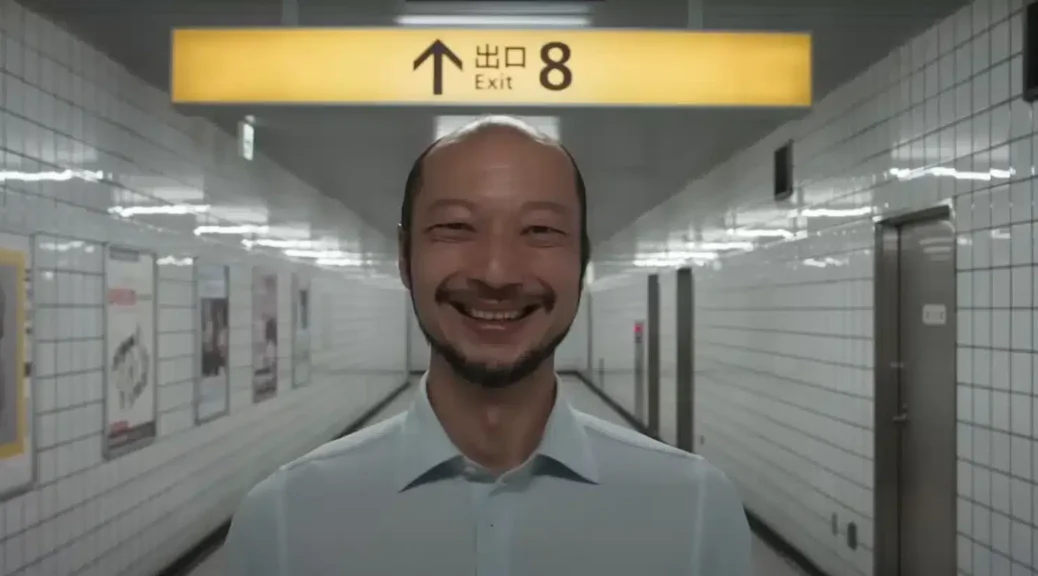
Perhaps the simplest and most unnerving is Genki Kawamura’s Exit 8, a captcha experiment in proving your humanity.

A minutes-long opening POV sequence announces the film as a video game, the first-person experience wearing thin just as Kawamura’s cinematic style alters. What has altered it?  Our hero, faced with a deeply human choice, enters the bowels of the metro and loses his phone signal.

Kazunari Ninomiya is “Lost Man.” Buds in his ears, his eyes on his phone, he’s almost entirely unconnected from humanity. Even with no reception, he’s so oblivious that it takes him quite a while in the underground passages to realize he’s walking in circles, forever finding himself back at the exact same spot in search of Exit 8.

Finally, he notices an information sign. If you see an anomaly, backtrack immediately. If there’s no anomaly, keep moving forward.

The monotony and claustrophobia build as white tiled, fluorescently lit hallway after hallway deliver oppressive tension. As the numbers ascend—Exit 1, Exit 2, Exit 3—you may find yourself yelling at the screen. Slow down! Don’t get sloppy now! Because if Lost Man misses one anomaly, one misplaced doorknob, one altered advertisement, it’s back to Exit 0 and the whole nightmare begins again.

And nightmare it is. Blackouts, crying babies, frozen smiles, giant hairless rats with human noses are some of the more obvious anomalies.

It would all become too monotonous to bear were it not for the chapter breaks, which allow us to shift perspective briefly. Yes, the other two characters—Walking Man (Yamato Kôchi) and The Boy (Naru Asanuma)—are likewise trapped in the labyrinthine underground. But their presence offers some clues beyond the surface level anomalies, some hint at the quest to find our humanity.

Kawamura doesn’t dig too deep for character development, but the spare setting and liminal hellscape bring it forth. Exit 8 seems not like a game you play again and again. Likewise, the film is unlikely to be one you revisit every spooky season. But it is a uniquely challenging effort and another surprising win for horror video game adaptations.