Tag Archives: movie reviews

Crazy Political Thriller

Ernest and Celestine: A Trip to Gibberitia

by Christie Robb and Emmy Clifton

This follow-up to the Academy-Award nominated 2012 movie Ernest and Celestine and an animated television series, all based on works by writer/illustrator Gabrielle Vincent, has the beloved duo of bear and mouse on a quest.

They have returned to Ernest’s hometown of Gibberitia to have his violin (a stradabearius) repaired by its creator, only to find that his formerly enchanting land filled with bears playing music has become a repressive regime. A new law has banned music with more than one note. Children are forced to take on the careers of their parents regardless of their personal inclination. And a masked hero of the underground resistance periodically pops up to protest with impromptu saxophone solos.

I had the chance to watch the movie with my nine-year-old-daughter. Here’s our take.

Mom Says:

The animation is beautiful, like watching a moving watercolor. The quest to find joy and individual purpose in a society determined to force one into a predetermined course is important. However, the film seems a bit spare. The relationships between the characters could have used some more fleshing out. But, I am coming late to this franchise having missed the previous installments.

The conflict spoke to my daughter who paused the film periodically to voice her suggested solutions to Ernest and Celestine’s problems. Impressive that the production team managed to tackle the ideas of fascism and political overreach in a low-stakes, nonviolent, way that speaks to children. It’s quirky and charming with some great visual gags and a musical theme that will keep you humming long after you’ve walked away from the film.

Kid Says:

I loved everything about the movie, except that, if you look really closely, all the animals have human hands. I did not like that.

The cute art style reminded me of Studio Ghibli movies.

Rikki-Tikki-Chatty

Nandor Fodor and the Talking Mongoose

by Hope Madden

In the 1930s, the Lock Ness Monster had a competitor for the attention of the world’s most gullible. On the Isle of Man, one seemingly normal family claimed that a talking mongoose lived on their property. His name was Gef (sounds like Jeff, which is just funny).

This really happened.

A psychologist named Nandor Fodor traveled to the Irvin family’s farm to prove or disprove these claims. His visit is the basis of writer/director Adam Sigal’s dramedy, Nandor Fodor and the Talking Mongoose.

Simon Pegg plays Dr. Fodor with a mixture of insecurity and vulnerability that’s appealing. Fodor is a skeptic, naturally, although – like probably all who investigate the supernatural – he wants to believe. He wants to prove that something beyond us is possible. Not that he’d admit it.

He certainly wouldn’t admit it to his assistant, Anne (Minnie Driver). Driver’s performance is delightfully bright, logical and yet open. Fodor may see this farce for what it is, but the experience is letting Anne see Fodor for what he is.

The film feels most relevant and transgressive when working as a clear theological allegory.

“All anyone wants in this world is to be happy,” the Irvin estate manager tells Fodor. “Maybe you’d be happy if you let people believe what they want to believe. People love that mongoose.”

“The one that doesn’t exist?” Fodor responds cynically.

“Yes.”

As religious metaphor, Nandor Fodor delivers a tale far more empathetic and compassionate ­than you might expect. But Sigal changes focus from “what makes people choose to believe in Gef” to “what makes someone create such a fabrication?”

Both questions have merit in an investigation or an allegorical film. But Sigal pivots so quickly that the “why believe?” question feels entirely unresolved and the “why lie about it?” resolution seems almost patronizing.

But a cast of eclectic, sometimes weirdly melancholy characters , Pegg’s angry befuddlement and Driver’s charm are almost enough to make up for it.

Under Construction

The Fallen Bridge

by Rachel Willis

The first images in director Yu Li’s latest film, The Fallen Bridge, are of a bridge collapsing on CCTV. It’s a compelling introduction to the unknown that lays at the film’s center.

The bridge collapse is the start of a deeper mystery – one of murder and corruption. After a skeleton is found inside one of the fallen bridge’s supports, Xiaoyu (Sichun Ma) is drawn home from college. She wants to know who murdered her father.

Xiaoyu’s main support comes not from her godfather and friend to her father, but a mysterious man, Meng Chao (Karry Wang), who claims to know what happened.

It’s not too hard to figure out what happened, and the film doesn’t keep you guessing. Without a mystery, there is no tension. We watch Xiaoyu talk to people who knew her father. All of them tell her who is responsible, but as Xiaoyu has no evidence, she keeps searching.

The film’s strongest element is Sichun Ma, but even she can’t seem to muster the outrage or grief necessary to allow the audience to connect or care about her character’s journey. Chao feels like a sidekick with very little to flesh out. He carries his own sins, but we’re only told what happened. We’re never allowed to see how his crimes weigh on him, or how helping Xiaoyu redeems him (or why he continues to help her at all).

Detectives wander in and out of the story; they slowly piece together the tale that the audience already knows, making each of their discoveries ring hollow. While Xiaoyu has all the cards in her hand, the detectives are left to bumble after leads. There’s a sense that the situation might have been resolved in a more compelling way if we weren’t left to wonder why Xiaoyu acts the way she does.

As the film reaches its climax, the focus seems to shift from Xiaoyu to Chao, a truly odd decision. We don’t get the satisfaction of seeing Xiaoyu right wrongs of the past or get her revenge on those responsible. Instead, Chao takes over, a stunning disappointment in a film already floundering to find its way.

There is a sensitivity to Xiaoyu and Chao’s relationship that would have strengthened the film had it been further explored. The lack of mystery might have been less bothersome had the two main characters been allowed to explore the grief that binds them. Unfortunately, what could have been an interesting character study is instead a lifeless mystery.

Teenage Dream

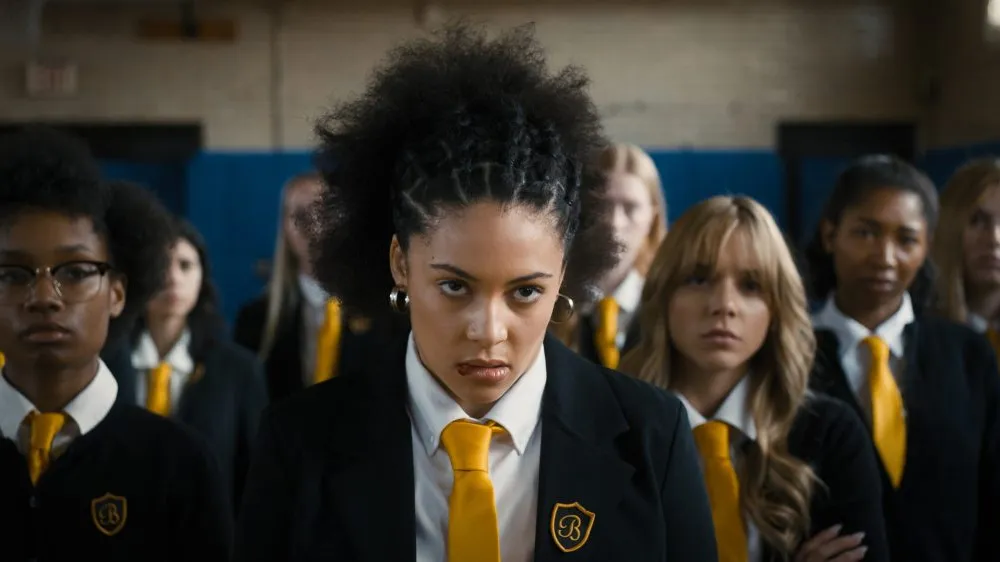
Perpetrator

by Hope Madden

Jennifer Reeder is preoccupied with missing girls. Her 2019 gem Knives and Skin watched a town fall to pieces around one such absence. Where that film was full of melancholy absurdities, Reeder’s latest, Perpetrator, is a little bolder, a little angrier. 

As Jonny (Kiah McKirnan) approaches her 18th birthday she goes a tad out of control. Her dad (also in some kind of crisis) doesn’t know what to do with her, but an out-of-town aunt (Alicia Silverstone, a sinister delight) offers to take her in. So, Jonny goes from a fairly anonymous, if reckless, urban life to something far more noticeable in her aunt’s small town.

And there is something deeply amiss in Jonny’s new hometown. Girls just go missing. All the time.

McKirnan’s fish out of water performance is so much fun here because Reeder forces the audience to identify with this feral creature. The rest of the town is so odd, almost willing victims after a lifetime of systemic herding. Jonny’s humor, cynicism and enjoyable streak of opportunism give the film a constant sense of forward momentum, though the just-this-side-of-surreal atmosphere has a dreamlike quality.

Silverstone’s prickly, unpredictable performance is nothing but twisted fun, and all the supporting turns contribute something simultaneously authentic and bizarre to the recipe. (That’s a cooking metaphor because of Aunt Hildie’s birthday cake, an ingenious and foul plot kink worth acknowledging.)

Reeder’s work routinely circles back to peculiar notions of coming of age, but John Hughes she ain’t. Goofiness and seriousness, the eerie and the grim, the surreal and familiar all swim the same bloody hallways, practice the same open shooter drills, and speak up at the same assemblies honoring the latest missing girl.

Reeder’s interested in the way women are raised to disregard one another, to compete with each other, to be adored and consumed, sexualized, victimized and vilified. Her reaction to this environment amounts to a reclamation of blood. Perpetrator swims in blood and gore and humor and terror and feminism galore.

Time and Again

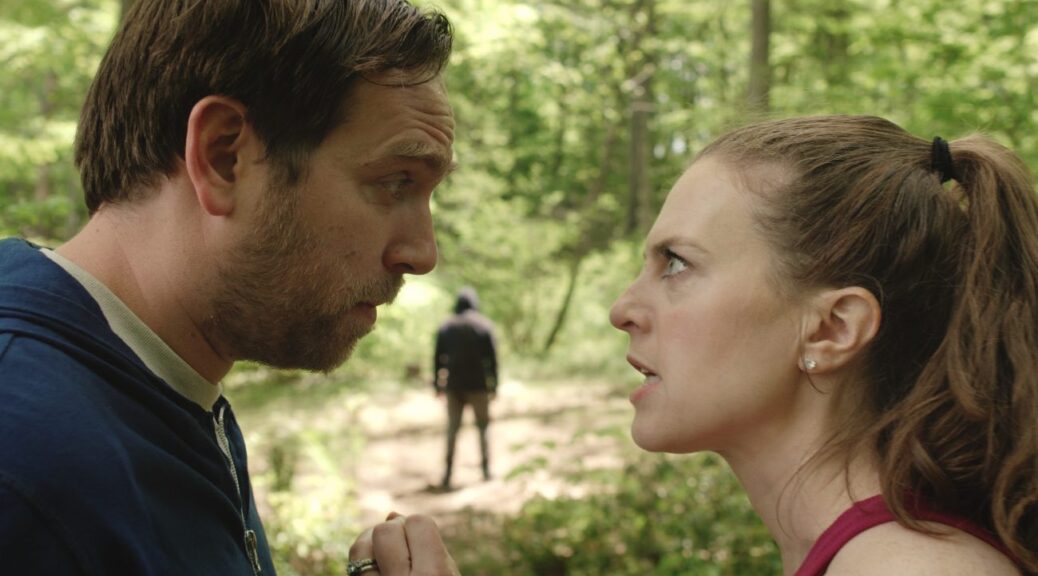
Brightwood

by Brandon Thomas

We’ve all been stuck at a dinner or party with that one couple that seemingly hates one another. The snide remarks, uncomfortable body language, and icy stares create a tense environment that’s almost tangible. Now, imagine that this couple are the only two characters in a 90 minute horror movie. It would be easy to root for their eventual demise, but through clever plotting and character arcs, Brightwood manages to circumvent early assumptions. 

Things are not going well for Jen (Dana Berger) and Dan (Max Woertendyke). Dan’s embarrassed himself – and mostly Jen – at a party the night before, and the hostility between the couple is at a fever pitch. That he’s tagged along on her morning run has only made Jen all the more angry. As Dan tries to match Jen’s pace – and beg for forgiveness along the way – the two slowly realize that their surroundings keep repeating and that odd-looking – but familiar –  strangers are appearing to the both of them. 

Writer/Director Dane Elcar takes his time getting to the genre trappings in Brightwood. The deteriorating relationship between Jen and Dan takes up the bulk of the film’s first act. It’s a portion that may test a lot of viewers as the rage and desperation radiating from the couple showcases two people at their lowest. That Berger and Woertendyke are so good at selling these heightened characters only makes the latter half of the film all the better. 

Elcar keeps things character-centric even as the events around the couple get weirder. Brightwood isn’t a plot heavy film. The strange events happening to Jen and Dan are never explained. The fascinating part of the film is witnessing their arc not only in “real time”, but also through various versions of themselves that come and go.

Things get devilishly funny and violent as the film races (ahem) to its climax. What could’ve at first been a talky relationship drama ends in blood-soaked mayhem by the time the end credits begin the role. Dead Alive this movie ain’t, but Elcar doesn’t shy away from the carnage.

The tonal shifts never feel jarring or unnatural, which is a testament not only to Brightwood’s script but also the actors bringing it to life. 

Brightwood is a clever addition to the time travel subgenre. Instead of getting lost in the mechanics of paradoxes and and alternate timelines, the film wisely keeps its eye on the two characters experiencing this horrifying event.

Atonement

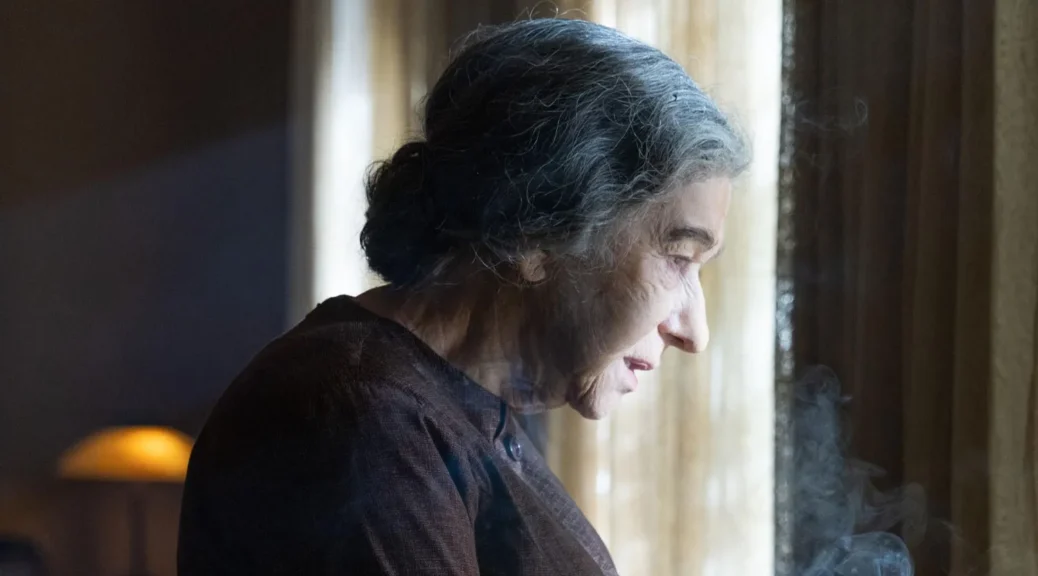
Golda

by Hope Madden

The Agranat Commission, a 1974 panel investigating the intelligence mishap that left Israel unprepared for the 1973 Yom Kippur War, creates the framing device for Guy Nattiv’s latest, Golda.

The venerable Helen Mirren dons sensible shoes, knits heavy brows and chain smokes her way through a terrific performance inside a superficial, if perfectly time stamped, historical drama. As Prime Minister Golda Meir, Mirren stands out, not only because the film delivers constant opportunities for the Oscar winner to showcase her skills. Mirren is a movie star and Nattiv films her as one – lengthy close ups, moments of vulnerability, moments of breathtaking savvy, crushing failure and overwhelming grief.

Her performance is never showy. But the direction is.

Much has been made of the fact that the English actor was perhaps an inappropriate choice to play Israel’s first woman Prime Minister. Mirren is capable, of course – she is an amazing talent. But she is hard to miss as Helen Mirren in the war room surrounded by Israeli actors including Lior Ashkenazi (as Chief of Staff David Elazar), Rami Heuberger (as Minister of Defense Moshe Dayan) and Dvir Benedek (as disgraced General Eli Zeira).

But Mirren’s appropriateness is not the problem with this film. Her performance certainly isn’t. The problem with Golda is how inexplicably bland it is. Writer Nicholas Martin penned the delightful Florence Foster Jenkins after a career in TV, but neither suggest a knack for nail-biting suspense, which is what this film both required and deserved.

Golda is no biopic. Indeed, the decision to include archival news footage of Meir only demonstrates how poorly this film captured the spirit of the Prime Minister.

It’s not a war movie by any stretch – there’s no action to speak of – and as a political thriller, it’s a bit too plodding to keep your attention. Frustrating is what it is.

Sparking a Revolution

Ashkal: The Tunisian Investigation

by Hope Madden

The haunting visual poetry of a cityscape littered with abandoned buildings and new developments is home to Youssef Chebbi’s latest, Ashkal: The Tunisian Investigation. The apt title describes not only the film’s plot – a mystery concerning a string of suspicious suicides – but also the identity of a country itself.

As Fatma (Fatma Oussaifi) and Batal (Mohamed Grayaâ) investigate the apparent self-immolation of a security guard at a high-rise construction site, they uncover evidence of an earlier, similar death that had been hidden by their police department colleagues. Why hide it? In a country where self-immolation – that astonishing act of defiance – triggered a revolution in 2010, these deaths feel particularly ominous. Especially for the corrupt.

As tyranny and its allies, police and corporate corruption, once again thwart justice, an epidemic of self-immolation spreads like a contagion through the city.

Oussaifi delivers a quietly fierce performance, one that Grayaâ counters with unexpected tenderness. Both actors are given plenty of room to breathe, Chebbi lingering with each in their private moments to allow for introspective, patient character development.

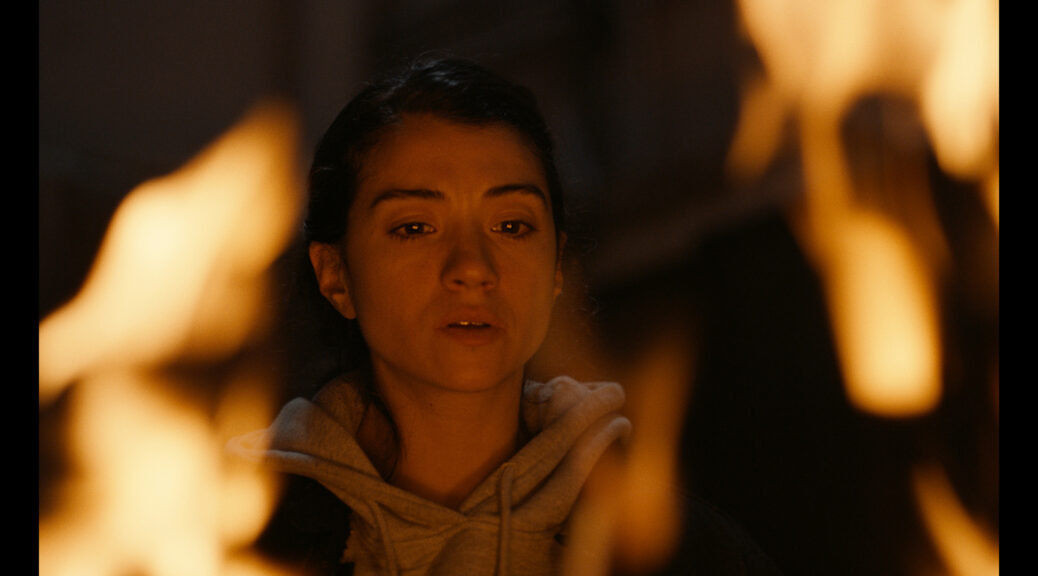
Those quiet moments look amazing, too. Ashkal is gorgeously filmed, Chebbi finding symmetry in the bones of the buildings and unexpected beauty in the fire. An evocative use of color, shadow and light create a hypnotic fusion of supernatural fantasy and police procedural.

The context is specific to Tunisia, but the themes are universal. As greed and corruption overwhelm a city, victimizing the poor and the powerless, political protest blends with cultural grief. Simultaneously pessimistic and hopeful, grim and beautiful, Ashkal is a meditation on modern times.

Escarabajo Azul

Blue Beetle

by Hope Madden

There’s something in the bones of the new DC movie Blue Beetle that’s very familiar. Very Spider-Man. Very Captain Marvel. Very Green Lantern, The Flash and Shazam.

Mainly Shazam.

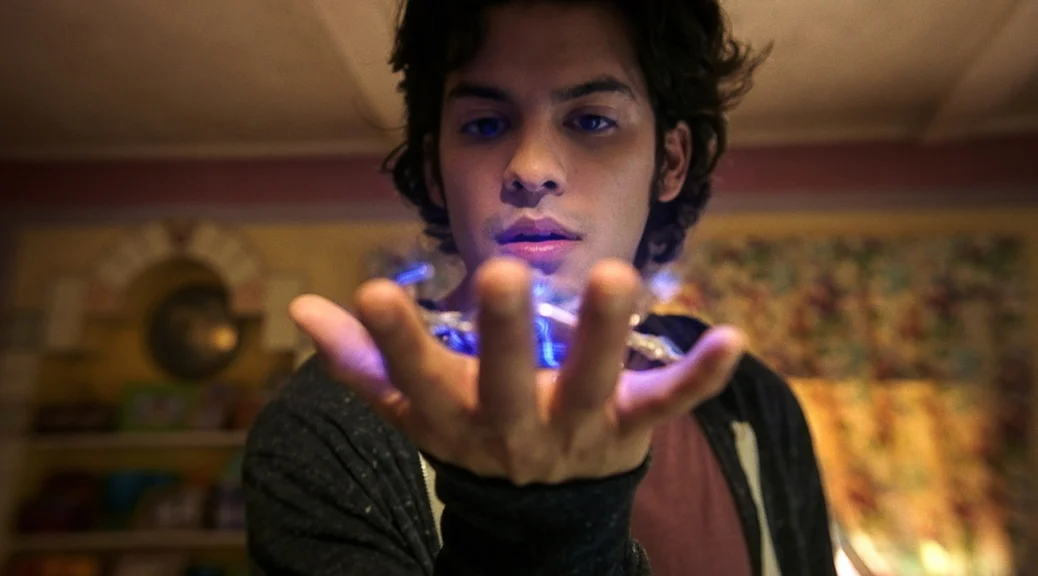
And director Angel Manuel Soto capably builds a recognizable plot from those bones. An unlikely protagonist (Xolo Maridueña) takes on superpowers without really wanting to, goes through an awkward phase of figuring out how to use them, then stumbles into danger and crime, and must eventually accept his fate and save humanity.

Blue Beetle delivers solidly on each of those plot points. Where it really makes its presence known, though, is in the way it fleshes out those bones.

Blue Beetle is unapologetically, vibrantly Latinx. It is stunning how a change of perspective revives a story.

Writer Gareth Dunnet-Alcocer (Miss Bala) writes rich, funny, fully developed characters and a winning cast takes advantage. Maridueña charms in the lead role while Belissa Escobedo’s sarcastic sister keeps him in check. George Lopez steals scenes as the looney, tech savvy, conspiracy theorist uncle and Nana (the great Adriana Barraza) kills it.

Plus, Susan Sarandon hams it up as villainous billionaire (is there any other kind?) Victoria Kord. It’s fun. But it’s not the film’s differentiator. This Mexican American superhero isn’t separated from his family, his neighborhood, his backstory or culture. Indeed, those roots not only strengthen the hero himself, but the entire film.

The story of underdogs facing down corporate greed, of the terrors of the global military industrial complex, the blight of gentrification, the joy of a good telenovela and every joke springs naturally and lands better because of the cultural context the filmmakers use to ground their story.

The plot may not break new ground, but the film itself feels revolutionary. Like Nana.