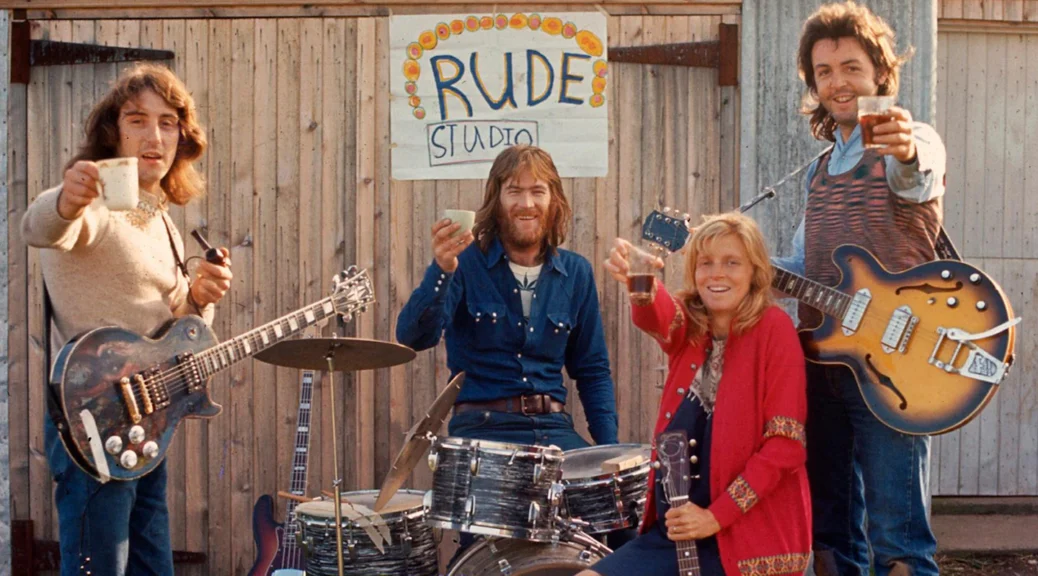
Paul McCartney: Man on the Run
by George Wolf
A seasoned filmmaker like Morgan Neville is smart enough to know that with Paul McCartney as your documentary subject, you gotta pick a lane and focus.
For Man of the Run, Neville picks a good one: how on Earth do you approach following up your stint in the most culturally significant band of all time?
Think about it. If you count Pete Best (first drummer), plus Stu Sutcliffe (original bassist) and even Jimmy Nicol (temporary tour replacement for a sick Ringo), they’ve been only seven souls in history who faced life as a “former Beatle.”
And McCartney is the most commercially successful, by far. Man on the Run takes us inside Paul’s strategy for that second act.
Neville (Won’t You Be My Neighbor?, Piece by Piece, Steve! and the Oscar-winning 20 Feet From Stardom) keeps mainly to the ten year period after Paul’s first solo album in 1970 officially signaled the end of the Beatles. Using archival photos, videos, interview clips and animation, Neville plays with an engaging audio/visual style that often mirrors a mixed-media scrapbook.
He also keeps a tight reign on the time stamp, limiting more recent interview clips (from Mick Jagger, Chrissie Hynde, Paul’s adult kids and others) to audio only, so as not to break the immersive spell that keeps us close to McCartney’s head space at the time.
And we hear and see much from the man himself. His thoughts on forming Wings with first wife Linda are endearing and self-reflective. He was seeking to combat his crushing fame by surrounding himself with bandmates, but couldn’t completely quell the ego and drive that made many of them feel like mere sidemen.
Home movies from down on his farm are warm and loving, much like the sentiments on John Lennon and some very early days with the Fab Four.
And you’ll probably learn a thing or two you didn’t know about the infamous pot bust in Japan.
But above all, Man on the Run succeeds in its mission to reconsider an important decade in the life of an icon. We see a man seeking a new kind of contentment at home and on the run, making music that only became more impactful and influential as the bands played on.
In theaters 2/19 and on Prime Video 2/27.

