Tag Archives: Gael García Bernal

Somewhere Beyond the Sea

Magellan

by Hope Madden

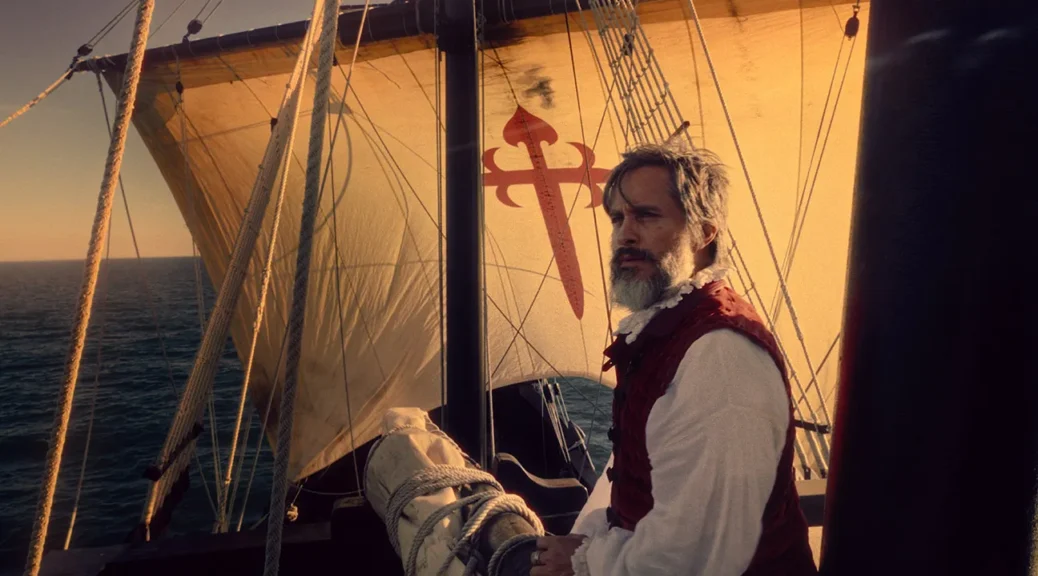
Lav Diaz’s 2-hour and 40-minute epic Magellan is not for the impatient viewer. With no exposition, a primarily stationary camera, and only one internationally known actor (Gael García Bernal in the title role), the filmmaker quietly undermines a historically accepted notion of exploration and perseverance.

Scenes have a painterly quality, the framing and lighting especially of interiors giving the impression of an oil painting. Each scene, threaded loosely together by time and location, feels more like a work of art into which characters tumble and behave.

Relying almost exclusively on long takes with an unmoving camera, Diaz emphasizes not the characters in a scene but its geography, its ecology. Even in sound design, the crash of ocean waves, the rustle of jungle leaves, the creak and moan of a ship at sea are given equal, sometimes even primary attention. These set ups let the environment dictate the scene, emphasizing the natural world and not the puny individuals so desperate to leave a mark.

Diaz, who generally films in black and white, revels in the hues and tones of the environments. Rich, deep browns in ship quarters conflict with the steely blue grey of the sky and ocean, which pale beside the rich greens of land. And the filmmaker insists that you notice, holding every shot far longer than expected so there’s nothing for you to do but take note of the brutal beauty.

The showiest thing about Magellan is its silences, what Diaz leaves unexplored and disregarded. Don’t go into this film expecting a rousing image of endurance and vision. This film is not impressed by the explorer. Diaz’s languid camera empties his film of the urgency you might expect of a film so pointedly critical of colonizers and exploiters, and that seems to be the point.

Diaz robs Magellan of the passion and romance often attached to his single-minded mission. The film’s unhurried nature subverts expectations and leeches the nobility from the history, leaving instead the impression of blundering, cruel acts performed by misguided, greedy men who died in the mud, far from home, while trying to steal land and enslave human beings.

Mucha Lucha

Cassandro

by Hope Madden

There’s rarely a good reason to miss a performance from Gael García Bernal. Even when the material around him doesn’t exactly work, he always does. His performances tend to be marked with a quietly observant, charming resilience.

In Cassandro, the narrative feature debut from documentarian Roger Ross Williams, Bernal amplifies that charm and resilience with an energy and magnetism that dares you to look away.

Bernal plays Saúl Armendáriz, a real life El Paso amateur lucha librador. Saúl loves wrestling, loves his mother, quietly loves another closeted librador, but wants more. Because of his size, he’s been pegged a “runt” which means, in the pre-determined and choreographed matches, he must always lose.

He doesn’t want to lose.

What Williams and Bernal channel is lucha libre – this unusual and rarely represented world – as a microcosm for society. The odds are stacked against Saúl. He cannot win. It’s not allowed. It’s not the role he gets to play.

So, he decides 1) to find a really good trainer (Roberta Colindrez, understated and excellent), and 2) play the “exotico” – that is, a wrestler who performs in drag.

Exoticos never, ever get to win.

And yet, the persona allows Saúl to be a little bolder, a little louder, a more vivid version of himself. It’s empowering. Cassandro still has to lose to the likes of El Gigántico because “lucha libre is a fairy tale and good must always triumph over evil.” But as his skill and charisma earn him fans, suddenly that old fairy tale feels less important to the promoters who decide match outcomes.

Ross’s documentarian instincts serve the film beautifully, as the world of lucha libre is never treated as a sideshow. There’s humor here, but we laugh with characters rather than at them. And though Cassandro hits the beats you’d expect from a dramatic biopic journey, moments feel authentic rather than manipulated for dramatic effect.

The entire ensemble shines, but Bernal owns the screen, his ever present smile a heartbreaking and beautiful image of the resilience and determination that fueled an icon of wrestling and LGBTQ culture.
