Tag Archives: Christie Robb

The Horror of Microagressions

Raging Grace

by Christie Robb

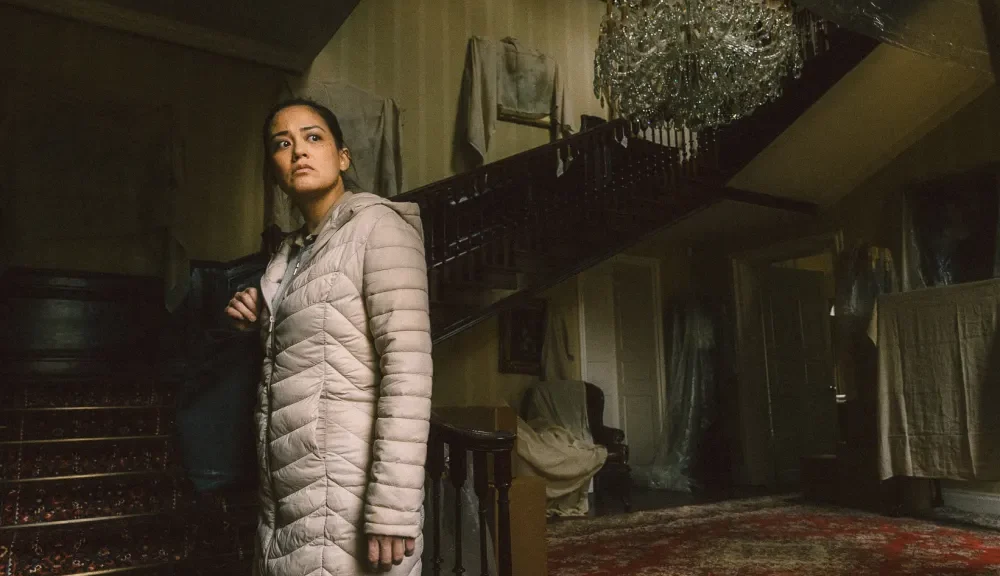
When Filipina illegal immigrant Joy (Max Eigenmann) has to come up with an extra five thousand pounds to fund her quest to obtain a work visa, she’s thrilled to get a job offer that pays one thousand a week under the table. It’s a live-in housekeeping gig at a swanky British estate that hasn’t been given a once-over in quite a long time.

There are few downsides. First, she’ll have to hide her young daughter Grace (Jaeden Paige Boadilla) from her employers. Second, she’ll have to look after the dying old white guy upstairs. And that involves following orders barked at her by the dying guy’s total Karen of a niece. Only, maybe the niece’s intentions aren’t entirely well-meaning. And then there’s the racism…and the classism…and the sexism. But, while Joy may be stressed, she’s also stoic and resilient.

This updated Gothic thriller helmed by debut director Paris Zarcilla and co-written with Pancake Zarcilla effectively suspends the viewer in a state of wary suspicion. Dim lighting, spooky old sheet-draped antiques, a discordant musical score, and a kid with a penchant for pranks and squeezing into tight spaces provides ample opportunity for jump scares.

But it’s not the long shadowy corridors, or the judgmental eyes of the family portraits on the walls, or the suspicious locked doors that spook Joy. It’s the worry that her kid is going to get her in trouble with the boss and she’ll end up getting deported.

Toward the end, the social-critique/Gothic horror gets a little bit too complicated and hard to follow for a few minutes with character choices that seem alternatively forced or not dialed up enough, but ultimately it was an effective take on the traditional atmospheric horror.

Could have used more rage, though.

Feelin’ Groovy

The Job of Songs

by Christie Robb

Paul Simon’s “59th Street Bridge Song (Feelin’ Groovy)” is a one minute and 43 second impression of being content and in the moment. It feels like a possible anthem for the Slow philosophy—an approach to life that values taking one’s time, doing things at the right pace, valuing the quality over the quantity in life.

Writer/director Lila Schmitz’s one hour and 13 minute documentary has a similar approach.

The Job of Songs is about the community of session musicians that populate the small village of Doolin in County Clare in the west of Ireland—the area around the Cliffs of Moher. An isolated village until the 1970s, folks gathered in homes to play traditional (“trad”) Irish music and to dance.

Opening the Cliffs to international tourism brought in increased revenue and enabled musicians to pursue their art professionally, but it also changed the cultural scene. Folks dashed in on day trips to take a snapshot of the Cliffs, but failed to linger and really take in the place and the people.

Tourism meant that performances moved from private to public spaces—out of the kitchen and parlor and into pubs and restaurants.  But performing trad music is still a community activity. At a session, anyone is welcome to pick up their instrument or raise their voice and join in, even if they only know a couple of bars to a piece.

Through candid interviews and emotional performances, Schmitz’s film explores the changing culture of Doolin and the various purposes songs have in the lives of the Irish of the West country. It’s a source of entertainment, yes. But songs also carry the often melancholy history of the Irish people and culture, allow the saying of otherwise unspeakable things, and give people permission to feel things that are not easily understood intellectually.

The film explores the different aspects, both dark and light, that this musical culture has in people’s lives. While the session scene brings people together, it also has ties to drink, depression, and suicide. And though singing the old trad songs maintains a connection to Ireland’s past with its history of brutal colonization, famine, and emigration, Schmitz also leaves space to explore the change that technology, tourism, and a recent history of immigration has brought to the scene. She shows how a culture so rooted in a place can slowly change over time.

The music of  Luka Bloom, Eoin O’Neill, Kate Theasby, Christy Barry, and Ted McCormac (among others) could be draw enough, but slowing down to appreciate the way the cozy light of the pub provides an antidote to winter’s gloom goes a long way toward making a person feel pretty groovy.  As does the drama inherent in the view of the green of the land ending abruptly in the pounding of the ocean. It’s a movie worth savoring.

It Was Capitalism All Along!

Blow Up My Life

by Christie Robb

Blow Up My Life is a paint-by-numbers thriller/comedy telling the story of a Adderall-snorting computer programmer, Jason (Jason Selvig), who commits career suicide by live-streaming his alcohol and drug-fueled celebration after he wins an award for the new app he has created for his pharmaceutical company employers.

The app dispenses customized doses of medicine through a vape. Its goal is to step people down from an opiod addiction.

When Jason uncovers evidence that the company’s latest software update has altered the app, which is now causing consumers to get hooked on the vape (ensuring skyrocketing profits for the company), he decides to do some undercover work to expose the truth.

A first feature written and directed by Ryan Dickie and Abigail Horton, the movie is technically proficient and a sometimes laugh-out-loud funny take on the thriller genre. Filmed on a tight budget over 18 days during October of 2020 with a relatively small cast, the film manages to do a lot with few resources. Under those circumstances, the fact that it manages to get most of the numbers colored in is pretty remarkable.

However, the main characters are underdeveloped. So, when the screws are tightened and Jason finds himself running for his life, it’s difficult to summon the energy to truly care about his welfare. His cousin, the Black hacktivist “girl-in-the chair” Charlie (Kara Young), is also a lightly sketched character, but Young’s charisma helps the audience connect with her.

As many of these movies do, this one starts in the middle in one of those “So, I bet you’re wondering how I ended up here?” situations. Strangely though, it kind of ends in the middle as well. There’s no resolution. No payoff.

The screen just goes black, and there’s no need to wait around for an end credits scene. There isn’t one. It’s up to you to complete the final bits of the canvas in your imagination.

American Nightmare

Ghosts of the Void

by Christie Robb

Jason Miller’s directorial debut Ghosts of the Void is successfully unsettling.

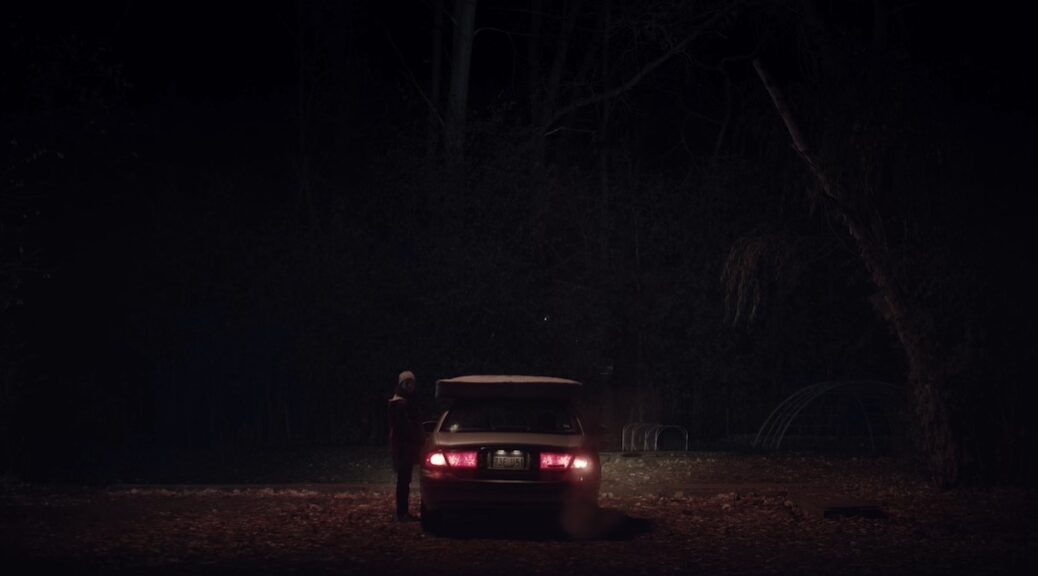
Jen (Tedra Millan, Daddy’s Girl) is barely keeping her shit together. She’s been supporting her husband Tyler’s (Michael Reagan, Lovecraft Country) ambition to become a novelist. He’d shown promise in college, but now they’ve been evited from their home and are trying to find an inconspicuous place to park for the night with only $40 and the contents of the car to their names.

They’ve driven to the “nice” side of town, just outside a country club’s fence. But physical proximity to the middle class will not be enough to secure their safety.

Jen’s not slept in weeks. They don’t have health insurance. And what’s with those creepy masked folks in the woods?

The film flashes back from the couple’s chilly car to scenes of the past, depicting the growing strain of the financial and creative pressures on their marriage and Jen’s growing emotional servitude to an unstable partner.

With a cast of just eight people and a very limited number of locations, Miller delivers an unexpected amount of creeping unease. Danger could come from multiple angles, so you find yourself scanning the screen, hoping to keep one step ahead of the jump scare.

Millan and Reagan deliver layered and realistic performances that keep the pace of this slow-burn of a character-driven horror moving.

With themes of financial and housing insecurity and lack of access to health care,  Miller really taps into the ways in which the American capitalist system can easily shift from an ambitious dream to a living nightmare.

https://www.youtube.com/watch?v=9u89mMGhejY

Boy Coloring Outside the Lines

Story Ave

by Christie Robb

The debut feature film from director/co-writer Aristotle Torres feels familiar. Talented young Black man in New York City, paused for a moment at one of life’s crossroads. One road heads toward safety and higher education, another leads into gang life and violence. But, we need a continuous supply of coming-of-age stories ’cause…well, kids just keep coming of age.

In Story Ave, talented teenage artist Kadir Grayson (Asante Blackk, This Is Us) is a wreck. His brother recently died in an accident for which Kadir blames himself. His mom is lashing out and looking for someone to blame. He escapes into the found family of his graffiti gang led by the mercurial Skemes (Melvin Gregg). But he can only gain full membership by bringing back some cash. So, armed with Skemes’s gun, he hits the streets. It is during an attempted mugging that he meets Luis (Luis Guzmán), an MTA worker that acts like the world’s chillest alcoholic guardian angel.

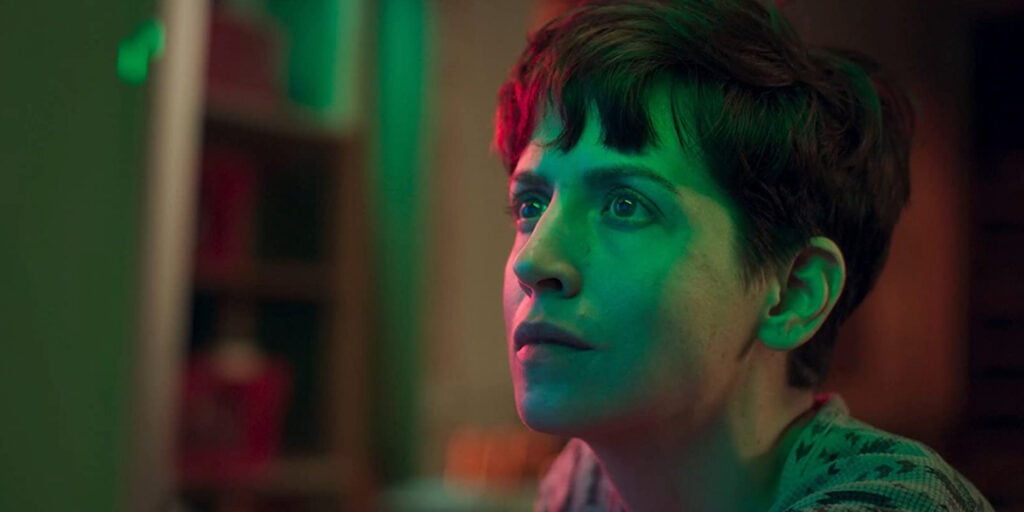
While the story might be familiar, Torres’s movie is a visual delight, which makes sense given his background directing music videos. Often bathed in neon primary shades or strobing color fluorescing in blacklight, the shot composition echoes the poppy style of the bubble letters the characters are applying to the sides of buildings.

Asante Blackk is just a gift. His performance is perfectly understated. He manages to show the complex range of Kadir’s shifting emotions, but he keeps them on a tight leash, avoiding the histrionics and sentimentality that the script could have easily lead him into. Guzmán, too, is good. But he’s given less to work with. One look at him wincing and holding his side and you know exactly how his character arc is going to end.

The ending of the film, too, feels predictable and like it comes too easily. It is wrapped up neatly in a college application essay voiceover that feels as if tacked on in postproduction. But as this is Torres’s first feature, I’m excited to see more from him as he comes of age as a feature director.

Munchausen by Comedy

Sick Girl

by Christie Robb

There’s gotta be a better name for a woman suffering from Peter Pan Syndrome than “Princess Pan.” Whatever it is, Wren Pepper in first-time writer/director Jennifer Cram’s Sick Girl has a terminal case.

The last single party girl left standing from a formerly tight squad, Wren watches her besties growing up and growing apart. Two are moms struggling through the fog of fatigue caused by cute but demanding young children. One is wrapped up in her boyfriend and training for a marathon.

No one wants to get drunk and hit the club anymore.

So, in a desperate bid for her friends’ attention, Wren invents a cancer diagnosis. Cause nothing brings folks together quite like the big C.

That this is an effective strategy is undeniable. Keeping your girlfriends company during chemo is the middle-aged equivalent of the early 20s puke vigil, where you hold a pal’s hair back as they vomit up too many sugary cocktails and you make sure they fall asleep on their side.

The problem is that lying about a cancer diagnosis is something that’s damn hard to come back from once the truth is out there.

Sick Girl is often charming. Nina Dobrev (the CW’s Vampire Diaries) imbues Wren with a reckless self-centered charisma that makes it tough to look away. The chemistry between the reconnecting girlfriends is delightful. And it’s satisfying to watch Wren squirm as the guilt about her lies mounts.

But, even though I wanted to take my disbelief and give it some drawing paper and a pack of crayons to keep it busy in a corner, it kept wandering back demanding attention. Cause a lie on this scale isn’t an aw-sucks wacky personality quirk. It’s too big. Too devastating. There’s a clinical diagnosis for faking an illness to get attention: Munchausen’s Syndrome. So wrapping the story up with a nice little bow at the end doesn’t really work. The ending feels unearned.

I don’t know how you can redeem Wren, short of her going to medical school, kicking all manner of ass, and actually finding a cure for cancer.

Still, if you can successfully distract your sense of disbelief, there’s a lot to enjoy in Sick Girl, including  Wendi McLendon-Covey (The Goldbergs) as Wren’s mom, Wren’s reaction to children in general, and watching this deluded narcissist suffer her way into personal growth. But, the film whiffs on opportunities to flesh out the personalities of the other three friends and show what Wren is bringing to the friendship table besides tequila shots and chaos.

Fantasy V Reality

The Latent Image

by Christie Robb

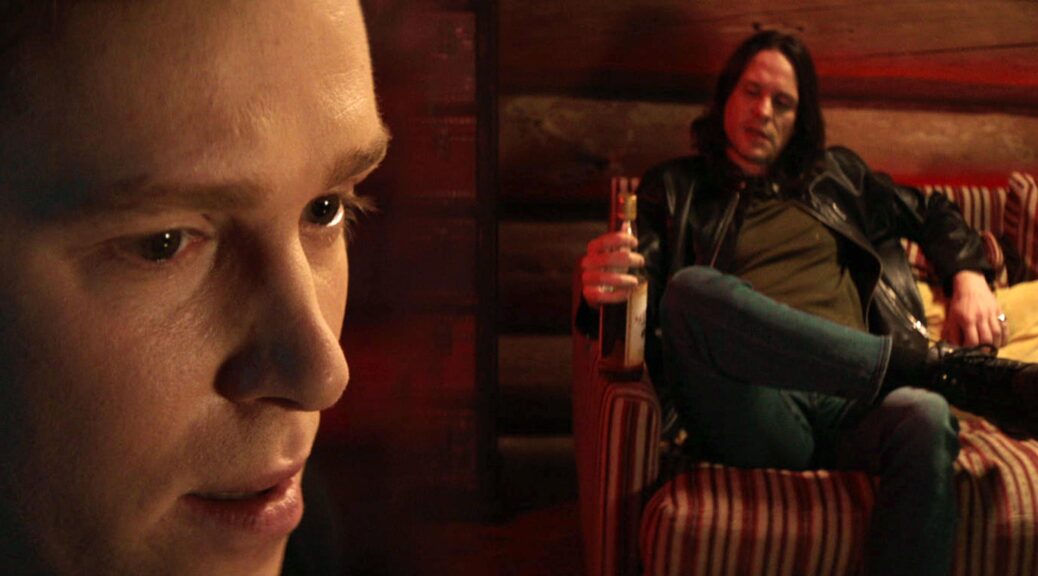
When thriller author Ben rents a remote, isolated cabin so he can get away and focus on writing his latest manuscript, his writing time is interrupted by the arrival of a mysterious stranger. Fascinated and a little attracted to the tall, dark, and brutally handsome man, Ben begins collaborating with him on the plot. Really trying to get in the head of the villain. Trying to figure out how he might get away with murder. Eventually, the lines between fantasy and reality start to blur.

Director Alexander McGregor Birrell, in collaboration with co-writer Joshua Tonks (who also plays Ben), creates an unnerving tale based on his 2019 short of the same name.  At the start, the movie drags at bit, but once it gets going, this new Latent Image keeps the audience guessing all the way until the end. It’s a movie of creeping unease rather than jump scares or gore.

The evolving relationship between Ben and “the Man” is the heart of the film. Jay Clift’s performance as the Man is unsettling in all the best ways. Tonks and Clift are both theatre performers, so you might assume that they would skew into the more broad style of acting that plays well even to the cheap seats in the back. But, except for the very occasional misstep, they really deliver on the subtleties necessitated by film.

If you are planning on a cabin trip this spooky season, consider adding this one to your watch list. Just make sure to lock the doors and windows at night and try to avoid any drifters.

https://www.youtube.com/watch?v=ZN4quUgR3h8

On a Journey of Self-Discovery with a Dead Mouse

Little Jar

by Christie Robb

Cast your mind back to the lockdown phase of the COVID pandemic. Spring of 2020. When office folks were sent home to hastily assemble a workspace in some relatively unused area of the house. When you figured you might as well open a bottle of wine at two in the afternoon on a Wednesday. When you weren’t entirely sure if you were living in the apocalypse or not.

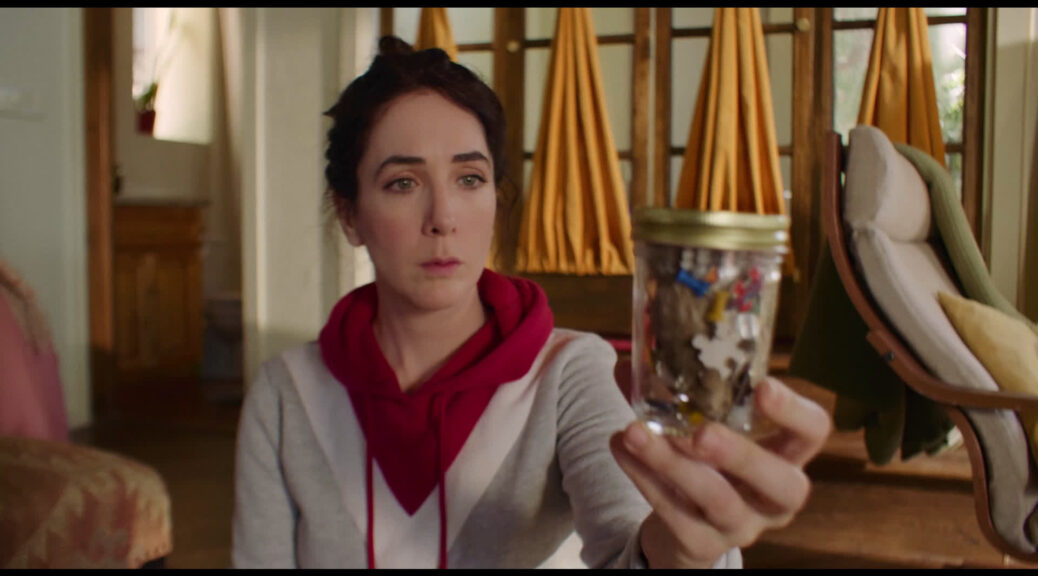
If you were an introvert, like Ainsley the main character of the movie Little Jar, you may have initially been pleased, especially if you, like her, lived alone. At first, Ainsley is elated to escape her boundary averse co-workers and even rebuffs the offer of a weekly Facetime hang with her brother. She wants to do this two week quarantine thing entirely on her own. Then, the internet goes down, she drops her phone in the bathtub, and the silence thickens.

She’s on her own. In the woods.

What could go wrong?

As the pandemic drags out into months, Ainsley gets creative in her attempts to find companionship and has to confront that sometimes basking in a little well-earned solitude can mutate over time into society forgetting you ever existed and your  being left for dead.

First time feature director Dominic Lopez, in collaboration with his co-writer and star Kelsey Gunn, create a dramatic and whimsical story that is completely absurd yet totally relatable. Primarily shot in one location with one actor and a taxidermy mouse in a beret as the leads, Little Jar really illustrates what independent filmmakers can accomplish with a limited budget (and that we’ve all probably still got a lot of pandemic stuff to deal with).

https://www.youtube.com/watch?v=Nd3Kp61f0yM

Crazy Political Thriller

Ernest and Celestine: A Trip to Gibberitia

by Christie Robb and Emmy Clifton

This follow-up to the Academy-Award nominated 2012 movie Ernest and Celestine and an animated television series, all based on works by writer/illustrator Gabrielle Vincent, has the beloved duo of bear and mouse on a quest.

They have returned to Ernest’s hometown of Gibberitia to have his violin (a stradabearius) repaired by its creator, only to find that his formerly enchanting land filled with bears playing music has become a repressive regime. A new law has banned music with more than one note. Children are forced to take on the careers of their parents regardless of their personal inclination. And a masked hero of the underground resistance periodically pops up to protest with impromptu saxophone solos.

I had the chance to watch the movie with my nine-year-old-daughter. Here’s our take.

Mom Says:

The animation is beautiful, like watching a moving watercolor. The quest to find joy and individual purpose in a society determined to force one into a predetermined course is important. However, the film seems a bit spare. The relationships between the characters could have used some more fleshing out. But, I am coming late to this franchise having missed the previous installments.

The conflict spoke to my daughter who paused the film periodically to voice her suggested solutions to Ernest and Celestine’s problems. Impressive that the production team managed to tackle the ideas of fascism and political overreach in a low-stakes, nonviolent, way that speaks to children. It’s quirky and charming with some great visual gags and a musical theme that will keep you humming long after you’ve walked away from the film.

Kid Says:

I loved everything about the movie, except that, if you look really closely, all the animals have human hands. I did not like that.

The cute art style reminded me of Studio Ghibli movies.

Risky Business

Trader

by Christie Robb

Writer/director Corey Stanton (Robbery) gets a great return on his investment with his one-actor/one-location movie, Trader.

Well, primarily one actor.

While she occasionally talks to some folks on the phone, the majority of the film falls on Kimberly-Sue Murray’s (Freeform’s Shadow Hunters) shoulders. She plays an unnamed sociopathic loner in a dingy, unfurnished apartment, who starts off the film by scamming an older man out of his credit card details.

She’s ambitious. And with the seven grand in her bank account, she educates herself about the stock market and becomes a day trader. After her bets start to pay off, she craves a seat at the “high-rollers table” and wants to get a face-to-face meeting with the bosses at a major brokerage firm.

And she’s willing to assume a lot of risk to do so.

Stanton and Murray manage to keep the momentum of the piece up despite the potential for audience fatigue at seeing the same person/location for an hour and a half. As her fortunes rise, the Trader revamps her apartment, which helps. She invests in programable lights that shift from green to red to reflect the changing market. The Trader also slips in and out of different personas with distinctive accents as she chats on the phone to set various scams in motion.

And then there’s her inner life, which is depicted in moody black and white and provides a contrast to the usual look of the film.  And, of course, there’s the trip she takes on some sort of new mind-altering drug to get a stock tip via vision quest. Any scene that starts with someone blending raw eggs, tomatoes, wasabi, a loose-leaf sheet of paper filled with inspirational quotes, and three times the amount of an experimental hallucinogenic in a bullet-blender and downing it like it’s a shot is bound to be memorable.

Despite Stanton’s best efforts to educate me on how day-trading works and the terminology involved, I did feel somewhat adrift on what exactly was happening from a financial perspective as the film neared its climax. But it was easy enough to get the gist.

Overall, this movie was a winner and an inspirational example of how to get a big bang for your buck.