Tag Archives: Herman Tømmeraas

What Makes You Beautiful

Sweetness

by Hope Madden

Back in 1982, German filmmaker Eckhart Schmidt released The Fan, a horror thriller about a teenage girl obsessed with a pop music star. It’s a wild, weird, uncomfortable technopop ride, and I admit I expected (hoped?) Emma Higgins’s Sweetness would be a kind of American update.

Because The Fan is so very weird, yet somehow relatable.

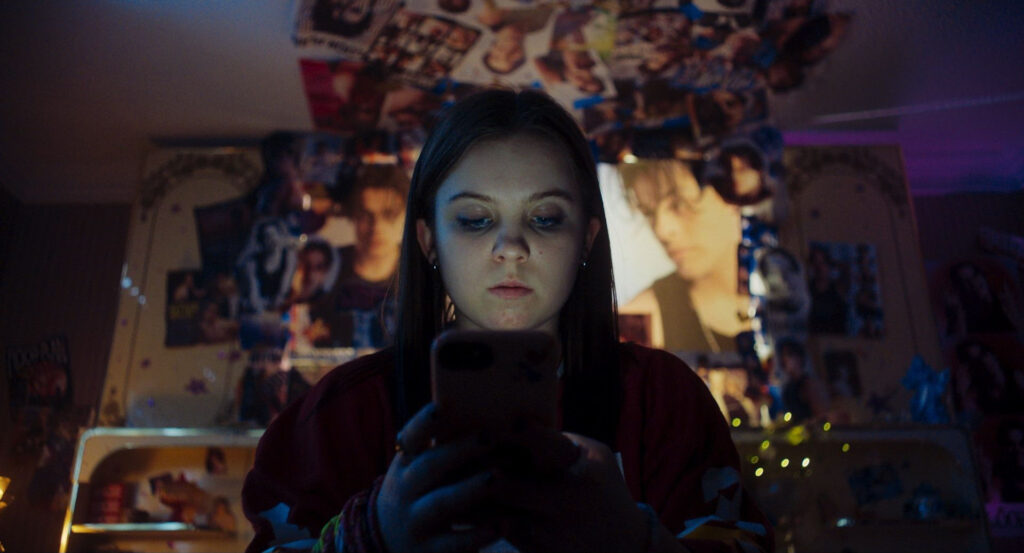
Higgins’s film is very different, and a touch more on the believable side. Kate Hallett (Women Talking) is Rylee, unpopular high school kid with an obsessive crush on Floorplan lead singer Payton Adler (Herman Tømmeraas). His pouty pretty face covers nearly every inch of her bedroom walls and ceiling. Her headphones are always in, his emotional vocals drowning out the mean girls in class, her father’s overly eager girlfriend (Amanda Brugel), and everything else Rylee doesn’t want to hear.

When bestie Sidney (Aya Furukawa, Fall of the House of Usher) leaves Rylee behind after a Floorplan concert, she meanders alone until being struck by a car driven by the very impaired object of her affection, Payton Adler!

Totally worth it!

What follows is a crooked path lined with the faulty logic of the young and the twisted imagination of a filmmaker who’s spent most of her career embedded with pop stars. Higgins has directed scads of music videos. That’s probably why the music for this film is so unnervingly authentic, exactly the kind of thing that would make a troubled teen swoon and believe her life had been saved.

Even if she’d, in fact, just been run down by a car.

Furukawa and Tømmeraas both shine, one as a semi-vacuous but still good friend, the other as a good-looking opportunist with a drug problem.

Hallett anchors the film with a sort of wide-eyed yet world wearied performance that’s as heartbreaking as it is frustrating.

Higgins never laughs at or Rylee and her youthful obsession. Though the movie doesn’t wallow in the maudlin, avoiding angst at all possible turns, the filmmaker demands that we empathize with this girl in a way that’s both moving and nightmarish.

Stylish cinematography and slick production design emphasize the pop music stylings, but the film is hardly all glossy exterior.

There are some telegraphed moments and a couple of convenient contrivances, and anybody seriously shocked by Rylee’s choices definitely needs to see The Fan. But there’s a twisted, broken little heart here and Higgins and Hallett want you to witness it.

Mama Mia

Nightmare

by Hope Madden

What happens if a woman reconsiders Rosemary’s Baby?

This is not to say that writer/director Kjersti Helen Rasmussen’s Nightmare is the masterpiece of Polanski’s 1968 Oscar winner. It is not. But this Norwegian horror delivers an intriguing pregnancy nightmare, one that benefits from a somewhat merciless female perspective.

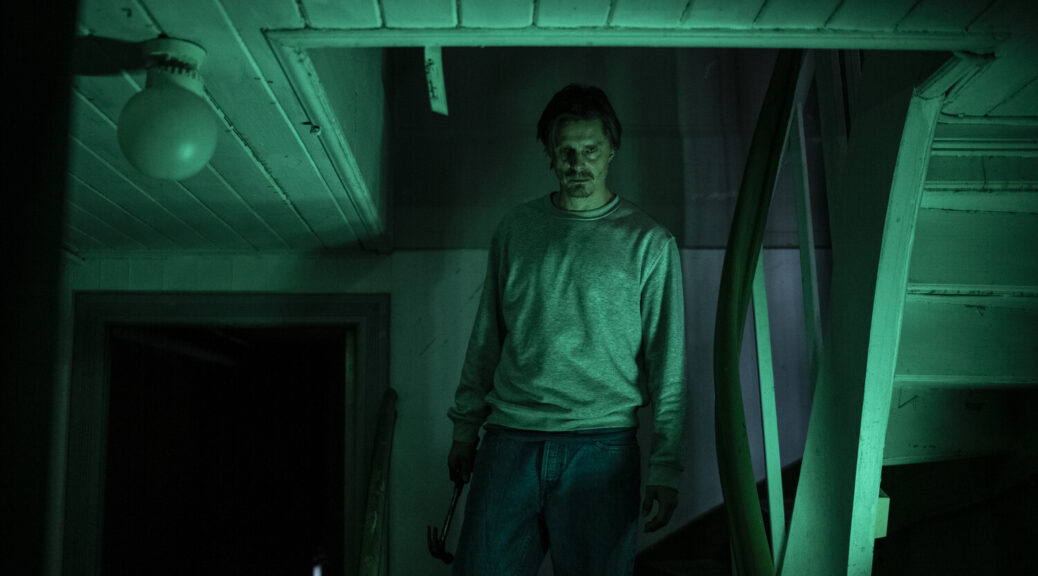
Eili Harboe (Thelma) is Mona. She and boyfriend Robby (Herman Tømmeraas, Leave) just bought an apartment. It needs a lot of work, but it’s all theirs and now they can be grown-ups. Mona isn’t sure she and Robby have the same definition of grown up, though, and here’s where things begin to break down.

Mona begins having nightmares that escalate into sleepwalking, sleep paralysis and hallucinations. Could it be stress over abandoning a burgeoning career to focus on renovations and – if Robby has a say in things ­– starting a family? Or maybe it’s the creepy neighbors and their screeching infant?

Whatever the case, Robby’s sexy, shirtless doppelganger comes to Mona every night. The relentlessness of it all has Mona questioning reality.

So do we. Rasmussen rarely clarifies what is really happening and what is nightmare. She mines the dreamy fact that what we see in our sleep is often an image of our waking troubles, particularly those we hide from ourselves. Mona wants to please, as so many women do, and the men around her take casual advantage of this. One scene in a doctor’s office pinpoints the moment Mona finally is moved to begin to act on her own.

Microagressions blend into bigger dangers as Mona’s life blurs with her nightmares. Rasmussen fills the reality with details and beautifully executed moments that fully outline Mona’s struggle. The darker fantasy world of the nightmares is given far less attention, and the medical world that bridges the two feels slapped together.

But Harboe’s understated turn, particularly in a handful of breathtaking scenes, helps Rasmussen blisteringly articulate an everyday horror women face.

None More Black

Leave

by Hope Madden

A baby left in a cemetery grows up to search for answers. Why was she abandoned in such a place, wrapped in a blanket covered in satanic markings and wearing an inverted cross? She discovers her parents were in a Norwegian Black Metal band.

So, to be honest, that explains it. Common practice, probably, and yet Hunter (Alicia von Rittberg) wants to know more.

Wait, will there be Norwegian Black Metal in Alex Herron’s Leave? Nice!

Herron, bringing writer Thomas Moldestad’s mystery to the screen, pits what you think you know about good against evil as he uproots a New Englander for Norway’s shores and answers.

Von Rittberg’s American accent is spotty, but the performance isn’t weakened by it. Her vulnerable but determined performance ably captures Hunter’s existential dilemma. She’s polite, slightly needy, capable but a little desperate. And the smiling faces she finds may or may not really be her friends.

These faces belong to rock stars (Ellen Dorrit Petersen) and schizophrenics (Morten Holst), spoiled cousins (Herman Tømmeraas) and clingy aunts (Ragnhild Gudbrandsen).  

Herron’s atmosphere makes the safe look seedy and the dangerous appear benign, but there is more depth to the tale than that. Yes, every character is a little slower on the uptake than they should be. And yet, somehow ­– thanks mostly to the film’s understatement – you don’t disbelieve any of the characters. Stig R. Amdam delivers a particularly nuanced turn as the family patriarch.

There are interesting themes here concerning patriarchy and “Christianity”, but Herron doesn’t belabor the point. His film is rarely showy, and even at its most obvious this light touch keeps it engaging.

Still, I think I was promised Norwegian Black Metal.